
Why Agility Ladder Drills Transform Athletic Performance
Agility ladder drills are exercises designed to improve your foot speed, coordination, and quickness by requiring you to move through a ladder pattern laid on the ground using various footwork sequences. These drills help athletes develop better body control, faster reaction times, and improved multi-directional movement—essential skills for nearly every sport.
Quick Answer: Top Benefits of Agility Ladder Drills
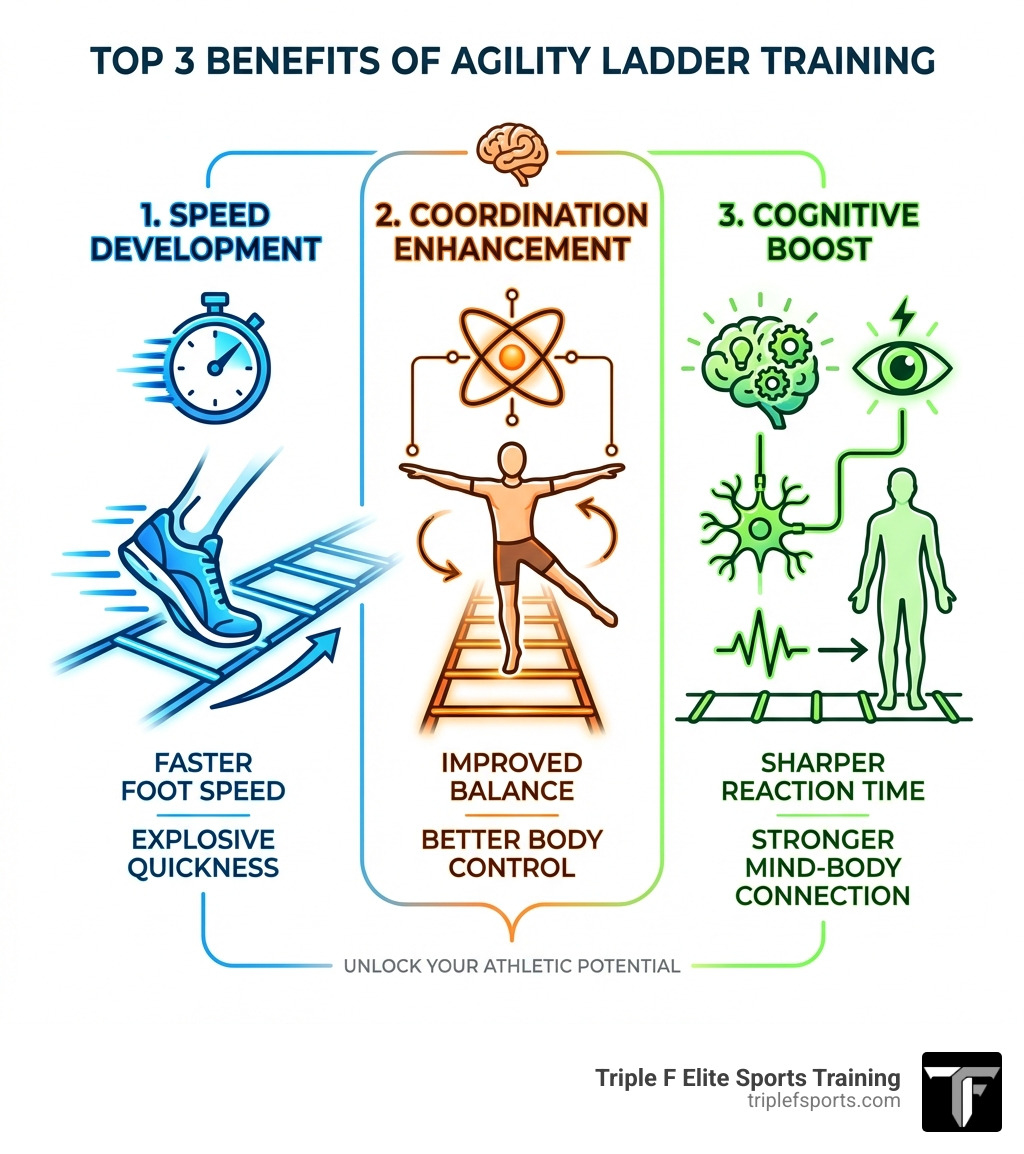
- Speed & Quickness: Develop faster feet and explosive first steps
- Coordination: Improve balance, body awareness, and proprioception
- Cognitive Function: Improve reaction time, anticipation, and mind-body connection
- Versatility: Effective for all sports and fitness levels, requiring minimal equipment
Working out should be about more than just lifting weights and doing cardio. It should improve how your body moves and reacts in real-time situations. Agility ladder drills challenge your neuromuscular system in ways that directly translate to better athletic performance on the field, court, or track.
The best part? You don’t need expensive equipment or a huge training facility to get started. An agility ladder is affordable, portable, and incredibly versatile. Whether you’re a youth athlete building foundational skills or an adult looking to maintain quickness and coordination, these drills deliver results when practiced consistently—even just 10 minutes twice a week can make a noticeable difference.
Research shows that agility ladder training promotes full-body balance by requiring you to be intentional about your movements, ideally with speed, power, and control. This type of training strengthens the connection between your brain and muscles, helping you move more efficiently and react faster to changing situations in competition.
I’m Lee Smith, an 11-year NFL veteran who opened Triple F Elite Sports Training to bring professional-level athletic development to the Knoxville area. Throughout my career as a blocking tight end, agility ladder drills were a cornerstone of my footwork training, helping me maintain speed and body control despite the physical demands of my position.
Why Every Athlete Needs an Agility Ladder
At Triple F Elite Sports Training, we understand that true athletic potential comes from a blend of physical prowess and mental acuity. That’s why we champion agility ladder drills as a fundamental component of any training regimen. These simple yet powerful tools offer a multitude of benefits that extend far beyond just looking good on the field.
One of the primary benefits of using an agility ladder for training is the significant improvement in speed and quickness. By forcing rapid foot turnover and precise placement, these drills train your body to move faster and more efficiently. This isn’t just about straight-line speed; it’s about the ability to accelerate, decelerate, and change direction in an instant—a critical skill in sports like soccer, basketball, football, tennis, and martial arts. We’ve seen athletes at our Knoxville facility make huge improvements in their speed and agility, often after just once a week of consistent ladder training.
Beyond raw speed, agility ladder drills dramatically improve coordination and balance. When you’re constantly stepping, hopping, and shuffling through the ladder, you’re enhancing your body’s ability to work together harmoniously. This continuous demand for precise movement patterns helps you develop better body control. As the research highlights, agility ladder training promotes full-body balance, requiring intentional movement with speed, power, and control. This translates to more stable and efficient movements, reducing the risk of falls and injuries during intense play.
Furthermore, these drills sharpen your cognitive function and mind-body connection. Agility ladder drills improve your cognition, quickness, and anticipation of changing directions. Each drill is like a puzzle your brain has to solve rapidly, forcing you to think on your feet and react instinctively. This heightened awareness and quicker decision-making are invaluable in sports environments. It’s about recruiting the correct muscles more quickly and efficiently. Regular integration of agility work into your weekly routine is recommended to maintain and improve this crucial neuromuscular coordination. This means your brain and muscles communicate more effectively, leading to faster reactions and more fluid movements.
The benefits of agility ladder drills are clear: they improve your footwork, speed, coordination, and overall quickness. They are a cornerstone of effective Sport Skill Development at Triple F Elite Sports Training, preparing athletes in Knoxville to excel in any challenge.
Mastering the Moves: Key Techniques for Effective Drills
To truly open up the power of agility ladder drills, it’s not enough to just go through the motions. Proper technique and form are paramount. As we emphasize at Triple F Elite Sports Training, quality over quantity is the way to go. Speed ladder drills are about quality and form rather than producing overload, meaning it’s better to perform a drill correctly at a slower pace than incorrectly at full speed.

Here are the key techniques and form considerations to ensure you’re performing agility ladder drills effectively:
- Athletic Stance: Low Center of Gravity: Always begin and maintain an athletic stance. This means keeping your hips slightly bent, knees slightly flexed, and your trunk positioned over your legs. Avoid leaning too far laterally or forward. This low center of gravity allows for quicker changes of direction and better balance.
- Light on the Balls of Your Feet: Throughout every drill, strive to stay light on the balls of your feet. This enables quick, reactive steps and minimizes ground contact time, which is crucial for speed. You should feel like you’re barely touching the ground, ready to spring into the next movement.
- Arm Action for Balance and Power: Don’t let your arms hang limp! Your arms are essential for balance and generating power. Keep your elbows bent at a 90-degree angle and pump your hands from shoulder height to hips (for men) or chest height to hips (for women). This coordinated arm swing helps drive your legs and maintain rhythm.
- Head and Chest Up: Keep your head up and chest open, looking forward rather than down at your feet. This not only helps with balance but also prepares you to anticipate the next movement or react to external stimuli, as you would in a game situation.
- Modifying Drills for Fitness Level: We encourage all athletes to start slowly. Master the movement pattern first, then gradually increase your speed. If a drill feels too complex or fast, take a break and reset. Focus on getting the movements down perfectly before trying to execute them at maximum speed. This approach helps build the mind-body connection and prevents the formation of bad habits. Conversely, if a drill becomes too easy, you can increase speed, add variations (like backward movements or crossover steps), or combine drills for a greater challenge.
The goal is to execute each movement with precision and control. As you become more comfortable, your speed will naturally increase. It’s a progressive journey, and focusing on these fundamentals will lay a strong foundation for advanced agility work.
The Ultimate Guide to Agility Ladder Drills
This section provides step-by-step instructions for various drills, categorized by difficulty to help you progress safely and effectively. We’ve curated a selection of essential agility ladder drills that we use at Triple F Elite Sports Training to develop athletes of all levels in Knoxville.
Beginner-Friendly Agility Ladder Drills to Build Your Foundation
These drills focus on basic footwork and rhythm, perfect for those new to the agility ladder or looking to refine their fundamental movements.

-
One-Foot In Each Square (Forward Sprint)
- How to: Stand at one end of the ladder. Step into the first square with your left foot, then quickly bring your right foot into the same square. Then, step your left foot into the second square, followed by your right foot. Continue this pattern, placing one foot in each square as you move forward down the ladder. Think of it as a mini-sprint, lifting your feet just enough to clear each rung.
- Focus: Quick, light steps; keeping feet low to the ground; maintaining rhythm.
-
Two-Feet In Each Square
- How to: Stand at one end of the ladder. Step both feet into the first square (left foot, then right foot). Immediately step both feet into the second square (left foot, then right foot). Continue this “in-in” pattern, ensuring both feet touch down inside each square before moving to the next.
- Focus: Fast foot turnover; coordination between both feet; maintaining an athletic stance.
-
Lateral Single-Leg Hops
- How to: Stand beside the ladder, facing forward. Lift one leg. Hop sideways on your standing leg into the first square, then hop out of the square, then hop into the next square. Continue hopping sideways down the ladder, staying on one leg. Once you reach the end, switch legs and repeat, coming back.
- Focus: Balance; single-leg strength; lateral quickness.
-
Side Shuffle
- How to: Stand facing sideways to the ladder, with the ladder to your right. Step your right foot into the first square, then bring your left foot into the same square. Immediately step your right foot into the second square, followed by your left. Continue shuffling sideways down the ladder, always facing the same direction. Repeat facing the opposite direction (ladder to your left).
- Focus: Lateral movement; maintaining a low athletic stance; keeping eyes forward, not rotating torso.
Intermediate Drills for Lateral Movement and Coordination
Once you’re comfortable with the basics, these drills introduce more complex footwork and multi-directional challenges, enhancing your coordination and ability to change direction quickly.
-
Ickey Shuffle
- How to: Stand facing the ladder. The pattern is “in-out-up.” Step one foot into the first square (in), then step it out to the side of the ladder (out), then bring the other foot into the first square and immediately step it forward into the next square (up). The foot that was “out” now steps into the second square alongside the “up” foot, and then steps out, and so on. It’s a challenging rhythm that takes practice!
- Focus: Dynamic side-to-side movement; quick changes in foot placement; challenging coordination. This drill is often described as “brain-breaking” initially, but incredibly rewarding.
-
In-Out Shuffle (2 in, 2 out)
- How to: Stand sideways to the ladder. Step your inside foot into the first square, followed by your outside foot. Then, step your inside foot out of the square (to the other side of the ladder), followed by your outside foot. Immediately move to the next square, repeating the “in-in-out-out” pattern.
- Focus: Lateral quickness; precise foot placement; maintaining continuous motion.
-
Carioca
- How to: Stand sideways to the ladder. Step your lead foot into the first square. Cross your back foot behind your lead foot and step into the second square. Then, step your lead foot into the third square. Next, cross your back foot in front of your lead foot and step into the fourth square. Continue this “behind-step-in-front-step” pattern down the ladder. Make sure to open your hips to get the back foot in the ladder, avoiding just swinging your foot out.
- Focus: Hip rotation; lateral agility; dynamic balance. This is a popular warm-up technique in sports like tennis, soccer, and martial arts.
-
Hopscotch
- How to: Stand facing the ladder. Jump with both feet straddling the first square (feet outside the ladder). Then jump with both feet together inside the second square. Jump with both feet straddling the third square. Continue alternating between straddling and jumping into the squares down the ladder.
- Focus: Explosive power; coordination; rhythmic jumping.
Advanced Plyometric and Complex Agility Ladder Drills
These drills incorporate explosive power, complex footwork, and multi-directional movements, pushing your athletic capabilities to the next level. They are excellent for developing quickness, tendon strength, and power.
-
Scissor Jumps (Lateral Scissor Hops)
- How to: Stand sideways to the ladder, with one foot inside the first square and the other foot outside. In one quick motion, jump and switch your feet so the outside foot is now inside the square, and the inside foot is outside. Immediately jump and move to the next square, repeating the scissor motion.
- Focus: Lateral explosive power; rapid foot exchange; core stability.
-
Lateral Hops with Stick
- How to: Stand sideways to the ladder. Hop with both feet into the first square, then immediately hop with both feet out to the other side of the ladder, landing softly and “sticking” the landing for a brief moment to stabilize. Then, hop back into the second square, then out to the other side, sticking the landing again. Continue this side-to-side hopping and sticking motion down the ladder.
- Focus: Explosive lateral power; deceleration; balance and control upon landing.
-
Crossover Steps (Ali Crossover)
- How to: Stand sideways to the ladder. Step your lead foot into the first square. Cross your trail leg in front of your lead leg, stepping into the next square. Immediately bring your lead leg out to the side of the ladder, then step your trail leg into the next square, followed by your lead leg crossing behind the trail leg into the following square. This is a continuous, fluid motion of stepping in, crossing over, and moving forward.
- Focus: Dynamic lateral movement; complex coordination; hip mobility.
-
Single-Leg Forward Hops
- How to: Stand at one end of the ladder. Lift one leg. Hop forward on your standing leg, landing in the first square. Immediately hop to the second square, then the third, and so on, maintaining a controlled, explosive hop on a single leg through the entire ladder. Repeat with the other leg.
- Focus: Single-leg power and stability; balance; explosive forward propulsion.
How to Integrate Agility Drills into Your Workout
Incorporating agility ladder drills into your fitness routine is straightforward and highly effective. For optimal results, we recommend integrating this neuromuscular work at least two times a week.
- Frequency: Aim for 2-3 times per week. This allows for sufficient recovery and adaptation, especially as you challenge your nervous system.
- Duration: Keep your agility ladder sessions concise, typically 10-20 minutes per session. The focus is on quality, precision, and speed, not endurance. Even just 10 minutes of dedicated drill work twice a week can yield significant improvements.
- As a Warm-up: Agility ladder drills make an excellent dynamic warm-up. They activate your fast-twitch muscle fibers, lift your heart rate, and prepare your nervous system for more intense training. Performing them at the start of your session, after a general warm-up, ensures your muscles are fresh and ready for quality movement.
- In a Fitness Circuit: Ladders are incredibly versatile and can be seamlessly integrated into a fitness circuit. You can alternate between a ladder drill, a strength exercise, and a cardio burst for a comprehensive workout.
- Sets and Reps: For each drill, we advise performing it for 20 to 30 seconds. This duration allows for multiple repetitions and challenges your ability to maintain speed and form.
- Rest Between Exercises: Take 10 to 20 seconds of rest between each individual agility ladder exercise. This brief recovery period helps you reset and maintain high quality for the next drill.
- Neural Recovery Between Sets: Crucially, take two to three minutes of rest between sets of drills. This longer break is essential for neural recovery, ensuring your nervous system is fresh enough to maintain intensity and precision. Trying to push through fatigue will compromise your form and reduce the effectiveness of the training.
By following these guidelines, you’ll maximize the benefits of your agility ladder training, enhancing your footwork, speed, and overall athleticism. This approach aligns perfectly with our philosophy at Skill-Based Training at Triple F Elite Sports Training, where we focus on precise, effective movements to build superior athletes.
Frequently Asked Questions about Agility Ladder Training
We often get questions from athletes in Knoxville about the best ways to use their agility ladders. Here are some of the most common inquiries we address:
Can I do agility ladder drills every day?
While the enthusiasm is great, we generally advise against performing agility ladder drills every single day. The primary focus of ladder training is on challenging your neuromuscular system for speed, quickness, and coordination, which demands high precision and intensity. This type of training can be taxing on your central nervous system.
For optimal results and to prevent overtraining or burnout, we recommend integrating agility work into your weekly exercise routine at least two to three times a week. This frequency allows for sufficient recovery and adaptation, ensuring that each session is high quality and effective. Speed ladder drills are about quality and form rather than producing overload. Allowing for proper rest, including the 2-3 minutes between sets for neural recovery, is crucial for seeing consistent improvements and staying injury-free.
Do agility ladders help with weight loss?
Agility ladder drills can certainly contribute to weight loss as part of a broader fitness program, but they are not a primary weight loss tool on their own. Here’s why:
- Calorie Burning: Performing agility ladder drills, especially with intensity, lifts your heart rate and burns calories. This contributes to a caloric deficit, which is necessary for weight loss.
- Workout Intensity: Incorporating ladder drills can significantly increase the overall intensity of your workout. High-intensity interval training (HIIT) that includes agility work is known to be effective for burning fat and improving cardiovascular fitness.
- Part of a Larger Cardio or Circuit Workout: When combined with other cardio exercises, strength training, and a balanced diet, agility ladder drills improve your overall fitness, metabolism, and body composition. They improve your ability to move efficiently, which can make other workouts feel easier and more enjoyable.
So, while agility ladder drills primarily focus on improving athletic performance metrics like speed, agility, and coordination, their dynamic nature makes them an excellent supplement to any weight loss journey.
What if I don’t have an agility ladder?
No problem at all! The beauty of agility training is that the core concepts—precise footwork, quick changes of direction, and rhythmic movement—can be practiced with minimal equipment. If you don’t have a physical agility ladder, you can easily improvise:
- DIY Ladder with Tape or Chalk: The simplest solution is to create your own ladder. Use athletic tape on a gym floor, masking tape on a hard surface at home, or chalk outdoors on pavement or a tennis court. Measure out approximately 18-24 inches for each “rung” or square, and mark them clearly.
- Use Lines on a Court or Field: Many sports courts (basketball, tennis) and fields have pre-existing lines that can serve as excellent guides for agility drills. You can use the baseline, sidelines, or even the free-throw line as your “ladder.”
- Focus on the Footwork Patterns: The equipment is just a guide. The most important aspect is focusing on the footwork patterns, the quickness of your feet, and the control of your body. You can even practice the movements in place without any markings, visualizing the ladder beneath you.
The goal is to train your body to execute these movements, and with a little creativity, you can achieve fantastic results regardless of whether you have a fancy ladder or not.
Conclusion
We’ve explored the incredible versatility and profound benefits of agility ladder drills, confirming their status as a cornerstone for athletic development. From improving your raw speed and quickness to enhancing your coordination, balance, and even cognitive function, these drills are a powerful tool for athletes of all levels. They refine your mind-body connection, sharpen your reactions, and prepare you for the dynamic demands of any sport.
The best part? Agility ladders are affordable, easy to use, and adaptable to any fitness level. With consistent practice—even just 10-20 minutes, two to three times a week—you can open up significant improvements in your athletic performance. Focus on quality and form over raw speed initially, and gradually progress through beginner, intermediate, and advanced drills.
At Triple F Elite Sports Training in Knoxville, we are dedicated to building foundational athleticism and helping every individual reach their peak potential. We believe in comprehensive training that develops not just physical strength, but also agility, mental sharpness, and confidence.
Ready to take your speed, quickness, and coordination to the next level? Don’t hesitate to reach out! Start your journey with our Youth Training programs or explore our offerings for adults and advanced athletes. We’re here to guide you every step of the way.