
Why Rehab for Athletes Is More Than Just Recovery
Rehab for athletes is the specialized process of restoring an injured athlete’s physical function, strength, and performance to safely return them to competition—often stronger than before injury. It differs from general physical therapy by focusing on sport-specific movements, biomechanics, and the unique demands of athletic performance.
Quick Overview: What Makes Athlete Rehab Different
- Specialized Assessment: Evaluates sport-specific movement patterns and biomechanics
- Functional Training: Incorporates exercises that replicate the demands of your sport
- Performance Focus: Aims not just for recovery, but improved athletic capability
- Progressive Loading: Gradually increases intensity to match competitive demands
- Mental Readiness: Addresses psychological barriers like fear of re-injury
- Return-to-Play Testing: Uses objective criteria to ensure safe return to competition
For athletes, recovering from sports-related injuries requires more than just rest and time. Whether you’re dealing with an ACL tear, rotator cuff injury, or chronic shin splints, the journey from injury to victory demands specialized care custom to your sport’s unique demands. The traditional rehab process often falls short because it doesn’t account for the explosive movements, rapid direction changes, and high-impact forces that sports require.
Research shows that football has the highest incidence of catastrophic injuries, with gymnastics and ice hockey close behind. Meanwhile, endurance sports like swimming, cycling, and rowing see more overuse injuries. Each sport places distinct stresses on your body—and generic rehabilitation programs simply can’t address these specialized needs.
At Triple F Elite Sports Training, we understand that the gap between medical clearance and true game-readiness can be frustrating. You might regain basic function through traditional physical therapy, but still lack the confidence, power, or sport-specific skills to perform at your peak. This is where sports-specific rehabilitation makes the difference.
The good news? With the right approach, rehabilitation isn’t just about getting back to baseline—it’s an opportunity to return to your sport stronger, more resilient, and better prepared than before your injury. Modern sports rehab combines cutting-edge techniques, advanced technology, and a deep understanding of athletic demands to transform setbacks into comebacks.
I’m Lee Smith, an 11-year NFL veteran who relied on world-class rehabilitation and performance support throughout my career to recover from numerous injuries typical of my position as a blocking tight end. Now I’m bringing that same professional-level care to athletes in Knoxville through comprehensive Rehab for athletes programs that integrate physical therapy with long-term athletic development.
Understanding Sports-Specific Rehabilitation vs. General Physical Therapy
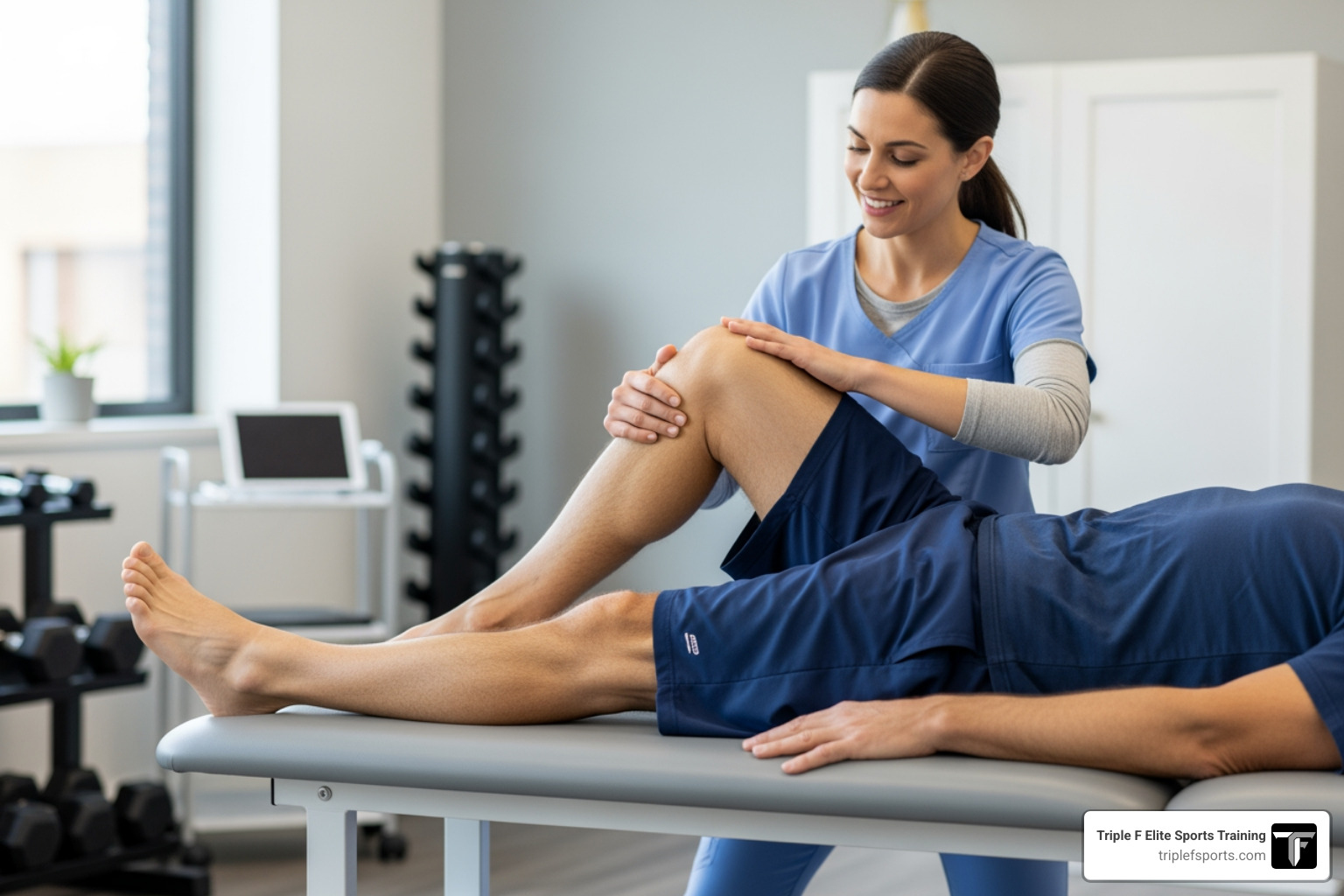
When you’re sidelined by an injury, it’s natural to seek help. But for athletes, not all physical therapy is created equal. While general physical therapy aims to restore everyday function and reduce pain, sports-specific rehabilitation goes a significant step further. It’s about optimizing your body to meet the rigorous and unique demands of your chosen sport, ensuring you don’t just recover, but excel.
We know that each sport places unique stresses on the body. A basketball player needs to jump, pivot, and land safely, while a swimmer requires exceptional shoulder mobility and endurance. Generic rehab might get you walking comfortably, but it won’t prepare you for a triple-double or a personal best in the pool. That’s where our specialized approach comes in. We dig deep into the biomechanical demands and movement patterns of your sport, crafting a plan that’s as unique as your athletic ambition.
Here’s a quick comparison to highlight the difference:
| Feature | General Physical Therapy | Sports-Specific Rehab |
|---|---|---|
| Primary Focus | Daily function, pain relief, basic mobility | Athletic performance, sport-specific movements, injury prevention |
| Patient Base | Broad, includes general population with various conditions | Athletes of all levels and ages |
| Treatment Goals | Return to normal daily activities | Return to sport, improved performance, reduced re-injury risk |
| Exercise Philosophy | Standard therapeutic exercises | Functional training, sport-specific drills, progressive loading |
| Outcome Measurement | Pain levels, range of motion, basic strength | Performance metrics, agility tests, return-to-play criteria |
The Importance of Sport-Specific Rehab for Athletes
Why is this specialization so vital? Because your body, as an athlete, is a finely tuned machine. When an injury occurs, it’s not just about repairing the damage; it’s about recalibrating that machine for peak performance. Our physical therapy services are designed to get you back in the game faster and stronger, minimizing the risk of future setbacks. Physical therapy, as experienced athletes know, is one of the most important weapons in every athlete’s arsenal. It’s the key to a fast, less painful recovery and can make you more competitive in general.
The benefits we focus on include:
- Faster Recovery: Custom exercises and advanced techniques accelerate healing.
- Performance Improvement: We don’t just fix; we optimize, addressing dysfunctions and weaknesses that might have existed pre-injury.
- Reduced Re-injury Risk: By correcting movement patterns and strengthening specific muscle groups, we build resilience.
- Sport-Specific Strength, Agility, and Coordination: Our programs mimic the exact movements and demands of your sport, ensuring you’re ready when it counts.
We’re proud to offer specialized care that understands the athlete’s mindset and body. More info about our Physical Therapy services.
Why is it Crucial for Athletes?
The stakes are higher for athletes. A sprained ankle for someone working a desk job might mean a few weeks of discomfort, but for a basketball player, it could mean missing crucial games or even a season. The unique stresses of sports demand a rehabilitation program that is equally unique.
Our goal is not merely to heal the injury but to restore your function, mobility, and strength to a level that allows for a safe return to competition. This often means you’ll be feeling better than before, with improved strength and performance. We focus on getting you back to being the athlete you were born to be, helping you gain a competitive edge by addressing the root causes of injury and building a more robust, resilient athlete.
Physical therapy is a time-tested method for getting back to sports as soon as possible with the least overall impact. It helps you manage pain without over-reliance on medications, offering a full range of drug-free pain management options like heat, icing, massage, and therapeutic exercises. It also helps improve both range of motion and flexibility, which not only improves performance but also reduces the risk of further injury.
The Blueprint for Recovery: Key Principles and Components of Rehab for Athletes
Every athlete’s journey back to the field, court, or track is personal, but it’s guided by universal principles and built upon core components. At Triple F Elite Sports Training in Knoxville, we don’t just treat injuries; we develop individualized plans that empower you to return stronger and more resilient. Our approach ensures that every step of your rehabilitation is purposeful and progressive.

A comprehensive approach to rehabilitation for athletes requires understanding the unique biomechanical demands and movement patterns of each sport. This personalized care is crucial for recovery, performance improvement, and injury prevention. We believe in a structured, scientific approach to Rehab for athletes, ensuring that your recovery is not left to chance. You can find A comprehensive overview of athlete rehabilitation in medical literature, and we apply these best practices every day.
The 7 Guiding Principles of Rehabilitation
Successful rehabilitation isn’t a random process; it adheres to well-established principles. We accept the “ATC IS IT” mnemonic to guide our programs:
- Avoid Aggravation: We carefully manage your load and intensity to prevent worsening your injury. “More is not always better,” as the saying goes.
- Timing: Rehabilitation begins as early as possible, even during the acute phase of injury, to minimize loss and promote healing.
- Compliance: Your active participation and adherence to the program are paramount. We work with you to set goals and ensure you understand the “why” behind every exercise.
- Individualization: Each program is custom to your specific injury, sport, and personal response to treatment. What works for one athlete might not work for another.
- Specific Sequencing: We follow a logical progression, ensuring foundational movements are mastered before advancing to more complex, sport-specific drills.
- Intensity: The program is challenging enough to stimulate adaptation and improvement but never pushes you beyond your safe limits.
- Total Patient: We treat the whole athlete, not just the injury. This includes addressing psychological aspects and maintaining the fitness of uninjured body parts.
Key Components of a Successful Plan
A robust rehabilitation plan for athletes integrates several critical elements:
- Pain Management: Our focus is on drug-free pain management. We use modalities like heat, ice, massage, and therapeutic exercises to alleviate discomfort and inflammation, setting the stage for active recovery.
- Flexibility & Range of Motion (ROM): Restoring full, pain-free movement is fundamental. We work to improve joint flexibility and muscle extensibility, crucial for both performance and preventing re-injury.
- Strength & Endurance: We build strength in injured tissues and surrounding musculature, and maintain cardiovascular endurance. This includes full-motion strengthening and progressive loading to balance antagonistic forces.
- Proprioception & Coordination: These are your body’s ability to sense its position and move smoothly. We incorporate exercises that challenge balance and coordination to rebuild rapid motor responses, essential for agility and injury prevention in sport.
- Functional Rehabilitation: This is where rehab truly becomes sport-specific. We introduce exercises that mimic the movements, demands, and conditions of your sport, progressing from basic to complex.
- Sport-Specific Drills: As you advance, we integrate drills directly from your sport, allowing you to gradually re-engage in activities like jumping, sprinting, throwing, or hitting, building confidence and readiness for return to play.
The Proactive Approach: Injury Prevention
The best injury is the one that never happens. Our comprehensive approach to Rehab for athletes isn’t just about recovery; it’s about building a more resilient athlete. We carefully address biomechanical issues, correct muscle imbalances, and improve movement efficiency. This proactive stance helps reduce the risk of future injuries. We also provide education on proper technique, the importance of structured warm-ups, and effective cool-downs, empowering you with the knowledge to protect your body long-term.
The Road to Victory: Navigating the Stages of Athlete Rehabilitation
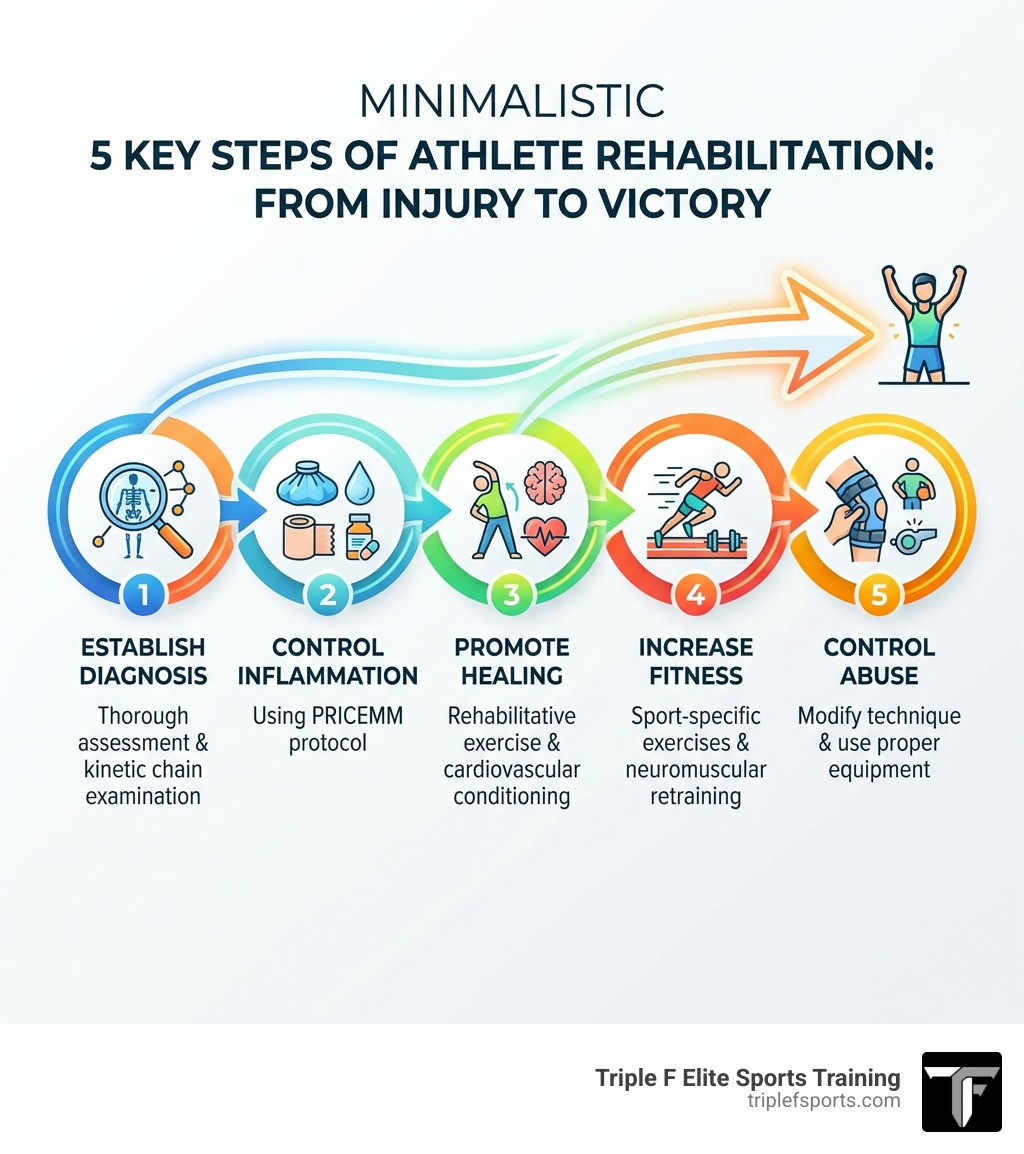
Rehabilitation is a journey, not a sprint. To successfully guide athletes from injury to victory, we follow a phased approach, systematically progressing through stages that ensure thorough healing, strength building, and mental preparation. This structured pathway, often described as a “progressive rehab journey,” allows us to gradually increase the challenge while carefully monitoring your body’s response.
Each stage has specific goals, and we work closely with you to set achievable targets, celebrate small victories, and adjust the plan as needed. The goal is always to get you back to full activity, confidence, strength, and stability.
Stage 1: The Initial Phase (Acute)
This initial stage, typically lasting about 4-6 days, is all about immediate care and protection. Our primary focus here is to control pain and inflammation, which are natural responses to injury but can hinder healing if excessive.
- Pain and Inflammation Control: We often employ the classic RICE protocol (Rest, Ice, Compression, Elevation) to manage swelling and discomfort. Rest doesn’t always mean complete inactivity; often, it’s about relative rest, where you avoid aggravating the injured area while maintaining fitness in unaffected body parts.
- Protecting the Injured Tissue: We implement strategies to protect the damaged area from further harm, allowing the initial healing processes to begin.
- Maintaining Fitness of Unaffected Areas: We ensure that while your injured area rests, the rest of your body stays as fit as possible, preventing overall deconditioning.
Stage 2: The Repair Phase (Subacute)
Once initial pain and inflammation are under control, we transition to the repair phase, which can last from day 5 to 8-10 weeks. This stage is crucial for regaining foundational capabilities.
- Restoring Range of Motion: We gently work to restore the full, pain-free movement of the injured joint or limb. This minimizes stiffness and prevents scar tissue from limiting flexibility.
- Gentle Strengthening Exercises: We introduce controlled, low-impact exercises to begin rebuilding strength in the injured muscles and surrounding support structures. This might include isometric (muscle contraction without movement) or isotonic (muscle contraction with movement) exercises.
- Improving Neuromuscular Control: We start re-educating your nerves and muscles to work together efficiently. This is vital for stability and coordination as you begin to move more freely.
Stage 3: The Remodeling Phase (Return to Sport)
The advanced stage of rehabilitation, often beginning around 21 days but continuing for 6-12 months, is where we prepare your body for the specific demands of your sport. This is about building robust strength, power, and agility, culminating in a confident return to play.
- Functional Training: We progress to exercises that mimic the complex movements and energy systems required by your sport. This helps bridge the gap between basic strength and game-day performance.
- Sport-Specific Drills: We integrate actual drills from your sport, gradually increasing intensity and complexity. For a basketball player, this might mean pivoting and jumping drills; for a runner, it’s about stride mechanics.
- Agility and Plyometrics: These exercises improve your ability to change direction quickly, react, and generate explosive power, crucial for almost any sport.
- Building Strength and Power: We continue to advance your strength and conditioning, ensuring the injured area is not only healed but stronger than before.
- Return-to-Sport Testing: Before you return to competition, we conduct comprehensive testing to objectively evaluate your readiness. This ensures you meet specific fitness standards and can perform sport-specific functions without pain or hesitation.
- Ensuring Psychological Readiness: We recognize that returning to sport is as much mental as it is physical. We work with you to address any fear of re-injury or anxiety, ensuring you’re confident and mentally prepared.
Advanced Tools and the Winning Mindset
At Triple F Elite Sports Training, we combine cutting-edge technology with a deep understanding of the human body and mind. This holistic approach ensures that your Rehab for athletes journey is not only effective but also empowers you with the mental fortitude to conquer any challenge.
Advanced Techniques in Sports Physical Therapy
To accelerate your recovery and improve your performance, we use a range of advanced techniques:
- Manual Therapy: Our skilled physical therapists use hands-on techniques, including massage, mobilization, and manipulation, to reduce pain, improve joint mobility, and restore proper movement patterns.
- Dry Needling: This technique involves inserting thin needles into trigger points in muscles to release tension, reduce pain, and improve muscle function.
- Electrical Stimulation: We use various forms of electrical stimulation to reduce pain, decrease swelling, improve muscle strength, and facilitate healing.
- Compression Therapy: Techniques like compression garments or devices can help reduce swelling and inflammation, especially after soft tissue injuries, promoting faster recovery.
- Antigravity Treadmills: These specialized treadmills allow athletes to run or walk at a reduced body weight, enabling earlier return to weight-bearing activities and progressive loading without overstressing injured tissues.
- Blood Flow Restriction (BFR): By applying a tourniquet to a limb during low-intensity exercise, BFR training can produce strength and hypertrophy gains similar to high-intensity training, which is invaluable during early rehabilitation phases.
These advanced tools, combined with our expert care, help us precisely target your needs and optimize your recovery.
The Psychological Side of Rehab for Athletes
“Injury is more than physical; that is, the athlete must be psychologically ready for the demands of his or her sport.” We wholeheartedly agree. The psychological aspect of sports injury is crucial, and rehabilitation programs must address mental resilience and coping strategies. It’s not just about fixing a broken body; it’s about rebuilding a shattered confidence and refocusing a determined mind.
Insights on psychological recovery from sport injury highlight that athletes often experience a range of emotions, including shock, denial, fear of re-injury, and mood disturbances. These are normal reactions, and we’re here to help you steer them.
Our approach to the psychological side of Rehab for athletes includes:
- Overcoming Fear of Re-injury: It’s common to be hesitant, but we guide you through progressive, confidence-building exercises and education to show you that your body is strong and ready.
- Building Mental Toughness: We integrate strategies to improve your mental resilience, helping you stay positive and committed throughout the often challenging rehab process.
- Goal Setting: We work with you to set realistic, performance-process-focused goals rather than just outcome-based ones. This keeps you motivated and focused on the journey.
- Visualization: Mentally rehearsing movements and successful returns to play can significantly aid physical recovery and build confidence.
- Coping Strategies: We equip you with tools to manage frustration, setbacks, and pain, ensuring you maintain a healthy mindset.
Mental skills can be learned, and we’re committed to helping you develop them, changing your injury into an opportunity for profound personal and athletic growth.
Building Your Comeback Team
Navigating an injury can feel isolating, but you don’t have to go it alone. At Triple F Elite Sports Training, we believe in a multidisciplinary, team-based approach to Rehab for athletes. This ensures that every aspect of your recovery and performance improvement is covered, from the initial diagnosis to your triumphant return to competition.
Common Injuries Treated with Sports Rehab
We specialize in treating a wide array of sports-related injuries, helping athletes in Knoxville get back to what they love. The most common sports injuries treated with physical therapy include:
- Sprains and Strains: From a twisted ankle on the basketball court to a pulled hamstring during a sprint, we help you heal and strengthen these common soft tissue injuries.
- ACL Tears: Often requiring surgery, ACL rehabilitation is one of our specialties, guiding you through every stage to regain stability and confidence.
- Rotator Cuff Injuries: Common in throwing sports like baseball or volleyball, we focus on restoring shoulder mobility, strength, and proper mechanics.
- Tendinitis: Whether it’s “tennis elbow” or Achilles tendinitis from running, we address the inflammation and underlying biomechanical issues.
- Shin Splints and Stress Fractures: Especially prevalent in runners, we help manage pain, correct gait mechanics, and strengthen the lower limbs to prevent recurrence.
- Concussions: While primarily managed by medical doctors, physical therapy plays a crucial role in addressing associated balance, vestibular, and neck issues to facilitate a safe return to activity.
The Multidisciplinary Team Approach
Your journey back to peak performance involves a coordinated effort from several experts. We foster an environment of seamless communication and collaboration among:
- Physical Therapists: Our primary role in guiding your physical recovery, designing your exercise program, and utilizing advanced techniques.
- Sports Medicine Physicians: For diagnosis, medical management, and surgical interventions when necessary.
- Athletic Trainers: Often the first responders on the field, they play a key role in immediate care and communicating your status to coaches.
- Strength and Conditioning Coaches: To integrate your rehab with performance training, building sport-specific strength, power, and endurance.
- Nutritionists: To optimize your diet for healing, energy, and overall athletic performance.
- Sports Psychologists: To address the mental and emotional challenges of injury, helping you build resilience and confidence.
A lack of communication between these vital team members can slow or prevent athletes from returning to peak capability and increase the risk of new injuries. That’s why we prioritize clear, consistent communication every step of the way. More info about our Sports Medicine approach.
When to See a Sports Therapist
Knowing when to seek specialized help is crucial for a swift and complete recovery. Don’t wait until a small issue becomes a chronic problem. You should consider seeing a sports therapist at Triple F Elite Sports Training if you experience any of the following:
- Persistent Pain or Swelling: If your pain or swelling doesn’t improve with rest or basic first aid, it’s time for an expert evaluation.
- Inability to Bear Weight: This is a clear sign of a significant injury that requires immediate professional attention.
- Recurring Injuries: If you find yourself repeatedly injuring the same area or never feeling fully recovered, we can help identify and address the root cause.
- Decreased Performance: If pain or stiffness is impacting your ability to perform at your usual level, or if you’re struggling to regain previous strength and agility, our specialized programs can help.
- Post-Surgery Rehabilitation: After any sports-related surgery, a structured rehab program is essential to regain function, strength, and safely return to your sport.
We offer a professional, Christ-centered approach to athletic development for youth and adults, ensuring you receive comprehensive care from a team that truly cares about your holistic well-being.
Your Path to Peak Performance Starts Here
We’ve covered a lot of ground today, from understanding the specialized nature of Rehab for athletes to the detailed stages of recovery, advanced techniques, and the crucial role of mental resilience. The key takeaway is this: recovering from a sports injury doesn’t have to be just about getting back to where you were. It’s an incredible opportunity to transform, to return to your sport stronger, smarter, and more resilient than ever before.
At Triple F Elite Sports Training in Knoxville, we provide comprehensive, Christ-centered athletic development that integrates professional physical therapy with performance training to help athletes of all ages recover and excel. We understand the physical and psychological demands of your sport because we’ve lived them. Our mission is to open up your full potential, turning setbacks into powerful comebacks.
Whether you’re a youth athlete dreaming of college scholarships or an adult athlete striving for personal bests, we are your partners in this journey. We offer a free first session so you can experience our unique approach firsthand. Don’t let an injury define your athletic career.
Take the first step towards not just recovery, but true victory. Begin your recovery journey with us today.