
Why Sports Skill Development is the Foundation of Athletic Excellence

Sports skill development is the systematic process of building fundamental movement abilities and sport-specific techniques that enable athletes to perform consistently at speed, under fatigue, and in high-pressure competition. Here’s what you need to master:
The Core Components of Sports Skill Development:
- Fundamental Movement Skills – Running, jumping, throwing, catching, balancing, and kicking (must be mastered by age 12)
- Performance Practice – Training to execute skills consistently under competition conditions, not just in isolation
- Long-Term Development – Following age-appropriate progressions over 8-12 years to reach elite levels
- Life Skills Integration – Building leadership, teamwork, and resilience alongside physical abilities
The difference between a day on the couch and a gold medal performance often stems from whether fundamental motor skills were developed early. Research shows that children who do not develop their fundamental motor skills by age 12 are unlikely to reach their genetic athletic potential. Yet many young athletes are pushed into early specialization or trained like professionals before their bodies are ready, leading to burnout, injury, and lost potential.
The real challenge isn’t just learning a skill in practice. It’s performing that skill consistently well at speed, when you’re exhausted, under pressure, and in front of thousands of people. As one coaching expert puts it: “There is a huge difference between learning a skill and learning to perform the skill consistently well at speed, when you are fatigued, under pressure and trying to execute the skill.”
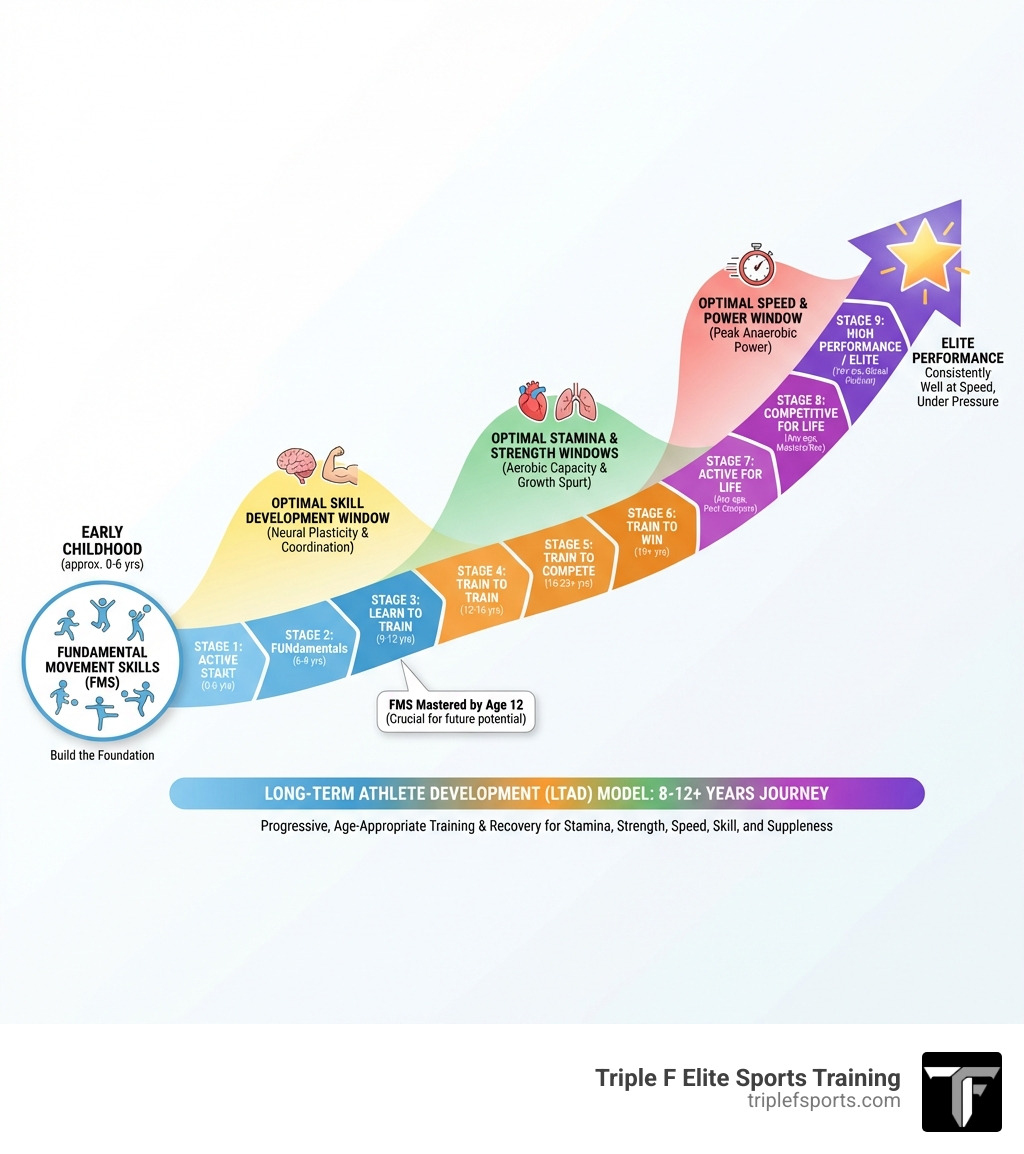
This is where structured, age-appropriate training makes all the difference. The Long-Term Athlete Development (LTAD) model provides a proven framework that takes athletes from playful exploration in early childhood through to elite performance, with specific trainability windows for stamina, strength, speed, skill, and suppleness at each stage.
But physical skills are only part of the equation. Sports also develop crucial life skills like leadership, teamwork, and resilience that transfer far beyond the field or court. Athletes who take ownership of their development—building positive relationships, practicing self-reflection, and applying skills in new contexts—set themselves up for success in all areas of life.
I’m Lee Smith, an 11-year NFL veteran who opened Triple F Elite Sports Training to bring professional-level sports skill development centered on faith to youth athletes in Knoxville. My experience taught me that elite performance requires world-class support systems, proper recovery, and most importantly, a foundation built on fundamental skills developed the right way at the right time.
The Foundation: Understanding the Long-Term Athlete Development (LTAD) Model
At Triple F Elite Sports Training, we understand that true athletic excellence isn’t built overnight. It’s the result of a thoughtful, long-term approach to sports skill development. This is precisely what the Long-Term Athlete Development (LTAD) model champions. It’s a comprehensive framework designed to optimize training, competition, and recovery schedules for each stage of an athlete’s growth. This model is widely recognized and adopted because it acknowledges that athletes develop at different rates and require custom approaches throughout their athletic journey.
Research consistently shows that it takes a significant commitment to reach the pinnacle of any sport. We’re talking about anywhere from 8 to 12 years of dedicated training for a talented athlete to reach elite levels. In fact, some studies even suggest 10-13 years to make an Olympic team and 13-15 years to win a medal. This isn’t just about showing up; it’s about smart, progressive training.
A key concept within LTAD is “trainability” – this refers to how responsive an individual is to training stimuli at different stages of their growth and maturation. Essentially, there are optimal “windows” when an athlete’s body is primed to develop certain physical capacities most effectively.
These critical periods are distinct for different physical capacities:
- Stamina: Best developed around the onset of Peak Height Velocity (PHV).
- Strength: Optimal windows are post-PHV for boys and around menarche/post-PHV for girls.
- Speed: There are specific age ranges where speed training is most effective, generally earlier for girls (6-8 years, then 11-13 years) and slightly later for boys (7-9 years, then 13-16 years).
- Skill: This is a crucial one for us! The optimal window for intensive skill training typically takes place between the ages of 9 and 12 for boys and between 8 and 11 for girls. This highlights the importance of getting those fundamental movements down early.
- Suppleness (Flexibility): A critical window for both genders is between 6 and 10 years of age.
Understanding these windows allows us to design programs that maximize an athlete’s potential, ensuring we’re not just training hard, but training smart. We integrate this philosophy into all our programs, including our Youth Training (12 to 18) to ensure every athlete is getting the most effective development possible.
The 9 Stages of the LTAD Model
The LTAD model isn’t a one-size-fits-all solution; it’s a pathway, adapting to the athlete’s physical, mental, and emotional development. It comprises 9 distinct stages, guiding athletes from their very first steps in sport to potentially a lifetime of physical activity.
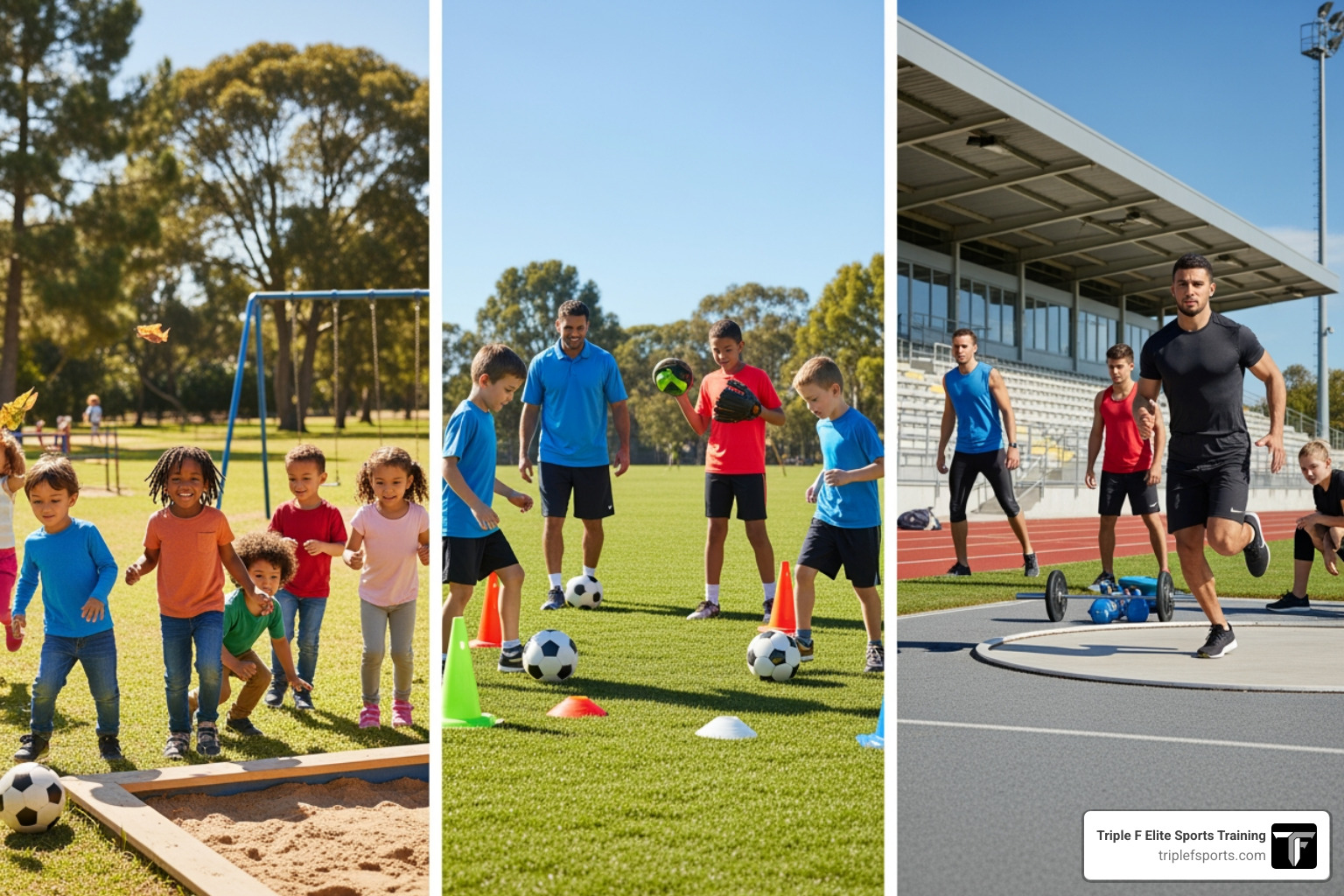
Let’s explore these stages:
- Active Start (0-6 years): This is all about daily, fun, unstructured physical activity. Think running, jumping, playing—anything that gets kids moving and exploring their environment. The goal here is to make physical activity an exciting and essential part of their daily routine.
- FUNdamentals (6-9 years for boys, 6-8 years for girls): Here, the focus shifts to developing fundamental movement skills (FMS) like running, jumping, throwing, and catching in a fun, positive, and multi-sport environment. This stage builds the ABCs of athleticism: agility, balance, coordination, and speed.
- Learning to Train (9-12 years for boys, 8-11 years for girls): This is often referred to as “Fundamentals 2” and is a critical period for developing foundational sports skill development. Athletes start to acquire basic sport-specific skills and general athletic abilities, with a continued emphasis on fun and varied activities. This stage aligns with the optimal skill training windows!
- Training to Train (12-16 years for boys, 11-15 years for girls): Also known as “Building the Engine,” this stage focuses on developing aerobic capacity, strength, and speed, alongside continued skill development. It’s about building a robust physical base while refining technical skills.
- Learning to Compete (16-18 years for boys, 15-17 years for girls): This is where athletes begin to apply their skills in competitive settings, learning about tactics, strategies, and mental preparation. It’s the “Challenge of Competition,” focusing on optimizing performance under pressure.
- Training to Compete (16-23+ years for boys, 15-21+ years for girls): The “Heat of the Battle” stage, where athletes specialize in their chosen sport, refining technical, tactical, physical, and mental skills to maximize performance. Training becomes more intense and specific.
- Learning to Win (18+ years for boys, 17+ years for girls): Focused on “Consistent Performance,” this stage is about achieving podium results and excelling at the highest levels of competition. Athletes learn to consistently deliver peak performance when it counts.
- Winning for a Living (20+ years for boys, 19+ years for girls): The “Performing When It Counts” stage, where athletes are fully dedicated professionals, aiming for sustained international success and potentially making a living from their sport.
- Active for Life (Any age): This crucial stage emphasizes lifelong participation in sport and physical activity, whether through continued competition, coaching, volunteering, or recreational play. It ensures that the benefits of sports skill development extend far beyond an athlete’s competitive career.
Understanding these stages allows us to tailor our coaching methods effectively, ensuring athletes are always learning and progressing in a developmentally appropriate way. For more insights into how skills are learned and taught, exploring various Skill Development theories can be incredibly insightful.
Why Age-Appropriate Training Matters
You might be thinking, “Why all this fuss about stages and windows? Can’t we just start early and push hard?” We often see parents and coaches eager to see their young athletes excel, sometimes leading to approaches that, while well-intentioned, can be counterproductive.
A common misconception is equating fundamental movement skills (FMS) with sport-specific skills. FMS are the basic building blocks – running, jumping, throwing, catching. They are distinct from, and should be mastered before, specializing in skills for a particular sport. Think of it like learning the alphabet before writing a novel. Without a solid foundation in FMS, athletes may struggle with more complex sport-specific movements later on. This is why developing FMS by age 12 is so crucial; without them, children are less likely to reach their full athletic potential.
Programs like the NCCP Fundamental Movement Skills Workshop for coaches emphasize breaking down simple skills into key components, providing stage-appropriate feedback, and leading activities that promote FMS in a safe and responsible manner. While that specific workshop is Canadian, the principles it teaches are universal: building competence and confidence in basic movements is paramount for all young athletes. The benefits of developing FMS are immense, laying the groundwork for lifelong physical activity and enjoyment of sports.
The dangers of over-specialization are well-documented. Pushing young athletes into a single sport too early, with intense, adult-like training regimens, can lead to:
- Early Burnout: The fun is stripped away, and the pressure becomes overwhelming.
- Increased Injury Risk: Young bodies aren’t ready for repetitive, high-impact stress. Poor movement patterns learned early can lead to overuse injuries, acute injuries, and long-term joint problems.
- Limited Skill Development: Focusing on one sport can hinder the development of a broad range of athletic abilities that come from multi-sport participation.
This is why we firmly believe that young athletes shouldn’t train like Olympians. Olympians are adults with fully developed bodies and years of specialized training. Applying their training intensity and specialization to a 10-year-old is inappropriate and often detrimental. Instead, we advocate for varied activities, encouraging multi-sport participation, and focusing on general athleticism during the “golden window” between ages 8 and 11. Technical skill development becomes much more effective after age 12, once those foundational movements are firmly established.
At Triple F Elite Sports Training in Knoxville, we offer Youth Assessments to accurately gauge an athlete’s current stage of development, helping us create personalized programs that are truly age-appropriate and effective.
A Modern Approach to Sports Skill Development: The Performance Practice Method
We’ve all heard the adage, “Practice makes perfect.” But in high-performance sports skill development, we’ve learned that “Performance Practice makes perfect performance.” There’s a crucial distinction here. Traditional practice often focuses on executing a skill in isolation, in a controlled environment, without the added complexities of competition. This is where the “Practice Makes Perfect” myth falls short. While foundational practice is essential, it’s simply not enough to prepare an athlete for the real game.
Performance Practice is our modern approach. It means training the way you want to perform. It’s about systematically preparing athletes to execute skills consistently well at speed, under fatigue, and under pressure – precisely the conditions they’ll face in competition. As coaches, we know that many competitions come down to the quality of skill execution during the final, critical moments. If an athlete can’t perform a simple task when they’re tired and the game is on the line, all that isolated practice counts for little.
This brings us to the concept of the “Training Brain” versus the “Competition Brain.”
- The Training Brain can sometimes be a bit lazy. It might accept less-than-perfect execution, allow for breaks, or not fully engage with the intensity required for competition. It’s focused on learning and repetition.
- The Competition Brain, on the other hand, is sharp, focused, and demands optimal performance. It’s wired for execution under duress.
Our goal is to ensure athletes use their “Competition Brain” even in training. This means consciously simulating competition conditions in every session. Training, in many ways, should be more challenging and demanding than the competition itself. If an athlete can consistently perform skills under heightened training pressure, then the actual game environment will feel relatively easier. This is the essence of what we do in our Skilled Based Training programs.
The 7 Steps to Mastering Skills Under Pressure
To truly master a skill for competitive performance, we guide our athletes through a structured, progressive process. This isn’t a quick fix; it’s a deliberate journey of refinement and conditioning. Here are the 7 steps of Performance Practice we focus on:
- Perform the Skill: First, the athlete must simply learn to execute the skill correctly. This is the basic foundation, understanding the mechanics and movement patterns.
- Perform the Skill very well: Once the basics are grasped, we focus on precision and quality. It’s not just doing it, but doing it right, with efficient technique.
- Perform the Skill very well and at speed: Now we introduce the element of pace. Can the athlete maintain quality and precision while increasing the speed of execution? This is where many traditional practices stop, but we’re only getting warmed up!
- Perform the Skill very well, at speed and under fatigue: This is a game-changer. We intentionally introduce fatigue into training sessions. Can the athlete still execute the skill perfectly when their body is tired, simulating the later stages of a game?
- Perform the Skill very well, at speed, under fatigue and under pressure: The stakes are raised. We add mental and emotional pressure. This could be a coach’s challenge, a time constraint, or a competitive scenario. Research shows that emotional stress and mental pressure significantly impact an athlete’s ability to perform skills with quality and accuracy, so we train for it.
- Perform the Skill very well, at speed, under fatigue and under pressure consistently: Being able to perform the skill under competition conditions once could be luck. Doing it consistently is the sign of a real champion. This step focuses on repeatability and reliability under all adverse conditions.
- Perform the Skill very well, at speed, under fatigue and under pressure consistently in competition conditions: The ultimate test. All the previous steps culminate in the ability to transfer these highly refined skills directly into the competitive arena, delivering peak performance when it matters most.
This systematic progression ensures our athletes are not just skilled, but performance-ready.
Overcoming Fatigue and Pressure in Your Sports Skill Development
Fatigue and pressure are the silent assassins of athletic performance. Even the most technically gifted athlete can falter when exhausted or overwhelmed. We’ve seen it countless times: a simple pass missed, a shot wide, or a defensive error in critical moments. This isn’t usually due to a lack of talent, but an inability to execute under strain.
Impact of Fatigue: When an athlete is fatigued, their neuromuscular control diminishes. Reaction times slow, decision-making becomes impaired, and technical execution suffers. Muscles don’t fire as efficiently, and coordination can break down. Training must prepare the body and mind to counteract these effects.
Impact of Pressure: Mental pressure, whether from the crowd, the importance of the moment, or personal expectations, can lead to a physiological response that interferes with fine motor skills. The “choking” phenomenon is a prime example, where athletes, despite having the skill, fail to perform when it counts. This is often linked to the psychological impact on their ability to perform.
So, how do we train for this?
- Training Strategies for Fatigue: We intentionally incorporate drills where athletes perform skills after periods of high-intensity physical exertion. As one coach suggested, sometimes a “10-minute emptying the tank” warm-up before learning a new skill can simulate a fatigued state. This teaches the body to maintain technical form even when tired. We might run conditioning drills and immediately transition into skill work, forcing athletes to find efficiency when their energy reserves are low.
- Training Strategies for Pressure: We integrate pressure into our skill practices. This could involve small-sided games with immediate consequences for errors, time limits for successful execution, or peer observation and feedback. The goal is to create scenarios that mimic the mental demands of competition, allowing athletes to practice managing their emotions and focusing on the task at hand.
- The Role of Recovery: Crucially, we emphasize the importance of recovery. Training hard means recovering hard. Adequate sleep, nutrition, and strategic recovery windows are vital for athletes to absorb training loads, repair their bodies, and return sharper. Without proper recovery, athletes can’t adapt to the demands of performance practice and are at higher risk of burnout and injury.
At Triple F Elite Sports Training, we understand that preparing for the highest levels of competition, like those in the NFL, demands this level of rigorous, performance-focused training. Our NFL Pre-Draft Training programs are designed to push athletes to master skills under the most extreme conditions, ensuring they are not just ready, but dominant.
Beyond the Game: Cultivating Life Skills Through Sport
While we’re passionate about physical sports skill development, we know that the benefits of athletics extend far beyond the scoreboard. Participation in sports is a powerful crucible for forging essential life skills – abilities or characteristics that can be developed through sport and successfully transferred to non-sport settings. This is what we call “life skills transfer,” and it’s a cornerstone of our philosophy at Triple F Elite Sports Training.
Why are these skills so important? Because they equip athletes for success not just in their sport, but in school, relationships, careers, and life in general. Learning problem-solving in a tight game situation, for instance, can help an athlete steer disagreements with friends or siblings. An athlete who learns to manage their emotions during a tense match will be better equipped to handle stress in academic or professional environments.
Holistic support programs for athletes recognize this dual development. They understand that mental health, personal growth, and career planning are just as crucial as physical training. While specific programs like Canada’s Game Plan offer comprehensive support, the underlying principle is universal: athletes benefit immensely from environments that nurture their entire being, preparing them for life’s many transitions.
Key Life Skills and How to Develop Them
Let’s explore some of the most impactful life skills cultivated through sports:
- Leadership: This isn’t just about being a team captain. Leadership in sports can manifest as advocating for social change, fostering inclusive community efforts, or simply setting a positive example. An athlete demonstrating leadership by standing up for a bullied teammate, for example, is applying this skill in a powerful way.
- Teamwork: Beyond just working together to win a game, teamwork involves learning and experiencing personal growth, social development, and socialization. Meeting teammates from diverse backgrounds and learning to collaborate effectively builds invaluable interpersonal skills. These are highly transferable; teamwork skills honed on the soccer field can be applied to working with diverse classmates in a school club, for instance.
- Resilience: Sports are full of setbacks: injuries, losses, conflicts with teammates or coaches. Resilience is the ability to adapt to risk and adversity, helping athletes bounce back from these challenges. Learning to cope with a tough loss or a training injury builds mental toughness that translates to overcoming obstacles in academic or professional life.
- Problem-solving: Every game is a series of problems to solve, from breaking down an opponent’s defense to adjusting strategy mid-game. These experiences sharpen an athlete’s ability to analyze situations, devise solutions, and act decisively.
- Emotional Control: The highs and lows of competition provide a perfect training ground for emotional regulation. Learning to stay calm under pressure, manage frustration, and celebrate appropriately are critical skills for navigating life’s emotional rollercoaster.
- Building Positive Relationships with Coaches and Teammates: This is foundational. Athletes can actively build these relationships by engaging in conversation, finding common interests, and fostering a comfortable and safe environment. Strong relationships provide a support system, teach communication skills, and model healthy interactions.
Strategies for Holistic Sports Skill Development
Developing these life skills isn’t passive; it requires intentional effort from athletes, supported by coaches and parents. Here are three key strategies athletes can use to take ownership of their life skills development:
| Strategy | Description The Long Term Athlete Development model is a framework for optimal training, competition and recovery.