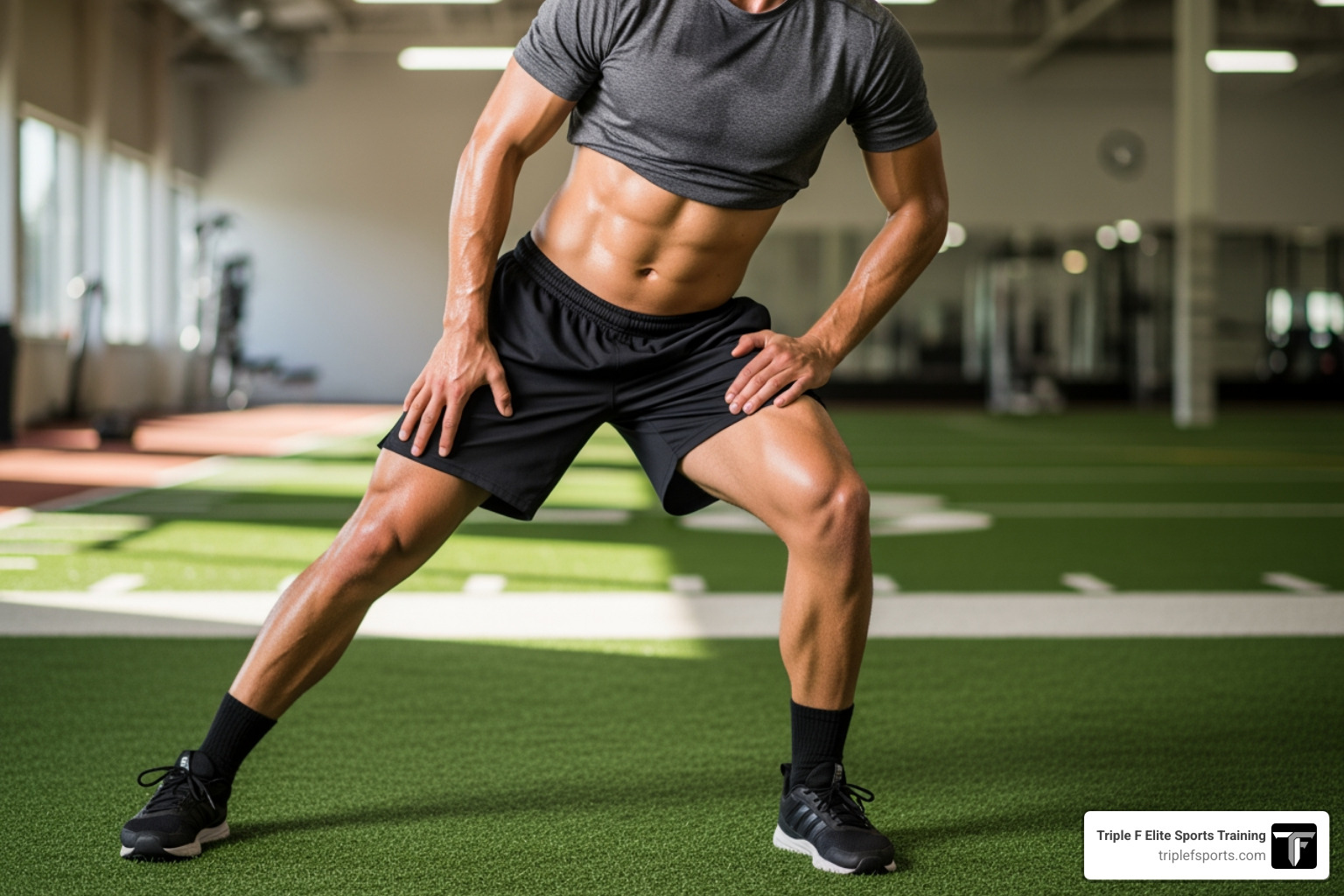
Why Groin Pull Prevention Matters for Every Athlete
Groin pull prevention starts with understanding what you’re up against and taking action before pain stops you in your tracks.
Quick Answer: The Essential Groin Pull Prevention Checklist
- Warm up dynamically before every practice or game (10-15 minutes minimum)
- Strengthen your adductors with exercises like Copenhagen adductions and side-lying leg lifts (2-3 times per week)
- Stretch your inner thighs daily, holding each stretch for 20-30 seconds
- Build core stability to support your pelvis and reduce strain on groin muscles
- Maintain muscle balance — your adductors should have at least 80% of your abductor strength
- Rest adequately and avoid overtraining to prevent fatigue-related injuries
Imagine cutting sharply toward the goal when a sudden, sharp pain shoots through your inner thigh. That popping sensation, followed by pain and difficulty moving, is the hallmark of a groin pull (or adductor strain).
This injury occurs when your inner thigh adductor muscles are overstretched or torn. It’s common in sports with sudden starts, stops, and direction changes.
Groin pain accounts for 2-5% of all sports injuries, and in sports like soccer and hockey, that number jumps to 9-18% of all injuries. For hockey players specifically, groin injuries make up almost half of all strain injuries. If you’re an athlete in soccer, hockey, football, track and field, or any sport requiring explosive movements and quick pivots, you’re at heightened risk.
The good news? Groin injuries can be prevented. Research shows that structured prevention programs can decrease groin injuries by almost one-third. The key is strengthening the right muscles, improving flexibility, maintaining proper muscle balance, and giving your body adequate rest.
I’m Lee Smith, an 11-year NFL veteran and founder of Triple F Elite Sports Training in Knoxville, TN. Throughout my career, groin pull prevention was critical to staying healthy and performing at the highest level. Now, I bring that same professional approach to our local athletes. Let’s walk through how to protect yourself from this common but preventable injury.
Foundational Strategies for Groin Pull Prevention
At Triple F Elite Sports Training, we believe that true athletic development isn’t just about pushing limits; it’s about building a resilient body that can withstand the demands of your sport. This means laying a strong foundation for groin pull prevention through smart training habits.
The Role of a Dynamic Warm-Up
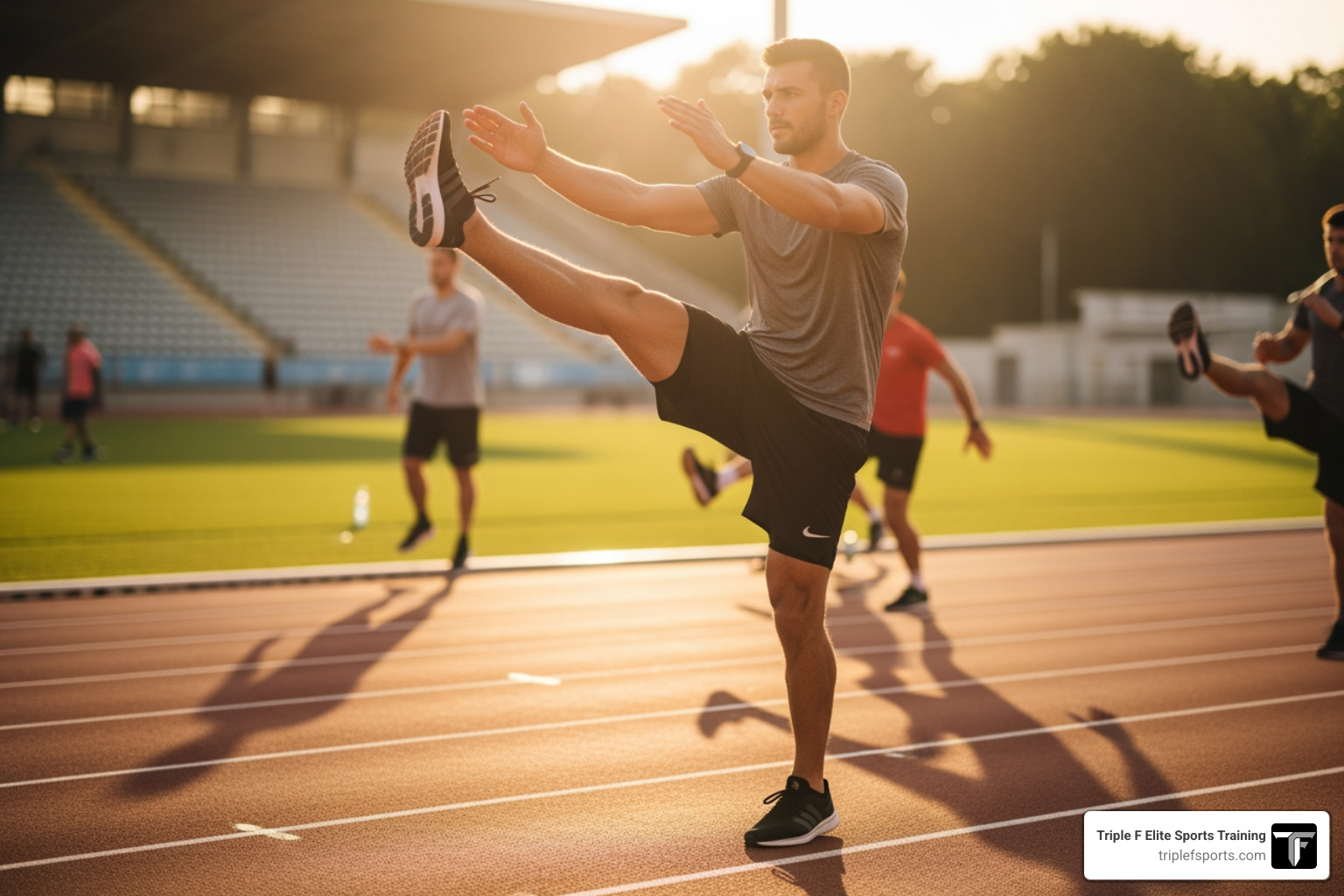
We always start our training sessions with a dynamic warm-up, and you should too. A proper warm-up prepares your muscles for the specific movements and stresses they’re about to endure by increasing blood flow, improving elasticity, and priming your nervous system for action. This significantly reduces your risk of a sudden injury like a groin pull.
Your dynamic warm-up should take about 10-15 minutes and include:
- Slow to fast movements: Gradually increasing intensity.
- Dynamic stretches: Movements that take your joints and muscles through their full range of motion.
- Sport-specific drills: Movements that mimic those you’ll perform in your sport.
Here are some of our favorite dynamic warm-up exercises:
- Leg Swings: Forward and backward, and side-to-side, to open up the hips and inner thighs.
- Walking Lunges: With or without a torso twist, to engage the hips and core.
- High Knees: To activate the hip flexors and improve coordination.
- Butt Kicks: To warm up the hamstrings and quadriceps.
- Carioca (Grapevine): A fantastic lateral movement that warms up the hip abductors and adductors.
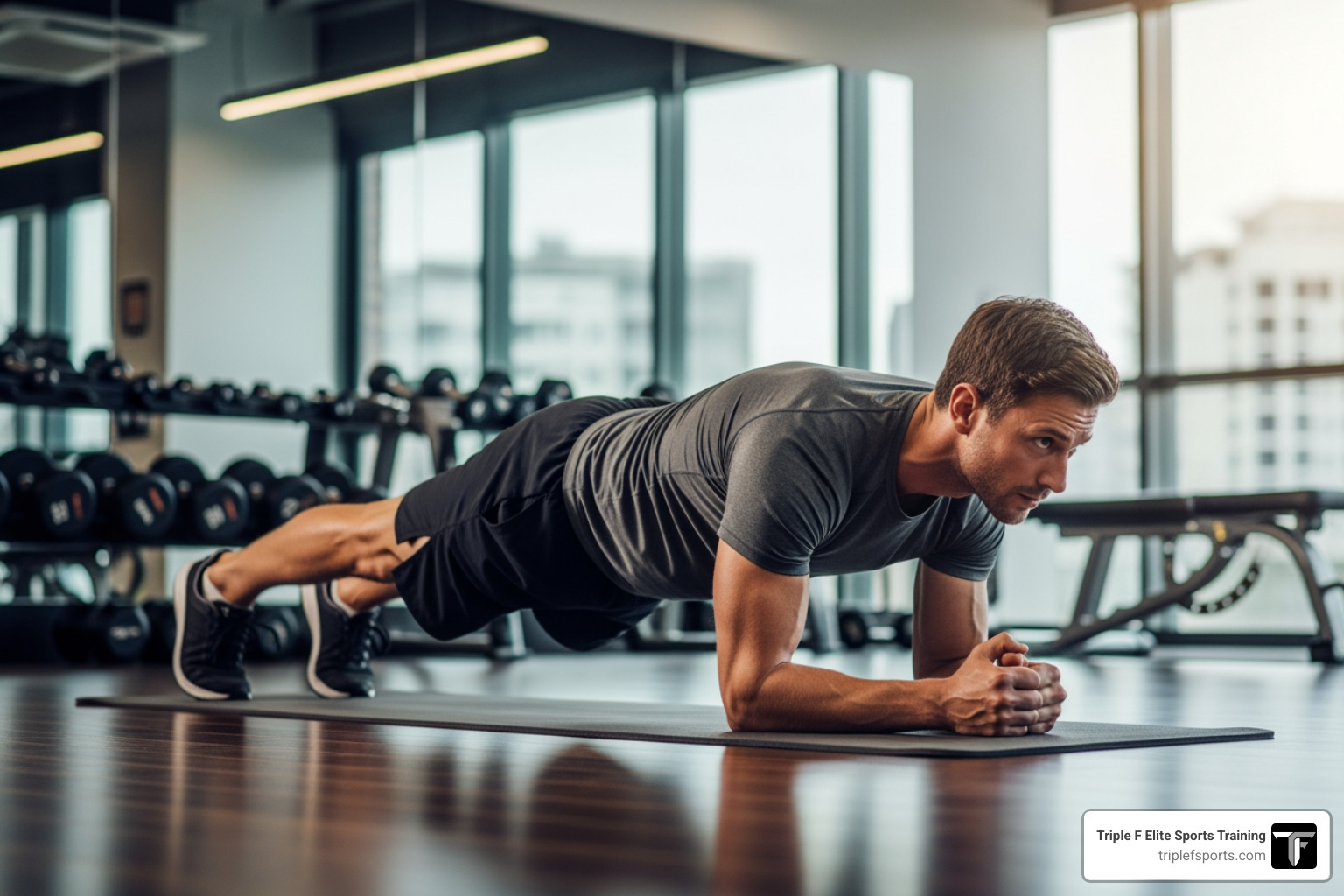
Why Core Stability is Crucial for Groin Health
Core stability isn’t just about six-pack abs; it’s about the deep muscles that stabilize your spine, pelvis, and hips. A strong, stable core acts as your body’s foundation, supporting all movement.
Why is this so important for groin pull prevention?
- Stabilizing the Pelvis: Your adductor muscles attach to your pelvis. If your core isn’t stable, your pelvis can tilt or rotate excessively during movements, placing undue stress on these inner thigh muscles. A stable pelvis provides a solid anchor point for your adductors, allowing them to function efficiently without overstraining.
- Reducing Strain on Adductors: Many athletic movements, especially those involving kicking, cutting, or rapid changes in direction, require significant force transfer through the core and hips. If your core is weak, your adductors might try to compensate, leading to overuse and eventual injury. A strong core helps distribute these forces, protecting your groin.
- Anti-Rotational Core Work: Sports often involve rotational movements. Strengthening your core to resist unwanted rotation (anti-rotational exercises) is particularly beneficial. This ensures that when you twist or pivot, the force is controlled and doesn’t violently tug at your adductor muscles.
Explosive maneuvers like a hockey stride or a soccer kick demand a strong core to prevent groin injury. Without it, the balance of forces is disrupted, making a groin pull much more likely.
The Importance of Rest and Avoiding Overtraining
Pushing your limits is exciting, but sometimes, the best thing you can do for your body is to rest. Muscle fatigue is a major culprit behind many sports injuries, including groin pulls. When your muscles are tired, their ability to contract effectively, absorb shock, and react quickly diminishes. This leaves them vulnerable to strains and tears.
- Increased Injury Risk: Training too much or for too long without adequate recovery leads to fatigue, which significantly increases the risk of injury. Your muscles simply can’t handle the load when they’re exhausted.
- Recovery Windows: We emphasize anchoring your training week around recovery windows. This means intentionally scheduling periods for your body to absorb the work you’ve put in and return sharper for the next session. This rhythm of high-intensity work followed by regeneration is key to sustained progress and injury prevention.
- Listening to Your Body: It’s crucial to pay attention to your body’s signals. Persistent soreness, unusual fatigue, decreased performance, or irritability can all be signs of overtraining. Pushing through these signals is a recipe for disaster.
- Importance of Sleep: Sleep is perhaps the most underrated aspect of recovery. This is when your body repairs tissues, consolidates memories (like new skills!), and restores energy levels. Aim for 8-9 hours of quality sleep each night to optimize your body’s healing and preparation for the next challenge.
Proper nutrition also plays a vital role in recovery, providing your muscles with the building blocks they need to repair and grow stronger. Learn more about how we integrate nutrition into our comprehensive training programs to fuel your body and prevent injuries by visiting our Nutrition page.
The Ultimate Groin Strengthening and Flexibility Program
Now that we’ve covered the foundational strategies, let’s dive into the nitty-gritty of strengthening and stretching. At Triple F Elite Sports Training, we incorporate these exercises into our Sport Skill training to help our athletes build robust, injury-resistant bodies.
Key Strengthening Exercises for Groin Pull Prevention
Strengthening your inner thigh (adductor) muscles is paramount for groin pull prevention. But it’s not just about the adductors; we also need to strengthen the lateral hip muscles (abductors and gluteals) to create balance and stability around the pelvis.
Here are some of our top picks for strengthening exercises:
- Copenhagen Adduction (Long and Short Versions): This exercise is a powerhouse for adductor strength and has been shown to significantly reduce the risk of groin injuries in athletes.
- How to do it (Long Version): Lie on your side with your top leg supported on a bench at the ankle. Lift your body and bottom leg off the ground, keeping your body in a straight line with your core and inner thigh. Lower slowly.
- How to do it (Short Version): Same as the long version, but your top leg is supported at the knee, making it less challenging.
- Recommended Reps and Sets: Start with 3 sets of 6-8 repetitions, focusing on slow, controlled movements.
- Sidelying Adduction: A fantastic, often overlooked exercise that directly targets the adductors.
- How to do it: Lie on your side with your bottom leg straight. Cross your top leg over, placing its foot flat on the floor. Keeping your torso stable, lift your bottom leg toward the ceiling using your inner thigh. Lower slowly.
- Recommended Reps and Sets: Aim for 3 sets of 8-16 repetitions.
- Clamshells: While primarily targeting the glute medius (a key abductor muscle), Clamshells are crucial for hip stability and balancing the strength ratio between adductors and abductors.
- How to do it: Lie on your side with your knees bent at a 90-degree angle and stacked. Keep your feet together and lift your top knee towards the ceiling, like a clamshell opening, without rolling your hips backward. Lower slowly. You can add a resistance band around your thighs for more challenge.
- Recommended Reps and Sets: Perform 3 sets of 12-15 repetitions per side.
- Fire Hydrants: Another excellent exercise for hip stability and glute activation.
- How to do it: Start on all fours (hands and knees). Keeping your knee bent at 90 degrees, lift one leg out to the side, like a dog at a fire hydrant, without shifting your torso. Keep your core engaged. Lower slowly.
- Recommended Reps and Sets: Perform 3 sets of 10-12 repetitions per side.
- Lateral Lunges: These are functional movements that strengthen the adductors, abductors, and glutes while improving dynamic flexibility.
- How to do it: Stand with your feet hip-width apart. Step out to the side with one leg, keeping that leg bent and your other leg straight. Push your hips back as if sitting into a chair. Keep your chest up. Push off your bent leg to return to the starting position.
- Recommended Reps and Sets: Do 3 sets of 8-10 repetitions per leg.
Proper form is always more important than the amount of weight or repetitions. If you’re unsure about your form, our physical therapists and coaches in Knoxville can provide expert guidance.
Essential Stretches for Groin Pull Prevention
Flexibility is the other side of the coin for groin pull prevention. Tight adductor muscles are a major contributing factor to strains. Regular stretching helps maintain good muscle balance and range of motion.
The American College of Sports Medicine (ACSM) recommends stretching major muscle groups 2-3 times per week, but daily stretching is most beneficial. We encourage daily groin stretches for optimal prevention.
Here are some essential stretches for your groin and inner thighs:
- Butterfly Stretch (Seated Groin Stretch):
- How to do it: Sit on the floor with the soles of your feet together and your knees bent out to the sides. Gently let your knees fall towards the floor. You can use your elbows to gently press your knees down for a deeper stretch.
- Hold Duration: Hold for 30 seconds.
- Standing Groin Stretch:
- How to do it: Stand with your feet wide apart, toes pointing forward. Shift your weight to one side, bending that knee while keeping the other leg straight. You should feel a stretch in the inner thigh of the straight leg.
- Hold Duration: Hold for 20-30 seconds, repeating 3 times on each side.
- Hip Adductor Stretch (Straddle Stretch):
- How to do it: Sit on the floor with your legs spread wide apart in a “V” shape. Keep your back straight and gently lean forward from your hips, reaching your hands towards your feet or the floor in front of you.
- Hold Duration: Hold for 15-30 seconds, repeating 3 times.
- Kneeling Hip Flexor Stretch: While not directly a groin stretch, tight hip flexors can indirectly affect groin mechanics.
- How to do it: Kneel on one knee, with the other foot flat on the floor in front of you (like a lunge position). Gently push your hips forward until you feel a stretch in the front of your hip and thigh of the kneeling leg.
- Hold Duration: Hold for 15-30 seconds per side.
How to stretch safely:
- Warm up first: Always perform light cardio (like a brisk walk or jog) before stretching. Never stretch cold muscles.
- Gentle and slow movements: Move into the stretch slowly and deliberately.
- Avoid bouncing: Bouncing can activate the stretch reflex, causing muscles to contract and increasing the risk of injury.
- Breathe deeply: Use your breath to help relax into the stretch.
- Stop if you feel sharp pain: A stretch should feel like a gentle pull, not pain. If it hurts, ease off.
Consistency is key! Incorporating these stretches into your daily routine or at least 3-4 times a week will dramatically improve your flexibility and contribute to better groin pull prevention.
When to Seek Professional Help for Groin Pain
Sometimes, groin pain isn’t just a simple muscle strain. It can be a complex area, and understanding the difference between a muscle pull and other conditions is vital for proper treatment and recovery. If you experience persistent or severe groin pain, it’s always best to get it checked out by a medical professional.
Groin Strain vs. Hernia: Knowing the Difference
A groin strain and a hernia both cause groin pain but are very different. A strain is a muscle tear, while a hernia is an organ pushing through a weak spot in the abdominal wall, often creating a bulge.
It’s important to know the key differences:
| Symptom / Condition | Groin Strain (Muscle Pull) | Inguinal Hernia |
|---|---|---|
| Location of Pain | Inner thigh, often localized to a specific muscle belly. | Lower abdomen, near the pubic bone, often radiating into the groin. |
| Type of Pain | Sharp, sudden pain, especially during activity; can be dull ache at rest. | Dull ache or discomfort, often worse with lifting, coughing, bending; may feel like a “pulling” or “dragging” sensation. |
| Onset | Often sudden, during a specific movement (kick, sprint). | Can be sudden after heavy lifting, or gradual over time. |
| Presence of a Bulge | Rarely, though swelling might occur. | Often a visible or palpable bulge, especially when standing, coughing, or straining. |
| Pain with Movement | Worsens with movements that stretch or contract the adductors. | May or may not worsen with leg movement; often worsens with abdominal pressure. |
| Other Symptoms | Swelling, bruising, tenderness to touch, reduced range of motion. | Feeling of heaviness, burning, or discomfort in the groin; may feel like something “gives way.” |
| When to See a Doctor | If pain is severe, doesn’t improve with rest, or limits daily activities. | Immediately if a bulge is present, especially if it’s painful, tender, red, or cannot be pushed back in (may indicate strangulation). |
We encourage you to be proactive about your health. You can significantly reduce your risk of a hernia by maintaining a strong core and using proper lifting techniques. Nuffield Health provides excellent insights into 4 things that may reduce your risk of hernia, many of which align with our principles of overall strength and wellness.
Other causes of groin pain can include:
- Stress Fracture: A tiny crack in a bone, often from repetitive stress and overuse.
- Osteitis Pubis: Inflammation of the pubic symphysis (the joint between your left and right pubic bones), often caused by repetitive stress or muscle imbalances.
- Referred Pain: Pain originating from another area (like your lower back or hip joint) that you feel in your groin.
- Nerve Irritation: Pain caused by a compressed or irritated nerve in the groin region.
Untreated groin pain can lead to chronic issues, altered movement, muscle weakness, and a higher risk of re-injury. Don’t let a nagging pain become a permanent problem.
The Benefits of Physical Therapy for Prevention and Recovery
When it comes to comprehensive groin pull prevention and effective recovery, physical therapy is our MVP. Our physical therapists at Triple F Elite Sports Training in Knoxville are experts in diagnosing, treating, and preventing musculoskeletal injuries.
Here’s how physical therapy can be a game-changer:
- Personalized Exercise Programs: Our physical therapists assess your unique needs and muscle imbalances to design a custom exercise program, moving beyond one-size-fits-all solutions.
- Hands-On Therapy: Manual techniques like massage and mobilization reduce muscle tightness, improve circulation, and restore joint movement, helping to address issues before they become problems.
- Improving Strength and Flexibility: Through targeted exercises and stretches, physical therapy systematically builds strength in weak areas and improves flexibility in tight muscles, directly contributing to groin pull prevention.
- Safe Return to Sport: After an injury, our physical therapists guide you through the phases of rehabilitation—from acute injury management to subacute healing, and finally, to sport-specific training. They’ll ensure you meet specific criteria, like regaining full range of motion and achieving adequate muscle strength, before you return to play. This phased approach minimizes the risk of re-injury.
- Preventing Re-Injury: Physical therapy doesn’t just treat the current problem; it equips you with the knowledge and tools to prevent future injuries. This includes education on proper body mechanics, warm-up routines, and ongoing maintenance exercises.
Whether you’re looking to prevent injuries or recover from one, our physical therapy services are designed to get you back in the game stronger and smarter. Learn more about how we can help you achieve optimal physical performance and prevent injuries by visiting our Physical Therapy page.
For our adult athletes, we integrate these preventative and recovery strategies into our training programs, helping you stay active and healthy. Find how our holistic approach can benefit you on our Adult Training page.
Frequently Asked Questions about Groin Injury Prevention
We get a lot of questions about groin injuries, and rightfully so! They can be painful and frustrating. Here are some of the most common questions we hear at Triple F Elite Sports Training, along with our expert answers.
How long does it take to recover from a groin pull?
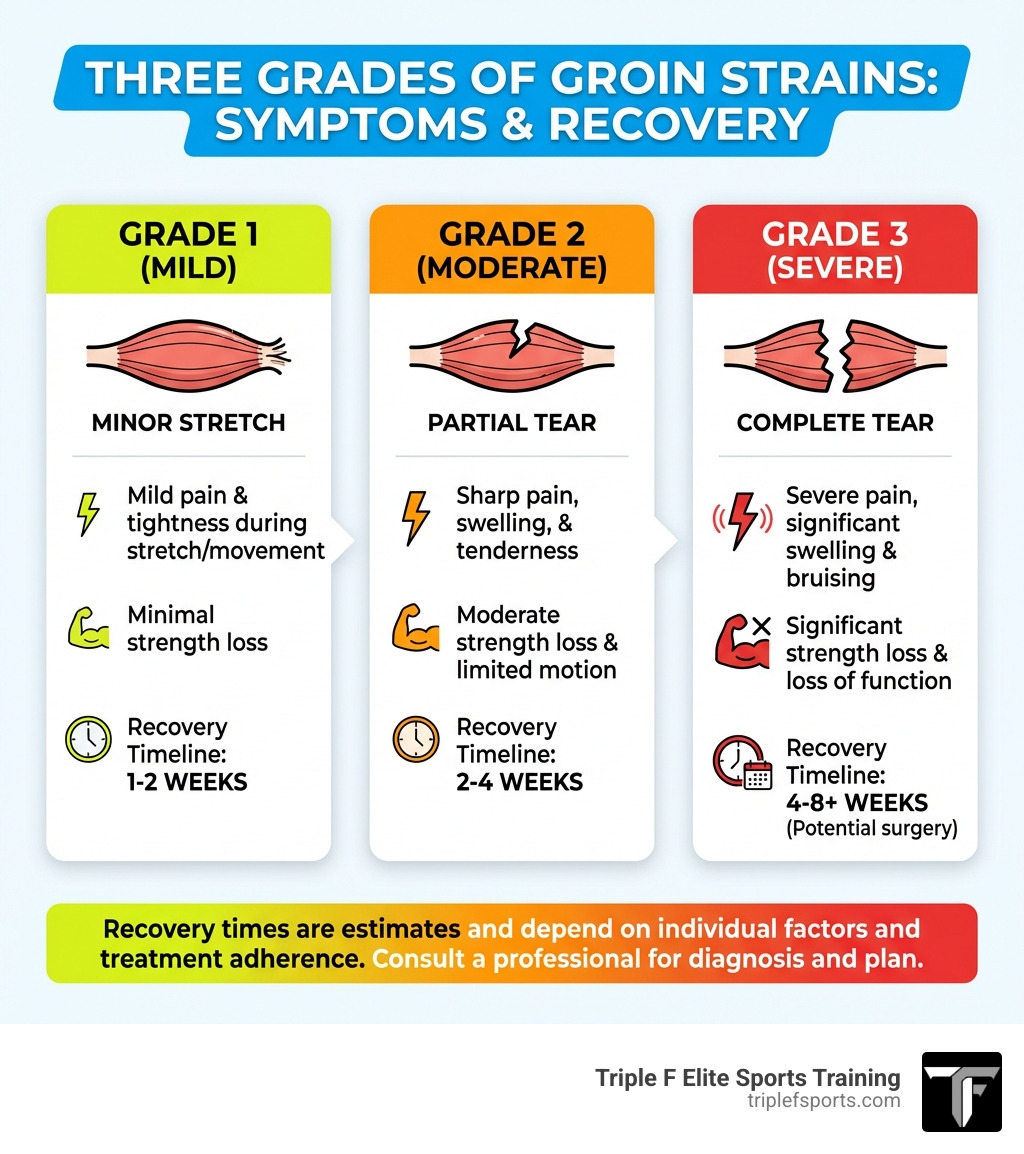
Recovery time for a groin pull depends on its severity, which is typically graded from 1 to 3:
- Grade 1 Strain (Mild): This involves a minor tear or overstretch of the muscle fibers. You might feel some mild pain and tenderness, but your strength and range of motion are mostly unaffected. Recovery typically takes 1 to 2 weeks of rest and gentle rehabilitation before you can gradually return to exercise.
- Grade 2 Strain (Moderate): This is a more significant tear, with noticeable pain, swelling, and some loss of strength and range of motion. You’ll likely have difficulty walking or performing daily activities. Recovery for a Grade 2 strain may take 3 to 6 weeks to heal fully, requiring a more structured physical therapy program.
- Grade 3 Strain (Severe): This is a complete rupture of the muscle. You’ll experience severe pain, significant swelling, bruising, and a substantial loss of function. You might even hear a “popping” sound at the time of injury. A Grade 3 strain can take 3 to 4 months to repair completely, often requiring extensive rehabilitation and sometimes even surgery.
Rushing back to sport before the muscle is fully healed significantly increases re-injury risk. Our physical therapists guide you through a safe, progressive return-to-sport protocol.
What is the best ratio for adductor to abductor strength?
Muscle balance is a critical aspect of groin pull prevention. Specifically, the balance between your adductor (inner thigh) and abductor (outer hip) muscles is key. These muscle groups work in opposition, and an imbalance can put undue stress on the adductors, making them more susceptible to injury.
Research suggests injuries are less likely when adductor muscles have at least 80 percent of the strength of the abductor muscles. If your outer hip (abductors) are much stronger than your inner thigh (adductors), this imbalance creates a vulnerability during movements like kicking or changing direction.
This is why our strengthening programs at Triple F Elite Sports Training always include exercises for both adductors and abductors (like Copenhagen Adduction and Clamshells) to ensure a balanced, resilient hip complex.
Can I do groin stretches every day?
Absolutely! Daily stretching of your groin muscles is not only safe but highly beneficial for groin pull prevention. Regular stretching can:
- Improve Flexibility: Increase the range of motion in your hip joint and lengthen your adductor muscles.
- Reduce Tightness: Alleviate chronic tension in your inner thighs, which can be a major risk factor for strains.
- Improve Muscle Balance: Contribute to overall muscle health and prevent imbalances.
However, there are a few important tips to follow:
- Always Warm Up: Perform 5-10 minutes of light cardio before you stretch to get blood flowing to your muscles. Never stretch cold muscles.
- Be Gentle and Slow: Move into each stretch slowly and only to the point of a comfortable tension, not pain.
- Avoid Bouncing: Bouncing can trigger the stretch reflex, causing your muscles to contract and increasing your risk of injury.
- Hold the Stretch: Hold each static stretch for 20-30 seconds to allow the muscle to lengthen effectively.
- Listen to Your Body: If you feel any sharp or intense pain, ease off the stretch immediately.
Making groin stretches a consistent part of your routine, whether daily or several times a week, will go a long way in keeping your adductors healthy and strong.
Conclusion: Commit to a Smarter Training Routine
Preventing a groin pull isn’t about luck; it’s about a consistent, smart, and proactive approach to your training. We’ve seen how devastating these injuries can be, but we’ve also seen how effective a well-rounded prevention strategy is.
To recap, the keys to groin pull prevention are:
- Dynamic Warm-ups: Always prepare your body for action.
- Targeted Strengthening: Build robust adductor and lateral hip strength.
- Consistent Stretching: Maintain flexibility and range of motion.
- Core Stability: Create a strong foundation for all movement.
- Muscle Balance: Ensure your adductors are strong enough to support your abductors.
- Adequate Rest and Recovery: Allow your body to repair and rebuild.
- Proper Lifting Techniques: Protect your body from unnecessary strain.
At Triple F Elite Sports Training in Knoxville, TN, we integrate these injury prevention principles into all our programs, from youth training to adult performance. Our professional, Christ-centered approach focuses on your holistic development—mind, body, and spirit. We empower athletes to achieve their full potential safely and sustainably.
Don’t wait for pain to dictate your journey. Take the next step in protecting your body and enhancing your performance. Learn more about our Sports Medicine approach and find how we can help you stay in the game, stronger and healthier than ever.