
What Is Football Specific Training (And Why It Changes Everything)
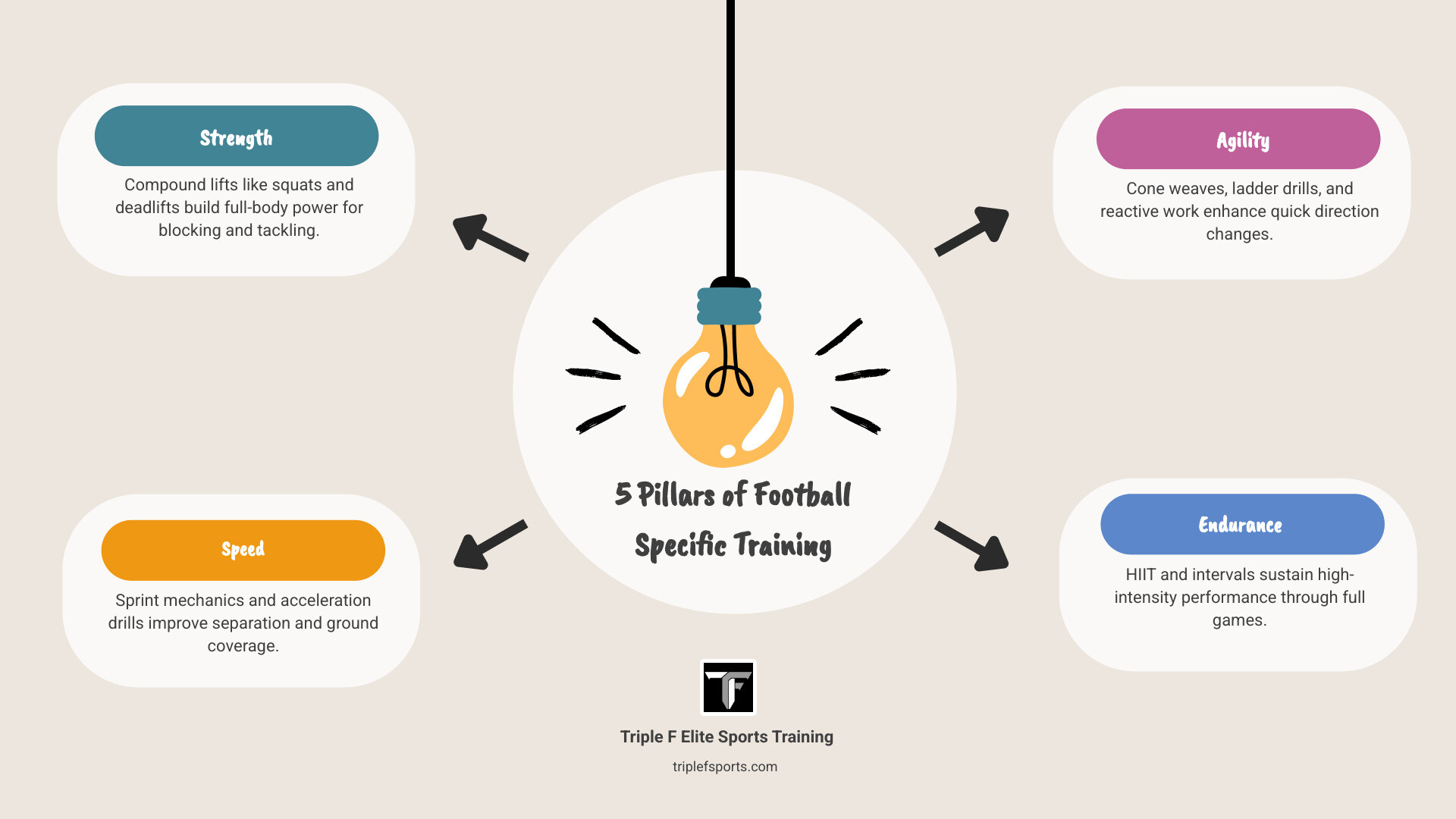
Football specific training is a targeted approach to athletic development that builds the exact physical qualities the game demands — explosive power, speed, agility, strength, and endurance — rather than relying on generic gym workouts.
Here’s a quick breakdown of what it involves:
- Strength – Compound lifts (squats, deadlifts, bench press) to build full-body power for blocking, tackling, and explosive movement
- Speed – Sprint mechanics and acceleration drills to gain separation and close ground faster
- Agility – Cone drills, ladder work, and reactive drills to change direction quickly and efficiently
- Endurance – HIIT and interval training to sustain high-intensity effort throughout a full game
- Position-specific work – Drills tailored to your exact role, because a lineman and a wide receiver have very different physical demands
Football isn’t just about being big or fast. It’s about being fast and strong in the right ways — and that’s exactly what a sport-specific approach delivers. Players who follow tailored programs have been shown to improve performance metrics like sprint speed and jump height within just 12 weeks.
I’m Kevin O’Shea, a Certified Strength and Conditioning Specialist and former college wide receiver who went on to coach at the high school level as a Wide Receiver Coach and Passing Game Coordinator — giving me a first-hand understanding of what football specific training truly requires at every level. That combination of playing, coaching, and conditioning experience shapes everything we do at Triple F Elite Sports Training.
Key Football specific training vocabulary:
- Bench press combine
- NFL pre draft training
Key Components of Football Specific Training
When we step onto the field in Knoxville, we aren’t just looking to “get a sweat in.” We are training for the specific, chaotic, and high-intensity environment of a four-quarter battle. Unlike marathon runners who need steady-state endurance, or bodybuilders who focus on muscle size, football players need a hybrid of several physical “gears.”
Research shows that footballers cover distances between 10 and 13 kilometres per game (depending on the code and position), but it’s the intensity of that distance that matters. Most football plays last no more than 20 seconds. This means our football specific training must prioritize repeated bursts of maximal effort.
| Component | Goal for Footballers | Key Focus |
|---|---|---|
| Strength | Force Production | Ability to move opponents and hold ground |
| Speed | Velocity | Covering 10–40 yards in the shortest time |
| Power | Explosiveness | Combining strength and speed for tackling/jumping |
| Agility | Change of Direction | Deceleration and rapid redirection |
| Endurance | Repeat Sprint Ability | Maintaining 100% effort in the 4th quarter |
Strength Foundation
Strength is the bedrock of everything we do. It underpins physical and technical actions like sprinting, holding off an opponent, and winning aerial duels. Without a solid strength base, your power and speed will always have a “ceiling.” We focus on building larger, more flexible muscles that allow for better force application to the ground. This isn’t just about looking good in the jersey; it’s about having the functional mass to absorb hits and deliver them.
Power Development
Power is the ability to exert maximum force in the shortest possible time. In football, power is what happens when a linebacker explodes through a gap or a receiver jumps to snag a high ball. We use plyometrics and Olympic lifting variations to bridge the gap between “gym strength” and “field power.”
Speed Mechanics
Speed in football is rarely about a 100-meter dash. It’s about the first five to ten steps. We focus on acceleration mechanics — how you lean, how your feet strike the ground, and how much force you apply. Applying more force to the ground during running is the fastest way to increase your top-end speed.
Agility and Change of Direction
Football is an unpredictable sport. You have to react to a ball carrier, a pass, or a block. True agility involves two phases: deceleration (slowing down without losing balance) and redirection (moving into a new path). We use reactive drills where players must respond to visual or audio cues, mimicking the split-second decisions made during a game.
Endurance and Conditioning
We don’t do “long, slow runs.” To mimic the demands of a match, we use HIIT (High-Intensity Interval Training) and interval sprints. If a play lasts 20 seconds, our conditioning should reflect that. This helps build “Repeat Sprint Ability,” ensuring you aren’t gassed after the first drive. You can find more on structuring these phases in this Football workout plan: Build strength, speed and agility.
Building Strength and Power
To dominate the line of scrimmage or break a tackle, we rely on compound movements. These exercises involve multiple joints and muscle groups working in unison, which is exactly how the body moves on the field.
- Squats: The king of lower body exercises. We use back squats and front squats to build the leg drive necessary for every position.
- Deadlifts: Essential for posterior chain strength (glutes, hamstrings, and lower back). This is where your “tackling power” comes from.
- Bench Press: While often overemphasized by amateurs, the bench press is vital for upper body “push” strength, which is critical for offensive and defensive linemen.
- Power Cleans: This is a staple in our football specific training. It teaches the body to move a heavy load from the floor to the shoulders as fast as possible, developing incredible explosive power.
For those specializing in the trenches, our Offensive Line Sports Training focuses specifically on the leverage and hand-fighting strength needed to move 300-pound opponents.
Speed and Agility Drills
Speed is a skill that can be taught. We break down sprint mechanics into manageable parts, focusing on arm pump, knee drive, and “triple extension” (the straightening of the ankle, knee, and hip).
Drills we recommend:
- Wall Drives: To practice the correct lean and knee drive for acceleration.
- Falling Sprints: To teach the body how to transition from a lean into a full sprint.
- Cone Weaves and Shuttle Runs: To practice low-center-of-gravity turns. Playing low involves bending at the hips and rotating at the ankles, which is essential for balance.
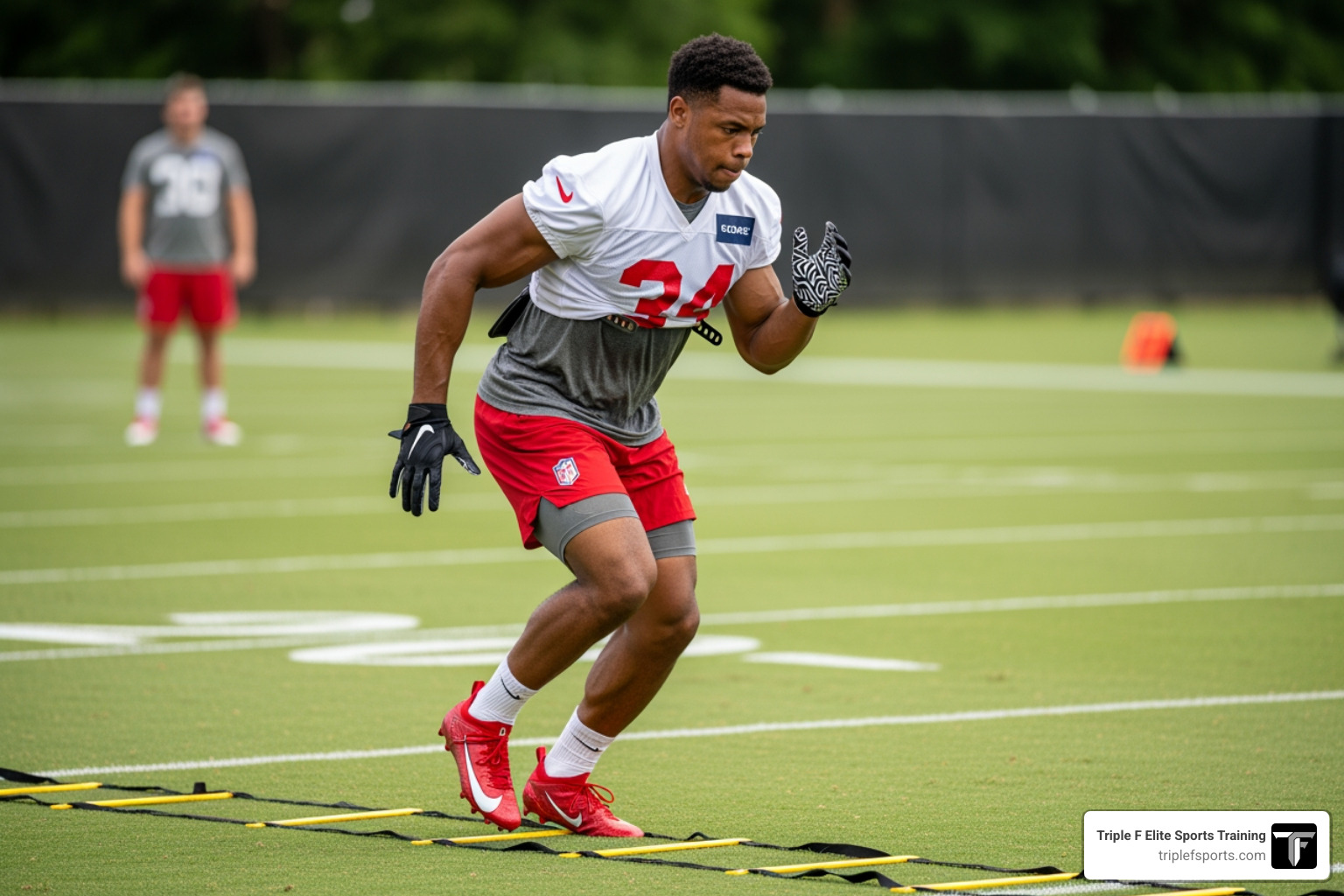
- Ladder Drills: Great for foot-eye coordination and “light” feet.
We often look to global standards for technical coordination, such as the Speed technical coordination – Part 4: Circuit 3 – FIFA Training Centre, which emphasizes high-volume speed training combined with technical movements.
Why Position-Specific Training Matters
A “one size fits all” approach is a disservice to football players. A 320-pound offensive tackle has vastly different physical requirements than a 180-pound cornerback. Personalized plans can improve match performance by up to 30%, according to recent sports science journals.
Role-Based Demands
Every role has distinct demands. If we ignore these nuances, we focus on size over function.
- Quarterbacks: Need incredible core torque for throwing and precise footwork to navigate a collapsing pocket.
- Linemen: Require “brute” power, leverage, and the ability to move laterally in short, explosive bursts.
- Wide Receivers: Must have “breakaway” speed and the ability to sink their hips instantly to break off a route.
- Running Backs: Need a mix of vision, balance, and the “bounce” to hit a hole and accelerate.
For a deep dive into how elite players handle this, check out our guide on Wide Receiver Training by Amari Rodgers.
Customizing Your Football Specific Training
At Triple F, we tailor the workouts to the specific stresses of your position.
- Core Torque: For QBs and rotators, we use medicine ball rotational throws to build the “whip” needed for deep passes.
- Sled Pushes: These are a favorite for linemen. Pushing a weighted sled for 10–15 yards perfectly replicates the drive-block movement.
- Reactive Agility: We use “Mirror Drills” where two players face each other; one moves randomly, and the other must react and follow. This builds the “read and react” skills needed for defensive backs and linebackers.
Learn more about these specialized movements through our Defensive Line Linebacker Sports Training.
Training for Skill Positions vs. The Trenches
The “Skill” guys (WRs, DBs, RBs) spend more time on sprint intervals and high-level plyometrics like depth jumps and bounding. These exercises improve the “elasticity” of the muscles, allowing them to spring off the ground.
The “Bigs” (OL, DL) focus more on lateral shuffles and hand-eye coordination drills. They need to be “heavy” but nimble. We often incorporate these different styles into our Knoxville Football Camp, where players can compete against their peers in position-specific challenges.
Conditioning, Mobility, and Injury Prevention
You can’t play if you’re on the sidelines. Football is one of the highest-risk sports for injury, with knee ligament sprains (ACL/MCL), ankle rolls, and hamstring pulls being the most common. A huge part of football specific training is “prehab” — training the body to handle the stresses of the game before they become injuries.
HIIT and Aerobic Capacity
To build the stamina needed for 60 minutes of football, we use interval sprints:
- Protocol: 6-10 sprints of 20-30 seconds each, with 40-60 seconds of rest.
- Goal: Replicate the “go-stop-go” nature of a drive.
Recovery and Mobility Exercises
Mobility is not the same as flexibility. Flexibility is how far a muscle can stretch; mobility is how much control you have over a joint’s range of motion.
- Hip Flexors: Footballers spend a lot of time in a “crouched” stance, which tightens the hips. We use dynamic lunges and “world’s greatest stretches” to open them up.
- Hamstring Health: We use “Nordic Curls” and “Razor Curls” to strengthen the hamstrings while they are lengthening, which is when most tears occur.
- Thoracic Spine: For QBs and receivers, a mobile upper back is key for reaching and throwing.
We also advocate for the use of foam rollers to manage “load” and soreness. Spending 45–60 seconds on the quads, calves, and lats after a session can significantly speed up recovery.
Sleep, Nutrition, and Hydration
Recovery happens long after you leave the gym.
- Sleep: We recommend 8–9 hours of sleep. This is when the body releases growth hormones to repair the muscle tissue we “broke down” during training.
- Nutrition: You need a mix of complex carbs for energy and high-quality protein for muscle repair.
- Hydration: Even a 2% drop in hydration can lead to a massive decrease in physical performance and cognitive function (making those “rapid tactical decisions” much harder).
For younger athletes starting out, we have specific resources like Youth Flag Football Drills Fun Effective Ways to Master the Game that introduce these concepts in a fun, manageable way.
Maximizing Results with Football Specific Training
To see real progress, you need a plan. 78% of footballers using tailored programs see significant improvements in sprint speed and jump height within just 12 weeks.
A Sample Weekly Structure:
- Day 1: Strength and Power (Upper Body Focus)
- Day 2: Speed and Agility Drills (Field Work)
- Day 3: Strength and Power (Lower Body Focus)
- Day 4: Conditioning and Endurance (HIIT/Sleds)
- Day 5: Mobility and Active Recovery (Yoga/Foam Rolling)
Consistency is the absolute key. We encourage our athletes to track their progress — every set, rep, and sprint time. If you aren’t measuring it, you aren’t managing it. For professional-level conditioning drills, we often reference the Physical and technical drill – Fitness & Conditioning Drills for Football & Soccer – Elite Soccer, which challenges players to maintain technical skills under extreme physical stress.
Frequently Asked Questions about Football Training
Why is strength training important for football?
Strength training is the foundation for full-body power. It isn’t just about moving weight; it’s about force application. Larger, stronger muscles allow you to apply more force to the ground (making you faster) and more force to an opponent (making you better at tackling and blocking). It also creates a “suit of armor” around your joints, significantly reducing the risk of injury during high-impact explosive movements.
How often should I train to see results?
For most athletes, a three-day minimum is required to see physical adaptations. A typical weekly structure includes alternating between heavy lifting days and skill-specific field days. Consistency over months, not weeks, is what creates elite performance. It is also vital to include recovery phases (deload weeks) where the intensity is lowered to allow the central nervous system to recover.
What are the best exercises for explosive power?
The “big three” for football power are:
- Power Cleans: For total body explosiveness.
- Box Jumps: To improve vertical leap and “landing” mechanics.
- Medicine Ball Throws: To build rotational power and core torque.
- Broad Jumps: To improve horizontal force (essential for that first-step explosion).
Conclusion
At Triple F Elite Sports Training in Knoxville, we believe in a “One Size Fits One” philosophy. Whether you are a youth player just starting your journey or an elite athlete preparing for the next level, our goal is to unlock your full potential through professional, science-based football specific training.
Our Christ-centered approach ensures that we are developing not just better athletes, but better people. We provide comprehensive performance training, physical therapy, and expert coaching to ensure you are explosive, resilient, and ready to dominate on Friday nights or Saturday afternoons.
If you’re ready to take your game beyond the basics, come see us in Knoxville for a free first session. Whether you’re looking for NFL Pre-Draft Training or just want to be the best version of yourself on the field, we have the tools and the expertise to get you there. Let’s get to work.