
Why Mental Skills Training Is the Missing Piece in Your Athletic Development
Example of mental skills training for athletes includes proven techniques that top performers use to gain a competitive edge. Here are the most effective mental skills you can start practicing today:
| Mental Skill | Example Practice | When to Use |
|---|---|---|
| Goal Setting | Write down one process goal (like “focus on follow-through”) before each practice | Daily training and competition prep |
| Visualization | Spend 5 minutes imagining yourself executing a perfect play, using all five senses | Before games and during recovery |
| Positive Self-Talk | Replace “I can’t do this” with “I’m ready for this challenge” | During tough moments in training or competition |
| Mindfulness & Breathing | Practice 4-count breathing (inhale 4, hold 4, exhale 4, hold 4) | Pre-game nerves and high-pressure situations |
| Concentration Drills | Focus on one external cue (like the ball or target) for 60 seconds without distraction | Improving game-time focus |
Most athletes spend countless hours training their bodies but neglect the mental game. Research shows that 40 to 90 percent of success in high-performance sports comes from mental factors, especially at elite levels. Yet very few athletes dedicate structured time to building psychological skills like focus, confidence, and emotional control.
The gap between good and great often isn’t physical ability—it’s mental toughness. When two athletes have similar strength, speed, and technical skill, the one with better mental skills will perform better under pressure, bounce back from setbacks faster, and stay motivated through challenges.
Mental skills training isn’t just for professional athletes or Olympians. Whether you’re a youth athlete learning the fundamentals or an adult competitor chasing personal records, developing your mental game is essential for reaching your full potential.
The good news? Mental skills are learned, not gifted. Just like you can train your body to get stronger and faster, you can train your mind to be more focused, confident, and resilient. It takes consistent practice, but the results are worth it.
As Lee Smith, an 11-year NFL veteran and founder of Triple F Elite Sports Training, I experienced how example of mental skills training for athletes transformed my performance—from handling pre-game nerves to staying focused through injuries and setbacks. Now I’m bringing that same professional-level mental training to athletes right here in Knoxville, helping them develop not just physical excellence but the complete mental toolkit they need to succeed.
The Foundation of Mental Toughness: Self-Awareness and Core Skills
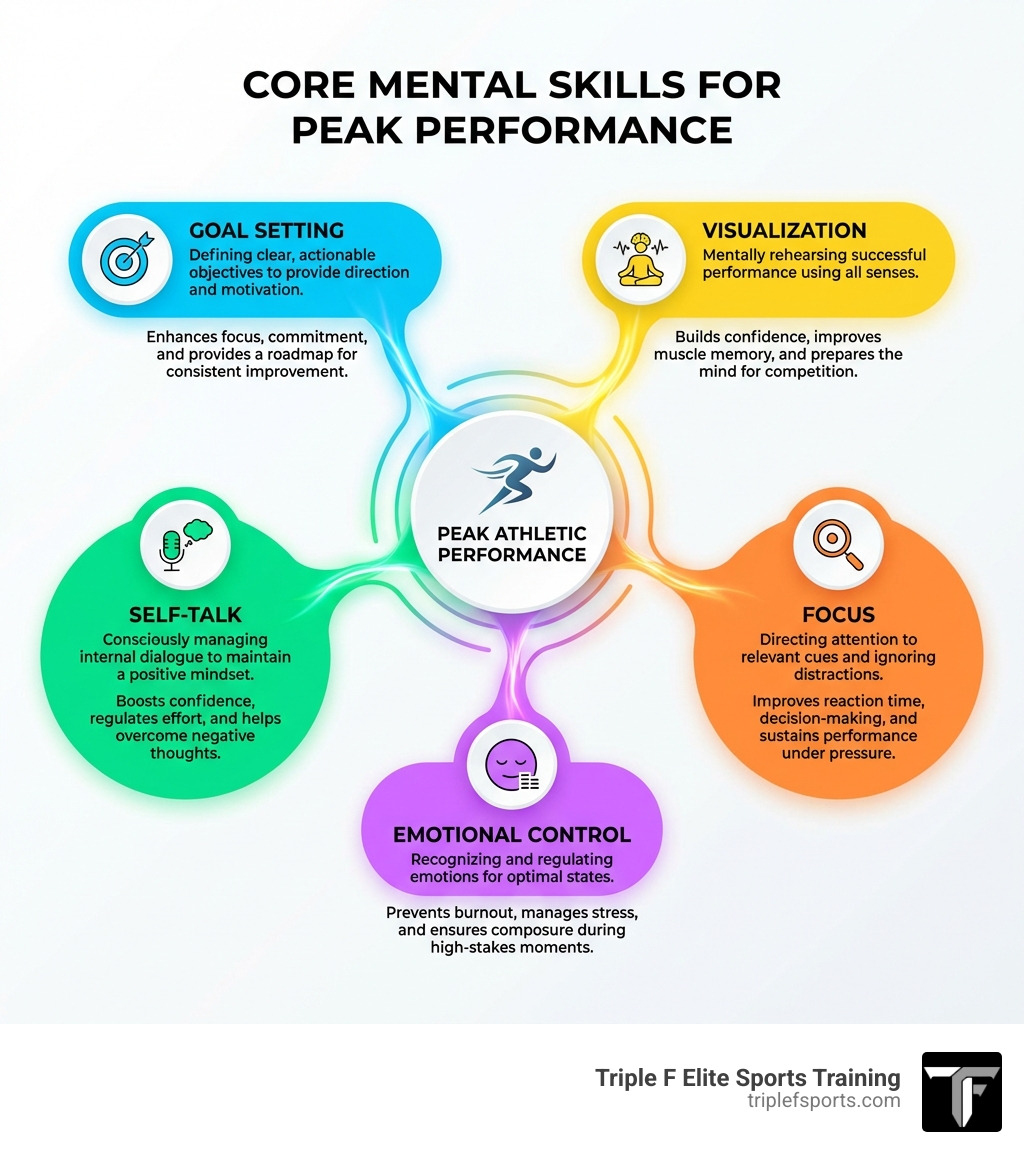
Just like a strong physical foundation is crucial for athletic performance, a robust mental foundation is key to open uping an athlete’s full potential. At Triple F Elite Sports Training, we’ve seen that the most successful athletes aren’t just physically gifted; they possess a deep understanding of their own psychology and cultivate specific mental skills to steer the demands of their sport.
These core mental skills, often highlighted by experts like Dr. Jack Lesyk, include:
- Attitude: Choosing and maintaining a positive outlook, even when facing adversity.
- Motivation: Sustaining a high level of intrinsic drive and commitment.
- Goals and Commitment: Setting clear, realistic goals and dedicating oneself to achieving them.
- People Skills: Effectively interacting with teammates, coaches, and opponents.
- Self-Talk: Managing internal dialogue to be constructive and supportive.
- Mental Imagery: Using visualization to rehearse performance and build confidence.
- Managing Anxiety: Effectively dealing with pre-performance jitters and pressure.
- Managing Emotions: Understanding and regulating feelings to maintain composure.
- Concentration: Maintaining focus and resisting distractions during performance.
These aren’t just concepts; they are learned behaviors that can be developed and refined through systematic training. For young athletes, integrating these skills early in their development, through stages like “Active Start” and “Train to Train,” lays a critical groundwork. It’s about teaching them that mental fitness is dynamic, constantly evolving, and just as important as physical prowess. We focus on education, self-awareness, implementation, and evaluation to ensure our athletes are building these foundational skills from the ground up, whether they’re in our Youth Training (12 to 18) programs or just starting out.
Understanding Your “Why”: Motivation and Commitment
Choosing a positive attitude isn’t always easy, but it is always a choice. We encourage our athletes to accept a growth mindset, viewing challenges not as roadblocks, but as opportunities to learn and improve. This mindset is fueled by intrinsic motivation—the internal desire to participate and excel because the sport itself is enjoyable and personally rewarding, rather than solely for external rewards like trophies or scholarships.
Research, including a 2018 review involving Cornell-affiliated researchers, confirms that goals driven by this autonomous motivation—those pursued for personal value or enjoyment—lead to greater effort and psychological well-being. This is particularly vital for developing young athletes, where fostering passion and a love for the game is paramount. We believe in helping athletes understand their “why,” connecting their daily efforts to their deeper values and long-term aspirations. This commitment to being the best they can be, within their limitations, is what truly defines success, regardless of the scoreboard. For more on developing this inner drive in younger athletes, explore our Future Pros Program.
The Power of Self-Awareness and Journaling
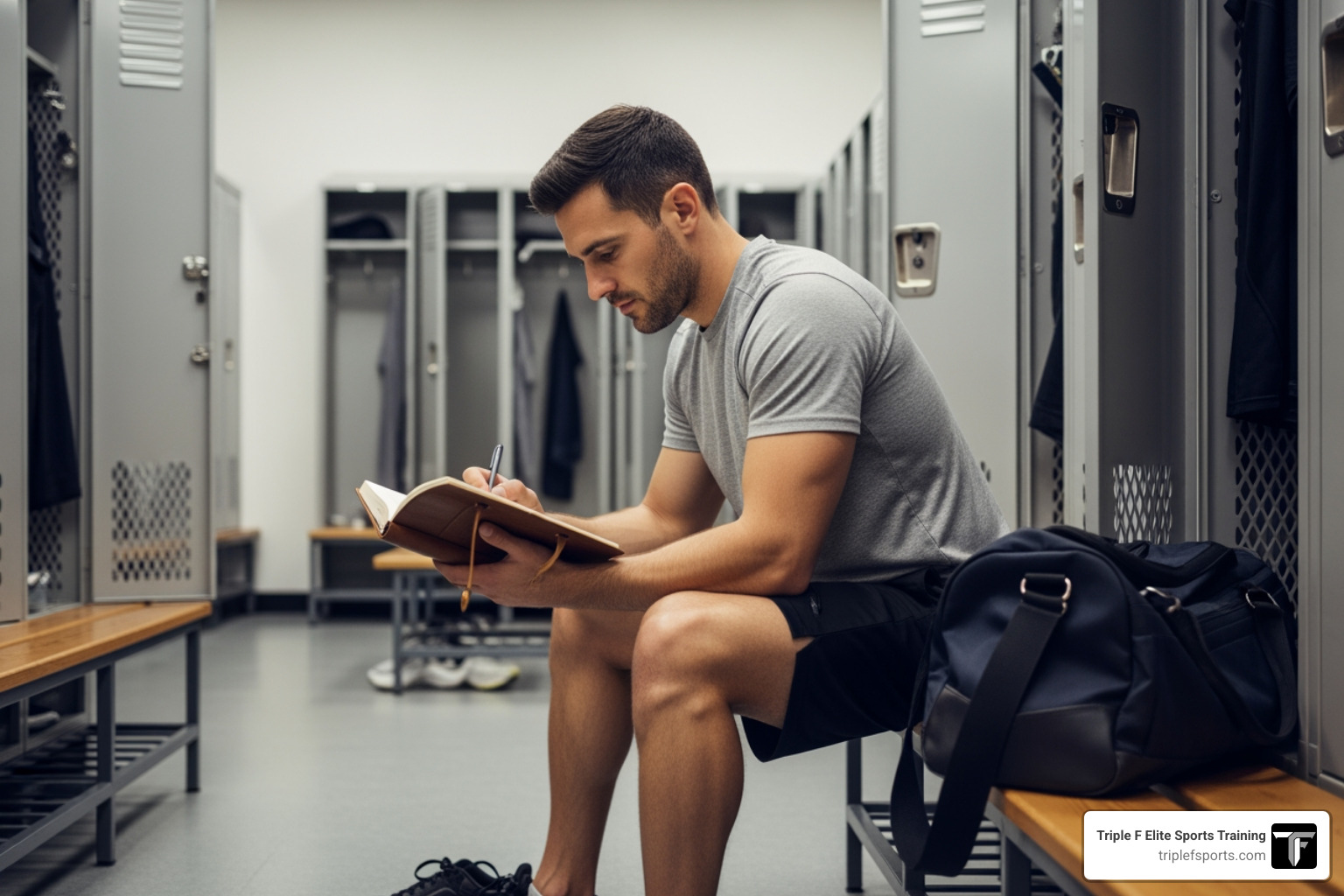
Self-awareness is the bedrock of all mental skills training. It’s about truly understanding your thoughts, emotions, and behaviors, especially under pressure. Think of it as your internal GPS, helping you steer the ups and downs of athletic life. Without knowing where you are mentally, it’s hard to plot a course to where you want to be.
One of the most effective tools for cultivating self-awareness is journaling. We encourage our athletes to keep a journal to:
- Track progress: Document training sessions, competition outcomes, and personal bests.
- Set reflective goals: Review past performances and experiences to inform future objectives.
- Identify patterns and triggers: Notice what thoughts or situations lead to anxiety, frustration, or peak performance.
- Connect physical and psychological states: Understand how sleep, nutrition, or stress impacts both your body and mind.
By regularly recording thoughts, emotions, training data, and competition outcomes, athletes can identify crucial patterns that affect their performance. This heightened self-awareness allows for precise adjustments to strategies, helping athletes learn from every experience. It’s a way to process experiences, build resilience, and continually refine the mental game, leading to a more robust and adaptable athlete.
Building Your Mental Toolkit: A Practical Example of Mental Skills Training for Athletes
Once we’ve established a foundation of self-awareness, we can start building specific mental skills. Psychological Skills Training (PST) is the systematic process of developing these “inner game” competencies. It’s not just about understanding them, but actively learning and practicing them, much like you would a physical skill. Let’s explore some practical examples of mental skills training that athletes can integrate into their routines.

A Step-by-Step Example of Mental Skills Training for Goal Setting
Goal setting is more than just dreaming big; it’s a strategic roadmap for success. When done effectively, it significantly improves motivation, increases confidence, improves focus, and boosts overall performance. We break down goals into three crucial types:
- Outcome Goals: These focus on the final result, often involving comparisons to others (e.g., “win the championship,” “get first place”). While motivating, they are often not entirely within an athlete’s control.
- Performance Goals: These are individual standards of success, focusing on personal bests or specific achievements (e.g., “set a personal record in the 100-meter dash,” “score 15 points in the game”). These are more controllable than outcome goals.
- Process Goals: These are the smaller, actionable steps and specific techniques an athlete must execute during performance (e.g., “master a new skill during practice,” “maintain proper form during the last mile of a race,” “focus on a consistent free throw routine”).
We emphasize process goals because they are the most controllable and provide the clearest path to achieving performance and outcome goals. A 2023 systematic review of goal-setting research confirms that focusing on the process is a highly effective method for behavioral change and performance improvement in sport.
To make goal setting effective, we use the SMART framework:
- Specific: Clearly define what you want to achieve.
- Measurable: How will you track progress and know when you’ve reached your goal?
- Adjustable/Attainable: Is the goal realistic, and can it be modified if circumstances change?
- Relevant: Does the goal align with your overall aspirations and values?
- Time-Referenced: Set a deadline for achieving the goal.
Example of Mental Skills Training: Setting Process Goals
Let’s say a basketball player wants to improve their free throw percentage (performance goal). A process goal might be: “Before every practice, I will visualize my free throw routine for 2 minutes, then take 20 free throws focusing on ‘high elbow, follow through’ each time, and track my makes.”
This simple example of mental skills training focuses on actionable steps, directly contributing to the larger performance goal. For our youth athletes, we integrate goal-setting into their development plans, often starting with assessments to help them identify areas for growth and set their own SMART goals. This builds ownership and intrinsic motivation. Learn more about how we assess athlete development, including mental aspects, through our Youth Assessments.
An Example of Mental Skills Training for Visualization and Rehearsal
Visualization, also known as mental imagery, is a powerful technique where athletes vividly imagine themselves executing skills perfectly, handling pressure, and achieving success. It’s not just daydreaming; it’s a deliberate and structured mental practice that activates the same neural pathways as actual physical performance. Think of it as practicing in your mind, without expending physical energy.
To make visualization effective, we encourage a multi-sensory experience:
- Sight: See yourself performing flawlessly, the environment, the scoreboard.
- Sound: Hear the crowd, the swish of the net, your coach’s encouragement.
- Feel: Experience the kinesthetic feeling of your muscles moving, the ball in your hand, the ground under your feet.
- Smell & Taste: Though less common, engaging these senses can deepen the experience (e.g., the smell of the gym, the taste of sweat).
Example of Mental Skills Training: Visualization Practice
A track and field athlete preparing for a sprint might spend 5-10 minutes in a quiet space, eyes closed, imagining:
- The start: Feeling the block, hearing the gun, exploding out with perfect form.
- The race: Maintaining speed, feeling strong, seeing themselves pull ahead.
- The finish: Crossing the line, the time on the clock, the feeling of accomplishment.
This comprehensive visualization technique has significant benefits. A 2020 study found that it can improve motor skills, increase muscle strength, boost self-confidence, and decrease anxiety. Elite athletes are particularly adept at this; a 2022 review confirmed that those competing at higher levels are more likely to employ these mental rehearsal techniques. Visualization can also be used to practice overcoming adversity, such as mentally rehearsing how to respond to a missed shot or a difficult opponent, building resilience even before the event occurs.
Mastering Your Inner Dialogue with Positive Self-Talk
The voice in your head can be your greatest ally or your worst enemy. Self-talk is that constant internal dialogue, and learning to manage it is a critical example of mental skills training. While research suggests that up to 80% of our daily thoughts can lean negative, we can consciously reframe this narrative.
We categorize self-talk into two effective types:
- Instructional Self-Talk: Specific, technical cues to guide performance (e.g., “high elbow, follow through” for a free throw; “explode” at the start of a race). This is particularly effective for fine motor skills.
- Motivational Self-Talk: Statements to increase effort, build confidence, and manage energy (e.g., “You’ve got this,” “Push through,” “Stay strong”). This is more beneficial for strength and endurance tasks.
A groundbreaking 2011 meta-analysis of 32 studies found that self-talk has a moderate positive effect on sports performance. The key is to make it conscious and constructive.
Example of Mental Skills Training: Self-Talk Techniques
- Thought Stopping: When a negative thought arises (“I’m going to mess this up”), mentally yell “STOP!” or use a cue word like “RESET!” then immediately replace it with a positive or instructional thought.
- Reframing: Change negative thoughts into positive or instructional ones. Instead of “I’m so tired, I can’t finish,” try “This is tough, but I’m strong enough to push through.”
- Personal Mantras: Short, powerful statements repeated to reinforce a positive mental state under pressure (e.g., a marathon runner repeating “strong and steady”).
By consciously directing our inner dialogue, athletes can anchor their focus, manage fatigue, and build confidence. It’s about training your mind to be your biggest cheerleader, not your harshest critic.
Mastering the Moment: Advanced Skills for Pressure and Performance
In the heat of competition, the ability to perform under pressure often separates good athletes from great ones. This requires advanced mental skills like unshakeable concentration, effective emotional regulation, and deep mindfulness. We know that pressure and stress are almost necessary components of performance, but they become detrimental when they overwhelm us. Our goal is to equip athletes with the tools to thrive in these high-stakes moments.
Sharpening Your Focus and Concentration
Concentration is the ability to direct and sustain attention on relevant cues while ignoring distractions. This isn’t a single skill but a dynamic process involving different styles of attentional focus, as described by psychologist Robert Nideffer:
- Broad-External Focus: Used for assessing a situation (e.g., a point guard scanning the entire court).
- Narrow-External Focus: Concentrating on one or two external cues (e.g., a golfer focusing solely on the ball before a putt). This is often superior for in-the-moment performance.
- Broad-Internal Focus: Analyzing and planning (e.g., a coach developing a game plan during a timeout).
- Narrow-Internal Focus: Mentally rehearsing or monitoring one’s own physical state (e.g., a diver mentally rehearsing their sequence).
Example of Mental Skills Training: Concentration Drills
- Focus Points/Flush Routines: Before a play or action, athletes can identify a stationary point on the field, take a deep breath, and mentally “flush” away distractions, then refocus on the task.
- Purposeful Breathing: Like LeBron James, who views his breath as the “power source for his concentration,” athletes can use techniques like Box Breathing (inhale for 4, hold for 4, exhale for 4, hold for 4) to reset focus and calm the nervous system.
- External Focus Advantage: We train athletes to focus on external cues (e.g., the target, the trajectory of the ball) rather than internal body movements. The Constrained Action Hypothesis suggests that focusing internally can disrupt automatic control processes, leading to inefficient performance.
By understanding and practicing these attentional shifts, athletes can resist distractions, regain focus when it’s lost, and play in the “here-and-now,” without dwelling on past mistakes or future outcomes.
Managing Anxiety and Emotions with Mindfulness
Mindfulness is the practice of being fully present and aware of the current moment, without judgment. For athletes, this translates to heightened awareness of their body, thoughts, and emotions during training and competition. Regular mindfulness and meditation practices offer profound benefits:
- Improved Concentration: Improves the ability to stay focused and non-reactive in high-pressure situations.
- Stress Reduction: Mindfulness aids in reducing stress hormone levels, which can accelerate physical recovery and improve overall well-being.
- Emotional Regulation: Instead of suppressing emotions, mindfulness teaches athletes to understand them and choose a constructive response. This “regulatory flexibility” is key to resilience. As we often say, it’s about responding, not reacting.
- Physical Recovery: Deep breathing, a core mindfulness practice, provides extra oxygen to the brain, helping to manage anxiety, pain, and strong emotions. Diaphragmatic breathing, in particular, can be a powerful tool for calming the body and mind. We often incorporate this into our recovery protocols, alongside Physical Therapy for a holistic approach.
Example of Mental Skills Training: Mindfulness for Anxiety Management
- Body Scan: During a break in play or a moment of rest, an athlete can quickly scan their body, noticing any tension and consciously relaxing those areas.
- Focused Breathing: Before a critical moment (e.g., a penalty kick, a serve), take a few slow, deep breaths, focusing purely on the sensation of air entering and leaving the body. This grounds the athlete in the present.
- Acceptance: Acknowledge nervous jitters as a normal part of competition. Instead of fighting them, accept them as energy that can be channeled into performance.
By developing these skills, athletes can achieve a sense of flow—that “in the zone” feeling where actions feel effortless and performance is at its peak.
Putting It All Together: Integrating Mental Skills into Your Daily Practice
The true power of mental skills training comes from consistent, daily practice. It’s not a one-time workshop or a magic pill; it’s a commitment to continuous growth, just like physical training. We believe in embedding mental drills directly into an athlete’s routine, making them as automatic as their physical warm-up.
Step 1: Assess Your Mental Strengths and Weaknesses
Before you can train your mind, you need to understand it. We guide athletes through self-assessments to identify their mental strengths and areas that need development. This might involve reflecting on:
- How do I typically react under pressure?
- What kind of self-talk do I engage in after a mistake?
- How well do I maintain focus during long practices or games?
From these insights, we help athletes prioritize one or two mental skills that will have the most significant impact on their performance. Trying to tackle everything at once can be overwhelming. Focusing on a specific skill, like improving self-talk or sharpening concentration, allows for targeted practice and noticeable progress. For those seeking more structured guidance, working with a coach or mentor can provide invaluable structure, accountability, and objective feedback.
Step 2: Embed Mental Drills into Physical Training
The most effective way to improve mental skills is to integrate them seamlessly into daily physical training. This makes the practice habitual and ensures that mental skills are sharpened in the very environment where they’ll be used.
Example of Mental Skills Training: Integration Strategies
- Mental Warm-ups: Before practice or competition, spend 5 minutes on visualization or focused breathing to get into a peak mental state.
- Self-Talk During Drills: While performing strength exercises, use motivational self-talk. During technical drills, use instructional cues (e.g., “hips forward” during a clean).
- Visualization During Rest Periods: Between sets or during recovery breaks, visualize perfect execution of the next movement or an upcoming play.
- Post-Training Reflection: After each session, take a few minutes to journal about what went well, what was challenging, and how mental skills were applied.
This consistent, integrated approach ensures that mental training isn’t a separate chore but an intrinsic part of an athlete’s overall development. We help our athletes in Knoxville build comprehensive training plans that include mental components, ensuring they are developing the whole athlete. This holistic approach is fundamental to all our programs, including Adult Training.
Conclusion: Your Journey to a Peak Performance Mindset
Developing a peak performance mindset is a journey, not a destination. The mental skills we’ve discussed—from self-awareness and goal setting to visualization, self-talk, concentration, and emotional regulation—are not innate gifts. They are learned, practiced, and refined over time, just like any physical skill. The consistent application of these example of mental skills training for athletes empowers individuals to steer challenges, bounce back from setbacks, and ultimately achieve sustained success in their chosen sport and in life.
At Triple F Elite Sports Training, we believe in developing the whole athlete—mind, body, and spirit. Our Christ-centered approach to athletic development, combined with comprehensive performance training, physical therapy, and even our volleyball club, is designed to open up your full potential. We’re here to help athletes in Knoxville build not just stronger bodies, but stronger, more resilient minds.
Ready to gain that competitive edge and master your mental game? Start your journey with our Skilled Based Training programs today, and let us help you build the mental and physical prowess you need to excel.