
Building Better Ballers: The Long-Term Athlete Development Model Football
The long-term athlete development model football is a comprehensive approach to training athletes. It’s a blueprint that guides football players from their first steps on the field to elite levels and beyond. This model focuses on building a strong foundation for lifelong success in the sport.
Here’s what the Long-Term Athlete Development (LTAD) model for football is about:
- A comprehensive framework: It’s a structured plan for athlete development.
- Age-appropriate training: It tailors training, competition, and recovery to a player’s developmental stage, not just their age.
- Holistic growth: It considers physical, mental, emotional, and cognitive development.
- Long-term focus: It prioritizes sustained participation and peak performance over short-term wins.
- Prevents pitfalls: It aims to reduce injuries, burnout, and early specialization.
Every parent wants what’s best for their child. For young football players, this means more than just winning games. It’s about building strong foundations. It’s about developing skills that last a lifetime. The long-term athlete development model football provides this roadmap. It’s a vital framework for ensuring every player reaches their full potential. This model shifts the focus from early specialization and immediate victories to a gradual, age-appropriate path. It aims for lasting health, enjoyment, and excellence in the sport. This approach is crucial for the future of football, especially for building a strong system like in Canadian football, which seeks to boost participation and international success.
I’m Kevin O’Shea, and my background as a Certified Strength and Conditioning Specialist and high school football coach has deeply immersed me in the principles of the long-term athlete development model football. This expertise drives my commitment to fostering holistic growth and peak performance in athletes. Together, we’ll explore the stages and factors that guide this journey.
What is the Long-Term Athlete Development Model Football?

At its core, the long-term athlete development model football is a physiological and pedagogical roadmap. It recognizes that becoming an elite athlete isn’t a sprint; it’s a marathon that requires patience, intentionality, and a lot of hard work.
Research suggests it takes a minimum of 10 years and roughly 10,000 hours of “deliberate practice” for a talented athlete to reach elite levels of performance. This isn’t just about spending time on the field; it’s about quality time spent on the right things at the right time. In our Knoxville facility, we see many parents who want to rush the process, but the LTAD model reminds us that skipping steps often leads to a lower ceiling of potential later on.
The Football Canada’s LTAD blueprint is one of the most respected versions of this model. It emphasizes system alignment—ensuring that coaches, parents, and organizations are all pulling in the same direction. It also embraces the concept of Kaizen, which is the Japanese philosophy of continuous improvement. In football, this means making small, incremental gains in technique and athleticism every day rather than looking for a “magic pill” or a single season of dominance.
To help athletes navigate this, we focus on Skilled Based Training that respects these developmental timelines, ensuring that a 10-year-old isn’t doing the same workout as a 20-year-old.
The 10 Key Factors of Athletic Excellence
To implement a successful long-term athlete development model football, we look at ten key factors that influence how a player grows:
- Physical Literacy: The foundation of all movement. If you can’t move well, you can’t play well.
- Specialization: Knowing when to focus on football and when to stay a multi-sport athlete (hint: later is usually better!).
- Developmental Age: Recognizing that two 12-year-olds can be vastly different in their physical maturity.
- Sensitive Periods: Identifying “windows of trainability” where the body is most responsive to certain types of training (like speed or stamina).
- Mental, Cognitive, and Emotional Development: Football is as much about the brain as the brawn.
- Periodization: Planning training cycles to avoid overtraining and ensure peak performance.
- Competition Calendar: Ensuring kids aren’t playing too many games and not training enough.
- Excellence Takes Time: Respecting the 10,000-hour rule.
- System Alignment: Connecting schools, clubs, and training facilities.
- Continuous Improvement (Kaizen): Always looking for marginal gains.
We also draw inspiration from The Youth Development Phase core principles, which emphasize creating a positive environment where players experiment and make mistakes without the fear of immediate benching.
Developmental vs. Chronological Age
One of the biggest mistakes in youth football is grouping kids strictly by their birth year. We call this “chronological age.” However, the long-term athlete development model football prioritizes “developmental age.”
Between the ages of 10 and 16, children of the same chronological age can be as much as three to five years apart in terms of biological maturation. You’ve likely seen this on the field: one kid has a full beard and is six feet tall, while his teammate hasn’t hit his growth spurt yet.
According to scientific research on maturation and injury risk, athletes going through their Peak Height Velocity (PHV)—their fastest period of growth—are at a much higher risk for overuse injuries and “adolescent awkwardness.” By tracking developmental age through skeletal age or growth rates, we can adjust training loads to protect them during these vulnerable windows.
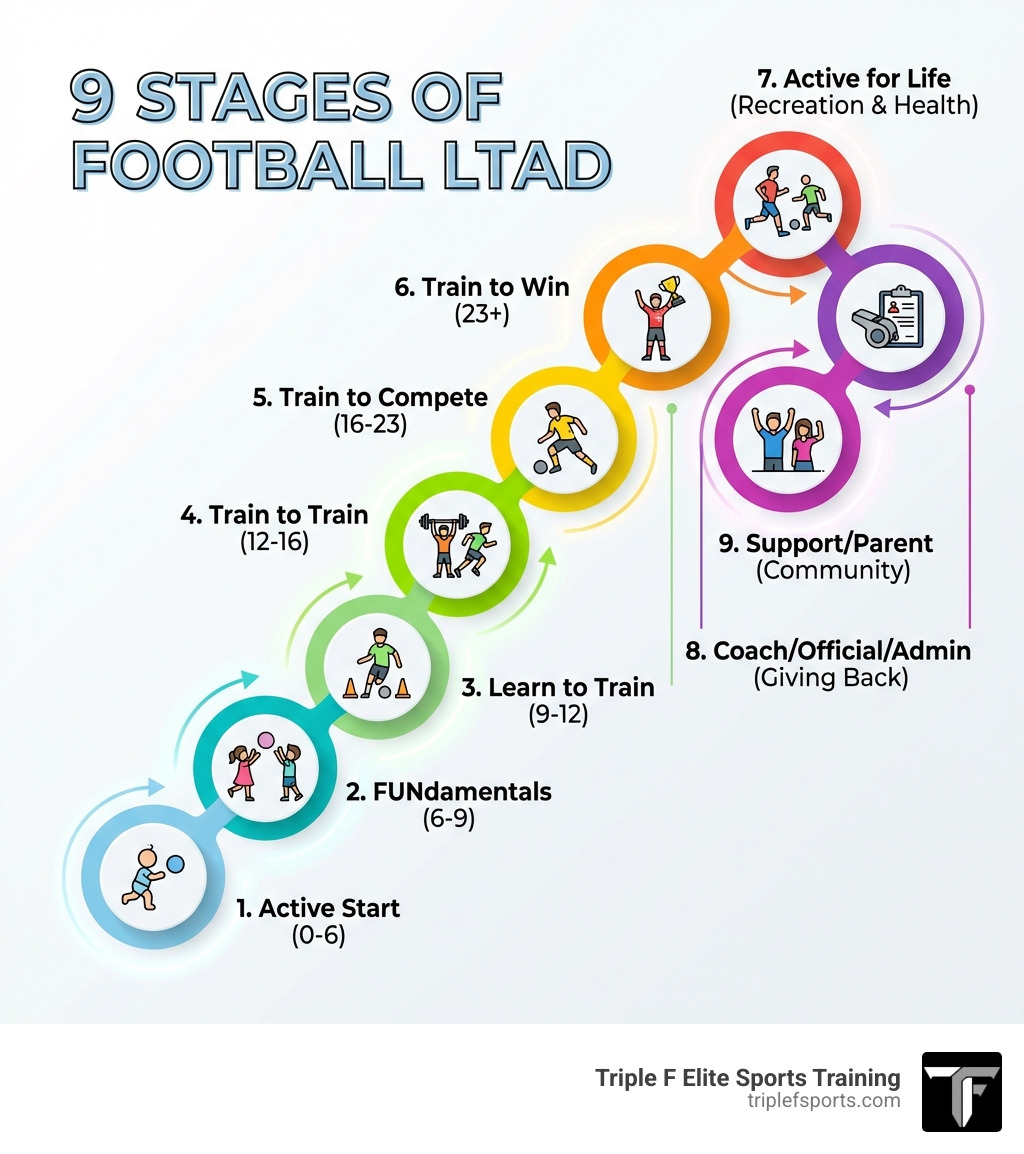
The Nine Stages of Football Development
Football Canada identifies nine distinct stages in their LTAD model. Each stage has specific goals and recommended training-to-competition ratios.
| Stage | Age (M/F) | Training vs. Competition Ratio | Main Focus |
|---|---|---|---|
| Active Start | 0-6 | 100% Play | Fun, movement, and exploration. |
| FUNdamentals | 6-9 | 100% Play/Practice | Basic movement skills (running, jumping). |
| Learn to Train | 9-12 | 70% Training / 30% Competition | Football skills and general athleticism. |
| Train to Train | 11-16 | 60% Training / 40% Competition | Building the engine (stamina and strength). |
| Learn to Compete | 15-18 | 40% Training / 60% Competition | Position-specific skills and tactics. |
| Train to Compete | 17-23 | 40% Training / 60% Competition | High-intensity, specialized performance. |
| Learn to Win | 18+ | 25% Training / 75% Competition | Maximizing performance for elite levels. |
| Train to Win | 19+ | 25% Training / 75% Competition | Maintaining peak performance. |
| Football for Life | Any | Varies | Staying active, coaching, or officiating. |
Developing Physical Literacy in the Long-Term Athlete Development Model Football
Physical literacy is the “alphabet” of athleticism. Just as you need to learn letters before writing a story, a football player needs to master fundamental movement skills before they can master a post route. This includes:
- Locomotor Skills: Running, jumping, skipping, and leaping.
- Object Control: Catching, throwing, and kicking.
- Stability: Balance and coordination.
For athletes in our Youth Training 12 to 18 programs, we emphasize these skills because they are the building blocks for speed and agility. Without a deep “movement vocabulary,” an athlete will eventually hit a plateau where their lack of coordination limits their football-specific talent.
From FUNdamentals to First Contact
The early stages (Active Start and FUNdamentals) should be all about fun. We want kids to fall in love with being active. At this age, multi-sport participation is key. Research shows that playing soccer, baseball, or basketball helps develop different muscle groups and coordination patterns that actually make you a better football player later on.
In football, we utilize modified games to make the sport age-appropriate. Instead of 11v11 tackle at age seven, the model suggests 6v6 tackle or, even better, 5v5 flag and touch football. This allows for more “touches” on the ball and more opportunities to practice skills without the heavy physical toll of full-contact tackle.
The Science of Success: The Five S’s and Sensitive Periods
Training isn’t just about working hard; it’s about working smart. The LTAD model identifies the “Five S’s” of training and performance:
- Stamina (Endurance)
- Strength
- Speed
- Skill
- Suppleness (Flexibility)
Each of these has a “sensitive period”—a window of time when the athlete’s body is most “plastic” and ready to improve in that specific area. For example, the optimal window for speed training in boys is between ages 7-9 and 13-16. If we miss these windows, it’s much harder to make up that ground later. This is why our Offensive Line Sports Training isn’t just about moving sleds; it’s about developing the specific “S’s” that match the player’s developmental age.
Optimizing Training Windows in the Long-Term Athlete Development Model Football
The timing of a growth spurt (Peak Height Velocity) is the “North Star” for training.
- Pre-PHV: Focus on speed (agility/quickness) and skill acquisition.
- During PHV: Prioritize flexibility (suppleness) and aerobic stamina. As bones grow faster than muscles, athletes can get tight and “clumsy.”
- Post-PHV: This is the golden window for strength. Once the hormonal system matures, we can safely introduce more significant resistance training.
Our Defensive Line Linebacker Sports Training utilizes these windows to ensure athletes are getting the right stimulus at the right time, maximizing their genetic potential.
Holistic Development: The Additional Five S’s
A truly great football player isn’t just a physical specimen. The full LTAD framework includes five more “S’s” for holistic growth:
- Structure/Stature: Monitoring growth to identify PHV.
- Schooling: Balancing academic demands with sports.
- Psychology: Building mental toughness and emotional resilience.
- Sustenance: Nutrition and recovery protocols to fuel the body.
- Socio-Cultural: Ensuring the athlete has a supportive environment at home and in the community.
Avoiding the Pitfalls of Early Specialization
One of the most dangerous trends in youth sports is early specialization—forcing a child to play only football year-round before the age of 14. While it might lead to a few more wins in middle school, it often leads to:
- Overuse Injuries: Repeating the same motions over and over before the body is mature.
- Burnout: Kids lose the “fire” for the game because it feels like a job.
- Early Retirement: Athletes quit the sport before they even reach their peak.
Football is a “late specialization” sport. Look at Wide Receiver Training by Amari Rodgers; elite players often have backgrounds in track, basketball, or baseball. These other sports provide “skill transfer”—the ability to take the footwork from the basketball court and apply it to a release at the line of scrimmage.
The Role of Stakeholders in LTAD Implementation
Successful implementation of the long-term athlete development model football requires a village:
- Parents: Your job is to encourage multi-sport play and resist the urge to push for “elite” status too early.
- Coaches: Must be certified and understand that winning a U10 trophy is less important than developing 20 kids who want to play again next year.
- Clubs/Associations: Need to align their competition schedules to allow for adequate training time.
The model also emphasizes inclusion. This includes addressing the unique physiological needs of female football players—who often hit their growth spurts earlier than boys—and creating pathways for athletes with disabilities through “First Contact” programs. Whether we are doing Offensive Line Training by Jon Feliciano or working with a first-time flag player, the goal is the same: athlete-centered development.
Frequently Asked Questions about Football LTAD
Why is early specialization discouraged in football?
Football is a complex, high-impact sport that requires a diverse range of athletic movements. Early specialization limits an athlete’s “movement vocabulary,” making them more prone to injury and burnout. By playing multiple sports, kids develop better overall athleticism, which makes them more “coachable” and versatile when they finally do specialize in their mid-teens.
What is the recommended training-to-competition ratio for youth?
For the “Learn to Train” stage (ages 9-12), the recommended ratio is 70% training to 30% competition. This means for every game played, there should be at least two to three high-quality practices. Too often, youth football is 90% games and 10% practice, which prevents players from actually learning the technical skills of the game.
How does the LTAD model address female football players?
The model recognizes that girls generally enter their growth spurts and windows of trainability earlier than boys (often by two years). This means that strength and stamina training can often start earlier for female athletes. It also advocates for inclusive environments where girls have the same access to high-quality coaching and modified game formats.
Conclusion
At Triple F Elite Sports Training in Knoxville, we believe that every athlete has a unique path to greatness. Our mission is to provide a professional, Christ-centered environment where we can apply the long-term athlete development model football to help your child thrive. Whether it’s through our comprehensive performance training, our specialized physical therapy, or our focus on the whole athlete, we are here to unlock their full potential.
We know that the journey from the backyard to the stadium is a long one, and we want to be there every step of the way. If you’re ready to see how a developmentally appropriate, science-based approach can change your athlete’s future, come join us. We are Building better ballers through skilled-based training and we want you to be a part of it.
Ready to get started? Claim your Youth Free Session today and let’s start building the foundation for a lifetime of success on and off the field!