
More Than Just Brute Force
An arm wrestling training program requires far more than raw muscle—it demands a strategic blend of specialized strength, explosive power, and sport-specific technique that most traditional gym routines simply don’t address.
Quick Overview: What Makes an Effective Arm Wrestling Training Program
- Training Frequency: 2-4 strength sessions per week plus dedicated table time
- Key Muscle Groups: Forearm flexors/extensors, brachialis, biceps, shoulders, upper back, and core
- Essential Exercises: Wrist curls, hammer curls, hook drills, plate pinches, farmer’s walks, and compound lifts
- Program Structure: 8-week cycles split into foundation building (weeks 1-4) and peak intensity (weeks 5-8)
- Critical Components: Sport-specific movements, progressive overload, adequate recovery, and injury prevention
You won’t beat a skilled arm wrestler by simply lifting heavy weights in the gym. As one training discussion puts it bluntly: “You’ll get smoked by someone who has trained with the table in mind.” The reality is that arm wrestling is a specialized strength sport where technique often trumps size, and grip strength—now recognized as a new “vital sign” in clinical screenings—plays a fundamental role.
Unlike bodybuilding, which chases muscle size for aesthetics, arm wrestling demands maximal strength in specific movements and angles. Your brachialis (the muscle below your biceps) matters more than your bicep peak. Your ability to cup your wrist and apply rotational force outweighs your bench press max. Research shows that arm wrestling requires a unique combination of grip strength, forearm and wrist stability, elbow flexor strength, and shoulder stability—a cocktail of attributes that general strength training alone won’t deliver.
The good news? With the right arm wrestling training program, you can develop these specialized attributes systematically. Whether you’re trying to beat your uncle at the next family barbecue or preparing for competitive matches, this guide will show you exactly how to build the functional strength, technique, and resilience that separates weekend warriors from serious competitors.
I’m Lee Smith, an 11-year NFL veteran who played 149 games as a blocking tight end, and I know that sport-specific training beats generic strength work every time. At Triple F Elite Sports Training, we’ve adapted the same professional-level principles I used throughout my NFL career to create targeted arm wrestling training programs that build real functional power for athletes of all levels.
The Anatomy of an Arm Wrestler: Key Muscles and Movements
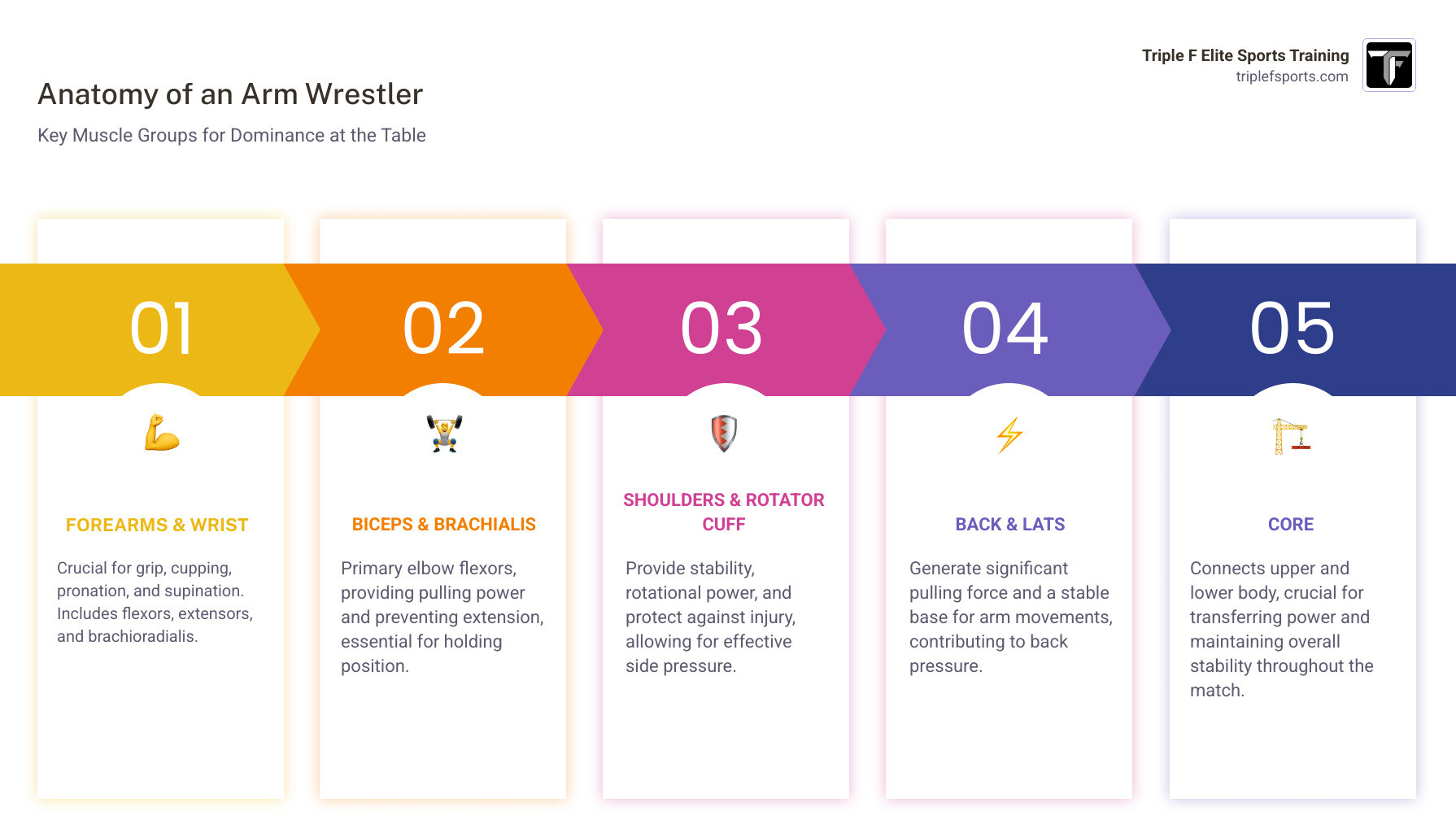
To excel in arm wrestling, we need to understand the battlefield: your body. It’s not just about a big bicep; it’s about a symphony of muscles working together in very specific ways. Arm wrestling requires a unique combination of grip strength, forearm and wrist stability, elbow flexor strength, and shoulder stability. This blend is what sets it apart from general strength training, making sport-specific training absolutely crucial. If we only focused on general hypertrophy, we’d be building a fancy car with a weak steering wheel!

Here are the primary muscle groups and movement patterns crucial for arm wrestling:
- Forearm Flexors and Extensors: These are your unsung heroes, often overlooked in general training. The flexors on the palm side control your “cupping” (bending your wrist inward) and grip strength, while the extensors on the back of your forearm prevent your wrist from being “pinned back.” Ignoring extensors is a common mistake, leading to imbalances and potential injury.
- Biceps and Brachialis: While the biceps get all the glory, the brachialis, located beneath it, is actually a more significant elbow flexor, especially in arm wrestling where you’re often pulling with a neutral or pronated grip. This “meaty” muscle is vital for pulling power.
- Brachioradialis: Running from your upper arm to your forearm, this muscle is critical for elbow flexion, particularly with a hammer grip or a top roll technique. It’s a powerhouse for generating torque and control.
- Shoulder and Rotator Cuff: Your shoulder is the fulcrum of power. Strong deltoids and a stable rotator cuff are essential for applying and defending force, as well as protecting this vulnerable joint from the high-torque movements of arm wrestling.
- Back and Lats: Your lats and upper back muscles (traps, rhomboids) stabilize your shoulder girdle and generate immense pulling strength, allowing you to “lean” into your opponent and transfer force effectively.
- Core Strength: Don’t underestimate the middle! A strong core provides balance, allows for efficient power transfer from your legs and torso to your arm, and helps resist your opponent’s side pressure. Without it, you’d be a noodle on the table.
- Lower Body Stability: We’ll dive deeper into this, but a strong lower body acts as your anchor. It provides the stability and body control needed to drive force from the ground up, resisting being pulled across the table.
Key Movement Patterns:
- Wrist Cupping/Flexion: The ability to bend your wrist inwards, maintaining a strong “cup” over your opponent’s hand.
- Pronation: Rotating your forearm so your palm faces downward. This is vital for the top roll technique, allowing you to turn your opponent’s hand.
- Supination: Rotating your forearm so your palm faces upward. Essential for the hook technique, where you try to rotate their hand outward.
- Side Pressure: Applying lateral force to push your opponent’s arm across the table.
- Back Pressure: Pulling your opponent’s hand and arm towards your body, often combined with other techniques.
To illustrate the difference, consider this: general hypertrophy training might focus on lifting heavy for overall muscle size, while an arm wrestling-specific approach prioritizes maximal strength in these unique angles and movements. Chasing size purely is far less valuable than sport-specific training for arm wrestling dominance. We’re not just building muscles; we’re building weapons custom for the table.
Designing Your Ultimate Arm Wrestling Training Program
Consistency is king, but smart programming is your queen. Most arm wrestlers benefit from strength training 2–4 times per week, with the exact frequency based on your experience level, recovery capacity, and how much “table time” (actual arm wrestling practice) you include. We need to balance stimulus with recovery, ensuring our bodies have enough time to adapt and grow stronger. Even as preseason momentum builds, we must anchor the week around recovery windows that let us absorb work and return sharper.
At Triple F Elite Sports Training, we emphasize a holistic approach, ensuring your arm wrestling training program is integrated with proper recovery and nutrition. More info about our Adult Training programs can provide further insights into how we structure our comprehensive athletic development.
Structuring Your Weekly Training Split
A well-structured weekly plan is vital. Here’s a sample framework, often utilizing a 4-day split, that integrates both gym work and table practice:
- 2-4 Gym Days Per Week: This allows for focused strength development while providing sufficient recovery. For example, a 4-day split might target different muscle groups or movement patterns on specific days.
- Integrating Table Practice: Ideally, 1-2 sessions of 20-30 minutes of actual arm wrestling practice (table time) should be included per week, separate from your heavy lifting days, or at least with sufficient recovery. This is where you hone your technique and leverage, directly applying your strength.
- Active Recovery: On non-lifting days, consider low-impact mobility work, stretching, or light cardio to aid recovery and maintain joint health.
- Listening to Your Body: This is paramount. Some discomfort is expected, but sharp, shooting pain is a red flag. Adjust your training, take extra rest days, or seek professional help if needed.
The Beginner’s Blueprint for an Arm Wrestling Training Program
For beginners, the goal isn’t to lift the heaviest weight, but to build a solid foundation of strength, master proper form, and understand the basic movements. We start with the fundamentals, just like we do with our younger athletes. More info about Youth Training 12 to 18 highlights our approach to building athletes from the ground up, focusing on mechanics before intensity.
Your beginner arm wrestling training program should:
- Focus on Building a Foundation: Prioritize general strength and muscle development across your entire body.
- Master Form Over Weight: Incorrect form leads to injury and ineffective training. Start light and perfect your technique.
- Simple Progression: Don’t overcomplicate it. Gradually increase reps, sets, or weight as you get stronger.
- Core Compound Lifts: Incorporate exercises like squats, deadlifts, and rows to build overall strength and stability.
- Basic Grip Exercises: Start with simple wrist curls, reverse wrist curls, and dead hangs to introduce your forearms to specific demands.
Advanced Periodization: An 8-Week Strength Cycle
For intermediate to advanced arm wrestlers, periodization is key to continued progress and preventing plateaus. This involves structuring your training into phases with varying intensity and volume. A common and effective approach is an 8-week cycle, often split into two 4-week phases.
-
Phase 1 (Weeks 1-4): Foundational Strength
- This phase focuses on building a base of strength and muscle with moderate loads and reps. Think of it as laying the groundwork for the intensity to come.
- We aim for an RPE (Rate of Perceived Exertion) of 7-8, which means you should have about 2-3 reps left “in the tank” at the end of each set. RPE is a scale from 1 to 10 that helps you gauge how hard you’re working, with 1 being “on the couch” and 10 being “I might actually die.” You can learn more about RPE here.
- The focus is on accumulating quality volume and perfecting movement patterns.
-
Phase 2 (Weeks 5-8): Peak Intensity
- This phase increases intensity with heavier weights and more intense arm-wrestling drills. We’re now pushing closer to our limits.
- We’ll target an RPE of 8-9, meaning you should have only 1-2 reps left in reserve.
- Total volume might slightly decrease, allowing for greater recovery from the heavier loads.
- Progression typically involves increasing weights by about 5-10% on major lifts from Phase 1.
This systematic approach ensures that we’re constantly challenging the body in new ways, promoting adaptation, and building towards peak performance.
The Essential Exercise Arsenal for Arm Wrestling Dominance
To truly dominate at the arm wrestling table, we need a diverse arsenal of exercises that target every crucial muscle group and movement pattern. This isn’t just about lifting heavy; it’s about training your forearms, wrists, elbows, and shoulders for optimal performance and injury prevention, while also improving your technique and leverage.

Foundational Strength Lifts
While arm wrestling is highly specialized, a strong general strength base is indispensable. These foundational lifts build overall power, stability, and muscle mass that supports your sport-specific movements. They also ensure we’re not just strong in one area but balanced throughout our bodies.
- Squats & Deadlifts: These are the kings of lower body and posterior chain strength. We often get asked, “What role does lower body strength play in arm wrestling?” The answer is huge! A strong lower body provides better stability, balance, and body control. It’s your anchor, allowing you to transfer force from the ground up and resist being “ragdolled” across the table. Deadlifts, especially when using a hook grip, also build incredible finger and thumb strength.
- Dumbbell Rows & Pull-ups/Lat Pulldowns: These exercises build a powerful back, essential for generating pulling force and stabilizing your shoulder.
- Bench Press & Overhead Press: While less direct, these build chest, shoulder, and tricep strength, contributing to overall upper body power and shoulder stability, which is crucial for resisting side pressure and preventing injury.
These lifts provide the raw horsepower. But remember, general hypertrophy training focuses on overall muscle growth, whereas for arm wrestling, we’re building sport-specific strength—power that translates directly to the table, not just bigger muscles.
Sport-Specific Arm, Wrist, and Hand Exercises
This is where we get specific. These exercises directly mimic the movements and stress of arm wrestling, building the specialized strength and endurance you need. They are key for improving technique and leverage in addition to building raw strength.
- Wrist Curls (Palms-Up) & Riser Curl: These target your forearm flexors, crucial for “cupping” your opponent’s hand and maintaining wrist control. The riser curl specifically develops the upward pressure through the hand and wrist, keeping your knuckles and thumb high.
- Reverse Wrist Curls & Reverse Barbell Curl: These strengthen your forearm extensors, balancing out the flexors and protecting your elbow and wrist joints from overuse injuries.
- Hammer Curls: Targeting the brachialis and brachioradialis, hammer curls build the thick, dense muscle often associated with arm wrestling power, especially for the top roll.
- Forearm Pronation: This exercise strengthens the pronator muscles of the forearm, vital for a strong top roll. It helps you generate torque and control your opponent’s wrist by rolling their hand outward.
- Forearm Supination: This strengthens the supinator muscle, which rotates your forearm so your palm faces upward. Essential for locking in a powerful hook.
- Hook Drills: These are gold! You can practice hook drills against a resistance band or a cable pulley to simulate the pressure and angles of a real match. It’s one of the most important tools in your arm wrestling exercise arsenal for improving grip strength and getting better at wrist control in a way that directly translates to the table.
- Plate Pinches: An excellent way to build crushing grip strength and finger endurance.
- Farmer’s Walks: These build incredible grip endurance, forearm strength, and core stability, all while carrying heavy weights over distance.
- Ulnar Deviation & Radial Deviation: These exercises strengthen your wrist in its lateral movements. Ulnar deviation targets muscles responsible for pulling the wrist towards the pinky side, while radial deviation focuses on pulling it towards the thumb side. Both are crucial for wrist stability and control during intense arm wrestling exchanges.
The Role of Specialized Equipment
While dumbbells and barbells are great, specialized equipment can take your arm wrestling training program to the next level, targeting specific strengths that conventional tools might miss.
- Wrist Rollers: A wrist roller is a tool consisting of a rod with a rope and weight attached. By rolling the rod to lift the weight, you engage your forearms, wrists, and grip strength. Using a wrist roller improves grip strength, improves forearm endurance, and increases wrist stability. It’s like a focused workout for your Popeye forearms!
- Thick Grips: Adding thick grips to barbells, dumbbells, or pull-up bars increases the diameter of the implement, forcing your hands and forearms to work harder. This builds crushing grip strength that directly translates to holding onto your opponent.
- Hand Grippers: Simple but effective, hand grippers are excellent for developing crushing grip strength and endurance. They are probably one of the best at-home forearm workouts to develop massive forearms.
These specialized tools allow us to apply pressure and resistance in ways that perfectly mimic the demands of the arm wrestling table, building specific strength that traditional dumbbells often can’t replicate.
Fortifying Your Body: Injury Prevention, Nutrition, and Recovery
We want you strong, not sidelined. In arm wrestling, tendons and ligaments are under immense stress. They can grow stronger, similar to muscles, but they need proper care. Injury prevention, nutrition, and recovery are not optional; they are essential pillars of a successful arm wrestling training program.
Pre-Workout Warm-Ups and Post-Workout Cool-Downs
Think of your body as a high-performance engine; it needs to be warmed up before it can redline and cooled down to prevent damage.
- Pre-Workout Warm-Ups: Dedicate 5-10 minutes to gentle dynamic stretching and joint rotations. Focus on wrists (circles in both directions, flexion, extension), elbows, and shoulders. Light cardio, like a few minutes on a bike, will increase blood flow. This prepares your tendons and ligaments for the stress to come, significantly reducing injury risk.
- Post-Workout Cool-Downs: After your session, perform gentle static stretches for your forearms, biceps, and shoulders. Hold each stretch for 30 seconds, repeating 2-3 times. This helps improve flexibility, reduce stiffness, and aid recovery.
Fueling for Power: Arm Wrestling Nutrition
You can train like a beast, but if you eat like a bird, you’ll never reach your full potential. Nutrition and recovery are paramount for arm wrestlers.
- Macronutrient Needs: Ensure a balanced intake of protein, carbohydrates, and healthy fats.
- High Protein Intake: Aim for approximately 1 gram of protein per pound of body weight (or 2.2g/kg) daily to support muscle repair and growth.
- Hydration Importance: Stay well-hydrated throughout the day. Dehydration can impair performance and recovery.
- The Role of Sleep: This is your body’s ultimate recovery tool. Aim for 7-9 hours of quality sleep per night. It’s when your muscles repair, hormones rebalance, and your central nervous system recovers.
- Scientific Research on Collagen Supplementation for Tendon Health: Consider taking 15g of gelatin/collagen with vitamin C 30-60 minutes before training. Research suggests that Vitamin C–enriched gelatin supplementation before intermittent activity augments collagen synthesis, which can be crucial for strengthening tendons and ligaments that are heavily stressed in arm wrestling.
At Triple F Elite Sports Training in Knoxville, we understand that nutrition is the fuel for performance. That’s why we offer specialized guidance to help you optimize your diet. More info about our Nutrition services can provide you with the strategies to fuel your body for power and recovery.
Common Mistakes in an Arm Wrestling Training Program
Even with the best intentions, we can fall into common traps. Avoiding these pitfalls is as important as knowing what to do.
- Overtraining: More isn’t always better. Training forearms every day is not smart; they need recovery time to grow bigger and stronger. Stick to 2-4 times per week to avoid overuse injuries.
- Ignoring Extensor Muscles: Focusing solely on wrist flexion (cupping) without training wrist extension can lead to muscle imbalances, increasing your risk of conditions like “arm wrestler’s elbow.” Always balance flexor work with extensor exercises.
- Ego Lifting with Poor Form: Using too much weight too soon, especially in specialized wrist and forearm exercises, can lead to poor form and injury. Leave your ego at the door and prioritize controlled, deliberate movements.
- Neglecting Recovery: Skipping sleep, under-eating protein, or ignoring rest days will severely hinder your progress and increase injury risk. Recovery is a primary training variable, not an afterthought.
- What to Do for Wrist or Elbow Pain: Some discomfort is normal as your body adapts, but sharp, shooting pain is a warning sign. If you experience persistent pain, stop the exercise, listen to your body, and don’t force painful ranges. Adjust your training, deload, or seek professional advice.
We offer comprehensive support for athletes in Knoxville, including expert guidance for injury prevention and rehabilitation. More info about our Physical Therapy services can help you address any issues and keep you training safely and effectively.
Conclusion: From the Gym to the Top of the Table
Developing a championship-level arm wrestling training program is a journey of specificity, consistency, and intelligent recovery. It’s about building a body that is not just strong, but uniquely adapted to the demands of the sport. We’ve covered everything from the intricate anatomy of an arm wrestler to structuring your weekly training, selecting the right exercises, leveraging specialized equipment, and fortifying your body with proper nutrition and recovery.
Technique is the number one factor for winning an arm wrestling match, but when you meet an equally skilled opponent, strength can give you the upper hand. The journey from a novice to a formidable competitor involves dedication, smart training choices, and an unwavering commitment to your goals.
At Triple F Elite Sports Training in Knoxville, we believe in building athletes from the ground up, with a focus on functional strength and long-term performance. Our Christ-centered approach ensures that we nurture not just the body, but also the mind and spirit, equipping you with the resilience and discipline needed to excel.
Take your strength to the next level with our Skilled Based Training. Whether you’re aiming for local bragging rights or competitive glory, we’re here to help you grip it, rip it, and conquer the table.