

What Professional Sports Coaching Really Means (And Why It Matters for Your Game)
Professional sports coaching is the structured process of guiding athletes to reach their full potential — combining physical training, mental development, and evidence-based learning strategies under the direction of a qualified coach.
Here’s a quick breakdown of what it involves:
- Role: A professional sports coach directs, instructs, and trains athletes to improve performance across physical, mental, and tactical dimensions
- Core knowledge areas: Professional expertise, interpersonal communication, and intrapersonal self-awareness
- Key athlete outcomes: Competence, confidence, connection, and character (the “4 C’s”)
- What separates pro coaching: Evidence-based practices, brain science literacy, and ongoing professional development — not just playing experience
Whether you’re a youth athlete just getting started or an adult competitor chasing a personal best, the quality of your coaching makes a measurable difference. Research shows that 96% of coaches believe scientific knowledge about the brain is valuable to their work — yet major gaps still exist between what coaches think works and what the evidence actually supports.
That gap is exactly what this guide is here to close.
I’m Kevin O’Shea, a Certified Strength and Conditioning Specialist and Wide Receiver Coach whose background spans athletic development, behavioral health, and hands-on experience in professional sports coaching at the high school level. I’m bringing that same evidence-based, athlete-first approach to athletes right here in Knoxville through Triple F Elite Sports Training.
Defining the Role and Evolution of Professional Sports Coaching
To understand the modern “pro” standard, we have to look at where the term came from. Interestingly, the word “coach” didn’t start on a sideline; it began in the 1500s in the Hungarian village of Kocs, where high-quality horse-drawn carriages were made. By the 1800s, students at Oxford University began using the term as slang for private tutors who “carried” them through their exams.
The origin of the word Coach eventually shifted from the classroom to the rowing sculls and cricket pitches of England. This historical evolution moved coaching from a hobby for amateurs into a rigorous, professionalized discipline. In the modern era, this professionalization is characterized by a shift from “intuition-based” coaching to “evidence-based” practice, where every drill and every rest period is backed by physiological data and psychological research.
Today, a professional sports coach is much more than someone who blows a whistle. We view the coach as an “orchestrator.” In complex sports systems, the coach must manage a massive web of variables: individual player temperaments, physiological data, tactical schemes, and even the social dynamics of the locker room. In the context of Knoxville’s competitive sports scene, this means coaches must be adept at interpreting biomechanical feedback while simultaneously navigating the psychological pressures of high-stakes recruitment.
The modern role is defined by the consistent application of integrated professional, interpersonal, and intrapersonal knowledge. This professionalization means that “having played the game” is no longer enough. True expertise requires a deep understanding of pedagogy (the science of teaching) and a commitment to evidence-based standards that protect and progress the athlete. The orchestrator doesn’t just call plays; they harmonize the various elements of an athlete’s life—from nutrition and recovery to academic balance and mental resilience—to create a sustainable path toward excellence.
Debunking Neuromyths and Leveraging Brain Science
One of the most fascinating—and slightly concerning—areas of professional sports coaching today is the intersection of the brain and the ball. While 96% of coaches find scientific knowledge about the brain valuable, many are still falling for “neuromyths.” These are popular but scientifically inaccurate beliefs about how the brain works.
The Learning Styles Trap
The biggest culprit? The “Learning Styles” myth. This is the idea that some people are “visual learners” while others are “auditory” or “kinesthetic,” and that they learn best when taught in that specific style.
- The Reality: Research shows that individuals do not actually learn better when information is tailored to a “preferred” style.
- The Prevalence: Despite being debunked, a staggering 83% of sports coaches currently use or have used coaching tailored to learning styles.
- The Gap: Only 12% of PK-12 coaches and a tiny 2% of higher education coaches correctly identified this as a myth.
Learning styles myth awareness varies significantly, but the desire to learn is universal. This myth persists because it feels intuitive, but by pigeonholing an athlete into one “style,” a coach may actually limit their ability to process information in multi-modal ways. At Triple F, we utilize “dual coding”—combining verbal instructions with visual demonstrations—to reinforce neural pathways more effectively than any single-style approach ever could.
Core Pillars of Professional Sports Coaching Expertise
What makes a coach an “expert”? It isn’t just a win-loss record. According to expertise research, professional coaching effectiveness is built on three pillars:
- Professional Knowledge: This is the “what” of coaching. It includes sport-specific tactics, exercise physiology, and biomechanics. It’s the descriptive and procedural knowledge needed to run a practice.
- Interpersonal Skills: This is the “how.” It involves the coach-athlete partnership, communication strategies, and the ability to build trust. A coach can have all the tactical knowledge in the world, but if they can’t connect with the athlete, that knowledge stays on the clipboard.
- Intrapersonal Reflection: This is the “why.” It’s the coach’s ability to look inward, acknowledge biases, and engage in reflective practice. Expert coaches are lifelong learners who constantly evaluate their own philosophy and impact.
Evidence-Based Strategies in Professional Sports Coaching
When we step onto the field in Knoxville, we aren’t just guessing. We use strategies that are proven to work. Instead of chasing myths, we focus on what the brain actually responds to: cognitive load management, retrieval practice, and neuroplasticity. Cognitive load management involves breaking down complex skills into manageable “chunks” to prevent mental fatigue, while retrieval practice forces the brain to actively reconstruct knowledge, making it more durable during the stress of competition.
Here are the heavy hitters currently used by top-tier professionals:
- Growth Mindset (78% usage): Teaching athletes that their abilities can be developed through dedication and hard work.
- Active Learning and Modeling (74% usage): Moving away from long lectures and instead using demonstrations and athlete-led problem solving.
- Experiential Learning (73% usage): Learning by doing, then reflecting on the experience.
- Mindfulness (70% usage): Using breathing and focus techniques to manage the high-pressure environment of competitive sports.
The Impact of Coaching on Athlete Development
The goal of professional sports coaching is to produce specific outcomes in the athlete. We don’t just want a faster 40-yard dash; we want a better human being. We measure this through the “4 C’s”:
- Competence: Technical and tactical skill. This goes beyond just knowing how to throw a ball; it involves the technical mastery of movement patterns that prevent injury and maximize efficiency.
- Confidence: A positive sense of self-worth and belief in one’s ability. This is built through incremental successes, fostered by a coach who knows when to push and when to support.
- Connection: Healthy bonds with teammates and coaches. This refers to the vital social support network within a team, which research shows is a primary driver of long-term athletic retention.
- Character: Respect, integrity, and responsibility. We believe that sports are a laboratory for life, and the character traits developed on the field—such as perseverance through adversity and ethical leadership—are the most valuable “stats” an athlete can carry into adulthood.
The Phases of Coaching
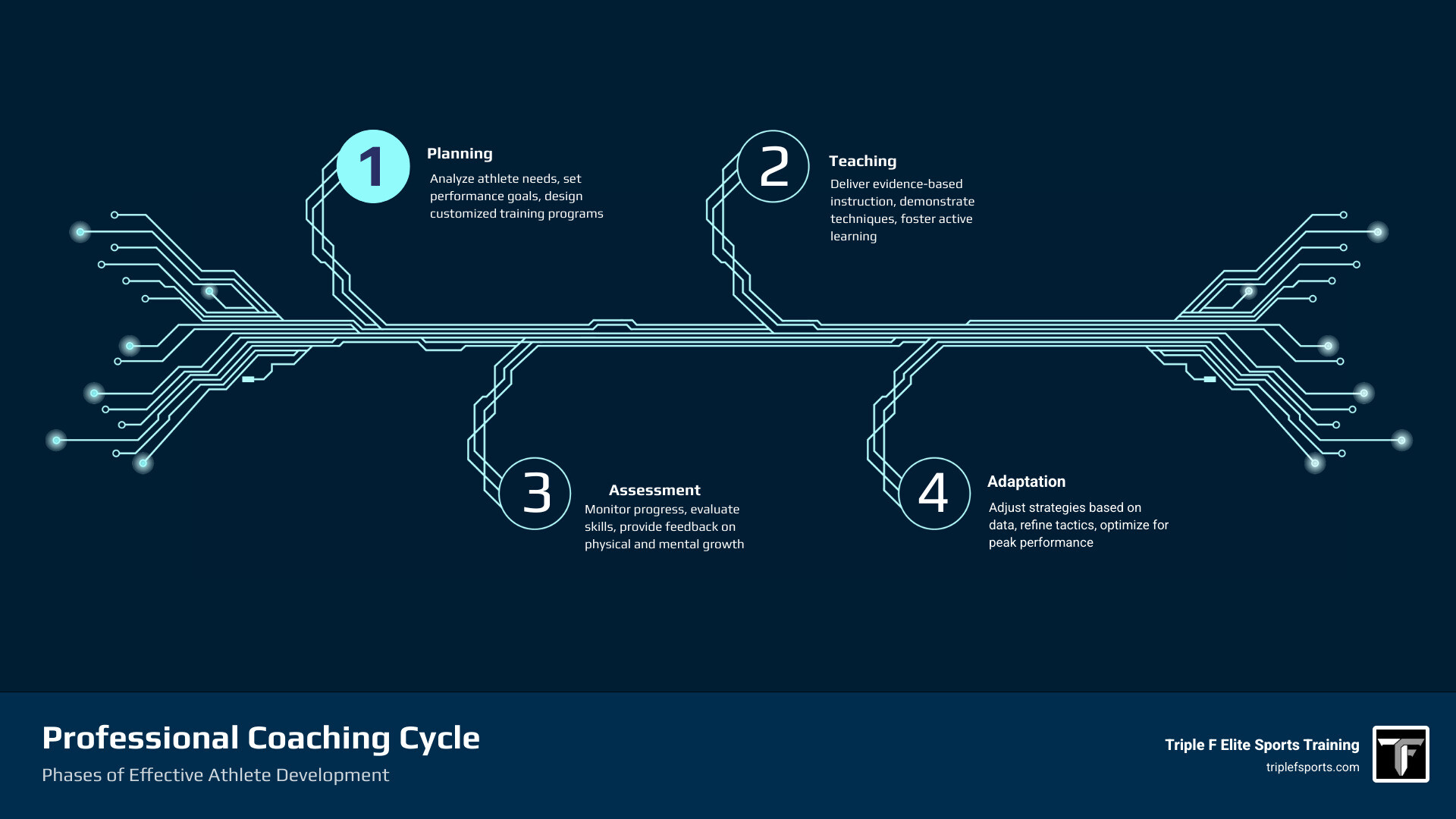
Effective coaching follows a roadmap. Whether we are working with a 12-year-old in our youth training programs or an NFL hopeful, the objectives shift based on the phase of development.
| Phase | Primary Objective | Key Strategy |
|---|---|---|
| Awareness | Identify goals and current state | Self-SWOT analysis, “Why” discovery |
| Willingness | Build motivation and commitment | Emotional anchoring, visualization |
| Knowledge | Acquire technical/mental tools | Skill acquisition, cognitive strategies |
| Action | Apply and evaluate performance | Competition, feedback loops, adjustment |
In the “FUNdamental” phase (typically younger youth athletes), the focus is on broad motor skills and creating a love for the game. As athletes move into more specialized training, we lean into Self-Determination Theory—ensuring athletes feel a sense of autonomy, competence, and relatedness. This is what keeps people playing for a lifetime rather than burning out by age 16. By prioritizing these psychological needs, professional coaches ensure that the drive to compete comes from within the athlete, rather than from external pressure.
Frequently Asked Questions about Professional Coaching
What are the most common neuromyths in sports?
The most prevalent is the “Learning Styles” myth, with 83% of coaches still believing that teaching to a specific visual or auditory style is superior. Other common myths include the “10% of the brain” myth and the “left-brain vs. right-brain” personality myth (about 18% of coaches still hold this one). Professional coaching standards are shifting to prioritize evidence-based practices over these popular but incorrect ideas.
What knowledge is essential for effective coaching?
Effective coaching requires a blend of professional (sport-specific), interpersonal (relationship-building), and intrapersonal (self-reflection) knowledge. An expert coach doesn’t just know the plays; they know how to teach them, how to motivate the individual player, and how to learn from their own mistakes.
How do coaches prefer to learn and develop?
Despite the rise of online webinars, coaches overwhelmingly prefer onsite professional development. They value scientific interest in the brain and prefer mentorship and reflective practice over “one-and-done” workshops. 97% of coaches want more access to brain science to help them improve athlete outcomes.
Conclusion
At Triple F Elite Sports Training in Knoxville, we are committed to moving beyond the myths. We provide a professional, Christ-centered environment where athletic development is treated as both a science and a calling. By integrating brain science, evidence-based pedagogy, and high-performance strength and conditioning, we help every athlete unlock their true potential.
Whether you are looking for physical therapy, volleyball club excellence, or elite speed and agility work, we invite you to experience the difference that professional standards make.
Ready to see what your best looks like? Come visit us in Knoxville for your free first session and let’s start building your 4 C’s today.