
Why Baseball Performance Training Is No Longer Optional
Baseball performance training is the structured, science-backed process of developing the physical and mental qualities that make baseball players better — from bat speed and pitching velocity to agility, strength, and mental toughness.
Here is a quick breakdown of what modern baseball performance training covers:
- Force and power development — building explosive strength through exercises like trap-bar deadlifts, med-ball throws, and depth drops
- Skill integration — connecting gym work directly to hitting, pitching, and fielding mechanics
- Technology-driven feedback — using tools like Rapsodo, bat sensors, and biomechanics analysis to measure real progress
- Recovery and injury prevention — sleep, nutrition, mobility work, and smart workload management
- Age-appropriate progression — from youth athletes learning fundamentals to adults chasing elite-level performance
The game has changed. A player who just “plays more baseball” and lifts generic weights is falling behind players who train with purpose and data.
Consider this: 1 mph gained in bat speed equals about 1.2 mph more in exit velocity. That single number shows how small, measurable improvements in training translate directly to on-field results. The gap between athletes who track those improvements and those who guess is growing fast.
That is exactly what this guide is for — to show you how to close that gap.
I’m Kevin O’Shea, a Certified Strength and Conditioning Specialist, former collegiate wide receiver, and high school coach who has spent years studying how elite athletic development transforms athletes from the ground up. My work in baseball performance training at Triple F Elite Sports Training is built on the same principles you’ll find in this guide: purposeful training, measurable progress, and athlete-centered development.
Defining Modern Baseball Performance Training
When we talk about modern baseball performance training, we aren’t just talking about doing a few curls and running poles. We are talking about a comprehensive system designed to build a “bigger motor.” The primary goals are simple but profound: increase explosiveness, improve movement efficiency, and ensure the athlete stays on the field.
Physical and Mental Benefits
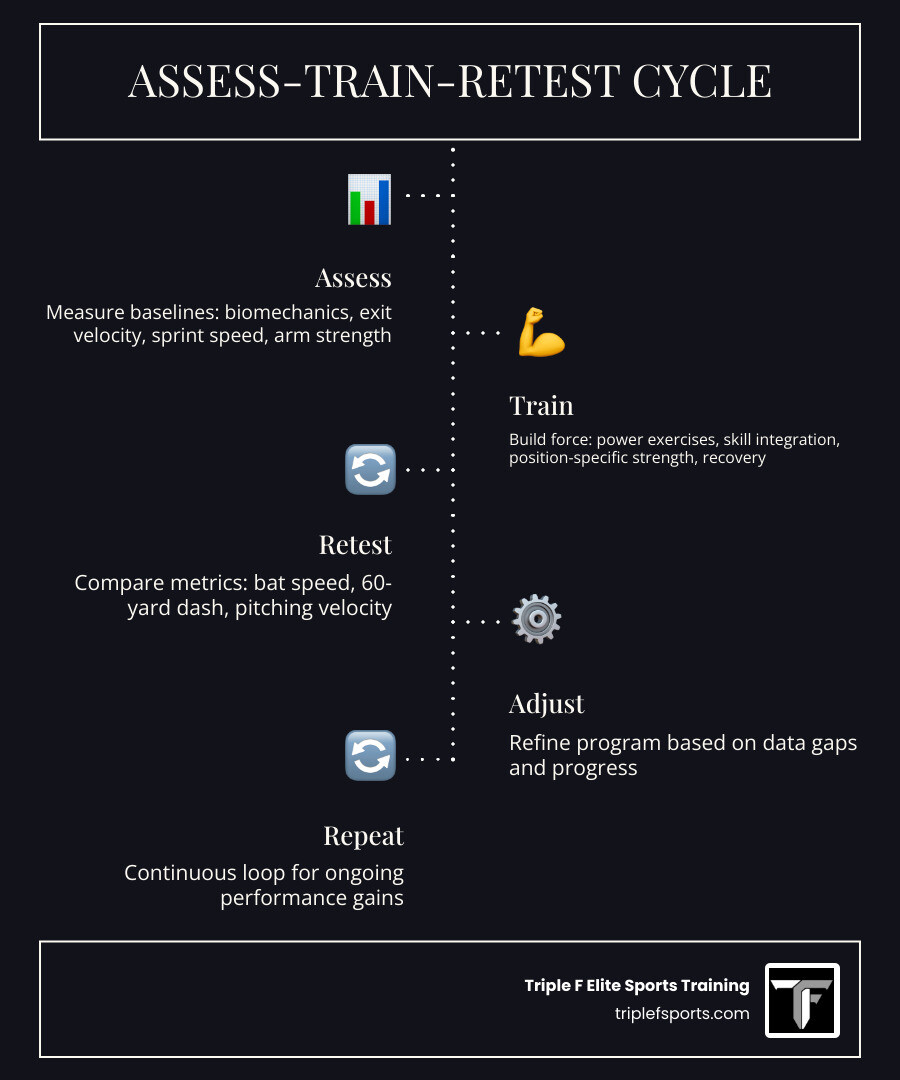
Physically, a proper routine builds rotational power, lateral agility, and linear speed. But the benefits go beyond the muscles. When an athlete sees their exit velocity climb from 85 to 92 mph because of their hard work in the lab, their confidence skyrockets. This builds a level of mental toughness that allows them to stay calm in a full-count bases-loaded situation. They know they’ve put in the work; the result is just a byproduct.
Our approach to Sport Skill development ensures that every ounce of strength gained in the weight room is translated into a more efficient swing or a more powerful delivery.
Debunking Common Training Myths
There is a lot of “old school” noise out there that can actually hold a player back. Let’s set the record straight:
- Myth: Lifting weights stunts growth. Truth: Supervised, age-appropriate strength training is safe and actually strengthens bones and connective tissues.
- Myth: You should only do sport-specific drills. Truth: If you only do baseball drills, you’ll eventually hit a ceiling. General physical preparation builds the foundation that allows your skills to shine.
- Myth: Long-distance running is good for pitchers. Truth: Baseball is an explosive sport. We work 90% of the time inside the ATP/CP system (Fast Twitch efforts of 12 seconds or less). Jogging three miles just teaches your body to be slow.
The Science of Force: Beyond General Strength
In baseball performance training, “strong” isn’t enough. You have to be fast and strong. The formula for success is Force = Mass x Acceleration. If you can produce a massive amount of force but it takes you three seconds to do it, you’ll never hit a 95-mph fastball. We focus on the Rate of Force Development (RFD)—how quickly you can go from zero to one hundred.
Research on the general-specific training continuum shows that while squats and deadlifts are great for building a base, we must eventually move toward movements that mimic the speeds of the game. For our Adult Training programs, this means incorporating:
- Overcoming Isometrics: Pushing against an immovable object to recruit maximum muscle fibers without the wear and tear of heavy eccentric loading.
- Deceleration Training: Teaching the body to “brake.” If your body doesn’t know how to slow down a fast arm or a violent swing, it will subconsciously limit your speed to protect itself.
- Ground Force: Baseball is played from the ground up. Whether it’s a pitcher’s back-leg drive or a hitter’s lead-leg block, your ability to put force into the turf determines your output.

Essential Exercises for Baseball Performance Training
To build a complete ballplayer, we utilize a mix of foundational and explosive movements:
- Upper Body: Scapular stability exercises (like prone Y-to-press) are vital. We don’t just want big shoulders; we want a stable “anchor” for the arm to rotate around.
- Lower Body: Single-leg squats and lateral lunges address the unilateral nature of the sport.
- Core Stability: We focus on “anti-rotation”—the ability to resist movement—which is the secret to transferring power from the legs to the hands.
- Explosiveness: Med-ball throws (scoops and shotputs) and depth drops (jumping off a box and landing “stiff”) teach the body to handle high-velocity forces.
If an athlete is recovering from an injury or looking to prevent one, our Sports Medicine team integrates these exercises into a “prehab” plan that keeps them durable.
Integrating Technology into the Training Cycle
The days of “eye-balling” a swing are over. We use a data-driven approach to remove the guesswork.
| Feature | Traditional Coaching | Tech-Enabled Performance Training |
|---|---|---|
| Feedback | Subjective (“Swing harder”) | Objective (Bat speed: 72.4 mph) |
| Progress Tracking | Seasonal stats | 6-week re-tests and smart reports |
| Injury Risk | Reactionary (Wait for pain) | Proactive (Workload and biomechanics tracking) |
| Personalization | One-size-fits-all | Custom “Expected Velo” models |
By using biomechanics labs and motion capture, we can see exactly where a “leak” in the kinetic chain is occurring. This data is then shared with our Physical Therapy team if we find a mobility restriction that is limiting performance.
Maximizing Exit Velocity with Tech
Using bat sensors like Blast Motion, we track metrics like swing plane and attack angle. This is critical because Skilled-Based Training has shown that for every 1 mph you add to your bat speed, you can expect a 1.2 mph gain in exit velocity. We don’t just want you to swing fast; we want you to have the barrel control to hit the ball hard consistently.
Pitch Design and Analytics
For pitchers, tools like TrackMan and Rapsodo are game-changers. We can analyze spin rate, horizontal break, and pitch tunneling to design an arsenal that keeps hitters guessing. This technology also allows for safe velocity ramp-ups by monitoring arm stress, ensuring that “chasing velo” doesn’t result in a trip to the surgeon.
Age-Appropriate Development and Injury Prevention
Training a 12-year-old like a Pro is a recipe for disaster. At Triple F, our Youth Training 12 to 18 follows a strict roadmap.
- Ages 11-12: Focus on movement quality, balance, and “joyful fundamentals.” We use Youth Assessments to ensure they can move their own body weight before adding iron.
- Ages 13-14: Introduction to structured strength training (hinge, squat, push, pull).
- Ages 15-18: Advanced periodization, high-output plyometrics, and recruiting-focused metric tracking.
Safety is our priority. We always recommend a pediatrician consultation before starting a heavy regimen, and we watch for overtraining signs like decreased velocity or persistent soreness. Growth plate safety is managed through gradual progression and meticulous form.
Structuring Your Weekly Performance Routine
A winning routine balances stress and recovery. Here is how a typical 7-day microcycle might look for an in-season or off-season athlete:
- Day 1: High Intent. Max effort sprints, heavy lifting, high-velocity throwing.
- Day 2: Skill + Mobility. Hitting drills, scapular stability, and “microdosing” mobility.
- Day 3: Moderate Load. Rotational power work and moderate strength training.
- Day 4: Active Recovery. Light movement, foam rolling, and Nutrition focus.
- Day 5: High Intent. Blended bullpens or live BP, explosive lower-body work.
- Day 6: Skill Integration. Position-specific work and core stability.
- Day 7: Full Rest. Sleep hygiene is key here—aim for 8-9 hours to let the nervous system reset.
Don’t forget the fuel! High protein intake (0.7–1.0 g/lb) and proper hydration are the building blocks of the muscle you’re working so hard to build.
Frequently Asked Questions about Baseball Training
Is my child physically ready for strength training?
Most children are ready for some form of strength training by age 7 or 8, provided they can follow instructions. However, we focus on bodyweight movements and coordination until they hit their growth spurt. A Youth Assessment is the best way to determine readiness.
How does performance training differ from a general gym workout?
A general workout aims for “fitness” or “looking good.” Baseball performance training aims for output. We don’t care if your biceps look great if you can’t rotate your hips explosively. Every exercise we choose has a “why” that relates back to the diamond.
What are the most important metrics to track for college recruiting?
For hitters: Exit velocity, 60-yard dash, and “hard-hit” consistency. For pitchers: Peak velocity, strike-zone command %, and spin efficiency. Technology allows you to have a “verified” profile that coaches trust.
Conclusion
At Triple F Elite Sports Training in Knoxville, we believe in a holistic, Christ-centered approach to athletic development. We aren’t just building better ballplayers; we are building better people. Whether you are a youth player just starting your journey or an adult looking to reclaim your edge, our team is here to help you unlock your full potential.
Ready to see what a tech-enabled upgrade can do for your game? We offer your first session for free so you can experience our methodology firsthand. Come join our community in Knoxville and start training with the purpose your talent deserves.