
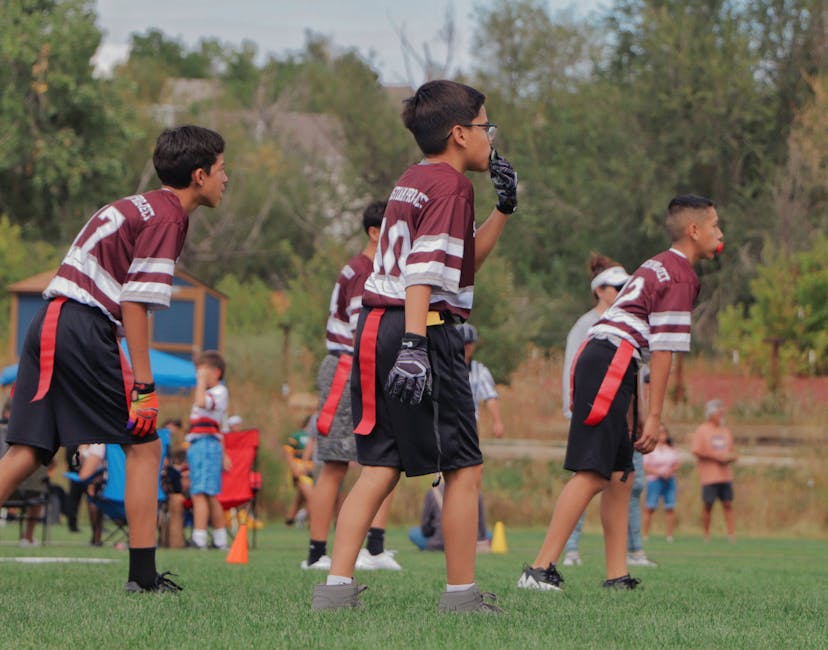
Why Mastering the Fundamentals Through Drills Matters
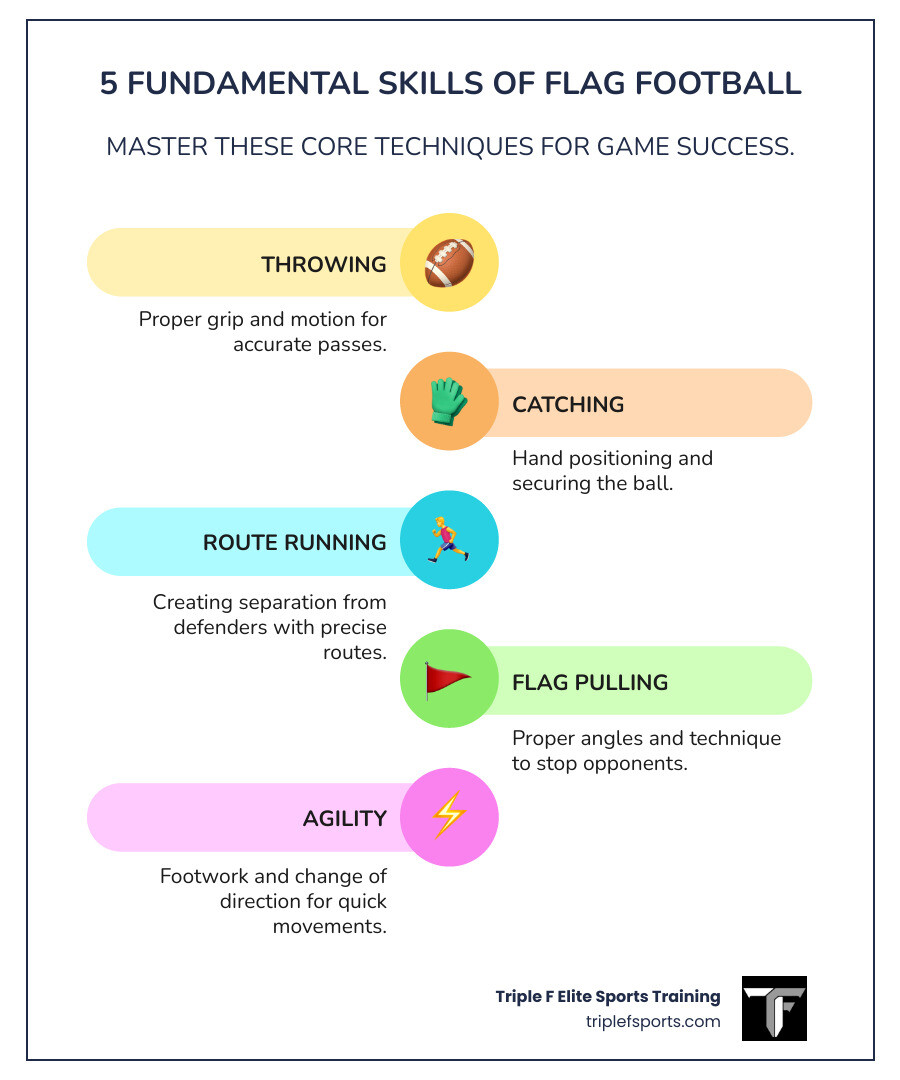
Drills for flag football are the foundation of player development, helping athletes master essential skills like throwing, catching, route running, flag pulling, and agility. Here are the key categories of drills every flag football player should practice:
- Footwork & Agility Drills – Improve speed, balance, and change of direction
- Offensive Drills – Develop throwing accuracy, catching technique, and route running
- Defensive Drills – Master flag pulling, coverage, and pursuit angles
- Team-Based Drills – Build communication, field awareness, and game decision-making
All successful flag football players have one thing in common: they master the fundamentals. Practicing a variety of drills makes players more versatile—a crucial advantage in the 5-on-5 format where every player has a role.
Flag football drills make practice engaging while developing real skills. When kids catch and throw the ball 30-40 times each practice, they develop faster and stay motivated. These high-energy drills help young athletes grow into well-rounded players who understand both offense and defense.
I’m Lee Smith, an 11-year NFL veteran and founder of Triple F Elite Sports Training in Knoxville, TN. Throughout my career with teams like the Patriots, Bills, Raiders, and Falcons, I learned that mastering fundamentals separates good players from great ones. Now, I bring that professional-level training to youth athletes in East Tennessee.
Foundational Footwork & Agility Drills
In flag football, speed, quickness, and the ability to change direction in an instant are game-changers. This is where mastering footwork and agility comes into play. These foundational skills aren’t just about looking fancy; they’re essential for evading defenders, staying with receivers, and preventing injuries. At Triple F Elite Sports Training, we emphasize comprehensive Sport Skill development, starting with these core movements.

Agility Ladder & Cone Drills
Agility ladder and cone drills for flag football are the bread and butter for improving a player’s footwork, balance, and coordination. They teach players to be light on their feet, react quickly, and make sharp cuts—all vital for both offense and defense.
- Ladder Drills: The agility ladder is fantastic for developing quick feet and intricate footwork patterns. Players can perform various patterns like “two feet in,” “in-out,” “shuffle,” and “Ickey Shuffle.” The key is to focus on quick, light steps, keeping the eyes up, and maintaining balance. These drills build muscle memory for fast, controlled movements, which translates directly to jukes and cuts on the field. You can even find videos like The Ladder Drill to demonstrate proper technique.
- Cone Weaves: Setting up a line of cones and having players weave in and out, either forward, backward, or laterally, improves hip flexibility and change-of-direction speed. Varying the distance between cones helps players adapt to different spacing on the field.
- Box Drill: Using four cones to form a square, players sprint forward, shuffle sideways, backpedal, and then shuffle the other way. This drill mimics the rapid changes in direction required in a game, enhancing both speed and control.
Fun & Engaging Agility Games
Especially for younger players, keeping drills fun and engaging is paramount. High-energy youth flag football drills help kids develop into well-rounded players while keeping them motivated.
- Red Light Green Light: A classic game adapted for agility. Players sprint on “Green Light” and stop instantly on “Red Light.” Adding variations like “Yellow Light” (jogging) or “Purple Light” (shuffling sideways) can make it more challenging and improve reaction time and body control.
- Volcanoes & Ice Cream Cones: This timed sprint activity, often found in lists of high-energy drills, helps players develop teamwork skills while also getting a great workout. Players are divided into two teams. One team tries to flip all cones to be “volcanoes” (upside down), while the other team flips them to be “ice cream cones” (right side up). On “go,” both teams race to flip as many cones as possible to their team’s type before time runs out. It’s chaotic, fun, and builds explosive speed and quick changes of direction. You can see an example of this drill here: Volcanoes & Ice Cream Cones. This drill, along with others, helps develop reaction time, which is crucial for both offense and defense in flag football.
By integrating these foundational footwork and agility drills for flag football into practice, we ensure our athletes are not just fast, but also agile and balanced, ready to make dynamic plays on the field.
Essential Offensive Drills for Flag Football
Offense wins games, and in flag football, that means precise throwing, reliable catching, smart route running, and effective ball handling. These are the core skills that turn plays into points. At Triple F Elite Sports Training, our Skilled Based Training focuses on developing these individual talents, ensuring every player understands their role in moving the ball downfield.

Quarterback & Throwing Drills
A great quarterback is the heart of any flag football offense. Developing throwing accuracy and proper technique is crucial for consistent success. Our goal for every kid is to have them catch and throw the ball 30-40 times each practice, ensuring they build confidence and proficiency.
-
Throwing Accuracy & Technique: We focus on the fundamentals: proper grip (fingers spread over the laces), a clean throwing motion (smooth arm action, elbow high), and a good follow-through (pointing to the target).
- Progressive QB Drill: Start with players kneeling, throwing short distances to focus solely on arm mechanics. Progress to standing, then standing with feet together, and finally incorporating step drops and throwing on the run. This systematic approach builds a solid throwing foundation.
- “The Wrong Foot”: This drill, as shown in instructional videos, helps players learn to throw the right way by practicing the wrong way. It highlights common errors and allows players to feel the correct mechanics by contrast. The Wrong Foot
- Robin Hood (Bullseye): Players work on their throwing technique and target practice. Set up hula hoops or cones as targets at various distances. Quarterbacks aim to hit the targets, refining both accuracy and distance control. This group activity also refines their accuracy.
-
Drop-Backs & Pocket Presence: Quarterbacks need to master their drop-backs (3-step, 5-step) and learn to scan the field.
- Pocket Drill: Set up cones to simulate a pocket. The QB practices dropping back, scanning, and stepping up or rolling out to avoid imaginary pressure, all without throwing a ball initially. This builds crucial pocket awareness and footwork.
Catching & Route Running Drills
Receivers are only as good as their hands and their ability to get open. We focus on developing hand-eye coordination, securing the ball, and understanding the nuances of route running. For advanced training, we even have specialized Wide Receiver Training by Amari Rodgers.
-
Hand-Eye Coordination & Securing the Ball:
- Trust Catch: This fun activity works on players’ reaction time and catching skills. Players stand facing each other, one holds the ball, and on a command, drops it. The other player must quickly react and catch it before it hits the ground. This builds soft hands and quick reflexes.
- “Hands Target Drill Pass and Catch”: Players pair up and focus on catching the ball with their hands (not body), forming a target with palms facing out and thumbs/pointing fingers touching to create a “triangle.” They gradually increase distance, emphasizing looking the ball into their hands and immediately tucking it away.
- Comeback Catch: A basic pass pattern that’s a staple for beginner offenses. The receiver runs downfield, plants, and cuts back towards the QB. This teaches turning, creating space, and presenting a good target.
-
Route Running: Understanding various routes and how to run them effectively is key to creating separation from defenders.
- Passing Tree: Coaches can teach players various routes (e.g., 5-yard curl, 5-yard out, 8-yard post, streak) and have them run through a “tree” of options. This helps receivers understand the depth and breaks of different patterns, while QBs learn to anticipate where their receivers will be.
- Run & Shoot: This drill focuses on common passing routes and defensive coverages. Players practice specific routes like the square-out or turn-in, emphasizing crisp cuts and acceleration out of the break.
Handoffs & Running Drills
While flag football is often pass-heavy, effective handoffs and running plays can keep defenses honest and add another dimension to the offense.
- Ball Security & C/QB Exchange:
- The Handoff: This activity helps players develop chemistry and refine the most basic movement of any successful running play. Players practice giving and receiving the ball, focusing on a clean exchange. The runner should present a good target, and the handoff should be smooth, with the ball immediately secured. This is critical for younger kids to reduce fumbles. You can watch this drill here: The Handoff.
- Center Snap Relay: Players learn to snap accurately and beat the clock in this action-packed race. The center snaps to the QB, who then hands off to a runner, or throws to a receiver, emphasizing the initial exchange.
- Running North-South & Evasion:
- Bull Rush: In this fun twist on Red Rover, players use bursts of speed to avoid defenders. One or two “bulls” try to pull flags from “runners” attempting to cross the field. This drill improves speed, evasion skills, and the ability to run through defenders rather than around them.
- “Don’t Sweep Too Wide Drill”: Many young players tend to run East and West on sweep plays, gaining no yardage. This drill uses cones to create a narrow lane, forcing runners to cut upfield and run North and South, maximizing yardage.
By honing these offensive drills for flag football, our athletes develop the precision, agility, and teamwork needed to orchestrate successful drives and score touchdowns.
Dominant Defensive Drills
Defense is where championships are won, even in flag football. Effective defense requires quick reactions, strategic positioning, and, most importantly, mastering the art of flag pulling. At Triple F Elite Sports Training, our Defensive Line & Linebacker Sports Training principles translate directly to flag football, focusing on pursuit angles, coverage, and agility to shut down opposing offenses.
Mastering the Art of Flag Pulling
Flag pulling is the equivalent of tackling, and it requires technique, speed, and timing. For younger ages, flag pulling is often considered the most important part of defense.
- Breaking Down & Proper Angles: Defenders need to learn how to approach a ball carrier, break down (slow down and get low), and take the correct angle of pursuit.
- Angle Flag Pull: This drill teaches defenders to run to where the ball carrier will be, not where they currently are. Set up cones and have an offensive player run at an angle. The defender must anticipate their path and intersect them, aiming to pull the flag from the side or rear.
- The Gauntlet: This drill is excellent for developing quickness, agility, and dynamic flag pulling. Players run through a series of cones or obstacles while defenders attempt to pull their flags. It simulates a chaotic game situation and improves the ability to pull flags while moving at speed.
- One-on-One Flag Pulling: A simple yet effective drill where one offensive player tries to evade one defensive player in a confined space. The defender focuses on staying in front, breaking down, and pulling the flag cleanly. This also helps offensive players practice flag guarding, which is a common penalty we coach them to avoid.
- Sharks vs. Minnows: This engaging game is a fantastic way to practice both evasion and pursuit. A few “sharks” (defenders) try to pull flags from “minnows” (offensive players) within a designated area. As a minnow loses their flag, they become a shark. This encourages constant movement, quick changes of direction, and teaches defenders to process quickly and make pulls.
- Pursuit Drill: This drill focuses on teaching defenders to chase down a ball carrier effectively. It often involves multiple defenders working together to “swarm” the ball carrier, as a good defense is like a swarm of bees around a hive. You can find examples of this in instructional videos like the Pursuit Drill.
Coverage & Interception Drills for Flag Football
Beyond flag pulling, defenders must excel at covering receivers and creating turnovers through interceptions.
- Man-to-Man Coverage:
- Mirror Drill: Two players face each other. One is the “receiver” and the other is the “defender.” The receiver tries to get open using various moves (juke, cut, stutter-step), and the defender must mirror their movements, staying within an arm’s length. This teaches defenders to watch the receiver’s hips, not their shoulders or head, to anticipate their moves.
- Backpedaling Drill: Defenders practice backpedaling in a straight line, maintaining a low center of gravity and keeping their eyes up. This is crucial for staying in front of receivers running deep routes.
- Zone Defense & Interception:
- Open Wheel Shuffle: Get ready to shuffle! Players develop their interception skills, speed, and agility in this fun game. Defenders shuffle laterally across a zone, reacting to a thrown ball or a receiver entering their area. It improves lateral quickness and the ability to break on the ball.
- Keep Away: This classic schoolyard game is perfect for teaching interception skills. Two teams try to keep possession of the ball by passing, while the defending team tries to intercept it. This teaches players to anticipate passes, read the quarterback’s eyes, and break on the ball. You can learn more about this drill here: Keep Away.
- Box Drill (DB Coverage): Four cones form a box. A defensive back practices covering a receiver (or an imaginary one) within the box, working on their change of direction, backpedaling, and breaking forward to “intercept” a pass. Resources like USA Football provide excellent guidelines for these types of drills.
By consistently practicing these defensive drills for flag football, our players in Knoxville develop into formidable defensive units, capable of shutting down offenses and turning the tide of any game.
Team-Based & Game-Situation Drills
Flag football is a team sport, and individual skills are only as effective as the team’s ability to work together. Team-based and game-situation drills for flag football are essential for developing field awareness, decision-making, communication, and preparing players for the pressure of competition. These drills also allow us to adapt training for different age groups and skill levels, ensuring everyone grows. At Triple F Elite Sports Training, we believe in building cohesive units, preparing our athletes for their Future Pros Program.
Small-Sided Games
Small-sided games are fantastic for simulating game conditions in a less structured, more dynamic environment. They encourage players to think, react, and communicate.
- Tic Tac Toe Drill: An age-old game gets a twist in this activity that promotes field awareness and decision-making. Players (or small teams) compete to complete a “Tic Tac Toe” line by running to specific cones and placing a marker (or performing a designated action). This forces players to quickly assess the field, make strategic decisions, and communicate to achieve their goal. It’s an excellent way to develop football IQ in a fun format. See how it works here: Tic Tac Toe.
- Flag Football Ultimate: This drill combines elements of Ultimate Frisbee with flag football rules. Teams try to move the ball downfield through passes to score in an end zone. Players with the ball have limited steps (e.g., two steps) and a limited time (e.g., 10 seconds) to pass, encouraging quick decisions and spreading out. Defensive players must stay an arm’s length away. This drill is great for developing overall offensive and defensive concepts, ball movement, and communication.
- 7-on-7 Drills: While many flag football leagues play 5-on-5, 7-on-7 drills are still incredibly valuable for simulating game-like situations. These drills typically involve a quarterback, running backs, and receivers against a full defensive unit, focusing on offensive plays, defensive coverages, and game flow. They help players practice executing plays under pressure and making reads. You can explore various 7-on-7 drills designed for flag football, like those from the New Orleans Saints.
Addressing Team Weaknesses
Coaches can use specific drills for flag football to identify and target particular team weaknesses, turning them into strengths.
- Swarm Drill: This drill addresses the common issue of individual defenders chasing a ball carrier from behind. The analogy is a “swarm of bees around a hive.” When a ball carrier breaks free, all other defensive players converge on them from different angles, not just chasing. This teaches team pursuit, cutting off angles, and ensuring multiple defenders are involved in the flag pull.
- Using the Sideline as a Defender: Many young players will run out of bounds for no gain on sweep plays. The “Use the Sideline Drill” teaches defenders to funnel offensive players towards the sideline, effectively using it as an extra defender to limit their options and gain. Players learn to angle their pursuit to cut off the field, rather than letting the ball carrier escape up the sideline.
- Running Plays Against a Defense: Instead of just running plays against air, introduce a limited number of defenders. Start with a “skeleton offense” (QB, RB, WRs) against a few defensive players. This allows the offense to practice timing and execution under realistic pressure, while the defense gets practice reading plays and reacting. Gradually increase the number of defenders as the team improves. When addressing issues like “running north-south,” coaches can set up mini-scrimmages that reward running through the middle or penalize running laterally for too long.
By incorporating these team-based and game-situation drills for flag football, we help our athletes in Knoxville not only develop individual skills but also understand how to function as a cohesive, intelligent unit on the field.
Frequently Asked Questions about Flag Football Drills
We often get questions from coaches and parents in Knoxville about how to make flag football practice effective and enjoyable for all. Here are some common queries and our expert advice.
How do you make flag football drills fun for kids?
Making drills for flag football fun is key to keeping young players motivated. If they’re having fun, they’ll want to come back and will develop a lifelong love for the game.
- Gamification is Your Friend: Turn drills into games with clear objectives, points, and friendly competition. Drills like “Volcanoes & Ice Cream Cones,” “Tic Tac Toe,” and “Keep Away” are perfect examples of combining skill development with playful competition.
- Creative Naming: Give drills exciting, memorable names. Instead of “Cone Weave Drill,” call it “The Serpent’s Slalom.” “One-on-One Flag Pulling” could be “The Flag Chase.”
- Positive Reinforcement: Celebrate every effort and small success. High-fives, cheers, and specific praise (“Great job keeping your eyes on the ball, Sarah!”) go a long way.
- High-Energy Environment: Keep the pace moving. Minimize waiting time by running multiple stations or splitting players into smaller groups. Use upbeat music during warm-ups.
- Variety is the Spice of Practice: Don’t do the same drills every week. Mix it up by introducing new challenges and revisiting old favorites. A variety of drills will keep players engaged.
- Coach Involvement: Get in there and participate! Show them how it’s done, joke around, and create a positive, encouraging atmosphere.
How can drills be adapted for different skill levels?
Adapting drills for flag football for varying age groups and skill levels is crucial for effective coaching. We believe in meeting each athlete where they are and providing a path for growth.
- Adjusting Speed and Complexity:
- Beginners: Start slow and walk through drills first. Simplify instructions to one or two key points. Reduce the number of cones or defenders and focus on basic mechanics.
- Intermediate: Increase the pace and add more elements to drills, like a defender for a receiver. Introduce decision-making, such as a QB choosing between two receivers.
- Advanced: Run drills at game speed. Introduce complex scenarios, add more defenders or time constraints, and challenge players to execute under pressure.
- Progressions: Use a progression: introduce a skill, practice it, then simulate game situations. For example, with handoffs, practice the exchange, add a runner, then a defender, and finally integrate it into a full play.
- Equipment Modifications: For younger kids, use softer, smaller footballs. For flag pulling, start with stationary targets before moving to moving players.
- Role Rotation: For youth teams, rotate positions frequently so every player gets experience throwing, catching, running, and defending. This helps develop well-rounded players.
How much practice time should be spent on drills vs. plays?
While running plays is exciting, the bulk of practice time for youth flag football should be dedicated to drills for flag football that improve individual skills.
- Drill-Heavy Focus: For youth teams, we recommend 70-80% of practice time be spent on drills. A play will fail in a game if a player can’t catch, throw, or pull a flag effectively, no matter how well it’s run.
- Individual Skill Development: The goal is for every kid to catch and throw the ball 30-40 times each practice. This repetition builds muscle memory and confidence, and drills allow for this high volume of touches.
- Teaching Through Components: Instead of running a full play repeatedly, break it down into components and drill each one. For example, practice the center-QB exchange, the QB’s drop-back, and the receiver’s route separately before combining them. This builds proficiency in each part.
- Game Simulation: Once skills are solid, use drills that simulate game situations (like small-sided games) to integrate them into a team context. This is where players learn to make decisions under pressure.
- Addressing Weaknesses: If your team struggles with a specific skill like flag pulling, dedicate more drill time to it. The bulk of practice time should be flexible enough to address team weaknesses.
Conclusion
Mastering drills for flag football is the undeniable pathway to becoming a confident, versatile, and impactful player. From the lightning-fast footwork of agility ladders to the pinpoint accuracy of throwing drills, the unwavering grip of catching exercises, the strategic angles of flag pulling, and the team synergy of game-situation drills—every repetition builds a stronger athlete. Consistent practice, focused on fundamental skills and adapted for age and ability, not only improves performance but also nurtures a lifelong love for the game.
At Triple F Elite Sports Training in Knoxville, we are passionate about Christ-centered athletic development. We believe in open uping every athlete’s full potential, providing the professional guidance and structured training needed to excel. Whether you’re a beginner just learning the ropes or an aspiring pro, our programs are designed to lift your game.
Ready to take your flag football skills to the next level? Come experience the Triple F difference and find how our expert coaching and custom drills for flag football can transform your performance. We’re here to help you achieve your goals, one drill at a time.
Join our Knoxville Football Camp today and let’s start building your future success!