
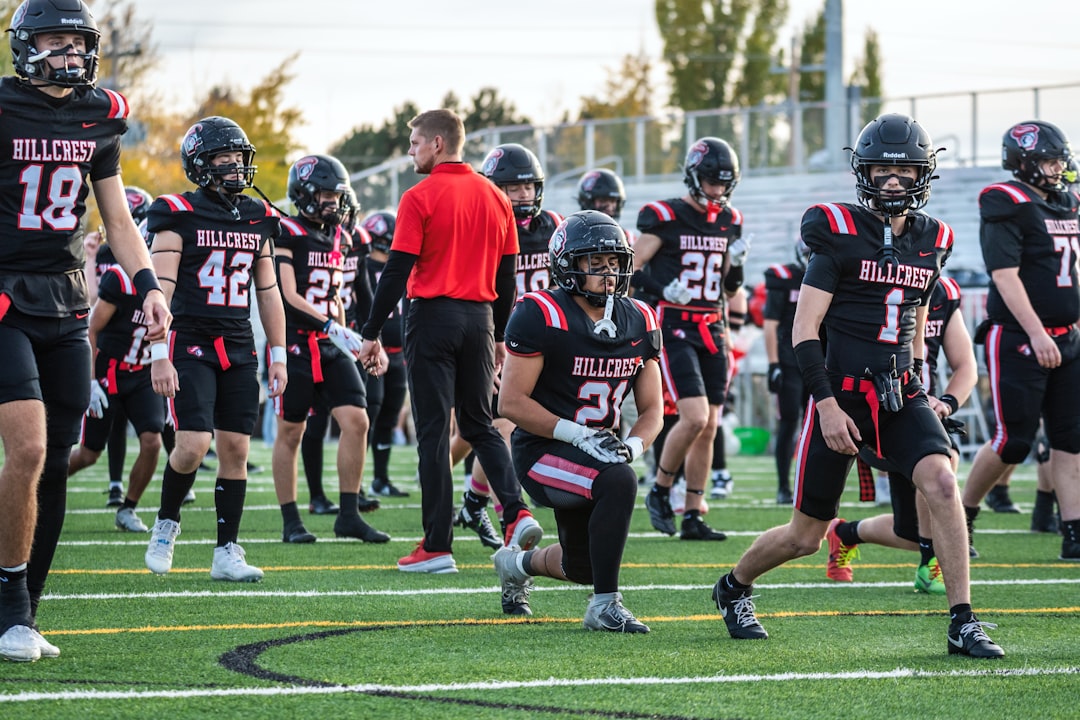
Why Youth Football Training Matters for Young Athletes
Youth football training is more than just learning to throw, catch, and tackle. It’s a comprehensive approach to developing young athletes physically, mentally, and emotionally while building life skills that extend far beyond the field.
Key Components of Effective Youth Football Training:
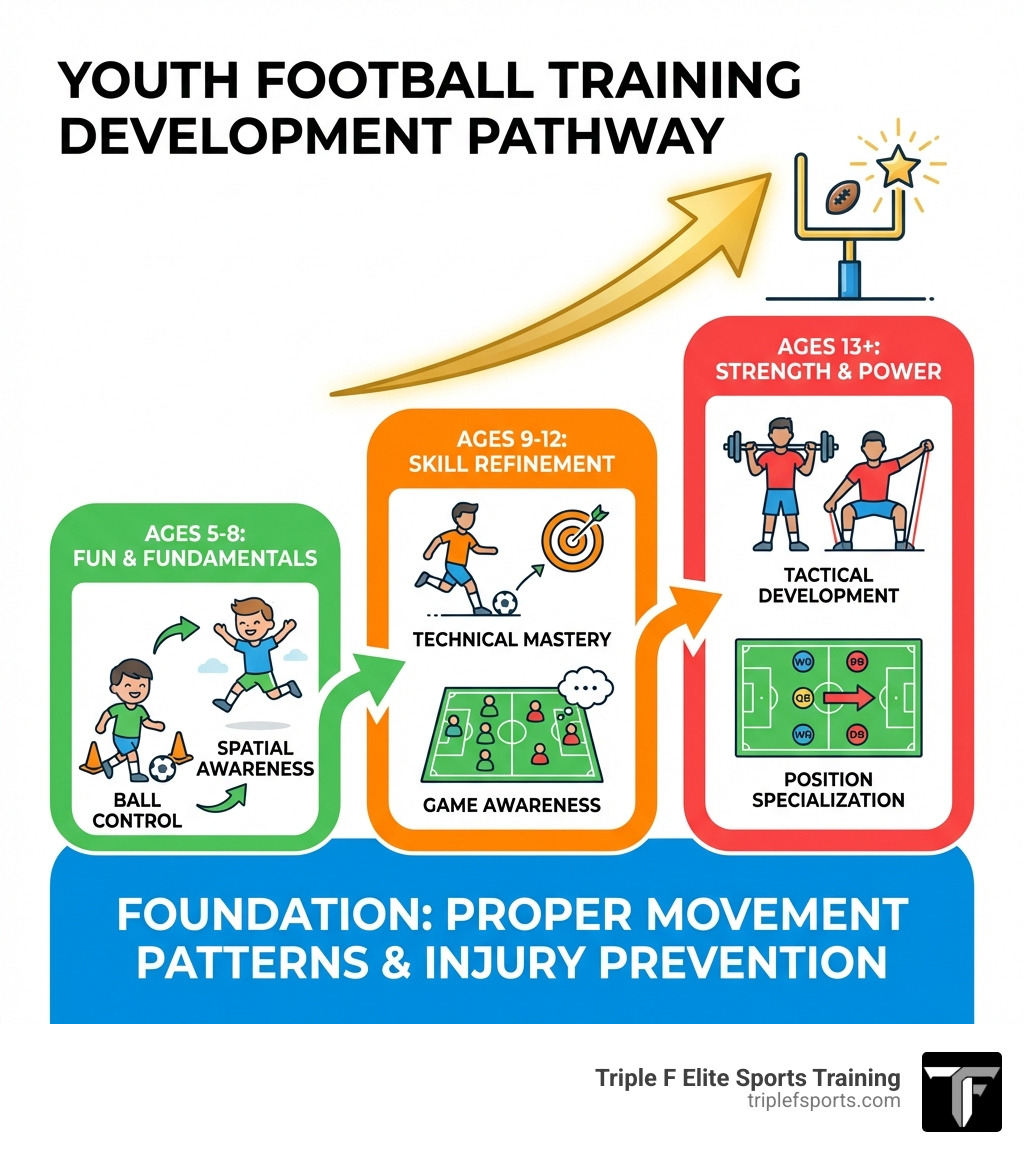
- Age-appropriate skill development – Foundation skills for younger players (U5-U8), technical refinement for mid-level (U9-U12), and strength/power for teens (U13+)
- Structured session design – Warm-up, skill development, conditioned games, and match play
- Small-sided games – Maximizes touches, decision-making, and player involvement
- Foundational athletic movement – Running, jumping, agility, coordination, and stability
- Safety and injury prevention – Proper movement patterns, concussion awareness, and age-appropriate progressions
- Fun-first philosophy – Keeping players engaged and building long-term love for the game
As FIFA emphasizes in their global training framework, football can be described as a school of life through which valuable skills can be taught, such as teamwork, dedication, perseverance and healthy lifestyles. The best youth programs focus on long-term athletic development rather than immediate results, understanding that proper foundational training prevents injuries, builds confidence, and creates well-rounded athletes.
The Foundation Years Matter Most
Research shows that youth athletes who master basic movement patterns early—running efficiently, balancing properly, and controlling their bodies in space—not only perform better in football but also reduce their risk of injury. Poor movement patterns developed in childhood can lead to overuse injuries and long-term joint problems as athletes grow.
Training should adapt as young athletes develop. For prepubescent players, the focus is on coordination, agility, and speed. As athletes mature and muscle mass develops, training shifts toward power, strength, and running efficiency. This progression ensures athletes build proper foundations before adding complexity and intensity.
I’m Kevin O’Shea, a Certified Strength and Conditioning Specialist and former high school Wide Receiver Coach who has spent years developing young athletes through science-based youth football training methods. At Triple F Elite Sports Training in Knoxville, I combine my experience coaching championship-level high school programs with individualized athletic development to help young players reach their full potential.
The Philosophy and Importance of Youth Football Training
At its heart, youth football training is about much more than the final score on a Saturday morning. We believe that the gridiron is a “school of life.” When a young athlete learns to pick themselves up after a missed block or stays disciplined in their lane during a kickoff, they aren’t just learning football; they are building character.
The philosophy behind successful youth development is rooted in a “fun-first” approach. If a child isn’t enjoying the process, they won’t stay in the game long enough to reap the benefits of high-level coaching. We look to global standards, such as those found in the Grassroots – FIFA Training Centre, which emphasize that the game belongs to the players. This global framework highlights the importance of bridging the gap between grassroots fun and elite-level performance through structured, long-term development.
In Knoxville, we see football as a vehicle for teaching dedication and perseverance. However, to ensure that this development is actually happening, we must start with a baseline. That is why Youth Assessments are so critical. By identifying a player’s current movement patterns, strengths, and imbalances, we can create a roadmap that respects their biological age and current skill level. This prevents the “burnout” that often occurs when kids are pushed into adult-style tactical training too early.
The Core Components of Youth Football Training
A well-structured youth football training session should feel like a coordinated dance, even if it looks like organized chaos to the untrained eye. You can’t just throw a ball out and hope for the best. To maximize development, we follow a specific session structure that keeps engagement high and maximizes “time on task.”

A typical high-quality session includes:
- Warm-up (10-15 mins): Focusing on dynamic movements, mobility, and getting the nervous system “awake.”
- Skill Development (15-20 mins): Isolated technical work, such as hand placement for linemen or route-running steps for receivers.
- Conditioned Games (15-20 mins): Drills that have “constraints” to force players to use the skills they just learned (e.g., a game where you can only score by passing).
- Match Play (20-30 mins): Small-sided games where the kids get to actually play.
- Cool Down & Review (5-10 mins): Reflecting on what was learned and bringing the heart rate down.
According to the Training Session Guide – Youth Football, the use of small-sided games is perhaps the most vital component. Whether it’s 3v3 or 5v5, reducing the number of players on the field ensures every child gets more touches on the ball and is forced to make more decisions per minute. This builds “game IQ” much faster than traditional 11v11 drills where a kid might stand around for 10 minutes waiting for their turn.
For those looking to see this structure in action, we offer a Youth Free Session at our Knoxville facility. It’s a great way to see how we balance professional-grade drills with an environment that kids actually want to be in.
Essential Equipment for Practice
To train like a pro, you need the right tools, but they must be scaled for youth. Using adult-sized equipment for a 7-year-old is a recipe for poor mechanics. Proper youth football training utilizes:
- Youth Sleds (MOD and LEV Sleds): These are specifically weighted and sized to teach blocking and tackling leverage without the risk of hitting a heavy, immovable object.
- Chutes: These force players to stay low, teaching them to maintain a low pad level and “win the leverage battle” from the snap.
- Dummies & Shields: Pop-up dummies and step-over bags allow for high-repetition contact drills while minimizing player-on-player impact.
- Tackle Wheels: An essential for modern safety, these help players learn the “wrap and roll” technique without needing a live runner.
- Agility Tools: Cones, dots, and ladders are the bread and butter of our Youth Memberships, helping athletes develop the footwork necessary for any position on the field.
Age-Appropriate Development Pathways
One of the biggest mistakes in youth football training is treating a 7-year-old like a miniature 17-year-old. Their bodies, brains, and nervous systems are in completely different stages of development. We categorize our training into distinct pathways to ensure every athlete is getting exactly what they need at the right time.
Our Future Pros Program is designed to navigate these stages, moving from general athleticism to sport-specific mastery.
Foundations for U5-U8 Youth Football Training
At this age, the goal is simple: fall in love with the game and learn how to move. We use the Play-Practice-Play model.
- Ball Control: It’s not about complex plays; it’s about can they carry the ball while running? Can they catch a soft-shell football?
- Dribbling and Agility: Even in American football, “dribbling” through cones helps with spatial awareness—understanding where their body is in relation to others.
- Fun-First: We use games like “Sharks and Minnows” to teach acceleration and evasion. If they are laughing, they are learning.
Skill Refinement for U9-U12 Youth Football Training
This is the “Golden Age” of motor learning. The brain is like a sponge for technical skills.
- Technical Mastery: We begin focusing on the “how” of the game—proper throwing mechanics, catching with hands away from the body, and the “breakdown” position for tackling.
- Numeric Progression: We use games that start 1v1 and gradually move to 2v1 or 3v2. This teaches players how to find and exploit space.
- Global-Analytical-Global: We start with a game (Global), pull the players out to work on a specific skill they struggled with (Analytical), and then put them back into the game to apply it (Global).
If you want to see where your child fits in this pathway, you can sign up for a Future Pro Free Session to get a taste of our age-specific coaching.
Foundational Skills and Injury Prevention
In our Knoxville facility, we often say that “better athletes make better football players.” You cannot build a high-performance engine on a shaky chassis. Foundational athletic skills—locomotor skills (running, jumping), object control (catching, throwing), and stability (balance)—are the building blocks of the game.
Mastering these patterns early is our primary tool for injury prevention. For example, teaching a child how to land properly from a jump or how to decelerate (stop) safely can prevent ACL tears and ankle sprains later in their career. As players move into our Youth Training 12 to 18 programs, the focus shifts toward maintaining these good habits while adding external resistance.
Safety also includes concussion awareness. We follow the latest standards in “heads-up” football and ensure all coaches can spot the signs of a concussion. By focusing on “wrap” tackling rather than “hit” tackling, we significantly reduce the risk of head impact.
Prepubescent vs. Mature Training Focus
| Training Category | Prepubescent (Ages 5-12) | Mature (Ages 13+) |
|---|---|---|
| Primary Focus | Coordination & Agility | Power & Strength |
| Movement | Running Efficiency | Explosive Acceleration |
| Skill Work | General Ball Skills | Position Specialization |
| Resistance | Bodyweight & Mechanics | Periodized Weightlifting |
| Goal | Foundational Literacy | Performance Optimization |
This scientific approach is why we offer specialized tracks like Wide Receiver Training by Amari Rodgers and Offensive Line Training by Jon Feliciano. We ensure the athlete has the “base” before they try to build the “peak.”
Frequently Asked Questions about Youth Football
How can parents best support their child’s athletic journey?
The best thing a parent can do is focus on the long-term journey rather than the result of a single game. Encourage multi-sport participation! Playing basketball or baseball in the off-season helps develop different muscle groups and prevents overuse injuries. Most importantly, model positive behavior—be the loudest cheerleader for effort, not just for touchdowns.
What is the role of the coach in motivating young players?
A coach in youth football training is a mentor first and a tactician second. Their job is to communicate clearly—using the “30-second rule” for instructions to match short attention spans—and to provide constant positive reinforcement. A great coach makes a player feel ten feet tall after a hard-fought rep, even if they didn’t win the drill.
Why are small-sided games crucial for development?
Small-sided games (like 4v4 flag or 7v7 passing drills) maximize the number of “meaningful involvements” a player has. In an 11v11 game, a lineman might never touch the ball, and a corner might only see one pass. In small-sided games, everyone has to run, catch, block, and make split-second decisions. This builds a much higher “Football IQ” over time.
Conclusion
Youth football training is a journey that requires patience, professional guidance, and a commitment to the “whole athlete.” Whether your child is just starting in a flag league or preparing for the rigors of high school ball, the foundations they build today will dictate their success tomorrow.
At Triple F Elite Sports Training in Knoxville, we are proud to offer a professional, Christ-centered environment where young athletes can thrive. From our Offensive Line Sports Training to our Defensive Line Linebacker Sports Training, we provide the specialized instruction needed to unlock every player’s full potential.
We invite you to join our community and see the difference that science-backed, individualized training can make. Ready to take the first step? Register for our next Knoxville Football Camp and let’s get to work on building the next generation of Knoxville’s elite athletes.