
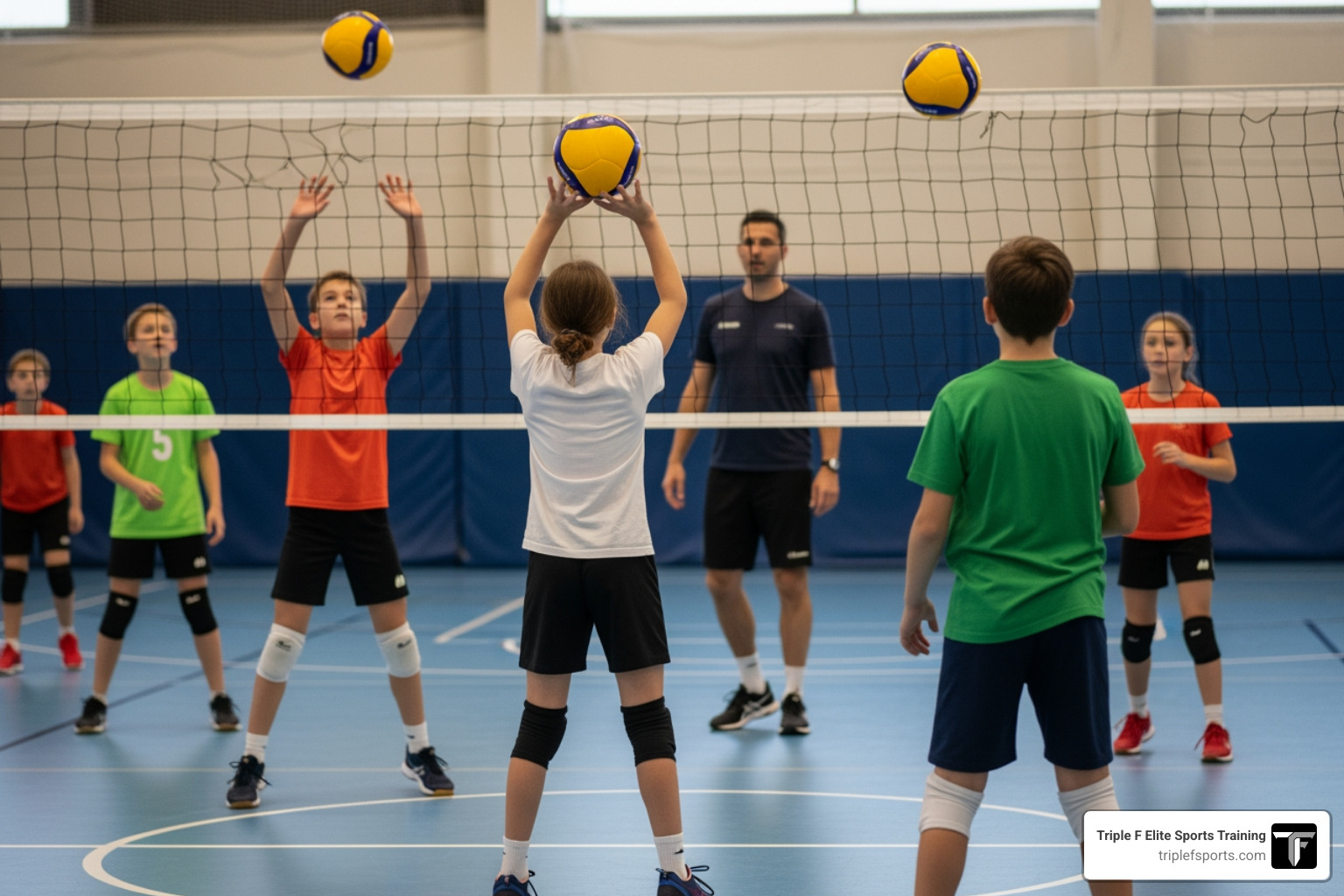
Why Youth Volleyball Training Matters for Young Athletes
Youth volleyball training is essential for developing the fundamental skills, physical abilities, and mental toughness that young athletes need to succeed on the court. Whether your child is just starting out or preparing for competitive play, understanding the right training approach can make all the difference in their development and enjoyment of the sport.
Quick Answer: What You Need to Know About Youth Volleyball Training
- Age Groups: Most programs serve ages 7-14, with some starting as young as 4
- Key Skills: Serving, passing (forearm and overhead), setting, hitting, blocking, and defense
- Training Formats: Instructional programs (skill-focused) vs. competitive leagues (game-focused)
- Game Formats: 4v4 for younger/smaller groups, 6v6 for traditional play
- Best Practice Approach: Gamelike drills that mimic real match situations
- Development Focus: Physical skills + mental toughness + sportsmanship + injury prevention
The landscape of youth volleyball training has evolved significantly over the past three decades. Gone are the days when coaches simply ran repetitive drills that looked good in practice but didn’t translate to game performance. Today’s best programs emphasize what USA Volleyball calls “gamelike drills”—training that mimics the random, chaotic nature of actual matches.
This shift matters because, as research shows, the average player only touches the ball for about two seconds during an entire three-set match. That means most of the game is about positioning, decision-making, and reacting to unpredictable situations—skills that can’t be developed through traditional, blocked drills alone.
For parents in Knoxville seeking quality training, the challenge is finding a program that balances proper skill development with age-appropriate fun while preparing athletes for the next level. Programs range from recreational instructional leagues (perfect for beginners) to competitive club teams (designed for players aiming at middle school, high school, or even collegiate play).
The stakes are real. Many players believe that participation in a club program is the only way to solidify their position on their high school team. While that’s not entirely true, structured training does provide a significant advantage. The key is matching your child’s current skill level and goals with the right type of program.
Beyond the physical skills, effective youth volleyball training addresses the whole athlete. Players aged 10-16 often lack mental toughness and self-confidence. They’re navigating growth spurts that can temporarily disrupt their coordination. They’re learning to balance athletics with academics and social life. The best programs foster team spirit, leadership, and discipline while building volleyball skills.
Safety is paramount. With 70% of sports-related traumatic brain injuries occurring in athletes under 18, proper training in technique—especially for jumping, landing, blocking, and diving—is not optional. Arm care, shoulder health, and injury prevention should be woven into every practice.
I’m Kevin O’Shea, a Certified Strength and Conditioning Specialist at Triple F Elite Sports Training in Knoxville, and I’ve spent years helping young athletes develop both physically and mentally through sports training programs that include youth volleyball training components. While my background spans football coaching and behavioral health, the principles of age-appropriate athletic development and mental resilience apply across all sports, and I’m committed to helping Knoxville’s young volleyball players reach their full potential.
Fundamental Skills and the Core of Youth Volleyball Training
At the heart of every successful player is a rock-solid foundation of the five core skills: Hitting, Overhead Passing (Setting), Serving, Forearm Passing, and Blocking. In our youth volleyball training sessions, we emphasize that these aren’t just isolated movements; they are the tools used to solve the “puzzle” of a live match.
According to the Official USAV Indoor Rules, the game is built on these contacts. If a player can’t serve accurately, the game never starts. If they can’t pass, they can’t set up an attack. We focus on teaching these skills through “whole training” rather than “partial training.” This means instead of just hitting a ball off a stationary tee, we want athletes seeing a ball come over the net, moving their feet, and then executing the swing.
Teaching Youth Volleyball Training Skills to Beginners
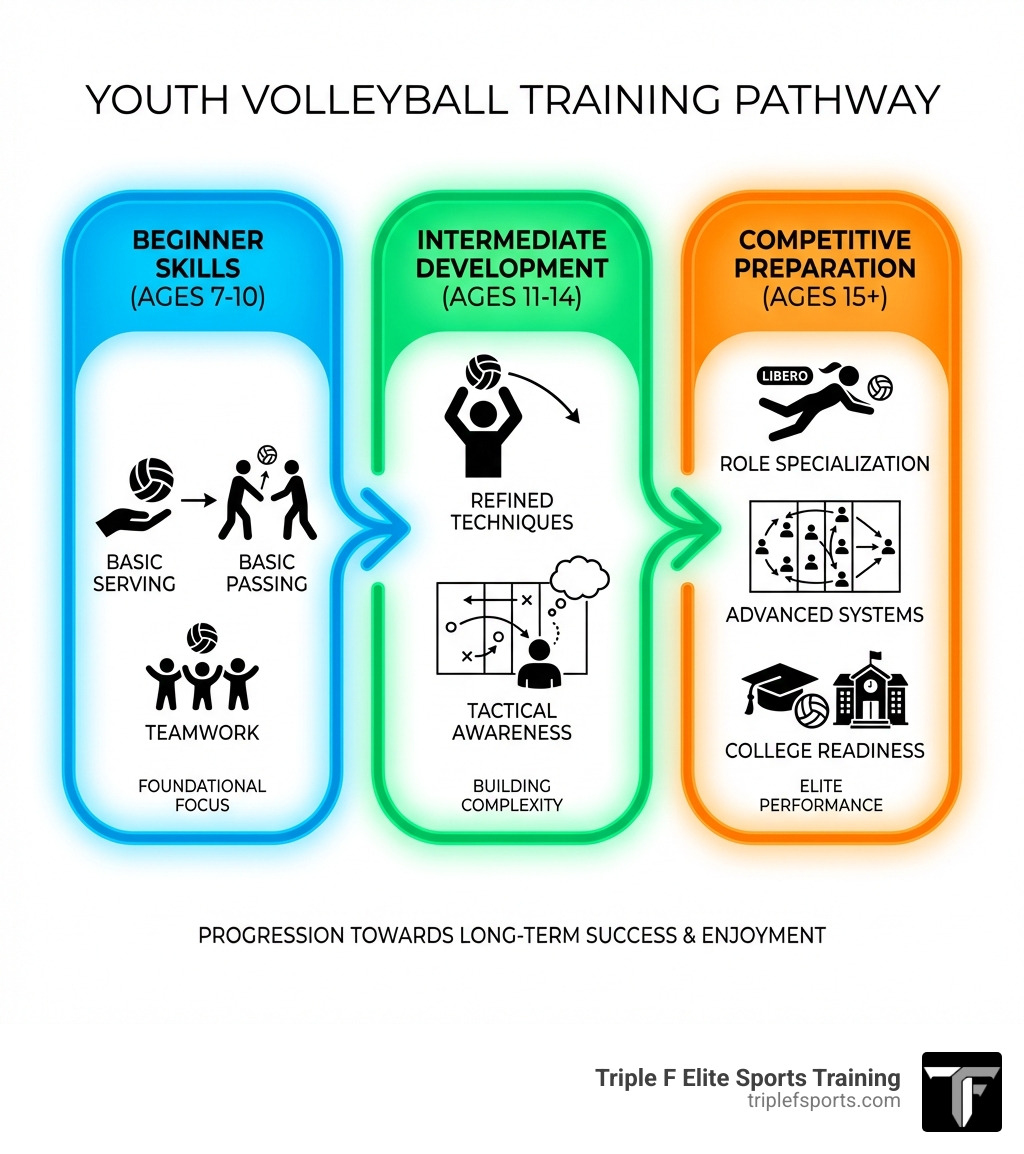
When we work with beginners, our focus shifts toward developing “the athlete” as much as “the volleyball player.” For children ages 7-10, we prioritize:
- Hand-eye coordination: Learning to track a moving object in three-dimensional space.
- Agility: Moving quickly in short bursts, which is the hallmark of the sport.
- Large motor skills: Learning how to jump and land safely.
- Spatial awareness: Understanding where they are on the court in relation to the net and their teammates.
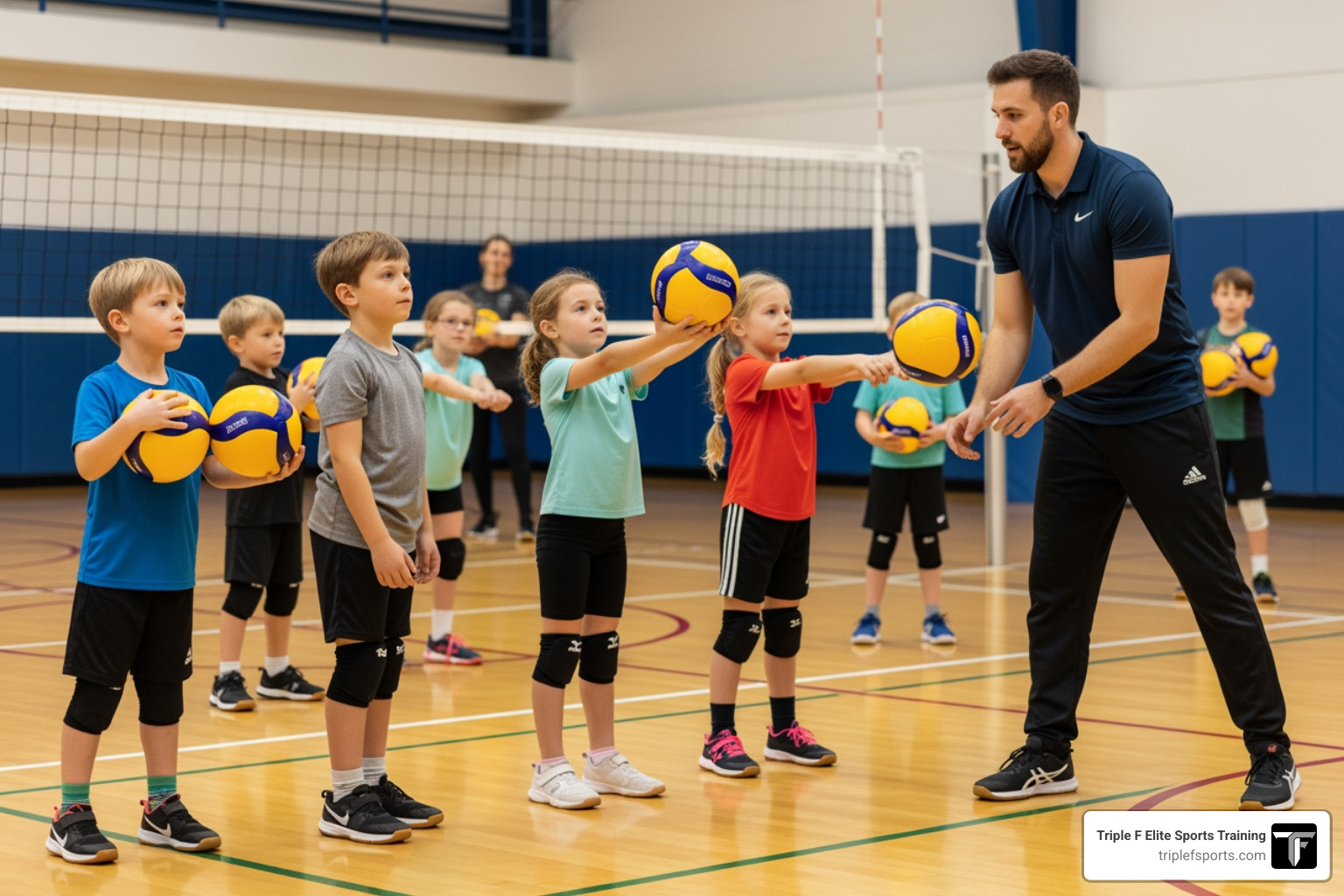
To keep things engaging, we use modified equipment. For the youngest “Volley Tots,” this might mean using lighter balls or lower nets to ensure they experience success early on. We want them to fall in love with the game, not get frustrated by a ball that feels like a lead weight. You can find more info about volleyball services at our facility that cater specifically to these foundational needs.
Advanced Techniques for Competitive Play
As players move into the “Fervid Phase” (typically around age 15 or 16), the training becomes more specialized. This is what the JVA 16U Training Curriculum refers to as the “Dedication Stage.”
At this level, we introduce:
- Jump Serving: Adding power and a higher contact point to put pressure on the opposing serve receive.
- Tempo Sets: Learning to hit “quick” sets to beat the opposing block.
- Reading Defense: Training attackers to look across the net and see where the holes are before they swing.
- Tooling the Block: Using the opponent’s hands to deflect the ball out of bounds for a point.
Age-Appropriate Drills and Practice Formats
The structure of a practice should change as the athlete grows. We don’t coach a 7-year-old the same way we coach a high school senior. One of the biggest mistakes in youth volleyball training is forcing adult-sized systems on child-sized bodies.
For younger groups, we often use a 4v4 format. Why? Because with fewer players on the court, each child gets more “touches” on the ball. Small team sizes are the best way to keep kids moving and engaged. As they gain experience and physical size, we transition to the traditional 6v6 format.
| Training Focus | Junior (Ages 7-10) | Senior (Ages 11-14) |
|---|---|---|
| Primary Goal | Motor skill development & Fun | Tactical IQ & Skill Refinement |
| Ball Contact | High frequency / Maximum touches | Quality over quantity / Situational |
| Court Size | Modified / Smaller | Standard |
| Format | 4v4 or “Short Court” | 6v6 and System Play |
| Key Metric | Effort and Participation | Accuracy and Decision Making |
Managing Chaos in Youth Volleyball Training Sessions
If you walk into a productive youth practice and it looks a little messy, don’t worry—that’s often by design! We accept “controlled chaos.” Traditional drills where kids stand in a long line waiting to hit one ball are boring and, frankly, ineffective.
Instead, we use gamelike drills that involve movement and multiple skills. For example, instead of just a “passing drill,” we run a “pass-set-hit” drill where the ball is always live. This type of random training is scientifically proven to lead to better game performance than “blocked training” (doing the same thing over and over).
Coaches can find inspiration in the USA Volleyball Lesson Plans, which provide core drills that keep athletes moving. To manage the “chaos,” we use crisp verbal cues and keep stations rotating every 5-10 minutes.
Transitioning to Middle School and High School Teams
As athletes prepare for school ball, the intensity ramps up. This transition requires a jump in Tactical IQ. Players need to understand offensive systems (like a 5-1 or 6-2) and defensive rotations.
We also begin position exploration. While we want every player to be well-rounded, middle school is often when athletes start to lean toward being a setter, a libero, or a hitter. We help them find where their natural talents shine while ensuring they don’t lose their “all-around” skills. For those ready for the next step, check out more info about 14U Team training to see how we bridge that gap.
Choosing Between Instructional Programs and Competitive Leagues
One of the most common questions parents ask us is: “Should my child do a clinic or join a league?” The answer depends on their current experience and goals.
Instructional Programs are low-stress environments. They are perfect for beginners because the focus is 100% on skill-specific technique. There are no standings, no “must-win” games, and the pressure is off. These are great for building confidence.
Competitive Leagues (often called “Club Volleyball”) are for athletes who want to test their skills against other teams. These programs involve tryouts, travel, and a higher time commitment. We offer Volleyball Pre-Tryout Clinics to help athletes prepare for this jump.
If your athlete is looking for a long-term home to develop, our Volleyball Club Team provides a structured environment that combines elite instruction with high-level competition right here in Knoxville.
Benefits of Gamelike vs. Traditional Drills
We firmly believe in the Specificity Principle: to get better at playing volleyball, you need to… play volleyball.
- Traditional Drills: Often involve a coach tossing a perfect ball. This is “practicing for practice.”
- Gamelike Drills: Involve a ball coming off a teammate’s arms or over the net. This is “practicing for performance.”
Gamelike drills force players to make decisions. They have to ask: “Is that ball mine? Where is my setter? How high is the block?” This mental processing is what separates great players from good ones. We also encourage performance tracking, where players keep score of their own “mini-games” to foster a competitive spirit.
Safety, Sportsmanship, and Holistic Athlete Development
At Triple F, our training is Christ-centered, meaning we care as much about the character of the athlete as we do their vertical jump. Youth volleyball training is a fantastic vehicle for teaching life lessons like resilience and teamwork.
Safety is our first priority. Volleyball players are prone to certain injuries, particularly in the shoulders and knees. We incorporate:
- Injury Prevention: Specific warm-ups that activate the core and glutes.
- Shoulder Health: Exercises to strengthen the rotator cuff and scapular stabilizers.
- Concussion Awareness: Educating players and parents on the signs of head injuries (70% of which happen to youth).
- Landing Mechanics: Teaching players how to land softly on two feet to protect their ACLs.
Our Youth Assessments help us identify any movement “red flags” before they become injuries. From there, our Youth Training (12 to 18) programs build the strength necessary to withstand the rigors of a long season.
Fostering Identity Beyond the Court
It is easy for a young athlete to get so wrapped up in their sport that they feel their entire worth is tied to their performance. We call this a “one-dimensional identity.” We work hard to foster a multidimensional identity. We want our players to see themselves as leaders, students, and teammates—not just “the girl who hits outside.”
Parents play a huge role here. Support your child’s development by focusing on their effort and sportsmanship rather than just the final score. Encourage them to have interests outside of the gym. This actually helps them play better because they aren’t carrying the “weight of the world” into every match.
Frequently Asked Questions about Youth Volleyball
What is the difference between 4v4 and 6v6 formats?
The 4v4 format is typically used for younger or beginning players (ages 7-10). It uses a smaller court and fewer players to ensure every child is involved in every play. The 6v6 format is the standard competitive version used in middle school, high school, and college. It requires more complex rotations and specialized positions.
How can coaches keep practices engaging for younger children?
The secret is to “gamify” everything! Instead of a “serving drill,” make it a “battleship” game where they try to hit targets on the other side. Keep instructions short (under 60 seconds) and keep the ball moving. If kids are standing in line, they aren’t learning—they’re getting bored.
What are the most important safety considerations for new players?
Proper footwear (volleyball-specific shoes) and knee pads are essential. Beyond gear, the most important safety factor is learning how to land from a jump and how to dive for a ball without using their elbows or knees to break the fall. We also emphasize proper hydration and listening to their bodies to prevent overuse injuries.
Conclusion
Youth volleyball training is a journey that starts with a single serve and can lead to a lifetime of health, friendship, and achievement. Whether your child is a “Volley Tot” just starting to bump the ball or a high schooler eyeing a college scholarship, the right training environment makes all the difference.
At Triple F Elite Sports Training in Knoxville, we are dedicated to helping every athlete open up their full potential. Our facility offers a unique blend of professional performance training, physical therapy, and a competitive volleyball club—all within a Christ-centered community. We believe that better athletes are made through deliberate, science-based work and a supportive environment.
Are you ready to see your athlete soar? We invite you to experience the Triple F difference. Start your journey with Triple F Elite Sports Training today and sign up for a free first session. Let’s get to work!