
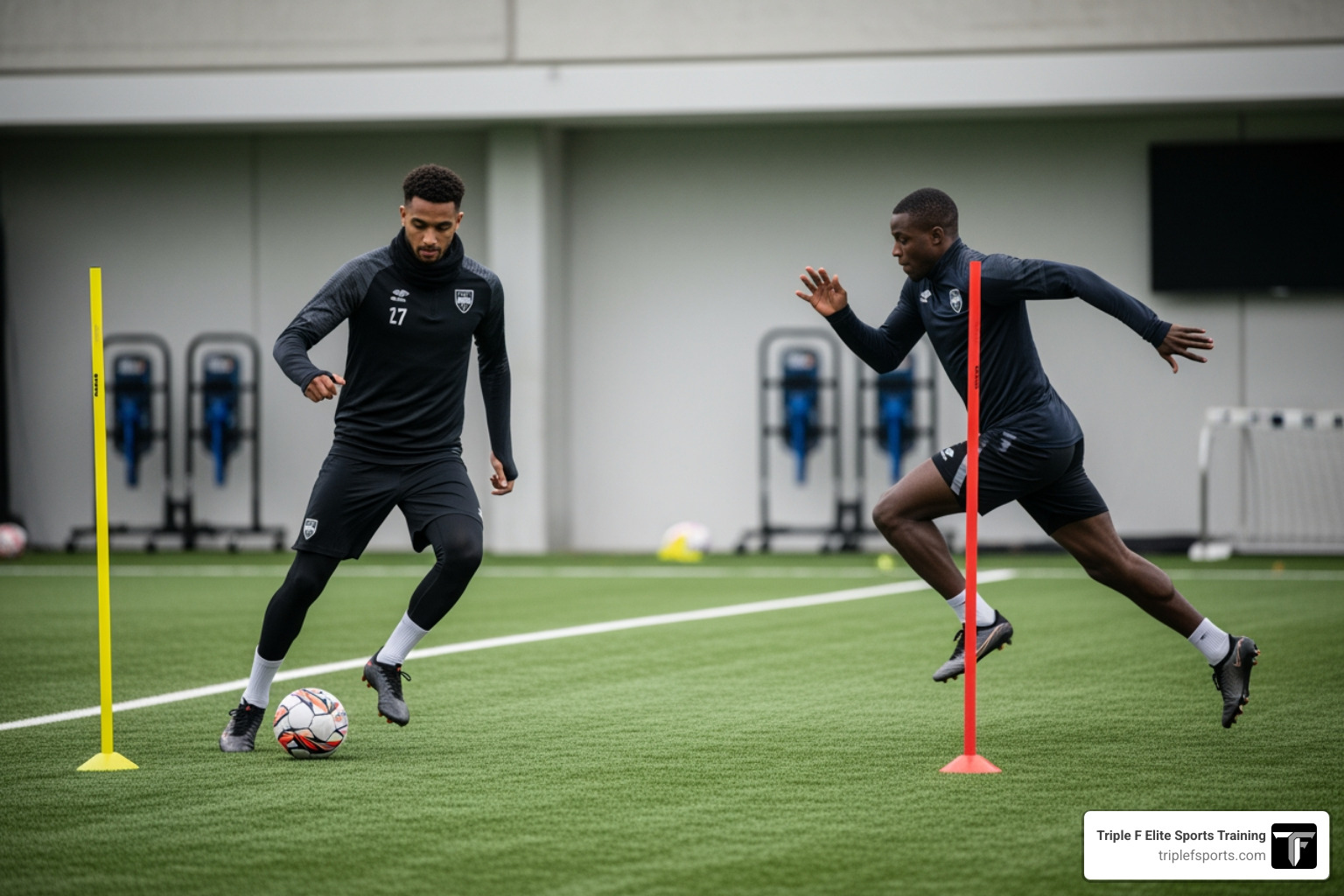
Why Skill Training for Athletes Is the Foundation of Peak Performance
Skill training for athletes is the systematic process of developing sport-specific motor skills through structured practice that integrates technical mastery, tactical understanding, and psychological resilience. Here’s what you need to know:
Core Components of Effective Skill Training:
- Technical proficiency – mastering proper body positioning, timing, and movement execution
- Tactical application – reading the game, anticipating opponents, and making quick decisions
- Mental toughness – maintaining focus, managing anxiety, and performing under pressure
- Progressive learning – advancing through cognitive, associative, and autonomous stages
- Strategic periodization – balancing skill work with strength training across competitive seasons
Whether you’re a youth athlete just starting out or an adult competitor refining your craft, understanding how to train skills effectively can mean the difference between good and great. Research shows that skills are outward signs of neuromuscular proficiency—your brain sending stronger, more precise signals to your muscles. But here’s the catch: exhausted athletes never move particularly fast, and even elite world champions suffer skill deficits when fatigued. That’s why when and how you practice matters just as much as what you practice.
The challenge most athletes face isn’t lack of effort—it’s training smarter with purpose and precision. Many athletes unknowingly waste hours practicing skills when their nervous system is too fatigued to learn effectively, or they pile on endless skill sessions during competitive seasons when their bodies need recovery most.
I’m Kevin O’Shea, a Certified Strength and Conditioning Specialist with eight years of experience in athlete development, including coaching high school wide receivers and now serving athletes at Triple F Elite Sports Training in Knoxville. My approach to skill training for athletes integrates proven motor learning principles with individualized programming that respects each athlete’s developmental stage and competitive demands.
The Fundamentals of Skill Training for Athletes
At its core, skill training for athletes is about more than just repeating a movement until you are tired. It is about embedding biomechanically complex movements into your muscle memory so they can be executed flawlessly under the intense pressure of competition. We define a Sport Skill as the ability to bring about some end result with maximum certainty and minimum outlay of energy or time.
When we talk about technical proficiency, we are looking at the “how” of the movement. For a handball goalkeeper, this might mean mastering the proper technique for saving low shots. For a quarterback in Knoxville, it might mean the precision of the footwork during a three-step drop. But technique alone isn’t enough. We must also develop tactical understanding—the “when” and “why.” This involves reading the game, anticipating what an opponent will do, and making split-second decisions.
One of the most overlooked benefits of high-quality Skilled-Based Training is injury prevention. By teaching the body the safest and most efficient ways to move, we minimize the risk of “wear and tear” or acute injuries caused by poor mechanics. For example, the International Handball Federation emphasizes that proper technique in goalkeeping not only improves save percentages but also protects the joints during explosive movements.
Finally, we cannot ignore psychological resilience. Skill training is the perfect laboratory for building mental toughness. It requires the athlete to stay focused during repetitive drills and to maintain composure when a new skill feels difficult to master. This neuromuscular proficiency is what allows an athlete to “play on autopilot” when the game is on the line.
The Three Stages of Motor Learning and Skill Acquisition
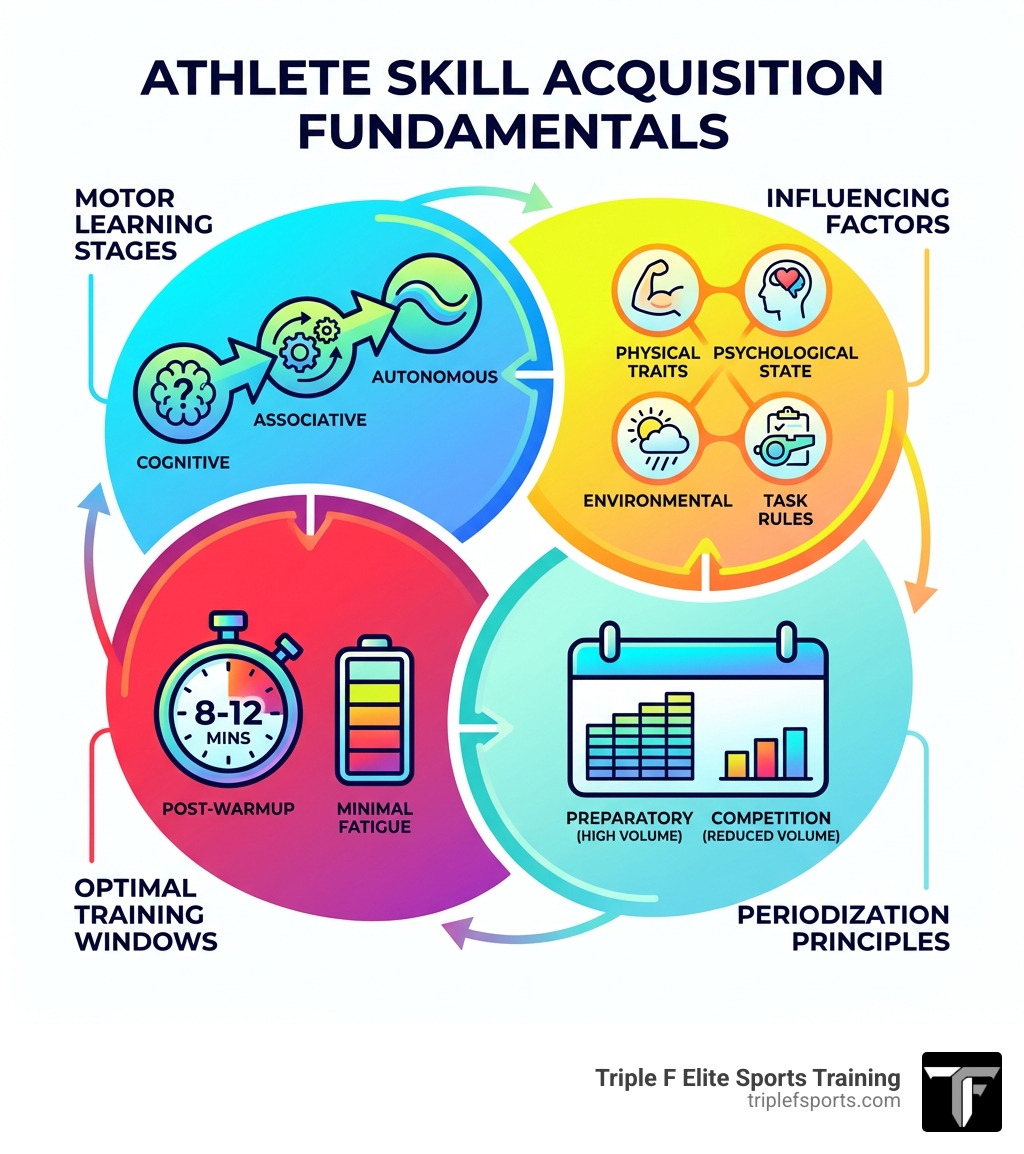
How do we actually learn a new skill? It doesn’t happen all at once. According to the research in Motor Learning and Control Concepts, athletes progress through three distinct stages. Understanding where you or your athletes sit in this progression is vital for coaching success.
- The Cognitive Stage (The “What” Phase): This is the beginner level. The athlete is trying to understand the requirements of the task. If you are a novice softball player learning to hit, you are thinking about your grip, your stance, and when to swing. Errors are frequent, and the athlete requires significant feedback. At this stage, we focus on keeping instructions simple.
- The Associative Stage (The “How” Phase): The athlete has grasped the basics. Movements are more consistent, and errors are fewer. Now, the athlete is “associating” the feel of the movement with the outcome. They might realize, “I swung too late because my front foot didn’t land in time.” This is where we increase the complexity of drills.
- The Autonomous Stage (The “Automatic” Phase): This is the elite level. The skill is now habitual. The athlete doesn’t have to “think” about the mechanics; they can focus entirely on the tactical environment (e.g., where the defenders are).
Throughout these stages, we must account for various constraints. As noted in research on Using Constraints in Movement Activities, skill development is influenced by:
- Individual Factors: Physical strength, cardiovascular health, and even psychological states like fear or motivation.
- Environmental Constraints: Whether you are practicing on turf in the Tennessee humidity or on a polished hardwood court.
- Task-Related Factors: The specific rules of the drill, the equipment used (like a weighted ball), and the instructions provided.
By manipulating these constraints, we can create “feedback loops” that force the athlete’s body to find the most efficient movement solution without the coach having to say a word.
Designing High-Performance Drills and Practice Sessions
If you want to maximize skill training for athletes, you have to throw out the “more is better” mentality. In our Future Pros Program, we prioritize quality over quantity. To develop true speed and skill, drills should consist of short, 3-8 second bursts of maximum effort.
Why so short? Because we want to protect “neural freshness.” If a drill lasts 30 seconds, the athlete begins to rely on metabolic endurance rather than neuromuscular precision. To keep the quality high, we utilize a 1:5 work-to-rest ratio. If an athlete sprints for 5 seconds, they need at least 25-30 seconds of rest to allow the nervous system to reset.
Another key factor is how we talk to our athletes. Research on Cueing the Youth Athlete shows that “external cueing” is far more effective than “internal cueing.”
- Internal Cue: “Keep your elbow tucked in.” (Focuses on the body part).
- External Cue: “Trace a path toward the target with your elbow.” (Focuses on the outcome/environment).
External cues lead to faster skill acquisition because they allow the body’s natural motor control systems to take over, rather than forcing the athlete to overthink their anatomy.
Optimizing the Training Window for Skill Training for Athletes
There is a very specific “window” in a practice session where the most learning happens. This window is located immediately after the warm-up, when the athlete is physically warm but the central nervous system (CNS) is not yet fatigued.
We recommend 8-12 minute blocks for dedicated skill and speed work. During this time, the athlete’s brain is most receptive to new patterns. Once metabolic fatigue sets in—when the athlete is “huffing and puffing”—their ability to acquire new skills drops significantly. As the saying goes, a tired athlete is no better than an old dog when it comes to learning new tricks! For more on this paradigm, we look to frameworks like Speed and Skill Optimization, which suggest that if you train slow, you stay slow.
Customizing Skill Training for Athletes Across Experience Levels
The way we train a 12-year-old in our Youth Training 12 to 18 program is vastly different from how we handle NFL Pre-Draft Training.
- For Novices: The focus is on fundamental movement skills—balance, proprioception, and basic mechanics. We keep the environment stable and predictable to build confidence.
- For Advanced Athletes: We introduce “situational reps.” This means adding pressure, unpredictable opponents, and game-like constraints. If an advanced pitcher is struggling with consistency, we don’t just have them throw more balls; we recreate the high-pressure environment of a full count with the bases loaded.
Balancing Skill Work with Strength and Conditioning
One of the biggest mistakes we see in Knoxville is athletes over-scheduling skill sessions (like hitting or pitching lessons) during the height of their competitive season. This often leads to burnout and a plateau in performance. To balance things correctly, we have to understand the Residual Training Effect (RTE).
As shown in the table above, speed and power are “perishable” skills. If you don’t train your maximal speed at least once a week, you start to lose it within 5 days. Conversely, your aerobic engine (endurance) stays with you for about a month. This is why we prioritize speed and power maintenance even during the season.
In our Offensive Line Sports Training, we use a Skills Periodization Framework to manage the load:
- Preparatory Period (Off-Season): High volume of skill acquisition and heavy strength work (2-3x per week).
- Competitive Period (In-Season): Reduced skill sessions (0-1x per week) to focus on game recovery, while maintaining strength (1-2x per week) to prevent injury.
This balance is especially critical for Strength and Conditioning in Female Athletes, who may need more focus on strength to support the biomechanical demands of their specific sport skills.
The Psychological Edge: Mental Skills for Success
You can have the best vertical jump in Tennessee, but if you can’t handle the pressure of a championship game, that physical skill goes to waste. Success in skill training for athletes is heavily dependent on nine specific mental skills that can be learned and trained.
- Positive Attitude: Viewing sport as a way to compete against yourself and learn.
- High Self-Motivation: Finding the internal drive to show up when no one is watching.
- Realistic Goal Setting: Setting targets that are challenging but achievable.
- People Skills: Learning how to communicate with coaches and teammates.
- Positive Self-Talk: Talking to yourself like you would a best friend.
- Mental Imagery: Using visualization to “rehearse” a skill before performing it.
- Anxiety Management: Accepting that “butterflies” are normal and using that energy to perform.
- Emotional Regulation: Staying level-headed regardless of a referee’s bad call or a teammate’s mistake.
- Concentration: Focusing on the “here and now” rather than worrying about the scoreboard.
In our Adult Training programs, we find that these skills are just as applicable to a professional career or a job interview as they are to the football field.
Frequently Asked Questions about Skill Training
How does skill training differ from work capacity training?
This is a crucial distinction we make in our Defensive Line Linebacker Sports Training. Skill training is about neuromuscular proficiency—quality, speed, and precision. It requires the athlete to be fresh. Work capacity training (conditioning) is about metabolic fatigue—teaching the body to endure and recover. Work capacity training belongs at the end of a practice, while skill training belongs at the beginning. If you mix them up, you’re just practicing how to move poorly while tired.
What are the “constraints” that influence skill development?
According to the Skill Training Periodization framework, constraints are the boundaries that shape how an athlete learns. They include:
- Individual: Your height, strength, and current mood.
- Environmental: The weather in Knoxville, the lighting in the gym, or the crowd noise.
- Task: The size of the ball, the number of defenders, or the “rules” of the drill. Coaches use these constraints to “nudge” athletes toward better techniques without over-explaining.
Why is the “training window” so short for speed and skill?
The Central Nervous System (CNS) is like a high-performance computer. It can only run at 100% for a short period before it starts to “overheat” or slow down. Once you hit that 8-12 minute mark of high-intensity skill work, your brain’s ability to send precise signals to your muscles begins to degrade. To get the best results, we prioritize quality over quantity. We’d rather have 10 perfect reps than 50 sloppy ones.
Conclusion
At Triple F Elite Sports Training in Knoxville, we believe that every athlete has untapped potential waiting to be unlocked. By focusing on science-based skill training for athletes, we help our community move faster, play stronger, and stay healthier. Our Christ-centered approach ensures that we are not just building better players, but better people who are equipped with the mental and physical resilience to succeed in all areas of life.
Whether you are looking for Skilled-Based Training to sharpen your technical edge or a comprehensive strength program to power your performance, we are here to support you. We invite you to come experience the Triple F difference—your first session is always on us. Let’s get to work!