
Why Youth Strength Training Belongs in Every Young Athlete’s Plan
Youth strength training is one of the most effective and research-backed tools for building a stronger, healthier, and more injury-resistant young athlete.
Here’s what you need to know at a glance:
- Safe to start: Children as young as 7-8 can safely strength train with proper supervision and form
- Not the same as weightlifting: Youth strength training uses light weights, bodyweight, and resistance bands — not heavy competitive lifts
- Proven benefits: Stronger bones, better sports performance, reduced injury risk, and improved confidence
- Key requirement: Qualified supervision and age-appropriate programming are essential
- Frequency: 2-3 sessions per week, 20-30 minutes each, is the recommended starting point
- Results timeline: Expect measurable gains after 8-12 weeks of consistent training
Despite what many parents worry about, the evidence is clear: when done correctly, youth strength training is safer than most youth sports — and the benefits go far beyond just getting stronger.
Still, a lot of confusion exists. Myths about stunted growth, damaged joints, and “kids being too young to lift” keep many young athletes from accessing one of the most powerful tools available to them. This guide cuts through the noise.
I’m Kevin O’Shea, a Certified Strength and Conditioning Specialist and former college wide receiver, and I’ve built my career around helping young athletes develop the physical and mental foundation they need to excel — making youth strength training a cornerstone of everything we do at Triple F Elite Sports Training. Let’s break down exactly what the science says, how to do it right, and how to build a program that actually works for your child.
Easy youth strength training glossary:
- resistance training for teens
- strength training for youth wrestlers
Is Youth Strength Training Safe? Debunking Common Myths

One of the first questions we hear from parents in Knoxville is: “Is this actually safe for my child?” It’s a valid concern. For decades, old-school myths suggested that lifting weights was a recipe for disaster for developing bodies. However, modern sports science has flipped the script.
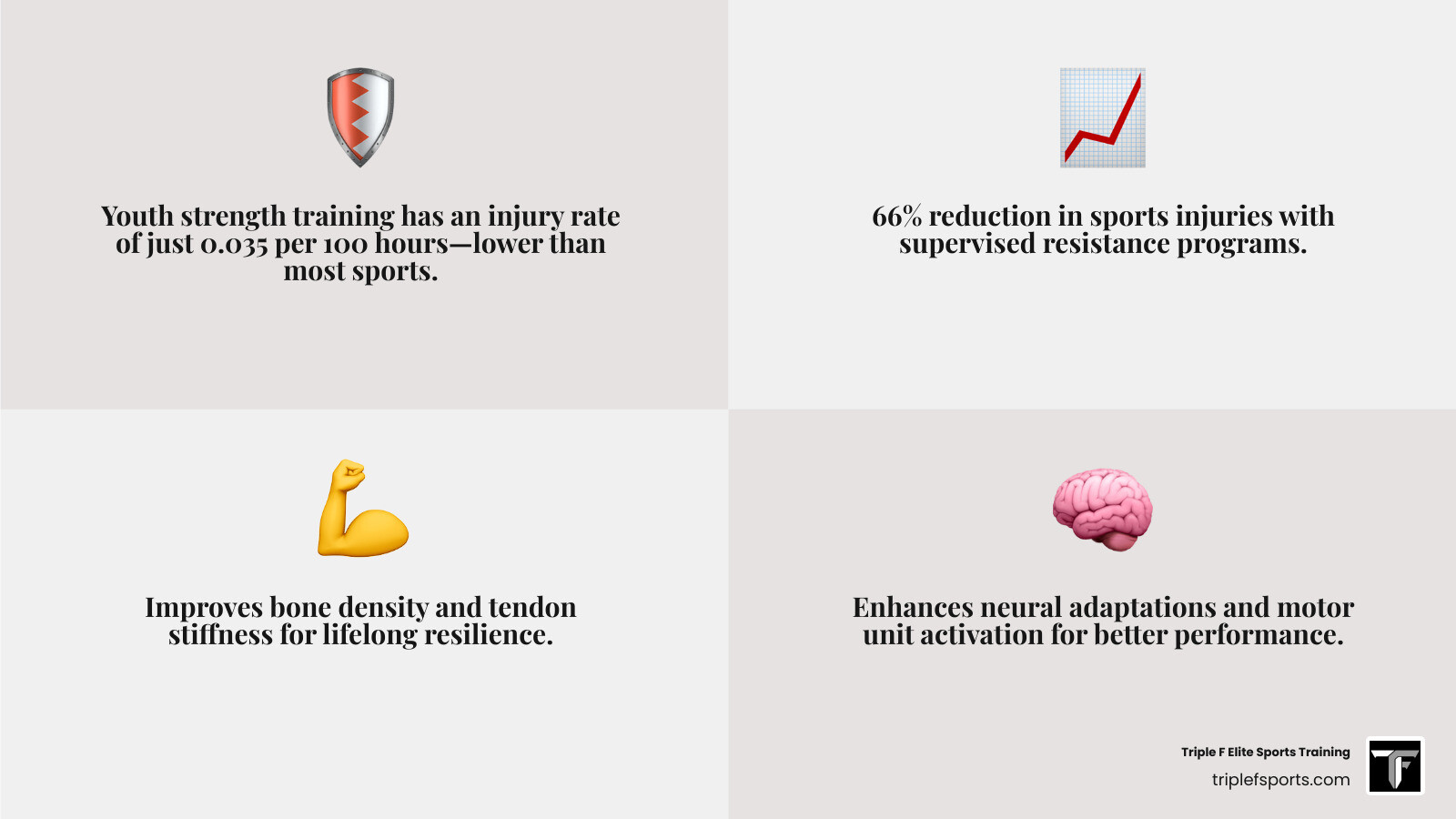
When we talk about youth strength training, we aren’t talking about maximal effort lifts or kids trying to “bulk up” like professional bodybuilders. We are talking about controlled, supervised resistance exercises. Research shows that properly supervised programs have incredibly low injury rates—ranging from 0.035 to 0.055 injuries per 100 participant hours. To put that in perspective, contact sports like rugby have injury rates closer to 0.800 per 100 hours. You can learn more about how we prioritize safety through our Youth Assessments.
Common Myths in Youth Strength Training
Let’s knock down the “big four” myths that often hold parents back:
- Stunted Growth: This is perhaps the most persistent myth. The fear is that lifting weights damages growth plates (the developing cartilage at the ends of long bones). However, there is no scientific evidence that youth strength training stunts growth or negatively impacts linear height. In fact, mechanical loading through resistance training can actually stimulate bone growth and increase bone mineral density. Scientific research on growth plate safety confirms that there is no need to avoid resistance training until the growth plates close.
- Flexibility Loss: Some believe that building muscle makes a child “muscle-bound” or stiff. In reality, performing exercises through a full range of motion actually improves functional flexibility and joint mobility.
- Testosterone Requirements: A common misconception is that children won’t get stronger because they lack the testosterone levels of adults. While kids won’t see the same muscle “hypertrophy” (size increase) as a grown man, they see massive strength gains through neural adaptations—their brains and nervous systems simply get better at “talking” to their muscles.
- Waiting for Skeletal Maturity: Many believe kids should wait until they are 12 or 15 to start. The truth is that maturity is about the ability to follow directions, not just a birthday. If a child is ready for organized sports (usually around age 7 or 8), they are likely ready for foundational strength movements.
Safety Statistics and Injury Prevention
Safety isn’t just about avoiding “heavy” weights; it’s about the environment. Most injuries in youth strength training occur in unsupervised settings, usually from “horseplay,” poor technique, or using equipment that is too large for a child’s frame.
By contrast, research on injury prevention in youth athletes highlights that strength training can actually reduce sports-related injuries by up to 66%. It prepares the tendons, ligaments, and muscles to handle the chaotic forces of a soccer match or a football game. At Triple F, we ensure a safe environment by maintaining low coach-to-student ratios and focusing on movement quality before adding a single pound of resistance.
The Physical and Mental Benefits of Resistance Training
The benefits of youth strength training extend far beyond the weight room. While the primary goal is often “getting stronger,” the physiological and psychological changes we see in young athletes are profound.
Physically, the body undergoes a “neural upgrade.” During childhood and adolescence, the nervous system is highly plastic. Strength training improves motor unit activation—meaning the body learns to recruit more muscle fibers more efficiently. We also see increases in the Bone Strength Index (BSI) and tendon stiffness. Stiffer tendons might sound bad, but in sports, it’s a superpower; it allows for better force transmission, making athletes faster and more explosive.
Athletic Performance and Injury Reduction
If you want your child to stay on the field and out of the physical therapy clinic, strength training is the answer. We’ve seen that targeted resistance work provides:
- 66% reduction in sports injuries: By strengthening the “brakes” of the body (the muscles that control deceleration).
- Rotator cuff protection: Essential for swimmers, baseball players, and tennis athletes.
- Knee stability: Especially for female athletes, combining strength training with plyometrics (jumping and landing drills) significantly reduces the risk of ACL tears.
For those looking to take their game to the next level, our Future Pros Program focuses on these specific performance markers to ensure long-term success.
Psychosocial and Health Outcomes
The “mental gains” are just as important as the physical ones. Youth strength training has been shown to:
- Boost Self-Esteem: There is a unique confidence that comes from realizing you can do something today that you couldn’t do last week.
- Improve Body Composition: It helps manage weight and increases lean muscle mass, which is vital given that obesity rates in adolescents have quadrupled over the last 30 years.
- Enhance Mental Health: Regular resistance training is linked to reduced symptoms of anxiety and depression in teens.
- Establish Healthy Habits: It sets the foundation for a lifetime of physical activity, showing kids that exercise can be a fun, rewarding part of daily life.
How to Structure an Effective Youth Strength Training Program
Structuring a program for a 7-year-old is vastly different from training a 17-year-old. We follow the F.I.T.T. principle (Frequency, Intensity, Time, and Type) while tailoring the experience to the child’s developmental stage.
Training Guidelines by Age Group
| Age Group | Focus | Frequency | Sets/Reps |
|---|---|---|---|
| 7-10 Years | Foundational movements, bodyweight, fun, coordination. | 2 days/week | 1-2 sets, 10-15 reps |
| 11-14 Years | Technique mastery, introducing light external resistance. | 2-3 days/week | 2-3 sets, 8-12 reps |
| 15-18 Years | Progressive overload, sport-specific tailoring, increased intensity. | 3-4 days/week | 3-4 sets, 6-12 reps |
For families looking for consistent development, we offer various Youth Memberships that provide the structure needed for these different stages.
The Role of Progressive Overload in Youth Strength Training
The secret sauce of any strength program is progressive overload. This doesn’t mean adding 20 pounds to the bar every week. In youth strength training, we follow the 5-10% rule. Once a child can comfortably perform 15 repetitions of an exercise with perfect form, we increase the resistance by only 5% to 10%.
If a child cannot complete at least 10 repetitions, the weight is too heavy. Form mastery always comes first. We use movement analysis to ensure that the athlete isn’t compensating with their lower back or other joints. If the form breaks down, the set is over.
Age-Specific Guidelines and Progression
- The Foundation (Ages 7-10): At this stage, it’s all about “physical literacy.” We use games, obstacles, and bodyweight exercises like squats, push-ups, and planks. The goal is to make the gym a place they love to be.
- The Transition (Ages 11-14): As kids enter puberty, we begin introducing more complex movements and light equipment like medicine balls and resistance bands. This is the “golden window” for developing general athleticism.
- The Performance Stage (Ages 15-18): Here, the training starts to look more like an adult program, but with a heavy emphasis on recovery and sport-specific needs. We might focus more on explosive power for a volleyball player or rotational strength for a baseball player.
Essential Components: Form, Equipment, and Nutrition
Success in the weight room is built on three pillars: how you move, what you use, and how you fuel. In a professional setting like Triple F, we maintain a 1:10 coach-to-student ratio. This ensures that every rep is watched, and every athlete learns proper weight room etiquette—like how to spot a partner and how to properly store equipment.
Equipment Selection for Developing Bodies
You don’t need a massive commercial gym to start youth strength training, but you do need the right tools.
- Bodyweight: The most important “equipment” is the athlete’s own body. Mastering the squat, lunge, and push-up is mandatory before adding weights.
- Free Weights: Dumbbells and kettlebells are great because they allow for natural movement patterns and engage stabilizer muscles.
- Resistance Bands & Medicine Balls: These are excellent for developing “velocity” and power without the high joint stress of heavy iron.
- Machines: While useful, we have to be careful. Most machines are designed for adult frames. If a child doesn’t fit the machine perfectly, it can force their joints into awkward, unsafe positions.
Recovery and Nutritional Considerations
You don’t get stronger in the gym; you get stronger while you sleep. Recovery is where the magic happens.
- Protein Intake: Active youth athletes should aim for approximately 1.5g of protein per kilogram of body weight. This provides the building blocks for tissue repair.
- Hydration: Water is the best choice. While sports drinks have a place during intense, long-duration events, water should be the primary source of hydration.
- Sleep: Adolescents need 8-10 hours of sleep for optimal hormonal regulation and muscle recovery.
- Rest Days: We recommend at least one or two days of rest or “active recovery” (like a light walk or swimming) between strength sessions.
For a deeper dive into fueling, check out this research on nutritional recommendations for young athletes.
Frequently Asked Questions about Youth Strength Training
At what age can my child safely start strength training?
Most experts, including the National Strength and Conditioning Association (NSCA), agree that kids can start around age 7 or 8. The real “test” isn’t age, but maturity. Can they follow multi-step directions? Do they have the balance and body control to perform basic movements? If they are ready for a local soccer or little league team, they are likely ready for a foundational strength program.
What is the difference between strength training and weightlifting?
This is a big one!
- Strength Training: A general term for using resistance (bands, weights, bodyweight) to build strength and health. This is what we recommend for youth.
- Weightlifting (Olympic Lifting): A competitive sport involving the “Snatch” and “Clean & Jerk.”
- Powerlifting: A competitive sport focused on the maximal weight for the Squat, Bench Press, and Deadlift.
- Bodybuilding: Focused purely on muscle size and aesthetics.
While Olympic lifting can be taught to older, experienced teens, we generally avoid competitive powerlifting and bodybuilding for pre-pubescent children to protect their developing skeletal systems.
How long does it take to see results from a youth program?
Consistency is key. You can expect to see measurable results in strength and coordination after 8 to 12 weeks. Interestingly, if a child stops training, they can lose about 3% of their strength per week, with most gains disappearing after 8 weeks of inactivity. This is why we emphasize building a year-round habit rather than just a “pre-season” burst.
Conclusion
Youth strength training isn’t just about winning the next game; it’s about building a foundation for lifelong health and confidence. By starting early with the right guidance, young athletes in Knoxville can unlock their full potential while staying safe and injury-free.
At Triple F Elite Sports Training, we are committed to providing a Christ-centered, professional environment where your child can grow physically and mentally. Whether they are a 7-year-old just starting to move or a 17-year-old chasing a college scholarship, we have the expertise to help them reach the podium.
Ready to see the difference for yourself? Claim your youth free session today and let’s get started. You can also find more info about youth training 12 to 18 to see how we progress our athletes as they grow.