

Why Every Lineman Needs a Dedicated Workout Program
A lineman workout program is a structured training plan built around the unique physical demands of playing in the trenches — or working on utility poles. Here’s what an effective one covers:
- Absolute strength — squat, deadlift, and press variations to build a powerful base
- Explosive power — Olympic lifts and plyometrics for a fast, violent first step
- Dynamic trunk control — core stability that lets you rotate, redirect, and hold your ground
- Grip strength — essential for blocking, climbing, and controlling opponents or equipment
- Agility and speed — directional drills that keep big athletes moving efficiently
- Recovery and nutrition — the often-skipped layer that makes every other piece work
Whether you’re a football lineman winning battles at the line of scrimmage or an electrical lineman hauling gear up a 120-foot pole, the physical demands are extreme — and general fitness programs simply don’t cut it.
The trenches reward athletes who are specifically trained for them. That means size, power, and endurance working together — not just one or two of those things.
I’m Kevin O’Shea, a Certified Strength and Conditioning Specialist and former collegiate wide receiver, and I’ve spent years developing position-specific training — including a lineman workout program — that builds athletes from the ground up. In the sections ahead, we’ll break down exactly how to train for the trenches, week by week.
Physical Demands of the Trenches: Football vs. Electrical Linemen
When we talk about a lineman workout program, we aren’t just talking about one type of athlete. In Knoxville, we see both football players looking to dominate the SEC and trade professionals preparing for the rigors of utility work. Both require a body forged for “trench warfare,” but the specific stressors vary.
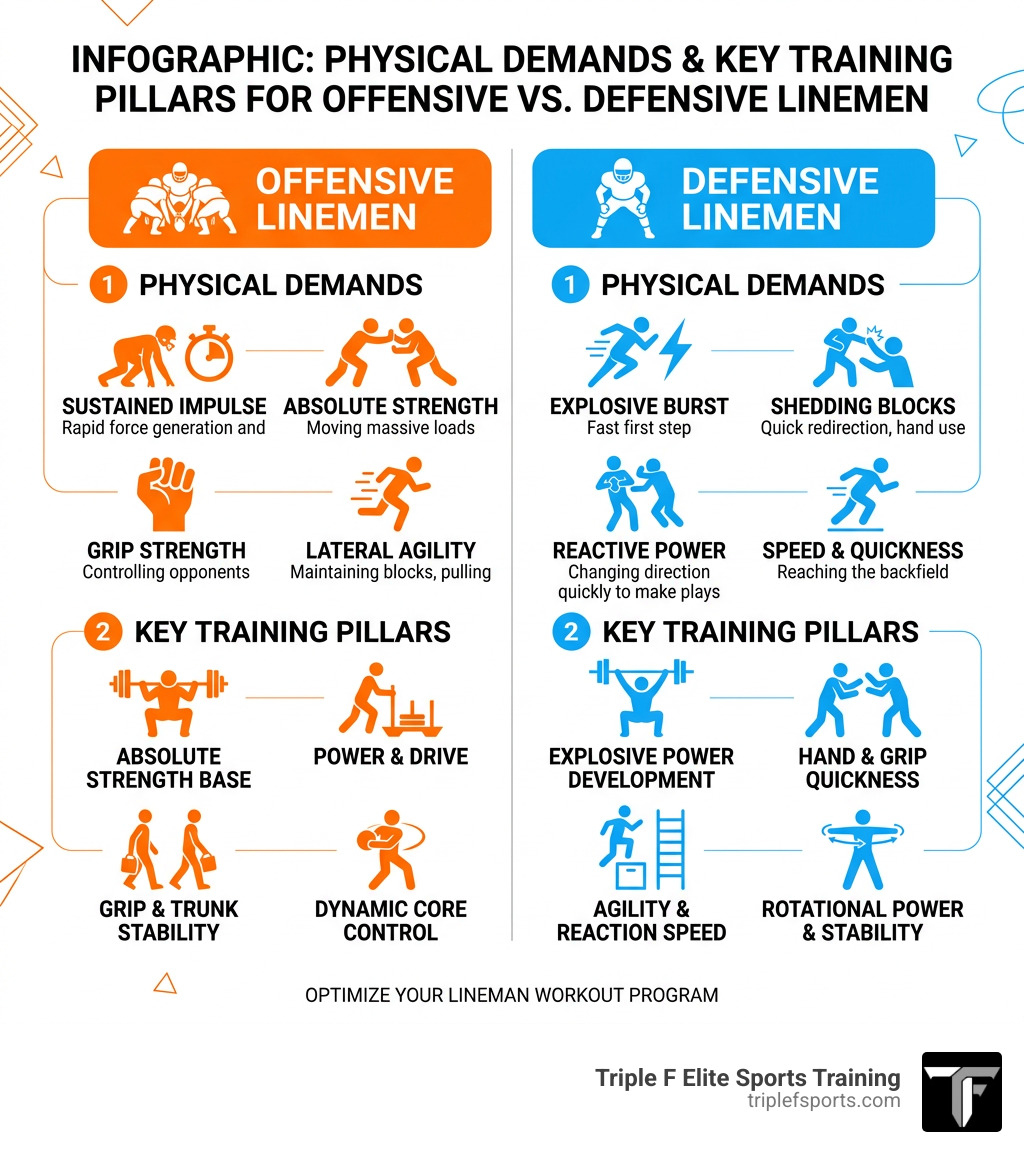
For the football lineman, the game is won in milliseconds. Research shows that offensive linemen typically make contact with the defensive line in just 0.4 seconds after the snap. That engagement usually lasts only about another half-second before a block is either sustained or shed. This requires what we call “sustained impulse”—the ability to generate massive force instantly and hold it against a resisting opponent.
On the other hand, electrical linemen face a marathon of strength. A standard utility pole is about 35 feet tall, but some reach a staggering 120 feet. These professionals must climb all day long while hauling heavy gear and pulling thick cables. For them, fitness isn’t just about performance; it’s about safety. Dehydration and poor conditioning are the leading causes of injury during the first few weeks of lineman school.
Whether you are firing off the ball or scaling a pole, you need a foundation of offensive line sports training that emphasizes functional movement over “beach muscles.” We focus on Triphasic training principles—concentrating on the eccentric (lowering), isometric (holding), and concentric (exploding) phases of a lift—to ensure our athletes can handle the violent redirects of the trenches.
Core Pillars of an Effective Lineman Workout Program
To build a dominant lineman, we don’t just “lift heavy.” We build an athletic technician. A successful lineman workout program must address four specific pillars:
- Absolute Strength: The ability to move maximum weight. This adds the necessary mass and “anchor” to your frame.
- Dynamic Trunk Control: This is more than just “six-pack abs.” It’s the ability to maintain a rigid spine while your limbs are moving and rotating under heavy loads.
- Impulse Endurance: This is the ability to repeat near-maximal explosive efforts. Think about the fourth quarter; you need to be just as explosive on the last play as you were on the first.
- Force Production: Training your nervous system to recruit “high threshold motor units” quickly.
Our approach to defensive line linebacker sports training focuses on these pillars to ensure that when you hit an opponent, they feel the full weight of your training.
Essential Exercises for a Lineman Workout Program
If you want to own the line of scrimmage, your exercise selection must be purposeful. We prioritize movements that transfer directly to the field or the job site.
- Trap-Bar Deadlift: This is our “bread and butter.” We aim for our athletes to eventually pull 2–3x their body weight. It builds massive lower-body force without the technical complexity of a straight-bar pull.
- Box Front Squats: These are superior for linemen because they mimic the “hips-back” blocking stance. By sitting on a box, you break the eccentric-concentric chain, forcing you to explode from a dead stop—exactly like firing out of a three-point stance.
- Hang Power Cleans: To develop that violent “pop” in the hips, we use Olympic lift variations.
- Unilateral Strength (Cossack Squats and Lunges): Linemen often engage on one foot or in wide, staggered stances. Training one leg at a time ensures you don’t have “strength leakage” when you’re off-balance.
How to Progress Your Lineman Workout Program Over 12 Weeks
You can’t go 100% all year round. We use periodization to peak our athletes for the season. A standard 12-Week Off-Season Lineman Workout Program is typically broken into three phases:
- Phase 1 (May – Hypertrophy & Technique): Focus on 60-70% intensity. We are building muscle mass and mastering the movements.
- Phase 2 (June – Strength & Power): Intensity jumps to 70-80%. We start adding speed to the lifts and increasing the weight.
- Phase 3 (July – Peak Power & Conditioning): We hit 80-100% of maxes. This phase includes heavy singles and high-intensity conditioning to prepare for training camp.
This structured progression is vital for youth training 12 to 18, as it prevents burnout and ensures the body is resilient enough to handle the collision-heavy nature of the sport.
Agility, Plyometrics, and Explosive Power
Being “big” is only half the battle. If you can’t move your feet, you’re just a stationary target. We incorporate “directional speed” and “transitional agility” into every lineman workout program.
We use drills like the L-Drill and the 5-10-5 shuttle to teach linemen how to sink their hips and change direction without losing momentum. Plyometrics, such as box jumps and lateral hops, are used to train the “stretch-shortening cycle” of the muscles.
For our offensive linemen, we focus heavily on “hip projection.” This is the ability to throw your hips forward into a block. We often use tools like Just Jump Mats to measure vertical and broad jumps, providing instant feedback on an athlete’s explosive capacity.
Short sprints are also non-negotiable. We keep them between 10-40 yards. A lineman rarely runs 100 yards in a straight line, but they frequently have to sprint 10 yards to pull on a run play or chase down a screen.
Sample Weekly Routines and Equipment-Free Options
We understand that not everyone has access to a world-class facility like Triple F every single day. That’s why a versatile lineman workout program should include both heavy-duty gym work and bodyweight circuits that can be done at home or on a job site.
| Day | Gym-Based Strength Routine | Equipment-Free Home Workout |
|---|---|---|
| Monday | Max Effort Lower (Deadlifts, Box Squats) | 30-Min Circuit: Air Squats, Lunges, Burpees |
| Tuesday | Max Effort Upper (Bench Press, Rows) | Push-up Variations, Plank Holds, Dips |
| Wednesday | Active Recovery (Yoga, Light Walking) | Active Recovery (Mobility Work) |
| Thursday | Dynamic Effort Lower (Speed Cleans, Jumps) | Jump Squats, Mountain Climbers, Bear Crawls |
| Friday | Dynamic Effort Upper (Speed Press, Pull-ups) | Towel Wrings, Core Circuit, 20-Min Jog |
| Weekend | Rest / Active Play | Rest / Active Play |
For those in the utility industry, NLC Workouts suggest 30-minute continuous circuits to simulate the endurance needed for climbing. These include high-rep air squats and planks to build the “slow-twitch” stability required for long hours on a pole.
Improving Grip Strength and Core Stability
In the trenches, if you can’t grab and control your opponent, you lose. For electrical linemen, grip is a matter of life and death when handling ropes and tools 100 feet in the air.
- Farmer’s Carries: Grab the heaviest dumbbells or buckets you can find and walk for 100 feet. This builds “crushing” grip strength and total-body stability.
- Towel Wrings: A simple but brutal exercise. Take a wet towel and wring it out 50 times. Your forearms will be screaming.
- Sandbag Cleans: Unlike a barbell, a sandbag shifts. This simulates a live human opponent, forcing your core to stabilize against an unpredictable load.
- Russian Twists & Planks: These build the rotational and anti-rotational strength needed to hold a block or stay stable while reaching out from a utility pole.
Recovery, Nutrition, and Performance Tracking
You don’t get stronger in the gym; you get stronger recovering from the gym. For big athletes, recovery is often the hardest part because of the sheer amount of stress placed on the joints.
Nutrition & Hydration Linemen need fuel. We recommend a baseline of 0.7 to 1.0 grams of protein per pound of body weight to support muscle repair. Hydration is even more critical. For electrical linemen in the Tennessee heat, losing just 2% of body weight in water can lead to a massive drop in mental and physical performance. We suggest adding electrolytes to your water to maintain muscle function during long shifts or practices.
The Speed Endurance Test How do you know if your lineman workout program is working? We use the “10 x 40-yard sprint” test. You perform 10 sprints with only 20 seconds of rest between them. The goal is to have at least 8 of those sprints within 0.55 seconds of your best 40-yard time. If you can do that, you have the “impulse endurance” to dominate the fourth quarter.
We also use youth assessments to track metrics like vertical jump, bar speed, and body composition. If your body fat is climbing while your strength stays the same, your recovery is likely lagging.
Frequently Asked Questions about Lineman Training
What is the best workout for a high school lineman?
The best workout for a high schooler focuses on the “Big Three” (Squat, Bench, Deadlift) while incorporating plenty of bodyweight movements like pull-ups and dips. At this age, mastering technique is more important than the weight on the bar. A 3-day-per-week full-body split often yields the best results without overtraining.
How do linemen improve their speed off the ball?
Speed off the ball is about “explosive hip projection.” You improve this through plyometrics (box jumps) and weighted “speed” reps where you move 50-60% of your max as fast as possible. We also practice starts from various stances—2-point, 3-point, and 4-point—to ensure the nervous system is primed to react to the whistle.
Why is grip strength so important for linemen?
For football players, grip allows you to “lock on” to an opponent’s jersey or shoulder pads within the rules of blocking. For utility linemen, grip strength is essential for knots, splices, and climbing. If your grip fails, your technique fails shortly after.
Conclusion
Building a body for the trenches isn’t about being the biggest person on the field—it’s about being the most powerful, stable, and resilient. A dedicated lineman workout program turns a “big guy” into an athletic technician capable of winning every engagement.
At Triple F Elite Sports Training in Knoxville, we take a Christ-centered approach to athletic development. We aren’t just here to help you lift more weight; we’re here to help you unlock your full potential as an athlete and an individual. Whether you’re looking for offensive line sports training to prepare for the upcoming season or you want to improve your functional fitness for a demanding career, our team is ready to help you forge your body for the trenches.
Ready to dominate the line? Come visit us in Knoxville for your free first session and let’s get to work.