
Why Adult Sports Performance Is the Missing Link in Your Fitness Routine
Adult sports performance training is one of the most effective ways for active adults to build real-world strength, move better, and stay in the game longer — whether you’re a former college athlete or a weekend warrior picking up pickleball.
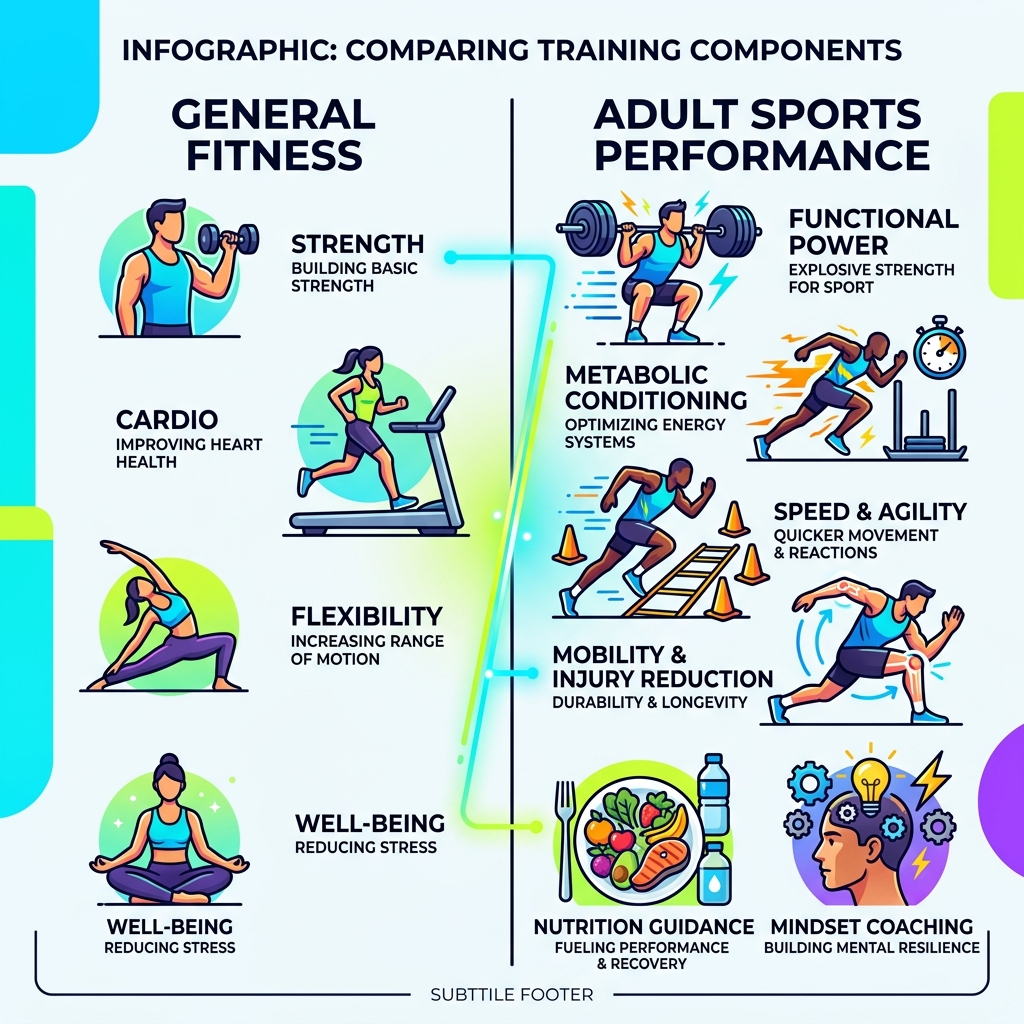
Here’s what adult sports performance training typically includes:
- Strength training – building functional power for sport and daily life
- Speed and agility work – improving movement efficiency and reaction time
- Metabolic conditioning – boosting cardiovascular capacity and endurance
- Mobility and flexibility – keeping joints healthy and reducing injury risk
- Nutrition guidance – fueling performance and recovery
- Mindset coaching – building the mental resilience to train consistently and compete confidently
This is not the same as a standard gym membership. General fitness keeps you moving. Sports performance training makes you better at moving — with a purpose behind every exercise.
The demand for this type of training has grown fast. Facilities across the country now report training over a million athletes — from youth players to adults in their 40s and 50s — using the same systems once reserved for professional sports organizations.
That shift matters. Elite training methods are no longer locked behind locker room doors. They’re available to any adult willing to put in the work.
I’m Kevin O’Shea, a Certified Strength and Conditioning Specialist, former college wide receiver at Franklin & Marshall, and co-founder of Triple F Elite Sports Training — and adult sports performance is something I’ve lived on both sides of the barbell. My background in athletic development, high school football coaching, and behavioral health gives me a unique perspective on what it really takes for adults to perform at their best, mentally and physically.
What is Adult Sports Performance Training?
If you’ve ever spent an hour on a elliptical staring at a wall and wondered, “What is this actually doing for my golf swing?” you already understand why Adult sports performance exists.
At its core, adult training is the process of applying elite athletic development principles to the physiological needs of adults. While youth training focuses on building foundational movement patterns, adult performance training is about refining those patterns, reclaiming lost explosiveness, and ensuring longevity.
We often see two types of people walk through our doors in Knoxville. First, there are the former athletes—the ones who played college ball and still have that competitive fire but find that their old “max out every day” routine now leads to more ibuprofen than progress. Second, we see active adults (often 35+) who have discovered a new passion for recreational sports like tennis or obstacle course racing and realize they need a body that can keep up with their ambitions.

The Science of Moving Better
Unlike a standard “boot camp” that just aims to make you sweaty, performance training focuses on neuromuscular training. This is essentially teaching your brain to send faster, more precise signals to your muscles. By improving movement mechanics, we don’t just make you stronger; we make you more efficient. You can see how this looks in practice by watching performance training in action.
We focus on three-dimensional movements. Life and sports don’t happen in a straight line on a machine; they happen in rotations, side-to-side lunges, and sudden stops. Our goal is to make sure your body is prepared for all of it.
Core Components of an Elite Athletic Program
To reach your peak, you can’t just pick up heavy things and put them down. You need a structured approach. A true Adult sports performance program is built on several pillars that work together to create a resilient, capable athlete.
1. Functional Strength and Power
We focus on “movement-based strength.” Instead of isolating a single muscle (like a bicep curl), we train patterns like the squat, hinge, push, and pull. This builds the kind of power production that translates to a more explosive first step on the court or a more stable core during a long hike. For many adults, semi-private training is the “sweet spot” here, allowing for personalized coaching on complex lifts while maintaining the energy of a group.
2. Speed and Agility
Who says adults can’t be fast? While you might not be trying to clock a 4.4-second 40-yard dash, speed and agility training are vital for joint health and metabolic conditioning. We use drills that focus on foot contact mechanics and reaction time. This keeps your fast-twitch muscle fibers active, which is one of the first things we tend to lose as we age if we don’t train them.
3. Metabolic Conditioning
We don’t do “cardio” in the traditional sense. We use interval-based conditioning that mimics the “work-rest” ratios found in sports. This builds a massive gas tank without the joint wear-and-tear of running miles on a hard pavement.
| Feature | Standard Gym Workout | Adult Sports Performance |
|---|---|---|
| Primary Goal | General health / Weight loss | Athleticism / Movement Quality |
| Methodology | Random exercises / Muscle isolation | Progressive programming / Movement patterns |
| Coaching | Minimal or “check-in” based | Career strength & conditioning pros |
| Tracking | Usually none or “calories burned” | Data-driven (speed, power, strength) |
| Injury Focus | Often ignored until it happens | Built-in prevention and “prehab” |
4. Sport-Specific Skills
Are you a golfer looking for more clubhead speed? A tennis player tired of “tennis elbow”? Or a pickleball enthusiast who wants to dominate the kitchen? We tailor the accessory work in our programs to help you excel in your specific sport. By focusing on rotational power and lateral stability, we help you stay competitive and, more importantly, injury-free.
Integrating Nutrition and Mindset for Adult Sports Performance
You can’t out-train a bad diet, and you certainly can’t perform if your head isn’t in the game. In our Knoxville facility, we believe that elite performance requires a holistic approach.
Nutrition coaching isn’t about “dieting”; it’s about fueling. Our registered dietitians work with adults to create individualized plans that support energy levels throughout the workday and recovery after a tough session. We focus on long-term habits—things like protein timing for muscle repair and hydration strategies for performance longevity.
Equally important are the psychological skills for peak performance. Mental resilience isn’t just for the pros. It’s for the parent who has to find the discipline to train after a 10-hour workday. It’s for the athlete coming back from a nagging injury who needs to trust their body again. We integrate stress management and mindset coaching to help our members build the grit needed to succeed both in the gym and in life.
Recovery and Injury Prevention Strategies
In your 20s, you might have been able to roll out of bed and sprint. In your 40s, that’s a recipe for a pulled hamstring. For the adult athlete, recovery is not “time off”—it is a proactive part of the training cycle.
Our approach to sports medicine and physical therapy for athletes is what we call “athlete-centered.” We don’t just want to get you “back to walking”; we want to get you back to competing.
The Proactive Recovery Toolkit
- Mobility and Flexibility: We use active stretching and foam rolling to ensure your joints move through their full range of motion.
- Dry Needling: A fantastic tool for treating trigger points and myofascial pain that can crop up from repetitive sports movements.
- Chiropractic Care: Focuses on the neuro-musculoskeletal system to keep everything in alignment.
- Injury Rehabilitation: If you are recovering from surgery (like an ACL repair), our “Return to Play” protocols bridge the gap between clinical physical therapy and full-speed competition.
By incorporating “movement as medicine,” we address the root causes of pain—often inefficient movement patterns—rather than just treating the symptoms.
Getting Started with Professional Coaching
The biggest hurdle for most adults is simply knowing where to start. You don’t just walk in and start throwing around heavy weights. Every journey at Triple F begins with a professional assessment.
The Assessment Process
Before you lift a single weight, we need to know your “starting line.” This involves:
- Injury History: Understanding where you’ve been so we can plan where you’re going.
- Movement Screen: Identifying any imbalances or “energy leaks” in how you move.
- Goal Setting: Are you training for a specific event, or do you just want to be the strongest version of yourself?
Once we have this data, we create a personalized game plan. We track your progress over time—measuring improvements in strength, speed, and body composition—to ensure the program is actually working. If you’re ready to take that first step, you can fill out an athletic intake form to get the ball rolling.
Choosing the Right Adult Sports Performance Membership
We know that adults have busy lives, which is why we offer flexible adult memberships designed to fit your schedule.
- Group Sessions: These 60 to 75-minute classes provide a “competitive but supportive” environment. There’s a certain magic that happens when you’re training alongside other people who are also pushing their limits.
- One-on-One Coaching: If you have very specific goals or are navigating a complex injury, private coaching offers the highest level of personalized attention.
- Training Frequency: Most of our members find success training 2 to 4 times per week. This allows for enough stimulus to see results while leaving plenty of time for recovery.
If you’re on the fence, we always recommend starting with a free trial session. It’s a no-pressure way to see our facility, meet our coaches, and experience the difference between “working out” and “training.”
Frequently Asked Questions about Adult Athletic Training
How does performance training differ from a standard gym workout?
Standard gyms usually provide you with equipment and leave you to your own devices. Performance training provides you with a system. Every movement has a purpose backed by exercise science. We don’t just want to make you tired; we want to make you better. While a standard gym might track how many calories you burned on a treadmill, we track your power output, your movement quality, and your progress toward specific athletic goals.
Is sports performance training safe for adults over 35?
Not only is it safe, it’s arguably safer than going it alone in a traditional gym. Because our programs are led by certified strength and conditioning professionals, we place a massive emphasis on proper form and technique. We scale every exercise to your current ability level. If a certain movement doesn’t work for your shoulders or knees due to a past injury, we have the expertise to provide a modification that still gives you the desired training effect without the risk.
What results can I realistically expect from a performance program?
Within the first few weeks, most adults notice a significant boost in energy and “real-world” strength—the kind that makes carrying groceries or playing with your kids feel easier. Over 3 to 6 months, you can expect measurable improvements in your vertical jump, sprint speed, and core stability. Perhaps most importantly, our members often report a “morale boost” and a renewed sense of confidence in their physical abilities.
Conclusion
At Triple F Elite Sports Training in Knoxville, we believe that Adult sports performance is for everyone. You don’t need a pro contract to train like a pro. Whether you’re looking to reclaim your competitive edge, recover from a nagging injury, or simply ensure you can stay active for the next thirty years, we have the tools and the expertise to help you get there.
Our approach is professional, data-driven, and Christ-centered. We aim to unlock your full potential by treating you like the athlete you are.
Ready to see what you’re truly capable of? We invite you to schedule a tour of our facility or contact us with any questions you have.
Start your adult performance assessment today and let’s get to work. Your peak performance starts here.