

Why Advanced Athletic Training Is the Key to Unlocking Your Peak Performance
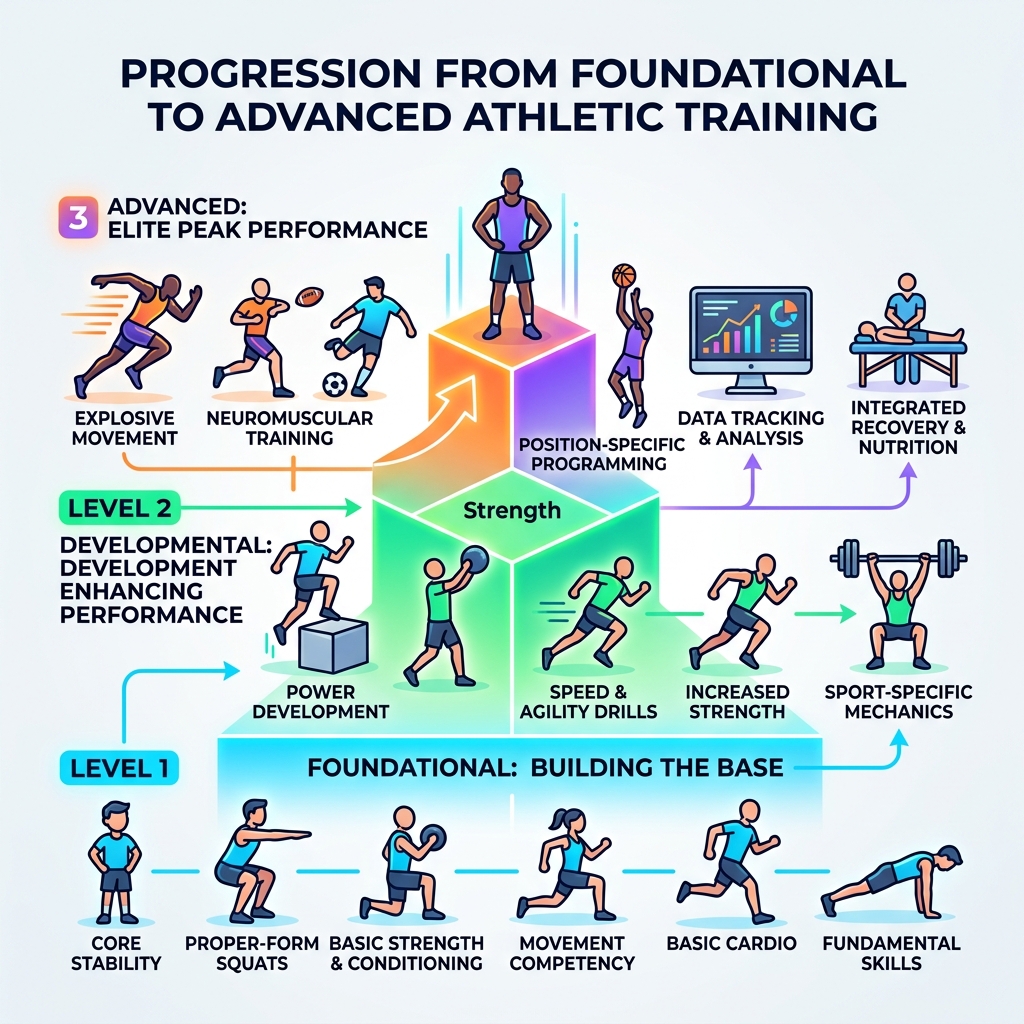
Advanced athletic training is a structured, science-based approach to developing elite physical performance — going far beyond basic fitness or general strength work.
Here’s a quick breakdown of what it involves:
- Speed and power development using neuromuscular and explosive training methods
- Agility and deceleration mechanics for real-game movement demands
- Sport-specific programming tailored to your position, sport, and season
- Injury prevention protocols built around joint integrity and movement symmetry
- Integrated recovery, nutrition, and mental performance support
- Measurable progress tracked through performance testing and data
Whether you’re a high school athlete chasing a college offer or an adult competitor looking to extend your career, the difference between good and great often comes down to the quality of your training system.
Most athletes hit a ceiling. They work hard, but they’re using the same basic methods that got them started — and those methods stop working. That’s exactly where advanced training comes in. It’s built for athletes who are ready to train smarter, not just harder.
I’m Kevin O’Shea, a Certified Strength and Conditioning Specialist and co-founder of Triple F Elite Sports Training, with a background in collegiate athletics and years of coaching experience — all of which shapes how I approach advanced athletic training for athletes at every level. In this guide, I’ll walk you through everything you need to know to take your game to the next level.
Simple guide to Advanced athletic training:
- Rehab for athletes
- Sports specific conditioning
- athletes gym
Defining Advanced Athletic Training vs. Basic Programs
The leap from a basic fitness routine to advanced athletic training is significant. While novice programs focus on general adaptation—simply getting the body used to moving weight—advanced programs are built on the principle of specificity and periodization. In a basic program, you might see “3 sets of 10” for months on end. In an advanced environment, we manipulate variables like tempo, rest intervals, and explosive intent to elicit a specific physiological response.
| Feature | Novice/Basic Training | Advanced Athletic Training |
|---|---|---|
| Primary Goal | General fitness and base strength | Peak power and sport-specific output |
| Periodization | Linear (steady increases) | Undulating or Block (varied intensity) |
| Speed Work | Basic running/sprints | Acceleration mechanics & max velocity |
| Movement | Mostly sagittal (forward/backward) | Multi-planar and reactive agility |
| Load Management | Static volume | High-threshold motor unit recruitment |
Speed development in an advanced setting isn’t just about running fast; it’s about biomechanical efficiency. We focus on the “first step” explosiveness and the ability to maintain top-end speed. Agility drills transition from pre-planned cone drills to reactive movements that mimic the unpredictability of a game. Power output is measured not just by how much you can lift, but by how fast you can move that weight—a concept known as the Rate of Force Development (RFD).
Absolute strength still matters, but for the advanced athlete, it serves as the foundation for skill-based training. If you are a runner, you might transition from general lifting to advanced base training to ensure your cardiovascular engine can support higher intensities.
Core Components of Elite Performance
To reach the elite tier, we focus on three pillars: force production, deceleration, and multi-planar movement.
- Force Production: This is your “engine.” It’s the ability to put maximal force into the ground to jump higher or sprint faster.
- Deceleration Mechanics: Most injuries happen when slowing down or changing direction. We teach athletes how to absorb force efficiently to protect their joints.
- Multi-planar Movement: Sports don’t happen in a straight line. Whether it’s offensive line sports training where lateral stability is key, or a midfielder cutting across a field, we train in every plane of motion.
Suitability Across the Athlete Lifecycle
Is advanced athletic training only for the pros? Absolutely not. While the intensity varies, the principles apply across the board:
- Youth Prospects: Focusing on fundamental movement skills and “pre-hab” to build a resilient body.
- Student-Athletes: Preparing for the rigors of collegiate recruiting and high-stakes high school seasons.
- Professional Offseason: Fine-tuning specific weaknesses and building explosive power for the next contract.
- Adult Training: We offer adult training for former athletes and “weekend warriors” who want to maintain high-level performance without the nagging injuries of traditional gym routines.
Science-Based Methodologies in Advanced Athletic Training

Modern training is a science, not a guessing game. One of the most effective methods we utilize is eccentric isometrics. This involves lowering a weight slowly and holding the “bottom” position. This builds incredible tendon strength and teaches the nervous system to remain stable under tension.
We also lean heavily into plyometric progressions. This isn’t just jumping on boxes; it’s about the “stretch-shortening cycle”—training your muscles to act like powerful springs. When combined with acceleration training, which focuses on the mechanics of the first 10-20 yards of a sprint, athletes become noticeably more “twitchy” and explosive.
For those preparing for specific milestones, such as NFL pre-draft training, we use Post-Activation Potentiation (PAP). This is a technique where a heavy strength movement is immediately followed by an explosive movement (like a heavy squat followed by a vertical jump), “priming” the nervous system for maximum output. Even endurance athletes benefit from these scientific structures, often using advanced marathon programming that balances high-intensity intervals with recovery.
Advanced Athletic Training for Injury Prevention
The best ability is availability. Advanced athletic training prioritizes joint integrity and the strengthening of decelerating musculature (like the hamstrings and glutes). By using symmetry testing, we can identify if one leg is significantly weaker than the other—a major red flag for ACL tears.
When an injury does occur, our physical therapy integration ensures that the transition from rehab back to the field is seamless. We don’t just clear you to play; we ensure you are “performance ready.”
Implementing Neuromuscular Training Protocols
Neuromuscular training is essentially “brain-to-muscle” coaching. We want the signals from your brain to reach your high-threshold motor units faster and more precisely. This is vital in volleyball training, where reactive agility—the ability to see a ball and move instantly—is the difference between a dig and a point for the opponent. By training these pathways, the game starts to “slow down” for the athlete.
The Role of Professional Athletic Trainers and Education
At the advanced level, the “trainer” isn’t just someone who likes the gym; they are healthcare professionals. Most states require athletic trainers to be licensed and hold the Board of Certification (BOC) credential of Athletic Trainer Certified (ATC).
The educational path is rigorous. Currently, athletic trainers must graduate from an accredited M.S. in athletic training program. These professionals are recognized as mid-level healthcare providers and are eligible for a National Provider Identifier (NPI) with the specific taxonomy code 2255A2300X. This medical background allows them to diagnose, treat, and rehabilitate injuries with a level of precision that a standard personal trainer cannot match. For those starting their journey, a bachelor’s in athletic training often serves as the prerequisite for these advanced master’s programs.
Post-Professional Clinical Excellence
To further elevate the field, many professionals pursue a Doctor of Athletic Training (DAT) or specialized graduate certificates. These programs focus on evidence-based practice and clinical outcomes, ensuring that the protocols used in the gym are backed by the latest peer-reviewed research. Whether it’s a master of science in athletic training or a doctorate, this education ensures your coach understands the “why” behind every rep.
Specialized Technology and Measuring Performance
You cannot manage what you do not measure. In an elite facility, we move beyond the stopwatch. We use specialized equipment to gain a competitive edge:
- Strobe Glasses: These force the brain to process visual information more efficiently, improving reaction time and focus.
- Resistance Cords: These allow for “game speed” resistance training, helping athletes build power without altering their natural mechanics.
- High-Speed Treadmills: These can reach speeds and inclines far beyond standard gym equipment, forcing neuromuscular adaptation.
- Data Analytics: Using force plates and wearable sensors to track every jump and sprint.
By discovering elite athletic training facilities, you gain access to tools that provide instant feedback on your performance, allowing for micro-adjustments that lead to macro results.
Holistic Integration: Nutrition, Recovery, and Mental Performance
Advanced athletic training is a 24-hour commitment. You can’t train like a pro and eat like a novice. We focus on metabolic fueling—ensuring you have the right nutrients to power through high-intensity sessions.
Equally important is mental toughness. We work with athletes to build the resilience needed to perform under pressure. This holistic approach is especially critical for our youth training 12 to 18 programs, where building healthy habits regarding sleep hygiene and soft tissue work sets the stage for a long, successful career.
Frequently Asked Questions about Advanced Athletic Training
Who is Advanced Athletic Training Suitable For?
While we work with professional and collegiate competitors, we believe that anyone with a “pro mindset” can benefit. This includes dedicated youth athletes in our future pros program and adults who want to push their physical limits. If you have a specific goal and the discipline to follow a structured plan, advanced training is for you.
How to Measure Progress in Advanced Athletic Training Programs?
We use a variety of metrics to ensure you’re heading in the right direction:
- Symmetry Assessments: Ensuring left-to-right balance in strength and power.
- Vertical Jump & Broad Jump: Measuring explosive power and force production.
- Sprint Splits: Using laser gates to track acceleration and max velocity.
- Force Plate Data: Analyzing how you move and absorb weight. Check our current training schedule to see when our next testing block begins!
What are the primary benefits of elite-level coaching?
Elite coaching provides more than just a workout; it provides a roadmap. The benefits include significant performance enhancement, a drastic reduction in injury risk, and improved career longevity. Perhaps most importantly, it gives athletes a “mental edge,” knowing they have prepared more thoroughly than their competition through rigorous sport skill development.
Conclusion
At Triple F Elite Sports Training in Knoxville, Tennessee, we don’t just “work out”—we develop athletes. Our facility is a professional, Christ-centered environment where we combine high-level science with a commitment to individual growth. Whether you are looking for professional coaching, comprehensive performance testing, or a supportive community to help you reach your goals, we are here to help you unlock your full potential.
Ready to see the difference for yourself? We invite you to join us for a free first session and experience the future of athletic development. Visit us at https://triplefsports.com/ to get started today. Let’s level up your game together.