
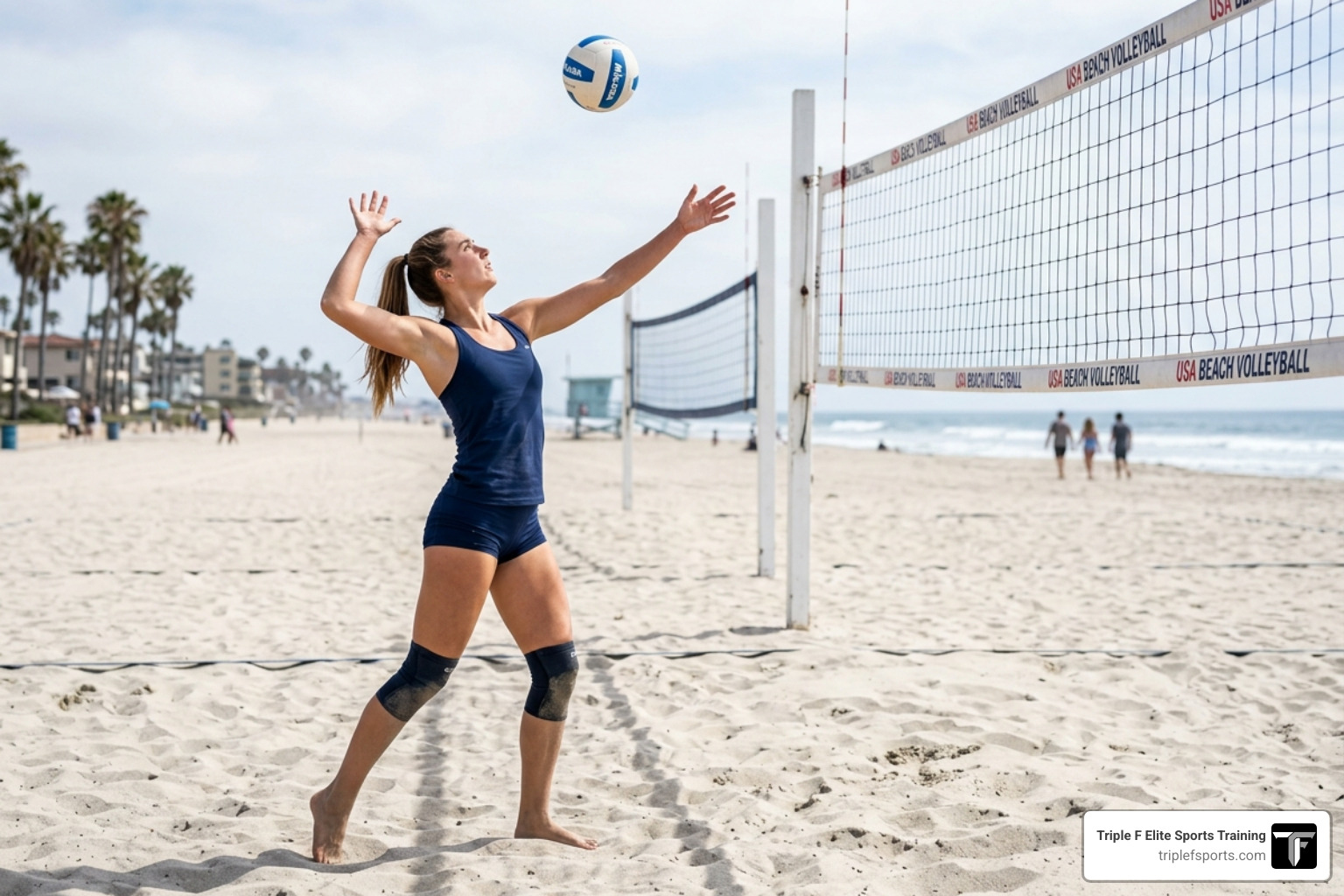
Why Individual Volleyball Training Is the Fastest Way to Level Up Your Game
Individual volleyball training is one of the most effective ways to accelerate your skill development — whether you’re a beginner or a competitive player looking to sharpen your edge.
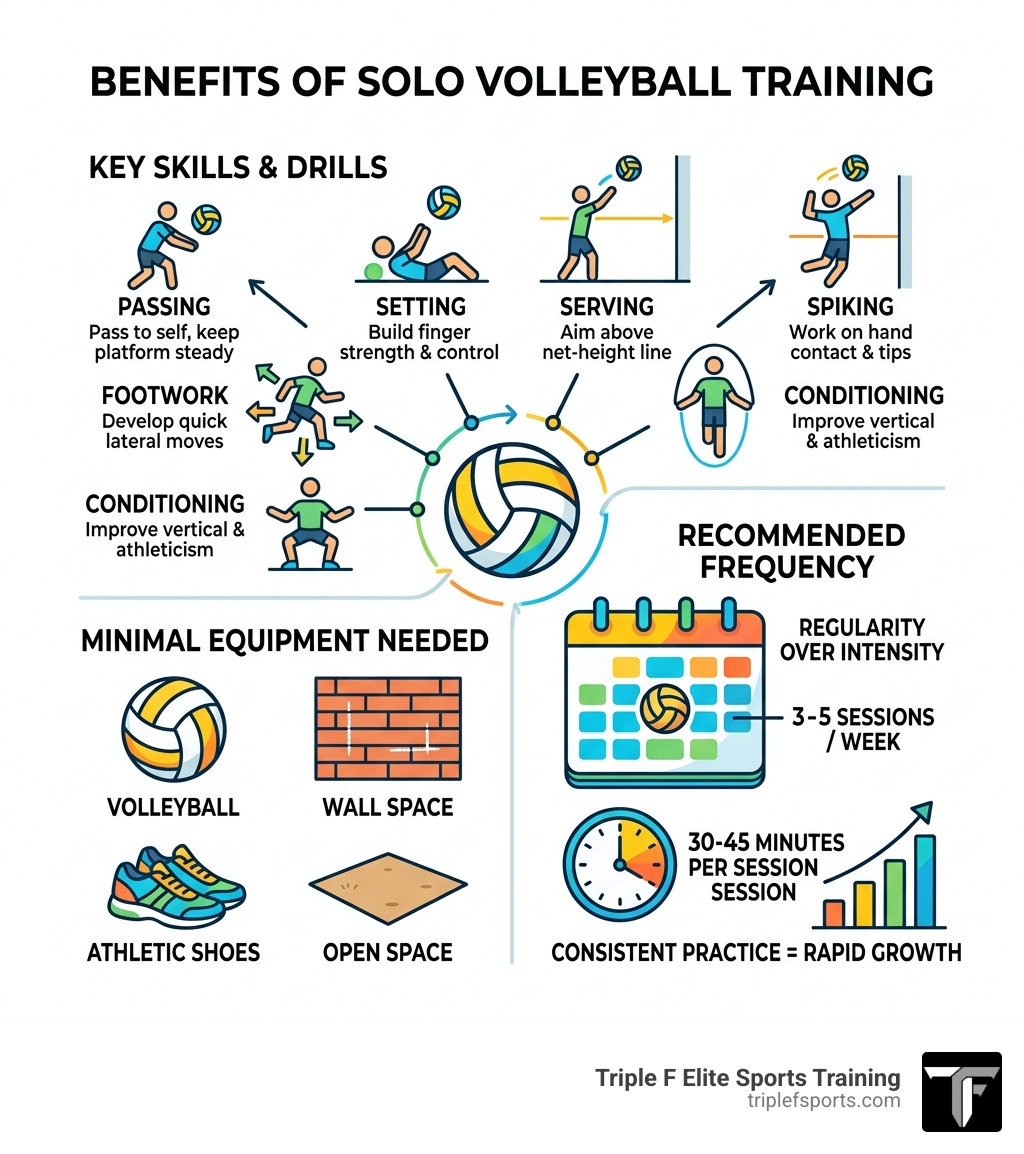
Here are the core solo drills you can start today:
- Passing: Pass straight up to yourself, keeping your platform steady and your feet moving
- Setting: Lie on your back with hands 6-8 inches above your face in a triangular window position and push the ball up repeatedly
- Serving: Stand 20-30 feet from a wall with a net-height line marked in chalk, serve above it, and sprint to recover
- Spiking: Set to yourself, then spike above the line using line shots, cut shots, and tips
- Footwork: Lateral hop-and-hold drills build ankle stability and balance without any equipment
- Conditioning: Jump rope, wall sits, plyometrics, and core circuits build volleyball-specific athleticism
You don’t need a net, a partner, or a court to get meaningfully better. A wall, a volleyball, and focused repetition are enough to build real skills.
I’m Kevin O’Shea, a Certified Strength and Conditioning Specialist at Triple F Elite Sports Training in Knoxville, with years of experience helping athletes design purposeful individual volleyball training programs that translate directly to game performance. Let’s walk through exactly how to build yours.
Mastering the Fundamentals: Essential Individual Volleyball Training Drills
When we talk about individual volleyball training, we are really talking about building a deep, intuitive connection with the ball. Without the distraction of teammates or the pressure of a live match, you can focus entirely on your “platform” and your “touch.” This is where muscle memory is forged.
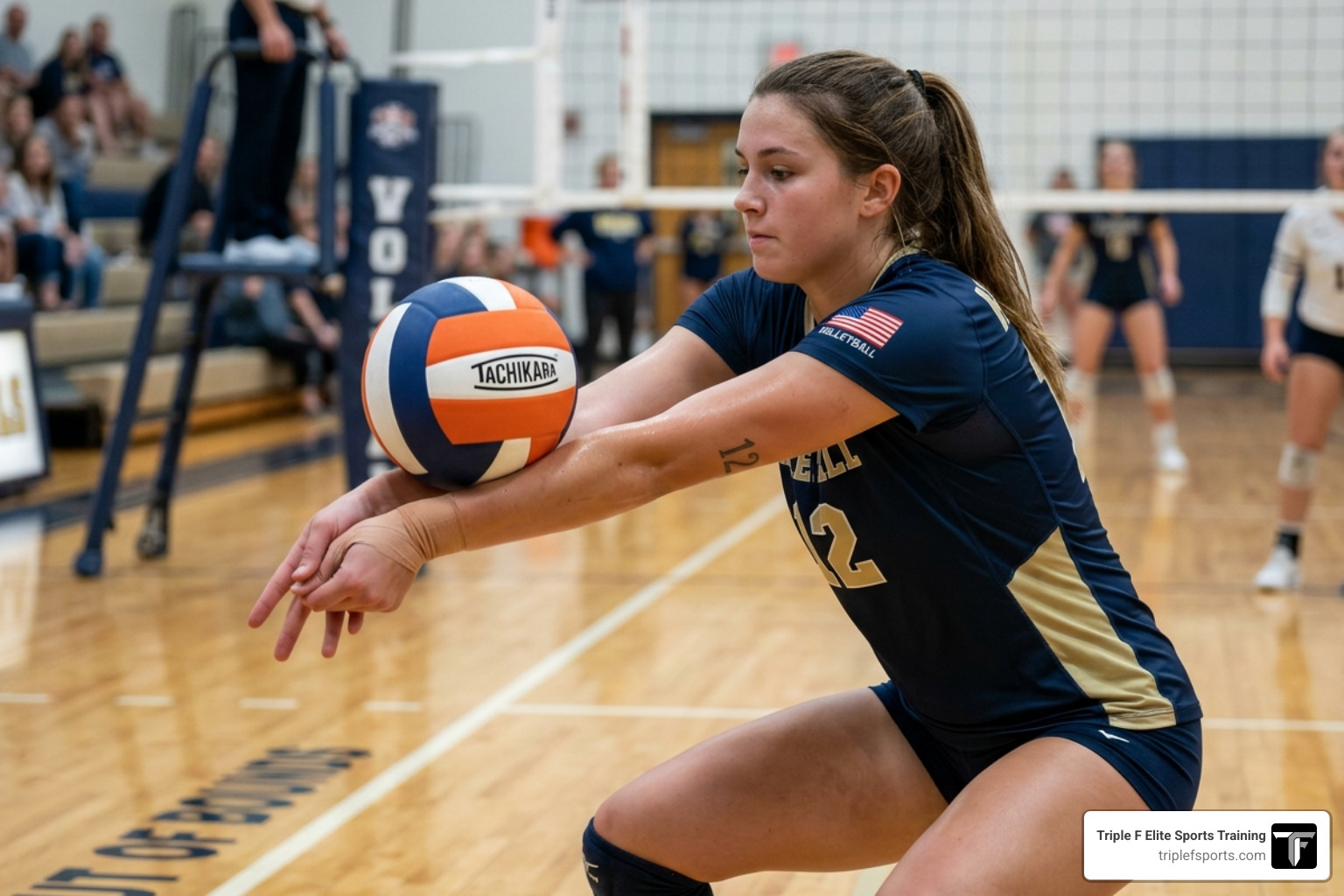
The goal is to make every contact intentional. According to Solo Drills To Improve Your Volleyball Skills – USA Volleyball, the wall is your best friend. It never misses a return and it never gets tired. By using a wall, you can simulate the speed and trajectory of a real game while getting ten times the touches you would in a team practice.
Beginner-Friendly Individual Volleyball Training
For those just starting out, we focus heavily on physical literacy and basic mechanics. If you can’t throw a ball with proper shoulder rotation, you’ll likely struggle with the mechanics of a powerful serve or spike. We recommend starting with Serve Up Success: Fun Drills for 10-13 Year Olds to build that foundational coordination.
Start with a simple self-toss. Toss the ball up, let it bounce, and move your feet to get centered under it. Once you’re comfortable, transition to standing attacks (down balls) against a wall. This helps you understand the timing of the arm swing without the complexity of a full jump approach.
Wall-Based Drills for Elite Ball Control
To move from beginner to elite, you need to master the “triangular window.” This is the shape your hands should make when setting.
- Lying Sets: Lie on your back with your knees bent. Hold your hands 6-8 inches above your face. Push the ball up toward the ceiling. Try to do this 50 times without moving your body.
- Vertical Sets: Stand up and set the ball to yourself. Focus on repositioning your feet under the ball every single time.
- Wall Passing: Stand 5-8 feet from a wall. Pass the ball against the wall, but rather than just hitting it back, try to pass it straight up to yourself first, then back to the wall. This “pass-to-self” technique is a secret weapon for improving ball control.
Engaging Solo Games and Challenges
Let’s be honest: hitting a ball against a wall for an hour can get repetitive. To keep the “fun” in individual volleyball training, we like to introduce challenges.
- Basket Volley: Place a laundry basket or a trash can where a setter would normally stand. Practice passing or setting into the basket from various distances.
- Consecutive Rep Goals: Can you get 100 sets in a row without the ball touching the ground? How about 50 one-handed “pokey” passes?
- Trick Shots: Practice hitting the ball off a slanted garage roof and reacting to the unpredictable bounce. This mimics the “chaos” of a real rally.
Training Without a Net: Creative Solo Solutions
One of the biggest myths in volleyball is that you need a net to improve. In Knoxville, we often see players practicing in driveways or local parks using nothing but a line on the ground.
Equipment Needs for the Home Court
You don’t need a professional setup. Here is our “minimalist” kit for individual volleyball training:
- A Volleyball: Obviously.
- Painter’s Tape or Chalk: Use this to mark a line on a wall at net height (roughly 7 feet 4 inches for girls and 8 feet for boys).
- A Wall: Preferably windowless and sturdy.
- Towels or Cones: Use these as floor targets for serving and hitting accuracy.
For those looking for a more structured environment, our Volleyball Clinics & Camps Knoxville provide the perfect transition from home practice to coached sessions.
Simulating Game-Like Ball Flights
The danger of solo practice is developing “lazy” habits. To avoid this, always visualize an imaginary net. When doing wall drills, don’t just pass the ball back and forth at chest height. Angle your passes so the ball arcs high, mimicking a free ball or a serve receive.
When practicing your serve, stand at least 20-30 feet away from your target. If you’re in a park, find a soccer goal and use the crossbar as your “net.” This forces you to hit over an obstacle, which is essential for building game-ready habits.
Conditioning and Athleticism for the Solo Player
Volleyball is a sport of explosive bursts. You aren’t running a marathon; you’re performing a series of high-intensity sprints, jumps, and dives over the course of two hours. Your Volleyball Training must reflect these demands.
Volleyball-Specific Strength and Agility
To dominate the net, you need a high vertical and quick lateral movement. We focus on “landing mechanics” just as much as the jump itself to prevent common ACL and ankle injuries.
| Exercise Category | Specific Drill | Benefit |
|---|---|---|
| Strength | Wall Sits (1 min) | Builds quad endurance for low defensive stances. |
| Power | Frog Jumps | Increases explosive vertical leap. |
| Agility | Lateral Hop & Hold | Improves ankle stability and change-of-direction speed. |
| Speed | 40m Shuttle Runs | Mimics the “serve and dash” movement of a match. |
Endurance and Injury Prevention
Physical preparation isn’t just about getting stronger; it’s about staying on the court. Statistics show that AI-driven training load monitoring can reduce injury occurrence by up to 30%. While you might not have an AI lab at home, you can monitor your own “load” by tracking how many jumps you take per session.
Don’t ignore recovery. We recommend 8-9 hours of sleep and a dedicated 10-minute mobility circuit every day. Focus on “shoulder CARs” (Controlled Articular Rotations) and ankle dorsiflexion rocks to keep your joints healthy.
Building a Professional Routine and Tracking Progress
Consistency is the difference between a player who “plays” volleyball and a volleyball athlete. Your individual volleyball training should be scheduled just like a team practice.
Common Mistakes to Avoid in Solo Practice
The biggest mistake we see is “flat-footedness.” In a game, you are never standing still. During solo drills, if you find yourself rooted to the spot, you aren’t training for volleyball; you’re just juggling.
Another pitfall is “traditional pepper.” While popular, standard two-person pepper often teaches players to hit the ball directly at their opponent and to “apologize” for hard hits. In a real game, you want to hit the ball away from people. When practicing alone, always aim for corners and gaps.
Indoor vs. Beach Volleyball Solo Adaptations
If you’re training for the sand, your individual volleyball training needs to account for the lack of stability. Sand sprints are incredible for building the stabilizer muscles in your feet and knees. Beach drills also require more “shot variety”—think pokey shots, rolls, and deep-dish sets—because the wind will always be a factor.
Frequently Asked Questions about Individual Volleyball Training
How often should I practice volleyball alone for optimal improvement?
During the off-season, we recommend 3-5 sessions per week. During the competitive season, once a week is usually enough to maintain your “touch” without overtaxing your body.
What are the best metrics to track during solo sessions?
Don’t just count time; count quality. Track your:
- Consecutive reps (e.g., “I hit 45 sets without a drop today”).
- Target accuracy (e.g., “I hit the towel 8 out of 10 times on my serves”).
- Vertical jump height (measure this once a month).
- RPE (Rate of Perceived Exertion) on a scale of 1-10 to ensure you aren’t overtraining.
Transitioning Individual Volleyball Training to Team Play
The final step is taking these isolated skills and applying them to a team environment. Our Volleyball Pre-Tryout Clinics are designed specifically to help players bridge this gap. We take the ball control you’ve built at home and add the “decision-making” element—deciding whether to tip or swing, or communicating with a fellow passer.
Conclusion
At Triple F Elite Sports Training in Knoxville, we believe that every athlete has an untapped reservoir of potential. Individual volleyball training is the key to unlocking it. By taking ownership of your development and putting in the work when no one is watching, you arrive at team practices more confident, more explosive, and more skilled.
Whether you are looking for Christ-centered athletic development or a high-performance Volleyball Training program, we are here to support your journey. Remember: the wall doesn’t lie, and the work doesn’t go unnoticed. Start your solo routine today, and we’ll see you on the court!