
What is Arm Wrestling and How Has it Evolved?
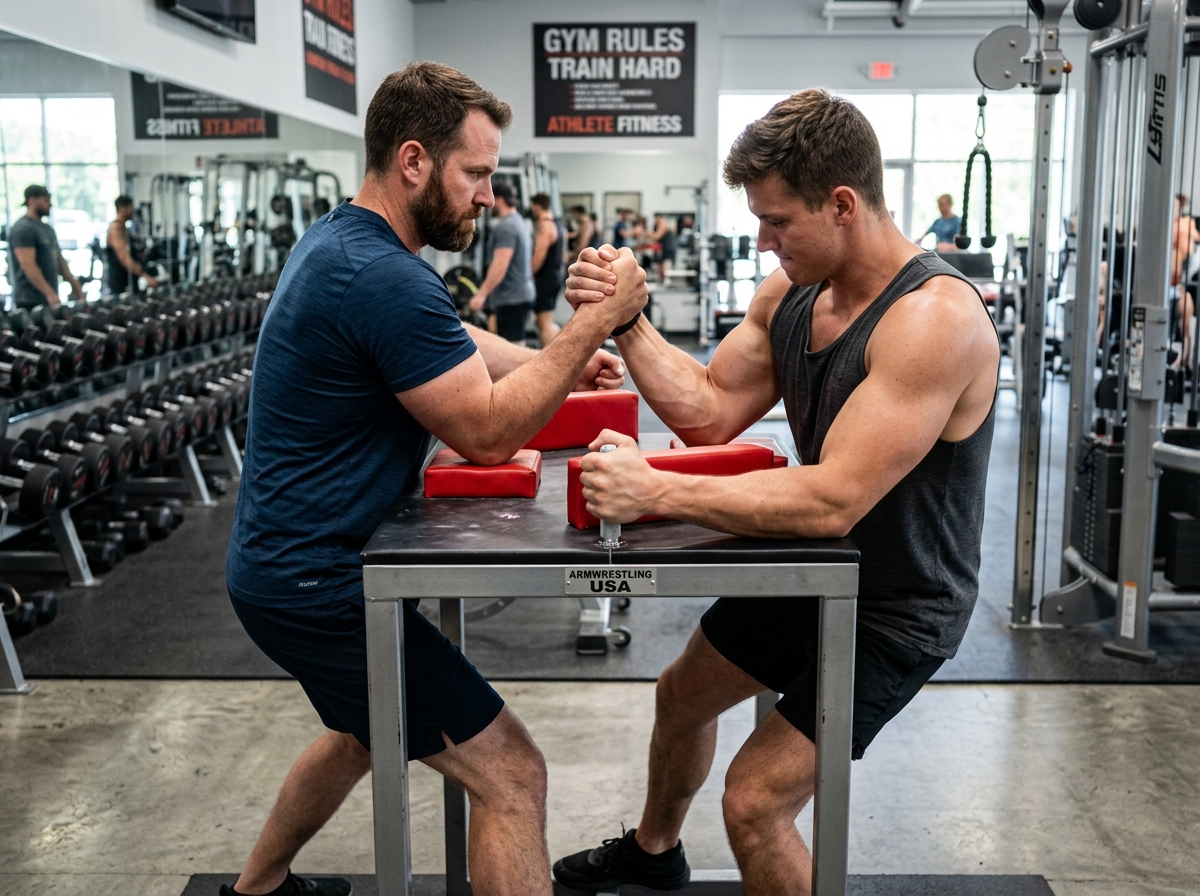
Arm wrestling is a strength sport where two competitors attempt to “pin” their opponent’s hand to a touch pad. While the premise is simple, victory requires a complex balance of power, strategy, and leverage. A competitive match uses a sturdy table equipped with elbow pads, pin pads, and hand pegs to ensure fair play and stability.
The history of arm wrestling spans centuries. Records of similar contests appear in ancient Japan (8th century Kojiki) and Native American traditions like “Indian Hand Wrestling.” The modern era began in 1954 in Petaluma, California, leading to the first World’s Wristwrestling Championship in 1962. The sport’s “Golden Age” in the 1970s and 80s was famously highlighted by the 1987 film “Over the Top.”
Today, organizations like the World Armwrestling Federation (WAF), World Armwrestling League (WAL), and International Federation of Armwrestling (IFA) host global competitions. The Pro Panja League has recently garnered billions of social media views, fueling a movement to include arm wrestling in the Olympics. This surge in popularity has introduced millions to the sport’s technical depth and intense rivalries.

Basic Rules and Match Setup
Understanding the rules is vital for safety and fairness. While minor variations exist between the WAF and IFA, the core principles are consistent.
A match starts with a referee’s grip: elbows on pads, hands clasped palm-to-palm, and thumb knuckles visible. The referee ensures shoulders are square and the starting position is balanced.
Key rules include:
- Elbow Contact: Your elbow must stay on the pad. Lifting it results in a foul.
- Shoulder Position: Shoulders must remain square to the table; you cannot turn your body away to gain leverage.
- Valid Pin: Victory occurs when any part of the opponent’s hand touches the pin pad or falls below the elbow pad’s plane.
- No Time Limit: Matches continue until a pin or disqualifying foul occurs.
- Grip Integrity: You cannot intentionally break the grip. If it slips, a strap is used to bind the hands.
Fouls are given for rule breaks, and two fouls typically lead to disqualification. Adhering to these rules prevents dangerous positions that cause injury. For full details, see the 2022 WAF Rules.
What Are the Main Arm Wrestling Techniques and How Do You Maximize Leverage?
Mastery of arm wrestling lies in three primary techniques: the Hook, the Toproll, and the Press. Each exploits different muscle groups and angles to disrupt an opponent’s leverage. A foundational concept is “posting”—keeping the forearm vertical with the wrist above the elbow to create a stable pillar for force transfer. Technical skill allows smaller wrestlers to overcome larger opponents by attacking weaknesses. For a visual guide, see Arm Wrestling Techniques (Demonstrated & Explained).
The Hook: Inside Power
The Hook is an “inside” move relying on wrist flexion, supination, and bicep strength. The goal is to cup your hand, pulling the opponent’s wrist inward and back to break their wrist position.
- Mechanics: Engages biceps, forearm flexors, and lats. You use supination (turning the palm up) to twist the opponent’s hand while pulling their arm toward your chest.
- Setup: Turn your palm slightly toward your face and bend your wrist toward your shoulder. Engage your lats to pull the opponent’s arm down, using your back muscles for power. This technique is ideal for those with strong biceps and superior wrist flexion. More tips are available at The Art of Manliness.
The Toproll: Outside Control
The Toproll is an “outside” technique focusing on pronation and finger strength. It aims to peel back the opponent’s fingers and turn their hand outward, moving the battle from the biceps to the wrist.
- Mechanics: Utilizes forearm pronators and back muscles. You pull back and sideways, rotating your hand outward to “climb” the opponent’s hand.
- Setup: Get your knuckles as high as possible on the opponent’s hand. Immediately pull their hand toward you while pronating (turning your palm outward). World champion Devon Larratt demonstrates the importance of hand cupping in this YouTube video with Larry Wheels.
The Press: Shoulder and Tricep Drive
The Press is a finishing move using triceps, shoulders, and chest strength. It is most effective once an opponent’s arm is already compromised.
- Mechanics: Align your body behind your arm and drive straight down through the opponent’s hand using your body weight.
- Execution: Keep your body close to the table and drive your elbow forward on the pad. Use your shoulder and triceps to push down. Beginners should be cautious to avoid lateral stress on the elbow.
Mastering Body Positioning and Grip
- Foot Placement: Place your dominant foot forward under the table for a stable base.
- Elbow Placement: Center your elbow on the pad, roughly 3-4 inches from your chest.
- Shoulder Alignment: Keep shoulders square and directly over your hand to channel full-body force.
- Grip Variations: Use a “High Grip” for Toprolls or “Cupping” for Hooks to gain mechanical advantages.
- Constant Pressure: Maintain engagement from the start to feel for weaknesses. For more on positioning, visit How to Win at Arm Wrestling.
How Can You Train Your Body and Prevent Injuries for Arm Wrestling Success?
Arm wrestling demands specialized strength in the forearms, wrists, biceps, and shoulders, with a unique emphasis on tendon durability. Common injuries include spiral humerus fractures and elbow tendonitis, often caused by poor technique or significant strength gaps. Prevention requires mastering mechanics and following a structured training regimen.
Essential Muscle Groups and Targeted Training
- Wrist and Forearm: Use wrist curls for cupping, reverse curls for extension, and pronation/supination drills with dumbbells.
- Hand and Finger: Use hand grippers and fat grip training to build a crushing grip and finger integrity.
- Biceps and Brachialis: Hammer curls and isometric holds at various angles are vital for the Hook and pulling power.
- Triceps: Essential for the Press; focus on extensions and close-grip bench presses.
- Shoulder and Back: Rows, pull-ups, and shoulder presses provide the foundational stability for all techniques.
Training Programs and Equipment
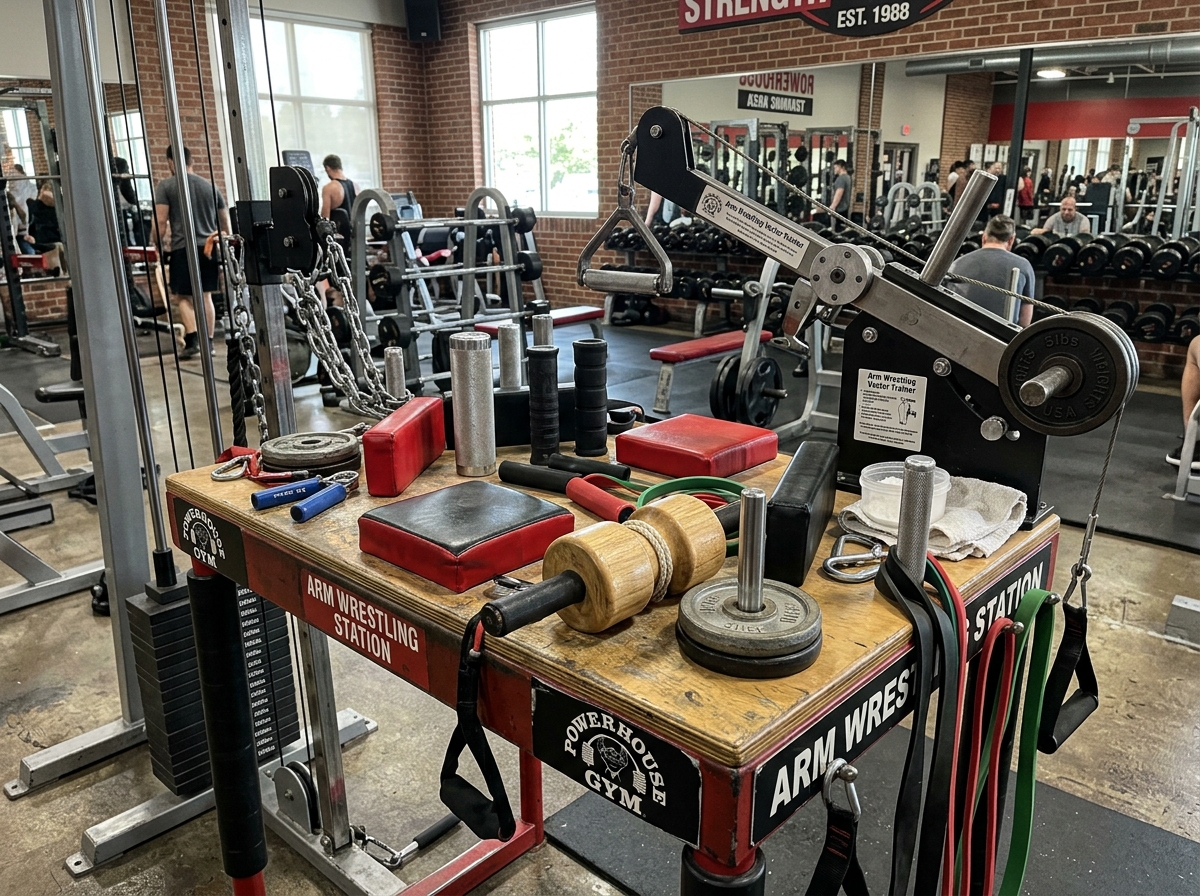
Effective training combines “table time” with gym work. Limit full-intensity sparring to 1-2 times per week to avoid overuse. Specialized equipment like wrist rollers, handle attachments, and resistance bands can mimic arm wrestling force vectors.
Progressive overload is key, but must be gradual to allow tendons to adapt. For a structured start, see the Arm Wrestling Training Program – For Beginners (2023) or our guide, “Grip It and Rip It”.
Injury Prevention and Safe Practices
- Warm-up: Use dynamic stretches and light resistance for the wrists and elbows.
- Concede Early: If you feel sharp pain or your arm is in a dangerous position, concede the match immediately.
- Stabilization: Strengthen the rotator cuff and core to protect joints during intense pulls.
- Professional Guidance: Triple F Elite Sports Training in Knoxville offers performance training and physical therapy to help athletes build strength safely and address musculoskeletal imbalances.
What Are the Rules, Fouls, and Winning Strategies in Competitive Arm Wrestling?
Competitive arm wrestling is governed by organizations like the WAF, IFA, and WAL. Understanding fouls and strategies is essential for any serious competitor.
Common Fouls and How to Avoid Them
Two fouls usually result in a match loss. Common infractions include:
- Elbow Foul: Lifting the elbow off the pad. Keep it firmly planted.
- Shoulder Foul: Turning the body so shoulders are no longer square.
- Dangerous Position: When the hand is pushed past the shoulder line, risking a fracture. Referees stop these matches immediately.
- False Start: Moving before the “Go!” command.
- Losing Grip: Hands separating without a strap.
For a full list, refer to the 2022 IFA Rules.
| Foul Type | Description | Consequence |
|---|---|---|
| Elbow Lift | Elbow leaves the pad | Warning / Foul |
| Shoulder Foul | Shoulders not square | Warning / Foul |
| Dangerous Position | Risk of humerus fracture | Immediate Stop |
| False Start | Moving before signal | Warning / Foul |
| Losing Grip | Hands separate | Foul / Strap applied |
Professional Equipment and Formats
- Table Specs: Standardized heights (40″ standing, 28″ sitting) with specific pad placements.
- Straps: Used to bind hands if a grip is lost, ensuring a strength-based finish.
- Tournament Formats: Includes single/double elimination and “Supermatches” (best of 3, 5, or 7 rounds).
- Divisions: Competitors are separated by weight class and by left or right arm.
Tips and Strategies from the Pros
- Identify Weakness: Quickly test if an opponent lacks wrist or bicep strength. Champion Janis Amolins notes that in a defensive toproll, you might sacrifice center position to maintain hand control.
- Explosive Start: The first second is often decisive; an explosive pull puts opponents on the defensive.
- Psychology: Maintain eye contact and confidence to intimidate opponents.
- Adaptability: Be ready to switch from a Hook to a Press if the initial move fails.
- Body Weight: Drive with your legs and lean into the table to maximize force.
Frequently Asked Questions About Arm Wrestling Techniques
Can a smaller, weaker person win against a stronger opponent?
Yes, absolutely. Technique, leverage, and strategic body positioning are often more critical than raw strength. By exploiting an opponent’s weaknesses and using efficient movements like the toproll or hook, a technically skilled arm wrestler can defeat a physically stronger adversary. It’s about working smarter, not just harder.
What is the most important muscle group for arm wrestling?
While many muscle groups contribute, the wrist and forearm muscles (flexors, extensors, pronators, supinators) are arguably the most critical. They dictate hand control, leverage, and the ability to apply force effectively, making them central to all major techniques. Without strong wrists and forearms, even powerful biceps and shoulders will struggle to maintain control.
How often should I practice arm wrestling techniques at the table?
For beginners, limiting full-intensity matches or heavy “table time” to 1-2 times per week is recommended to prevent overuse injuries and allow for adequate recovery. On other training days, focus on specific strength training for key muscle groups and technique drills without an opponent, such as using specialized equipment or resistance bands. As you advance, you might increase frequency, but always prioritize recovery and listen to your body.
Conclusion
Arm wrestling is a captivating sport that demands a holistic approach, combining physical prowess with mental fortitude and, most importantly, refined technique. By understanding the core techniques like the hook, toproll, and press, mastering body positioning, and committing to sport-specific training, you can significantly enhance your performance and even overcome stronger opponents. Remember to prioritize safety, train intelligently, and continuously refine your skills. Whether you’re a casual enthusiast or aspiring competitor, the journey to becoming a formidable arm wrestler is one of continuous learning and dedication. To further develop your strength, technique, and overall athletic potential, consider exploring specialized training programs. At Triple F Elite Sports Training in Knoxville, Tennessee, we offer comprehensive performance training and physical therapy to help athletes of all levels excel in their chosen sport, unlocking your full potential through Christ-centered athletic development. Learn more about our skilled-based training programs here.