

Why Volleyball Strength Training Is the Missing Piece for Most Players
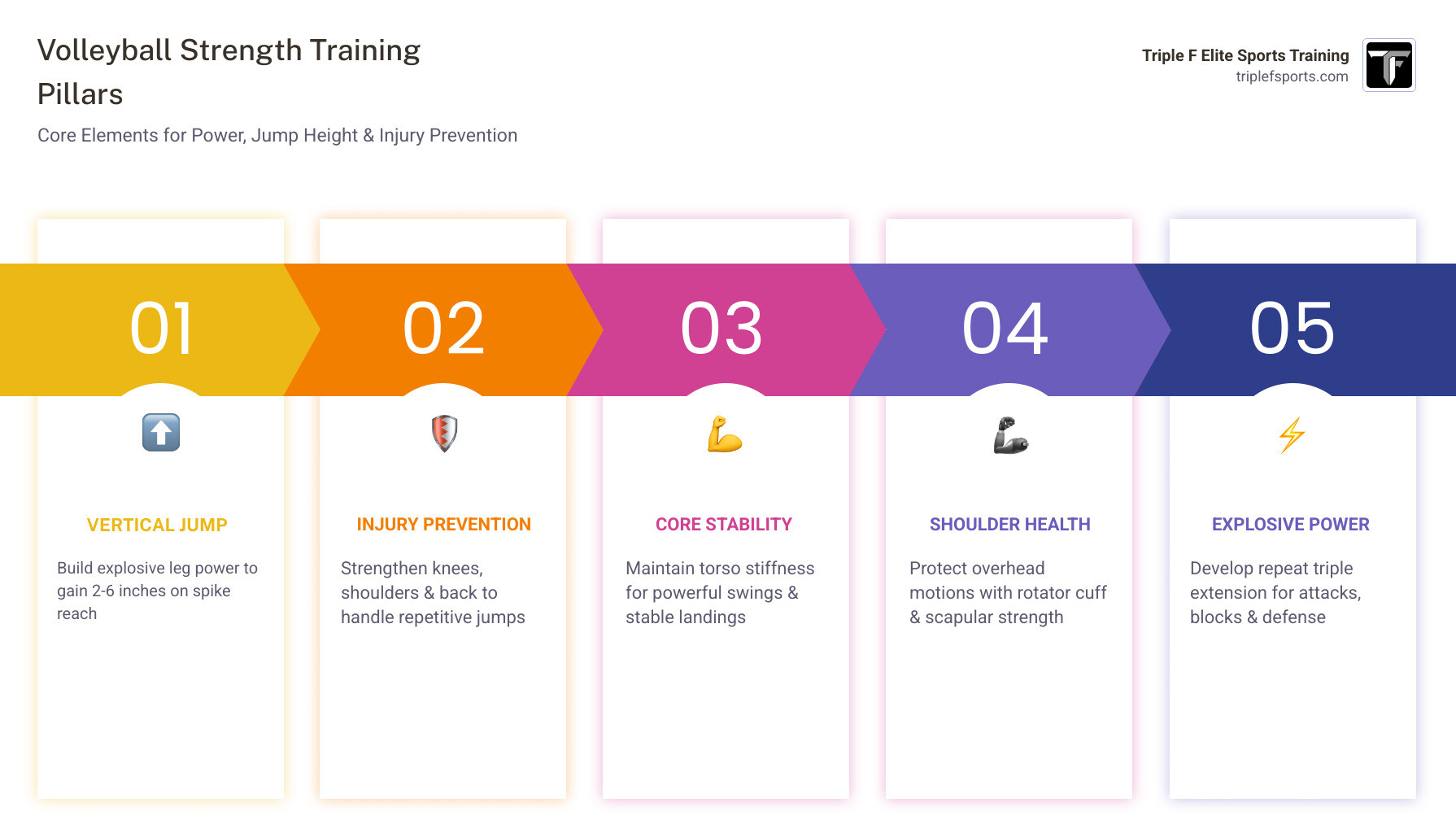
Volleyball strength training is one of the most overlooked tools for athletes who want to jump higher, hit harder, and stay healthy through a full season.
Here’s what it can do for you — fast:
- Vertical jump: A structured program can add 2–6 inches to your jump height
- Attack power: Stronger hips and shoulders mean harder, more controlled swings
- Injury prevention: Targeted strength work protects knees, shoulders, and lower back
- Court endurance: Better-conditioned athletes outlast opponents in long tournaments
- Defensive range: Stronger legs move faster and recover quicker between plays
The problem? Most players either skip the weight room entirely, or train the wrong way and burn out before the season even peaks.
This guide breaks down exactly how to build volleyball-specific strength — without running your body into the ground.
I’m Kevin O’Shea, a Certified Strength and Conditioning Specialist who has spent years helping athletes develop real, transferable power through smart training. I bring that same approach to volleyball strength training at Triple F Elite Sports Training here in Knoxville — building programs that are tough enough to work, and sustainable enough to last.
Volleyball strength training terms to know:
- Advanced athletic training
- Rehab for athletes
- Sports specific conditioning
Volleyball Strength Training Starts With the Demands of the Sport
Volleyball looks graceful until you realize it is basically repeated jumping, stopping, cutting, rotating, and swinging at high speed. A rally may only last a few seconds, but those seconds ask a lot from the body.
That is why Volleyball strength training has to match the sport. We are not training just to lift more weight. We are training for:
- Triple extension at the ankles, knees, and hips
- Faster vertical jumps
- Better lateral movement and recovery steps
- Safer deceleration and landing mechanics
- More force through the overhead swing
- Repeat power across long matches and tournaments
- Core stiffness so power transfers instead of leaking away
If a player can jump high once but lands poorly and fades by set three, that is not complete performance.
What Volleyball Strength Training Actually Improves
Done well, strength training improves almost every major volleyball action:
- Vertical jump height
- Approach jump power
- Attack and serve velocity
- Block reach
- Defensive range
- Reaction strength on first steps
- Work capacity through multiple sets and tournament days
Research and coaching data both point the same way: players who follow a structured program often see meaningful gains in jump height, commonly around 2 to 6 inches over time depending on training age, consistency, and program quality. For a broader look at the sport’s movement demands, the USA Volleyball resource hub is a helpful external reference for players, coaches, and families.
The Physical Demands by Rally and Match Play
A typical match includes:
- Short bursts of explosive effort
- Repeated jumps for hitting and blocking
- Side shuffles and crossover steps
- Approach steps off one foot or two
- High-speed arm swings
- Torso rotation on attacks and serves
- Single-leg stability during takeoff and landing
That mix is why volleyball players need both strength and elasticity. Heavy lifts help build force. Plyometrics help express it quickly. Core and shoulder work help transfer and control it.
The Best Volleyball Strength Training Exercises for Power, Jump Height, and Durability
The best exercises are the ones that check three boxes:
- They build force in the muscles volleyball players actually use
- They teach athletes to produce that force quickly
- They reduce wear and tear over a long season

Lower-Body Exercises That Build Vertical Jump
Lower-body strength is the engine of jumping. Our favorite foundations include:
- Back squat
- Goblet squat
- Trap-bar deadlift
- Romanian deadlift
- Split squat
- Lateral lunge
- Good morning
- Calf raises and pogo variations
Why these work:
- Squat patterns build overall leg strength
- Deadlift and RDL patterns strengthen the posterior chain, especially glutes and hamstrings
- Split squats and lunges improve single-leg strength and balance
- Lateral lunges train side-to-side force for defensive movement
- Good mornings help athletes build hip hinge strength that supports jumping and landing
- Calf work matters because the ankle is part of triple extension too
For most players, progressive overload should be simple and steady:
- Add a little weight
- Add a rep or two
- Improve range or control
- Keep technique clean
The goal is not maxing out every week like it is a social media challenge. The goal is useful strength.
Volleyball Strength Training for Explosiveness
Once a strength base exists, we layer in explosive work such as:
- Dumbbell snatch
- Hang clean pattern variations
- Squat jumps
- Box jumps
- Broad jumps
- Lateral bounds
- Depth landings
These teach triple extension and rapid force production. A dumbbell snatch is especially useful because it trains hips, legs, and upper body to work together in one explosive pattern. Lateral bounds help because volleyball is not played only in straight lines.
A key detail: not every jump drill should be maximal. We want a blend of:
- Jumping for height
- Jumping for stiffness and quick contacts
- Landing for control
- Bounding for lateral power
That landing piece is huge. If athletes cannot absorb force well, all the power in the world becomes expensive on the knees.
Upper Body, Core, and Shoulder Work That Transfers to the Court
Volleyball players need strong shoulders, but they also need shoulders that stay happy in May, not just in January.
We prioritize:
- Push press
- Pull-ups or assisted pull-ups
- Rows
- Landmine press
- Anti-rotation presses
- Medicine ball rotational throws
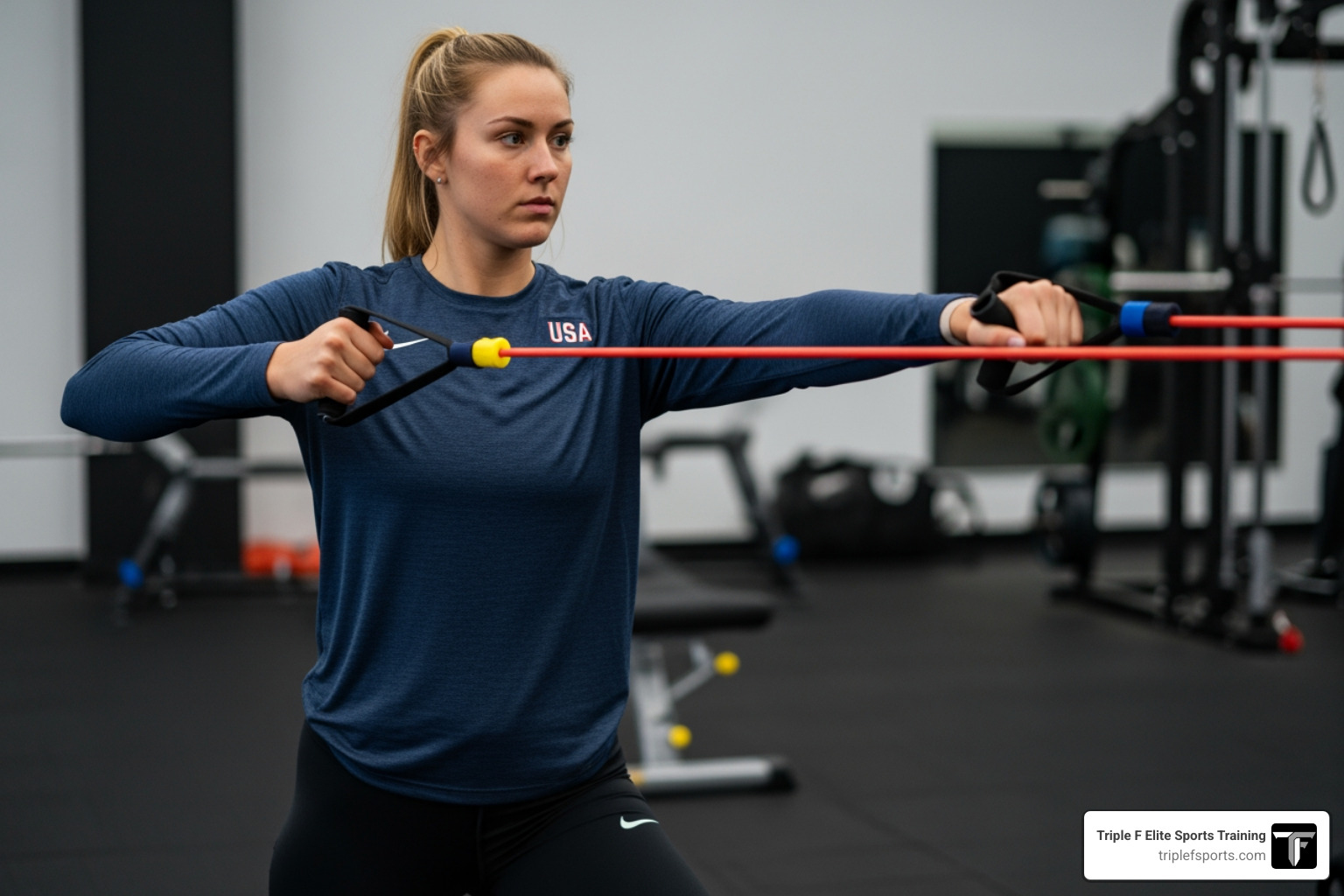
- Band external rotation
- Scapular control drills
- 10-and-2 drops
Upper body training should create balance. For every hard overhead action in volleyball, we need pulling strength, cuff strength, and scapular stability to support it.
Medicine ball throws are excellent because they teach power transfer from the ground through the core into the arms. That is useful for serving and attacking. Anti-rotation work helps players resist twisting when they need a stable base to pass, land, or hit.
Bodyweight Volleyball Strength Training at Home
No gym? No problem. Bodyweight work can absolutely be effective, especially for beginners, youth athletes, or teams with limited practice time.
A strong no-gym menu includes:
- Push-ups
- Split squats
- Reverse lunges
- Pogo jumps
- Single-leg glute bridge
- Front plank
- Side plank
- Wall sit
- Band pull-aparts
- Y-T-W shoulder patterns
- Squat holds
- Calf raises
A simple home circuit might look like this:
- 10 push-ups
- 8 split squats each leg
- 15 pogo jumps
- 20-second side plank each side
- 12 band pull-aparts
- 10 single-leg bridges each side
Repeat 2 to 4 rounds.
Bodyweight work is also easy to blend into Skilled-based Training or team practice when equipment is limited.
How to Progress Volleyball Strength Training for Beginners, Intermediate, and Advanced Players
Not every athlete should train the same way. A middle school beginner does not need the same loading or jump volume as a college-bound outside hitter.
| Level | Main Focus | Strength Work | Plyometrics | Weekly Frequency |
|---|---|---|---|---|
| Beginner | Movement quality | Bodyweight, goblet, basic hinge | Low contacts, landing drills | 2 days |
| Intermediate | Strength plus power | Bilateral and unilateral loading | Moderate contacts, med-ball work | 2 to 3 days |
| Advanced | Peak force and speed | High-intent lifts, individualized volume | Complex and contrast work | 3 days with careful recovery |
Beginner Volleyball Strength Training: Build Technique First
Beginners should earn intensity through control.
We start with:
- Bodyweight squat
- Goblet squat
- Hip hinge drills
- Split squat
- Push-up variation
- Basic row
- Plank and anti-rotation holds
- Landing mechanics from low heights
Important beginner rules:
- Train 2 days per week
- Keep plyometric contacts low
- Use slower tempos to learn positions
- Focus on posture, alignment, and smooth reps
- Stop sets before technique falls apart
For youth athletes, supervised strength training is safe and effective when technique comes first. If you want a deeper youth-specific breakdown, see our In-Depth Guide to Youth Strength Training and Teen Strength: A Guide to Resistance Training for Young Athletes.
Intermediate Players: Add Strength and Elastic Power
Intermediate players usually have basic lifting skill and can handle more targeted programming.
This is where we emphasize:
- Bilateral strength lifts like squats and trap-bar deadlifts
- Unilateral work like split squats and single-leg RDLs
- Moderate loads for 4 to 8 reps
- Medicine ball throws
- Jumps and bounds with intent
- Contrast training, such as a heavy squat followed by a jump
This level usually works well with 2 to 3 weekly sessions. We also start monitoring jump quality and fatigue more closely.
Advanced Players: Peak Power Without Overtraining
Advanced players need enough training to improve, but not so much that performance drops.
Priorities include:
- High-intent lifts
- Complex training
- Position-specific volume
- Force-velocity balance
- Deload weeks
- Readiness tracking
An advanced middle blocker may need more repeat-jump support. A libero may need less heavy jump volume and more lateral speed and trunk stability. At this stage, individualization matters a lot.
Weekly and Seasonal Planning: How to Get Stronger Without Burning Out
The best program on paper can still fail if it does not fit the season.
A sustainable plan accounts for:
- Practice frequency
- Match load
- Travel and tournament weekends
- School stress
- Recovery capacity
- Age and training history
A Simple Weekly Plan for Teams Practicing 2 Hours Twice a Week
This is common for youth and club teams, especially around 14U. When time is tight, we like a 20-minute strength block built into practice.
Sample weekly structure:
Practice Day 1
- 5 minutes dynamic warm-up
- 5 minutes jump prep and landing mechanics
- 8 minutes bodyweight strength circuit
- 2 minutes shoulder care
Practice Day 2
- 5 minutes dynamic warm-up
- 5 minutes medicine ball or explosive work
- 8 minutes lower-body and core circuit
- 2 minutes band prehab
Sample exercises:
- Squat jumps
- Reverse lunges
- Push-ups
- Wall sits
- Lateral shuffles
- Planks
- Band pull-aparts
- Pogo jumps
This style of micro-session works well because it builds consistency without hijacking volleyball practice.
Off-Season, Pre-Season, and In-Season Strength Training
Training should change across the year.
Off-season
- Build muscle and movement quality
- Increase max strength
- Develop weak areas
- Higher volume is okay here
Pre-season
- Shift toward power and speed
- Keep strength work but trim volume
- Increase jump specificity
- Practice more volleyball-like movement patterns
In-season
- Maintain strength
- Reduce total lifting volume
- Keep intensity moderate to high
- Avoid exhausting legs before major matches
- Taper during tournament-heavy weeks
A simple rule:
- Off-season: build
- Pre-season: convert
- In-season: maintain
That approach helps athletes improve without feeling cooked by midseason.
Position-Specific Adjustments for Setters, Hitters, Blockers, and Liberos
All players need a base, but positions do matter.
Setters
- Shoulder endurance and stability
- Core control
- Quick feet
- Moderate jumping load
Hitters
- Approach power
- Rotational core strength
- Upper-body pulling balance
- Landing control
Middle blockers
- Repeat jump ability
- Stiff ankles and calves
- Fast lateral movement at the net
- Knee-friendly volume management
Liberos
- Lateral speed
- Deceleration
- Low-position strength
- Core endurance
- Less emphasis on max jump volume, more on movement quality
If you coach multiple positions together, use the same skeleton program and adjust the jump and accessory volume.
Recovery, Nutrition, and Progressive Overload That Keep Players Improving
You cannot out-train bad recovery.
We tell athletes to cover the basics first:
- Eat enough protein daily to support muscle repair
- Use carbohydrates before and after practice for energy and recovery
- Hydrate consistently, not just when thirsty
- Sleep 8 or more hours when possible
- Keep soreness manageable, not heroic
Progressive overload should be boring in the best way:
- Increase load gradually
- Add reps carefully
- Keep 1 to 3 reps in reserve on most sets
- Use RPE so athletes learn effort without grinding every session
For broader performance support, our Beyond the Gym: Mastering Athletic Strength Training article pairs well with volleyball-specific planning.
Injury Prevention and Progress Tracking in Volleyball Strength Training
Volleyball has predictable trouble spots:
- Jumper’s knee and patellar tendon irritation
- Shoulder pain
- Low back tightness
- Shin splints
- Muscle imbalances from repeated overhead play
Smart strength work reduces risk by improving tissue tolerance and movement quality.
Preventing Common Volleyball Injuries With Smarter Strength Work
For knee health, we use:
- Eccentric squat variations
- Split squats
- Hamstring strengthening
- Glute medius work
- Landing and deceleration drills
For shoulder health, we use:
- Rotator cuff training
- Scapular stability work
- Rows and pull variations
- External rotation drills
- 10-and-2 drops
For low back control, we use:
- Anti-extension core work
- Anti-rotation work
- Hip mobility
- Hinge mechanics
- Glute strength
The key is not doing random prehab forever. It is building a program where strength, mobility, and landing skill all support each other.
How to Measure Results Beyond Just the Weight Room
Progress is not just the number on the bar.
We like to track:
- Standing vertical jump
- Approach jump
- Broad jump
- Push-up test
- Pull strength
- Practice attendance
- Soreness and fatigue log
- Injury frequency
- Match-to-match freshness
If jump height rises, soreness stays manageable, and players feel better deep into tournaments, the program is working.
When to Pull Back to Avoid Burnout
Burnout rarely shows up all at once. It usually whispers first.
Watch for:
- Flat jumps
- Heavy legs for several days
- Poor sleep
- Irritability or low motivation
- Nagging knee or shoulder pain
- Slower practice movement
- Performance dips despite hard effort
That is when we adjust:
- Cut jump volume
- Reduce accessory work
- Use a deload week
- Prioritize sleep and recovery
- Balance practice load with training load
Pushing harder is not always the smart move. Sometimes the best performance boost is one less set.
Frequently Asked Questions about Volleyball Strength Training
Can volleyball players gain 2 to 6 inches on their vertical jump with strength training?
Yes, many can. The 2 to 6 inch range is realistic for athletes who follow a structured program consistently. Results depend on training age, current strength level, body composition, jump technique, and whether plyometrics are paired with a solid strength base.
Beginners often see the fastest gains because they have more room to improve.
Is Volleyball strength training safe for middle school and high school athletes?
Yes, when supervised and age-appropriate. Youth resistance training is safe when athletes learn good technique, use appropriate loads, and progress gradually. We do not rush young players into advanced lifts before they can squat, hinge, land, and brace well.
For more on this, visit Youth Training 12 to 18.
What if my team has no weight room or very limited practice time?
You can still build a lot with bodyweight drills, resistance bands, medicine balls, and short training blocks inside practice. Even 15 to 20 minutes twice a week can improve movement quality, strength endurance, and jump mechanics if the plan is organized.
For more ideas, see our Cheat Sheet to Youth Volleyball Training Options.
Conclusion
The best Volleyball strength training plan is not the one that leaves athletes exhausted. It is the one that builds stronger jumps, healthier shoulders, better movement, and enough recovery to actually use that strength on the court.
When we train with the sport in mind, progress gets simpler:
- Build technique first
- Add strength gradually
- Layer in power
- Adjust for the season
- Respect recovery
- Track results
That is how players get stronger without burning out.
If you are ready to build volleyball-specific strength with a professional, sustainable plan in Knoxville, we would love to help. Triple F Elite Sports Training offers Christ-centered athletic development, performance training, physical therapy support, and volleyball programming designed to help athletes reach their potential.
Start with a free first session and learn more here:
You can also explore more resources for players and families: