
What You Need to Know About Volleyball Coaching Lessons
Volleyball coaching lessons give players a structured path to develop real skills — from passing and setting to reading the game under pressure. Whether you’re a youth athlete just starting out or a competitive club player looking to sharpen your edge, the right coaching makes a measurable difference.
Here’s what effective volleyball coaching lessons typically cover:
- Fundamentals — passing, setting, hitting, blocking, and serving
- Practice structure — warm-up, technical drills, game-like situations, competitive finish
- Format options — private (solo), small group (duet/trio), or team-based sessions
- Teaching methods — direct instruction for beginners, guided discovery for developing players
- Physical conditioning — strength, explosiveness, agility, and injury prevention
- Mental skills — confidence, focus, and communication under pressure
Great coaching isn’t just about running drills. It’s about creating an environment where players understand why they’re doing what they’re doing — and that understanding is what turns repetition into real growth.
I’m Kevin O’Shea, a Certified Strength and Conditioning Specialist with a background in athletic development and behavioral coaching — and at Triple F Elite Sports Training, I bring that same performance-first mindset to volleyball coaching lessons in Knoxville. Let’s break down exactly what it takes to coach and train smarter.
Volleyball coaching lessons vocab to learn:
The Modern Coach’s Toolkit: USA Volleyball Academy and Multi-Platform Learning
To deliver top-tier volleyball coaching lessons, coaches must commit to continuous education. The sport is constantly evolving, and the old-school “do it because I said so” approach has been replaced by science-backed, multi-platform ecosystems.
At the core of professional coach development is the USA Volleyball (USAV) Coach Academy. Hosted on the Litmos platform, this program offers a tiered curriculum divided into Bronze, Silver, and Gold modules. It moves away from rigid, single-platform content delivery to provide an interactive, comprehensive learning path. The curriculum is organized across five core categories:
- Craft: Technical training for indoor and beach skills, including serve receive, rotations, and motor learning. Highly acclaimed courses like USA Volleyball: Reading with Karch Kiraly and USA Volleyball: Motor Learning are found here.
- Body: Athlete wellness, nutrition, physical training, injury prevention, and concussion protocols.
- Mind: Sport psychology, mental training, self-talk, and confidence building.
- Heart: Parent communication, sportsmanship, inclusion, and athlete safety.
- Team: Culture building, legal duties, and managing team dynamics.
Complementing the USAV Academy is the massive library from the Art of Coaching Volleyball. Featuring over 4,000 coaching videos, this resource covers everything from basic footwork to complex offensive systems. Premium memberships start at $10.83/month, granting access to more than 3,000 specialized training videos, free online courses, and clinic discounts. This enables coaches to study legendary leaders, such as John Dunning demonstrating the locator step or Russ Rose explaining offensive coverage systems.
By blending the systematic certification of the USAV Academy with the on-demand, video-rich library of the Art of Coaching Volleyball, modern coaches can build a dynamic curriculum. For a deeper look into these elite strategies, explore our guide on how to Level Up Your Game With Pro Coaching Secrets.
Structuring Effective Volleyball Coaching Lessons for All Skill Levels
A great coach doesn’t just toss balls onto the court and hope for the best. Every training unit must have a deliberate flow that balances physical output with cognitive learning.
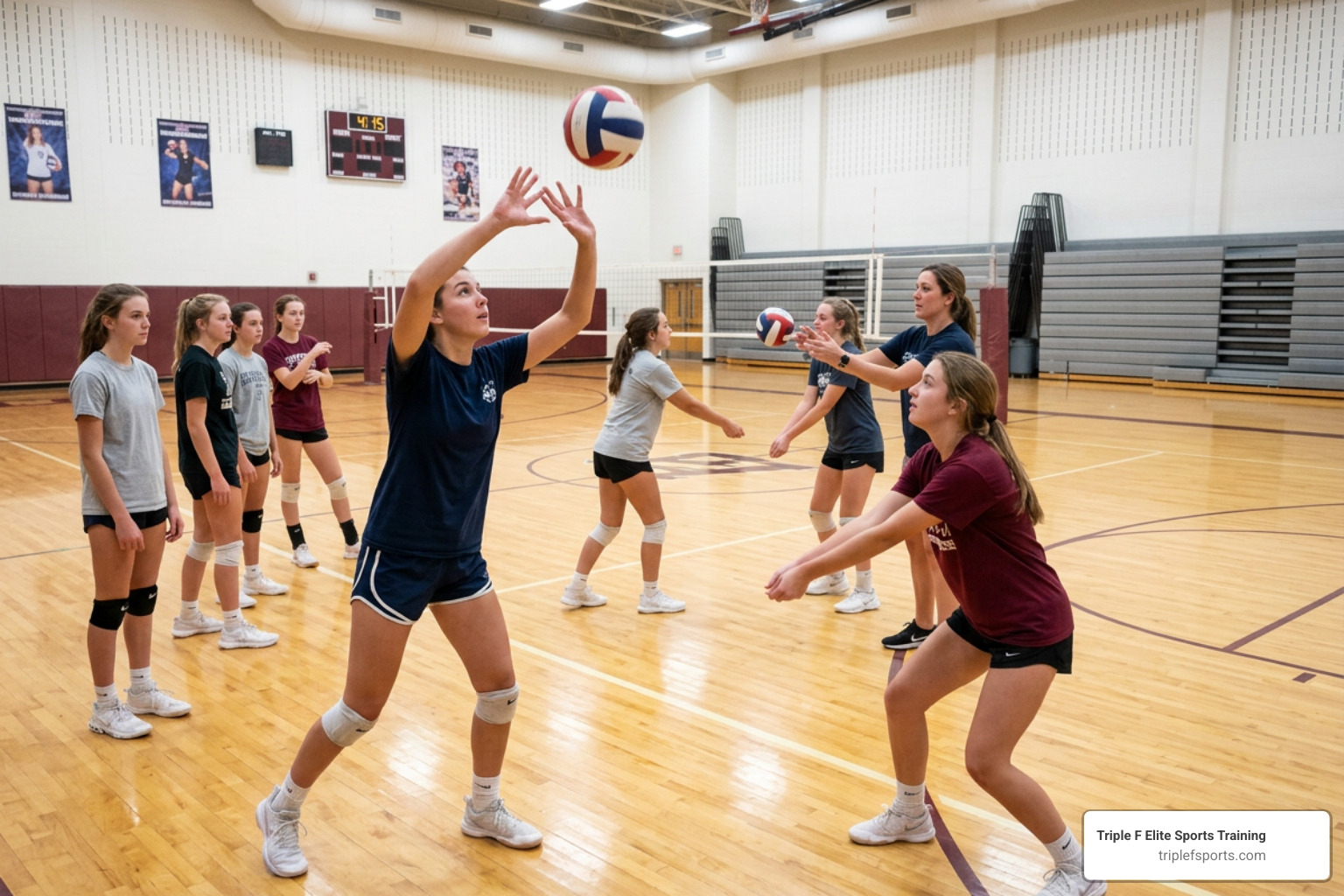
According to coaching best practices, a highly productive 60-to-90-minute volleyball practice should be structured using a four-part framework:
- Dynamic Warm-Up (10-15% of time): This phase must be volleyball-specific. Rather than static stretching, we utilize dynamic movements (lunges, arm swings, lateral shuffles) and light ball-handling to prepare the nervous system.
- Technical Block (25-30% of time): Focus on one specific skill theme per session (e.g., hand placement during setting or platform angle during serve receive). Research shows that dedicating 75% of this block to high-repetition drills builds the muscle memory necessary for rapid development.
- Game-Like Phase (40-45% of time): Move away from isolated, static drills. Volleyball is a game of reading and reacting. In this phase, we introduce constraints and realistic situations, such as transition play, side-out scoring, or receiving live float serves.
- Competitive Finish (10-15% of time): End the session with a high-energy, score-based challenge. Games like “King of the Court” or small-sided scrimmages (2v2, 3v3) simulate match pressure and keep training fun.
For those just starting out, check out Effective Strategies: How to Coach Volleyball for Beginners – Volleyball Vantage for foundational teaching tips.
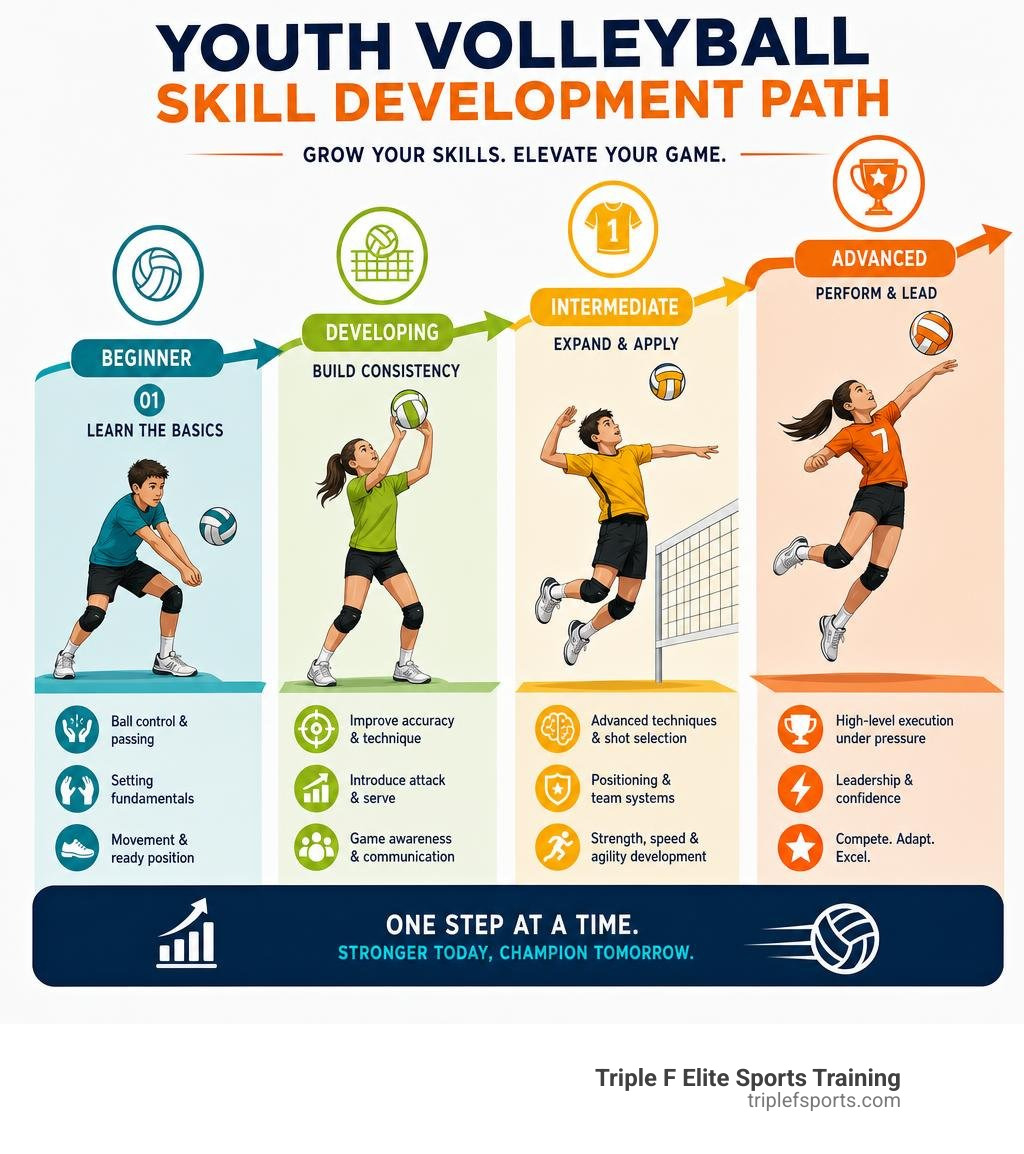
When working with youth and beginner players, coaches must balance specialization with general athletic development. Early specialization often leads to overuse injuries and mental burnout. Instead, youth players should master all five basic skills: serving, passing, setting, hitting, and blocking.
Building a broad foundation of coordination, spatial awareness, and basic ball control ensures that when players eventually specialize in high school, they possess the athletic toolkit to excel. To learn more about setting up these foundational blocks, read about The Best Way To Start Youth Volleyball Lessons Today and dive into Volleyball Skill Development Drills And Strategies For Success. For an overall look at skill progression, our resource on going From Beginner To Pro Coaching Secrets For Rapid Sports Skill Development is an invaluable guide.
Designing Private and Small Group Volleyball Coaching Lessons
While team practices are essential for tactical development, private and small-group training is where individual mechanics are refined. To maximize development while remaining cost-effective, coaches utilize tiered scheduling and group sizes.
Across the club landscape, private lesson pricing structures vary based on coach experience and group size. Industry benchmarks show:
- Solo Lessons: Typically range from $80 to $100 per hour.
- Duet Lessons (2 players): Generally cost $50 per player per hour.
- Trio Lessons (3 players): Typically cost $40 per player per hour.
For groups of four or more, sessions are usually classified as clinics, which follow different pricing and registration structures. Additionally, facilities often charge court rental fees (ranging from $40 to $50 per hour) which may be billed separately from the coach’s instructional fee.
Small-group training (duets and trios) is often more effective than solo training. It allows coaches to design drills that require a passer, a setter, and a hitter, maintaining the natural read-and-react sequences of the sport while reducing the financial burden on parents. If you’re planning to book individual training, make sure to read Volleyball Private Lessons Your Survival Guide to get the most out of your sessions.
Leveraging Digital Platforms and Volleyball Coaching Lessons Online
Modern coaching doesn’t stop when you step off the court. Digital platforms and online video analysis allow coaches to provide remote feedback, extending the learning window.
By analyzing video frame-by-frame, coaches can point out subtle mechanical errors — such as an early arm swing or incorrect footwork approach — that are difficult to spot in real-time. Platforms like Joe Trinsey’s coaching series offer incredible insights into modern drill design, tutoring, and mentorship. Utilizing these digital tools helps players develop a deeper understanding of the game. For more on how to incorporate these modern concepts, check out Summer School 2026 – Smarter Volley by Joe Trinsey .
Teaching Methodologies: Direct Instruction vs. Guided Discovery
How a coach communicates during a lesson is just as important as the drill itself. There are three primary teaching methodologies used in modern volleyball coaching:
| Teaching Method | Definition | Best Used For | Example in Practice |
|---|---|---|---|
| Direct Instruction | Coach explains and demonstrates exactly how to perform a movement. Focuses on preparation and posture. | Beginners, introducing new skills, and explaining rigid rules (such as overlap rules). | Teaching a 7-year-old hand positioning for passing using the cue “pancake, pancake, sausage, sausage.” |
| Guided Discovery | Coach asks questions and designs constraints to lead the player to find the solution themselves. | Intermediate to advanced players developing decision-making skills. | Asking a hitter, “Where was the blocker’s block open?” to help them recognize defensive gaps. |
| Mutual Exploration | Coach and player work together to find unique movement solutions. Encourages self-organization. | Elite players refining highly specialized skills or adapting to unusual game situations. | Allowing a player to experiment with different jump-set contact points to find their optimal tempo. |
While traditional coaching relied almost exclusively on Direct Instruction, modern sports science emphasizes Guided Discovery and Mutual Exploration. Movement skills are not just blueprints retrieved from the brain; they are the result of an athlete’s perception and interaction with their environment.
By allowing players to self-organize and solve movement problems naturally, we build resilient athletes who can adapt to the chaotic, nature of a real match. To explore these teaching dynamics further, read Summer School Part 2 – Smarter Volley by Joe Trinsey .
Physical Conditioning and Injury Prevention Protocols
To perform at a high level and stay on the court, volleyball players require specialized physical preparation. Volleyball is characterized by short, explosive rallies lasting 5 to 30 seconds, separated by brief rest periods. During a single match, a player may perform upward of 50 maximal jumps.
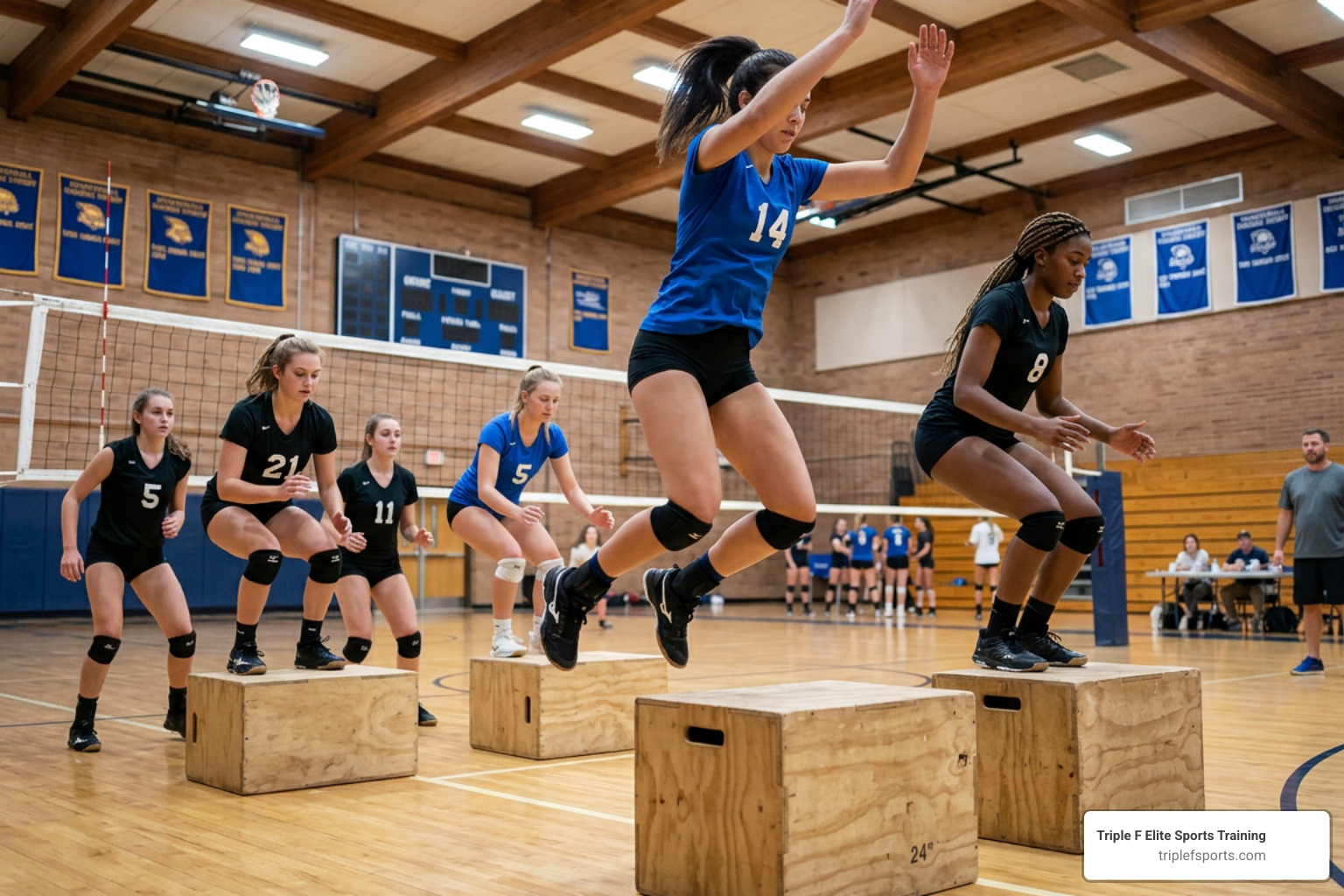
According to the FIVB LEVEL II coaching manual, a comprehensive physical training program must focus on:
- Resistance Training: To build explosive power and protect joints from mechanical stress, players should engage in resistance training using loads greater than 60% of their maximum muscle strength.
- Trunk Stability: A strong core is essential for transferring power from the lower body to the upper body during attacks and blocks, while also protecting the lumbar spine.
- Plyometrics and Landing Mechanics: Training must emphasize safe take-off and landing mechanics. Landing on one foot or with valgus knee collapse (knees caving inward) is a primary cause of ACL tears and patellar tendinitis.
- Mobility and Prehab: Dedicated mobility work targeting the ankles, hips, and thoracic spine ensures the body can handle the extreme ranges of motion required in defensive digging and overhead hitting.
At Triple F Elite Sports Training in Knoxville, we combine our athletic performance expertise with specialized on-court protocols to build robust, explosive athletes. Discover how we integrate these elements into our Volleyball/Volleyball Training programs.
Match Preparation, Team Cohesion, and Psychological Training
A team’s success during a match is heavily determined by their preparation and mental resilience. Effective match preparation involves structured pre-match warm-ups that prepare both the body and mind, clear in-game coaching management, and constructive post-match evaluations.
During matches, coaches should keep instructions simple. In a timeout, giving players one or two clear, actionable cues is far more effective than overwhelming them with tactical changes.
Equally important is building team cohesion and psychological strength. Volleyball is the ultimate team sport; “silent teams are slow teams.” Coaches must foster constant communication on the court regarding coverage, rotations, and intentions.
Building a positive, supportive environment where players are encouraged to take calculated risks without fear of immediate benching builds the confidence needed to win tight games. For tips on developing these leadership and communication qualities, check out How to Coach Volleyball | Tips for Becoming a Great Coach .
In Knoxville, preparing for the club season means aligning your training schedule with local competition phases. Players can check out local opportunities through the Volleyball Programs – City of Knoxville to stay active in the community.
To get ready for the competitive season, players can fine-tune their skills at Volleyball Pre Tryout Clinics, find local sessions through our Knoxville Volleyball Clinics Your Guide To Local Training guide, or check out our comprehensive list of Volleyball Clinics Camps Knoxville and Volleyball/Clinics Camps.
Frequently Asked Questions about Volleyball Coaching
How do I structure a 60-minute volleyball coaching lesson?
A highly effective 60-minute lesson should be broken down into:
- Warm-Up (10 mins): Dynamic, volleyball-specific movements and light ball control.
- Technical Block (20 mins): High-repetition drills focusing on a single theme (e.g., passing or setting).
- Game-Like Phase (20 mins): Reading and reacting drills with live variables and constraints.
- Competitive Finish (10 mins): A , score-based game to practice under pressure.
What is the difference between private and small group volleyball coaching lessons?
Private lessons are solo (1-on-1) sessions that allow for highly individualized mechanical corrections. Small group lessons (duets or trios) involve 2 to 3 players. Small group lessons are more cost-effective and allow the coach to run realistic, multi-contact drills (pass-set-hit sequences) that better simulate actual game play.
At what age should youth volleyball players begin position specialization?
Players should avoid specializing in a single position until they are around 14 or 15 years old (typically entering high school). Prior to that, youth athletes should rotate through all positions and learn all foundational skills. This builds well-rounded athleticism, prevents overuse injuries, and ensures they understand the entire flow of the game.
Conclusion
Mastering the court requires a combination of technical skill, explosive physical conditioning, and smart tactical understanding. Whether you are a beginner learning the basic platform pass or an advanced player preparing for club tryouts, professional volleyball coaching lessons are the key to unlocking your full potential.
At Triple F Elite Sports Training in Knoxville, TN, we provide professional, Christ-centered athletic development for youth and adult athletes. Our state-of-the-art facility offers comprehensive performance training, physical therapy, and dedicated volleyball training designed to take your game to the next level.
Ready to elevate your performance and avoid the net errors? We invite you to claim a free first session with us today. Visit our Triple F Volleyball Training Program to sign up and start your journey toward elite athletic development.