
The Best Free Athlete Training Program PDFs You Can Download Right Now
If you’re looking for an athlete training program pdf, here are the top free options worth downloading in April 2026:
| Program | Duration | Focus | Best For |
|---|---|---|---|
| 12-Week Beginner Hybrid Athlete Program | 12 weeks | Strength + endurance | General athletes |
| NSCA Basics of Strength and Conditioning | Ongoing | Technique + safety | Coaches and beginners |
| 4-Week Speed, Strength & Power Manual | 4 weeks | Speed, agility, power | Multi-sport athletes |
| 8-Week Olympic Weightlifting Course | 8 weeks | Olympic lifts | Intermediate lifters |
| 10-Week Track and Field Plan | 10 weeks | Sprint, jump, throw | Youth track athletes |
Most athletes waste months spinning their wheels with no real plan. The truth is simple: a structured program changes everything.
Research consistently shows it takes about 12 weeks of combined cardio and strength training to produce a meaningful shift in your fitness. That’s not a guess — it’s the timeline coaches rely on when building programs that actually work.
Whether you’re a youth athlete in Knoxville just getting started, or an adult trying to level up your performance, the right downloadable plan gives you a clear roadmap from Day 1 to Week 12 — and beyond.
I’m Kevin O’Shea, a Certified Strength and Conditioning Specialist and wide receiver coach whose experience spans athletic development, high school football, and elite sports training — and helping athletes find the right athlete training program pdf to match their goals is exactly what I do at Triple F Elite Sports Training. Let’s break down the best free plans available right now so you can get started today.
Athlete training program pdf terms explained:
The Science of the Hybrid Athlete Training Program PDF

To build a truly elite athlete, we can’t just throw random exercises at the wall and hope they stick. We rely on the gold standard of sports science: the National Strength and Conditioning Association (NSCA) guidelines. When you download a high-quality athlete training program pdf, it should be rooted in the SAID principle—Specific Adaptations to Imposed Demands. This means if you want to be an explosive volleyball player or a dominant offensive lineman, your training must specifically mimic those demands.
One thing we often tell our athletes here in Knoxville is that becoming an expert isn’t an overnight process. Real expertise in strength and conditioning is estimated to take about 10,000 hours—or roughly 10 years of dedicated practice. While you don’t need a decade to see results, you do need a program that respects the complexity of the human body. Understanding how to navigate these variables is why resources like the [PDF] nsca-coach-1.4.pdf are so valuable for those looking to understand the “why” behind the “what.”
Core Principles of the Athlete Training Program PDF
Every effective athlete training program pdf is built on a few non-negotiable pillars:
- Progression: You can’t lift the same 135 pounds for three years and expect to get stronger. We have to gradually increase the challenge.
- Specificity: A marathoner doesn’t need a 500-pound bench press, and a shot putter doesn’t need to run 50 miles a week.
- Overload: To see change, we must stress the body beyond its current comfort zone.
- Reversibility: Use it or lose it. Strength can decrease by about 3% each week if you stop training entirely.
- Diminishing Returns: Your biggest gains happen early. As you get more elite, we have to work much harder for smaller improvements.
For our younger competitors, these principles are even more critical. We focus heavily on youth training 12 to 18 to ensure they are building a foundation that lasts a lifetime without burning out or getting injured.
Bioenergetics and Performance Timing
Understanding your “engine” is key. Your body uses three main energy systems, and a good athlete training program pdf targets the one most relevant to your sport:
- Phosphagen (ATP-PC) System: This is for high-power bursts lasting less than 20-30 seconds (think a 40-yard dash or a heavy triple on squats).
- Glycolytic System: This kicks in for moderate-intensity efforts lasting 30 seconds to about 3 minutes.
- Oxidative System: This is your long-term engine for anything lasting longer than 3 minutes.
Here is a pro tip we use at Triple F: if you are grinding through a heavy set of compound movements, try “hyperventilation breathing.” Research suggests that specific breathing techniques on big sets can actually increase your reps by about 30%. It’s a small tweak that yields massive results. If you’re looking to dive deeper into explosive power specifically, check out this Olympic Weightlifting: 8-Week Training Course for a structured look at the snatch and clean & jerk.
Structure of a 12-Week Beginner Hybrid Athlete Program
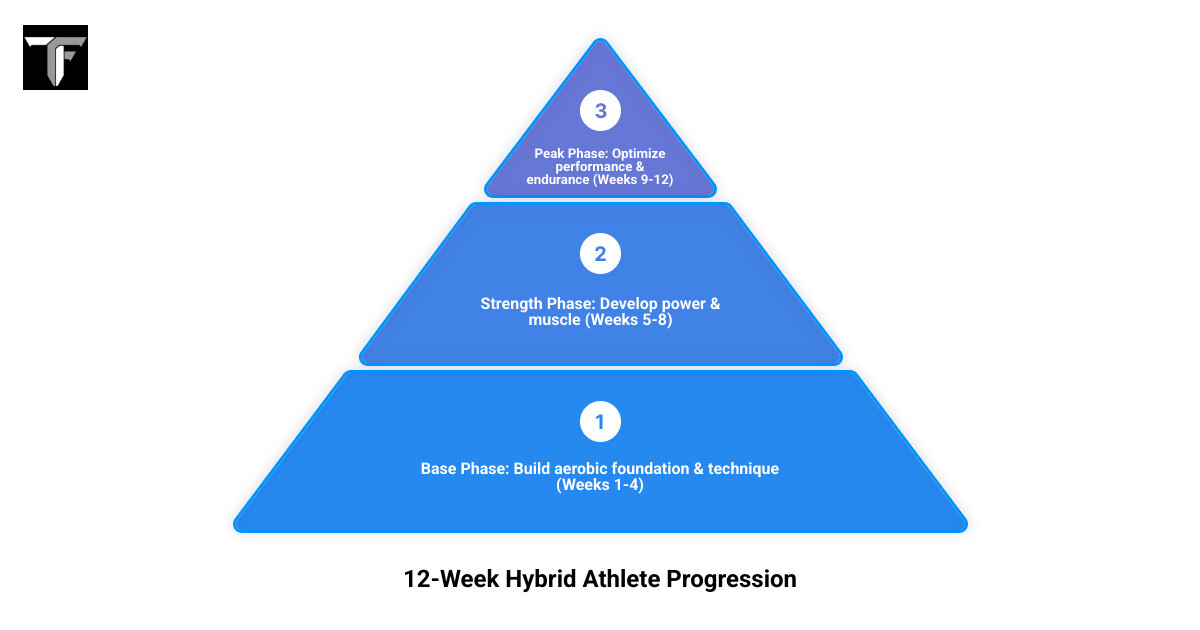
A “Hybrid Athlete” is someone who wants the best of both worlds: the strength of a powerlifter and the gas tank of a runner. This is one of the most popular requests we get for an athlete training program pdf. We typically break these 12 weeks into three distinct phases:
- Base Phase (Weeks 1-4): Building the “engine” and perfecting movement patterns.
- Strength Phase (Weeks 5-8): Increasing the load and focusing on muscle hypertrophy.
- Peak Phase (Weeks 9-12): Sharpening intensity and testing new limits.
One of the biggest mistakes we see is athletes trying to do everything at once. To avoid the “interference effect”—where cardio kills your gains—we follow the 4-hour separation rule. Research shows that separating your cardio from your weight training by a minimum of 4 hours allows for significantly faster progress in both strength and muscle growth. You can see how we coordinate these sessions in our current training schedule.
Weekly Structure of the Athlete Training Program PDF
Most serious athletes hit the gym 4 to 5 times per week. A typical hybrid week might look like this:
- Monday: Heavy Upper Body + Optional Zone 2 Cardio (PM)
- Tuesday: Interval Runs (Sprints)
- Wednesday: Heavy Lower Body
- Thursday: Rest or Active Recovery (Mobility)
- Friday: Full Body Power + Tempo Run
- Saturday: Long Slow Distance (LSD) Cardio
- Sunday: Full Rest
This structure ensures you aren’t overtaxing the same energy systems two days in a row. For those specifically looking to improve their running game during the off-season, The Distance Runner’s Offseason Training Manual offers great insights into mileage progression.
Scheduling for Maximum Hypertrophy
If your goal is to get “jacked” while staying fast, the order of operations matters. Always perform heavy weights before cardio. Lifting requires the most neurological focus and muscle glycogen. If you run 5 miles and then try to squat, your form will suffer, and your strength will be compromised.
At Triple F, we prioritize compound lifts (squats, deadlifts, presses) at the start of the session when you are freshest, followed by accessory work to round out the physique. This approach is central to our adult training programs, where we balance busy schedules with high-performance goals.
Mastering the Weekly Workout: Strength, Cardio, and Recovery
When you look at a weekly workout in a modern athlete training program pdf, it’s not just about “working hard.” It’s about working in the right zones.
- Zone 2: This is “conversational” pace. You should be able to breathe through your nose. It builds your aerobic base without beating up your joints.
- Zone 3: This is a steady jog where nasal breathing becomes difficult.
- Zone 5: This is “all-out” effort. Think assault bike sprints or hill repeats.
Using an RPE (Rate of Perceived Exertion) scale from 1 to 10 helps you stay honest. If the program says RPE 7, you shouldn’t be collapsing on the floor. If you want to see how an elite program balances these zones, the Faster in 50 Program is a fantastic resource for concurrent training.
Nutrition for the Hybrid Athlete
You can’t drive a Ferrari on low-grade fuel. For hybrid athletes, nutrition is the differentiator. Here are our baseline recommendations:
- Protein: 1g per pound of body weight (mainly from animal sources).
- Fats: 60-90g per day to support hormone health.
- Carbs: The remainder of your calories should come from high-quality carbs to fuel your training.
If you’re training for peak performance, like our athletes in NFL pre-draft training, you need to be at maintenance calories or a slight surplus. Trying to build an elite engine while in a massive calorie deficit is a recipe for injury.
Recovery Strategies and What to Avoid
We tell our Knoxville athletes that you don’t grow in the gym; you grow while you sleep. Sleep is your #1 recovery tool. Beyond that, compression gear can help decrease DOMS (delayed onset muscle soreness) and speed up recovery.
However, there is a major “don’t” in the recovery world: Avoid ice baths if your goal is muscle growth. While cold therapy is great for reducing pain before a big game, it actually blunts the inflammatory response your body needs to build new muscle. If you want to get bigger and stronger, skip the ice and stick to a Zone 1 cool-down (10 minutes of very light movement) post-workout. This is a staple in our volleyball training to keep athletes fresh throughout long tournament weekends.
Specialized Training Plans for Every Discipline
Not every athlete training program pdf is one-size-fits-all. Depending on your sport, the “weight” of each training component shifts.
| Sport Category | Primary Focus | Key Movement Patterns |
|---|---|---|
| Olympic Lifting | Power & Technique | Snatch, Clean & Jerk, Front Squat |
| Endurance Running | Aerobic Capacity | Tempo runs, Long runs, Core stability |
| Multi-Sport Agility | COD & Explosiveness | Shuffles, Plyometrics, Sprints |
Safety is paramount, especially with compound lifts. Always ensure you have a spotter for heavy bench presses and squats. If you’re looking for a structured track-focused plan, the 10-Week Training Plan – Athletics provides a great roadmap for speed and event-specific drills.
Position-Specific Development
At Triple F, we believe in training the athlete for their specific role on the field. A wide receiver needs elite acceleration and “hand-eye” coordination, whereas an offensive lineman needs raw power and lateral stability.
We take pride in our specialized coaching, such as our wide receiver training by Amari Rodgers. These plans focus on the first 5-10 steps of acceleration, which is often more important than top-end speed in a game setting.
Youth and Future Pro Foundations
For our “Future Pros,” the goal isn’t to see how much weight they can move today, but how well they can move for the next twenty years. We emphasize technique over load every single time. Our Future Pros Program is designed to build “the coach’s eye” in young athletes, teaching them to value form and safety above all else.
Frequently Asked Questions about Athlete Training Programs
How long does it take to see results from a hybrid program?
It typically takes about 3 months (12 weeks) of consistent training to see significant changes in both cardiovascular endurance and muscular strength. This is because your body needs time to undergo physiological adaptations, such as increasing mitochondrial density and muscle fiber recruitment.
Should I do cardio or weights first?
Research indicates that heavy weights should generally precede cardio sessions. Lifting weights requires high levels of ATP and neurological freshness. If you do cardio first, you’ll be too fatigued to lift with proper form. For optimal strength and hypertrophy, separate the two by at least 4 hours.
Why are ice baths discouraged for muscle growth?
While ice baths are excellent for immediate recovery before a competition or during a multi-day tournament, they can blunt the inflammatory response necessary for muscle hypertrophy. Inflammation is the signal that tells your body to repair and grow muscle; by “freezing” that process, you might actually be slowing down your long-term strength gains.
Conclusion
At Triple F Elite Sports Training in Knoxville, Tennessee, we aren’t just a gym; we are a Christ-centered community dedicated to unlocking your full potential. Whether you are a youth athlete looking to make the varsity squad or an adult wanting to reclaim your peak fitness, we provide the professional environment you need to succeed. From performance training to physical therapy, we have everything under one roof.
Downloading Your Athlete Training Program PDF and Next Steps
Ready to stop guessing and start growing? Download your athlete training program pdf and commit to the 12-week journey. The best program is the one you actually follow. If you’re in the Knoxville area, we’d love to help you customize your plan. We even offer a free first session to get you started on the right foot.
Take the first step toward the podium and start your skilled-based training journey with us today. Whether it’s speed, strength, or total athletic dominance, the road to the top starts with a plan. Let’s get to work!