
The Golden Window: Why Ages 8–11 Are Perfect for Speed and Agility Training
Speed and agility drills for 10 year olds are one of the most effective ways to build a well-rounded young athlete — and the timing couldn’t be better.
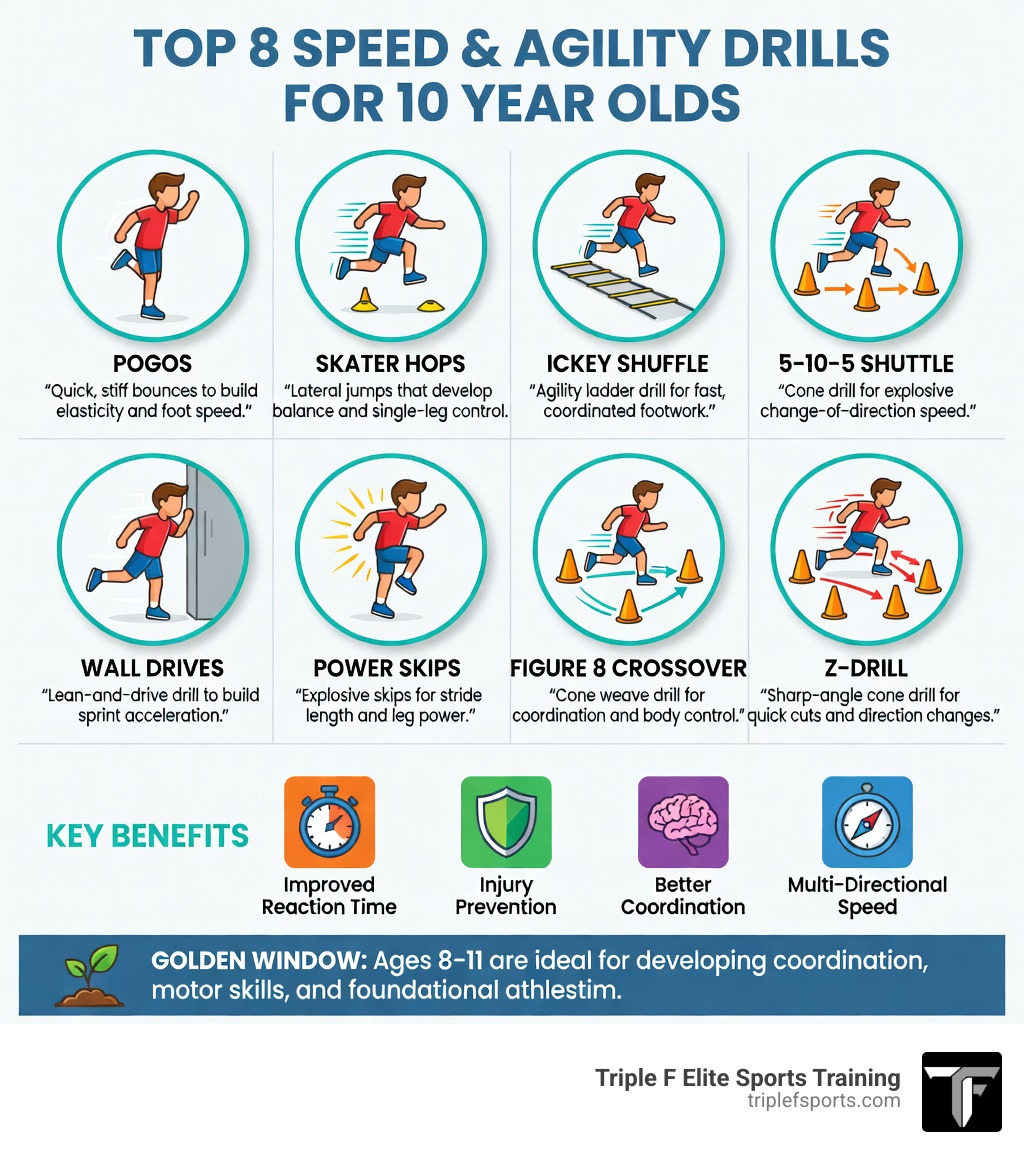
Here are the best drills to get started:
- Pogos – quick, stiff bounces to build elasticity and foot speed
- Skater Hops – lateral jumps that develop balance and single-leg control
- Ickey Shuffle – agility ladder drill for fast, coordinated footwork
- 5-10-5 Shuttle – cone drill for explosive change-of-direction speed
- Wall Drives – lean-and-drive drill to build sprint acceleration
- Power Skips – explosive skips for stride length and leg power
- Figure 8 Crossover – cone weave drill for coordination and body control
- Z-Drill – sharp-angle cone drill for quick cuts and direction changes
Ages 8 to 11 represent what sports scientists call the “golden window” for athletic development. During this stage, kids’ brains and bodies are primed to absorb movement patterns, coordination, and motor skills faster than at almost any other point in life.
With over 35 million kids participating in organized sports each year, the difference between kids who thrive and those who fall behind often comes down to one thing: foundational athleticism built early.
The good news? You don’t need a fancy gym or expensive equipment to get started.
I’m Kevin O’Shea, a Certified Strength and Conditioning Specialist and former college wide receiver who has spent years coaching athletes at every level — including developing speed and agility drills for 10 year olds through structured, science-backed youth training programs. Let’s break down exactly what your young athlete needs to get faster, sharper, and more confident on any field or court.
Why Speed and Agility Drills for 10 Year Olds are Game-Changers
At Triple F, we often see parents who are eager to get their kids into the weight room. While strength is important, for a 10-year-old, the real “secret sauce” is neuromuscular efficiency. This is a fancy way of saying we want the brain and the muscles to talk to each other as fast as possible. When a child performs speed and agility drills for 10 year olds, they aren’t just “working out”; they are literally wiring their nervous system for elite performance.
According to ScienceDirect, agility is a skill-related component of physical fitness that relates to the ability to rapidly change the position of the entire body in space with speed and accuracy. For a pre-teen, this isn’t just about moving fast in a straight line. It’s about how they react when a soccer ball takes a weird bounce or how they adjust their feet to field a ground ball.
One of the biggest reasons we prioritize these drills is injury prevention. Many non-impact injuries in youth sports occur during deceleration — the act of slowing down or landing after a jump. By teaching kids how to absorb force and control their center of gravity, we make them “injury-resistant.” We focus heavily on Coordination, which is the ability to select the right muscle at the right time with the proper intensity.
Before we dive into the drills, we always recommend youth assessments. Every child is different; some have natural “spring” but lack balance, while others are strong but struggle with proprioception (their body’s awareness of where it is in space). Developing these motor skills during the “golden window” ensures they don’t just become good players, but great athletes.
Top Speed and Agility Drills for 10 Year Olds to Master
When we talk about skilled-based training, we want drills that challenge the mind as much as the legs. Here are the foundational movements every 10-year-old should have in their toolkit.
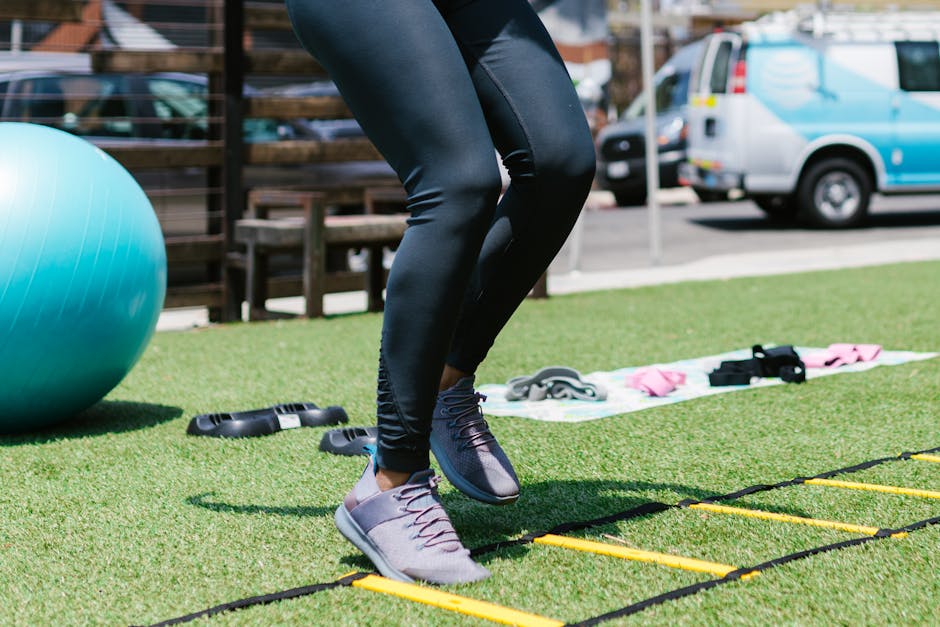
1. The Ickey Shuffle (Agility Ladder)
This is the “gold standard” for foot speed. The pattern is “In-In-Out.” You step into the first square with your right foot, follow with your left, then step outside the next square with your right foot while moving forward. It builds incredible rhythm and coordination.
2. 5-10-5 Shuttle (Pro Agility)
This is where we define Speed as the ability to move quickly across the ground. Set up three cones 5 yards apart. Start at the middle cone, sprint 5 yards to the right, touch the line, sprint 10 yards all the way to the far left cone, touch the line, and sprint 5 yards back to the center. It teaches explosive starts and sharp turns.
3. Skater Hops
These are fantastic for lateral power. Imagine your child is a speed skater. They jump sideways from the right foot to the left, “sticking” the landing with a slight knee bend before jumping back. This builds the single-leg stability required for sports like tennis and basketball.
4. Pogos
We love pogos because they build “elasticity.” Have your child jump with stiff ankles, spending as little time on the ground as possible. It should look like they are jumping on a pogo stick. This trains the tendons to act like springs, which is the key to true explosive speed.
5. The Z-Drill
Set up four cones in a “Z” pattern, about 5 yards apart. The athlete sprints to the first cone, shuffles laterally to the second, and sprints to the third. This forces them to transition between different types of movement—a skill that translates directly to the football field or soccer pitch.
6. Wall Drives
Have your athlete lean against a wall at a 45-degree angle with their hands at shoulder height. On your command, they drive one knee up while keeping the back leg straight and the heel off the ground. This mimics the “drive phase” of a sprint and teaches them the proper body angle for acceleration.
7. Power Skips
These aren’t your playground skips. We want height and distance. The athlete should drive their knee and opposite arm up explosively, aiming to spend as much time in the air as possible. It’s great for stride length and leg power.
8. Figure 8 Crossover
Place two cones about 10 feet apart. The athlete runs in a figure-eight pattern around them. This drill is excellent for teaching kids how to lean into a turn and use “crossover” steps to maintain speed while changing direction.
How to Structure a Fun 30-45 Minute Training Session
At Triple F in Knoxville, we know that if it isn’t fun, a 10-year-old isn’t going to want to do it. You can’t just run them through “boring” laps. You have to gamify the experience. Our current training schedule always balances hard work with high engagement.
The Dynamic Warm-Up (10 Minutes)
Never start with static stretching (sitting and reaching for toes). Kids need a dynamic warm-up to increase blood flow. We use movements like high knees, butt kicks, and “world’s greatest stretch” to improve flexibility and prepare the joints for impact.
Skill & Drill Phase (15-20 Minutes)
This is where you pick 3 or 4 of the drills mentioned above. Keep the reps short (10-15 seconds) and the rest periods long enough for them to catch their breath. Focus on quality over quantity. If they are stumbling through the Ickey Shuffle because they are tired, they aren’t learning the right pattern.
The “Game” Phase (10 Minutes)
This is the secret to preventing burnout. We love “Sharks and Minnows.” One or two kids are the “sharks” in the middle of a square, and the rest have to get from one side to the other without getting tagged. It forces them to use all the agility skills they just practiced in a chaotic, reactive environment.
Comparison: Linear Speed vs. Multi-Directional Agility
| Feature | Linear Speed | Multi-Directional Agility |
|---|---|---|
| Focus | Straight-line velocity | Change of direction & reaction |
| Example | 40-yard dash | 5-10-5 Shuttle |
| Key Skill | Stride length & frequency | Center of gravity control |
| Sport Use | Fast breaks, base running | Defending a dribbler, cutting |
Cool-Down & Recovery (5 Minutes)
Finish with light walking and some deep breathing. This is also the time to talk about the “Three Pillars of Recovery”:
- Hydration: Water is best, but kids need electrolytes if they’ve been sweating hard.
- Sleep: 10-year-olds need 9-11 hours of sleep for their muscles and brains to recover.
- Nutrition: Focus on “real food”—proteins for muscle repair and complex carbs for energy.
Essential Equipment and Safety for Youth Training
You don’t need a million-dollar facility to see results, but a few key items can help.
The Basic Kit
- Agility Ladders: Great for footwork and coordination.
- Cones: Essential for marking distances and “targets” for turns.
- Mini Hurdles: Excellent for teaching kids to pick their feet up and for plyometric jumps.
Safety First
The most important rule we have is Form Before Speed. We never want a child to move faster than their form allows. If their knees are caving in during a Skater Hop, we slow them down. This is the best way to ensure non-impact injury prevention.
Proper footwear is also a must. Make sure they have athletic shoes with good lateral support—no flip-flops or heavy boots! As they progress, we might introduce age-appropriate resistance (like light bands), but we always start with bodyweight.
To keep them motivated, we recommend progress tracking. Use a stopwatch to time their 5-10-5 shuttle or count how many clean squares they can do on the ladder in 20 seconds. Seeing those numbers go down (or up!) gives them a huge boost in confidence.
Frequently Asked Questions about Youth Speed Training
How often should you schedule speed and agility drills for 10 year olds?
We recommend 2-3 sessions per week, lasting about 20-30 minutes each (within a larger 45-minute practice). Consistency is more important than intensity. If you do too much too soon, you risk burnout or overuse injuries. For older siblings, we offer youth training for 12 to 18, which scales up the intensity, but for 10-year-olds, keep it light and frequent.
Which sports benefit most from speed and agility drills for 10 year olds?
Almost all of them!
- Soccer: Constant short bursts and lateral movements.
- Baseball: Explosive base running and quick reactions in the field.
- Basketball: Defensive shuffling and fast-break transitions.
- Tennis: Rapid reaction times and court coverage. Check out our fun drills for 10-13 year olds for sport-specific ideas.
What are the most common mistakes in youth speed training?
The biggest mistake is rushing the form to get a faster time on the stopwatch. Another is using heavy weights too early. At age 10, “Power” is about moving their own body weight quickly, not moving a heavy bar. Power is the ability to apply maximum force in minimum time—and for a kid, that force should come from their own muscles and “springiness.” Finally, don’t forget recovery. Overtraining is a real thing, even for 10-year-olds.
Conclusion
At Triple F Elite Sports Training in Knoxville, Tennessee, we are dedicated to helping young athletes reach their full potential through professional, Christ-centered athletic development. Whether your child is just starting their sports journey or looking to take their game to the next level, our environment is designed to build not just faster athletes, but more confident individuals.
We believe every child deserves the chance to see what they are capable of. That’s why we offer a Future Pro Free Session to get you started. Come visit our facility, meet our coaches, and see how we can help your 10-year-old become faster than greased lightning.
For more information on our programs and how we structure our youth training services, reach out. Let’s get to work!