
Why Every Basketball Player Needs Agility Training
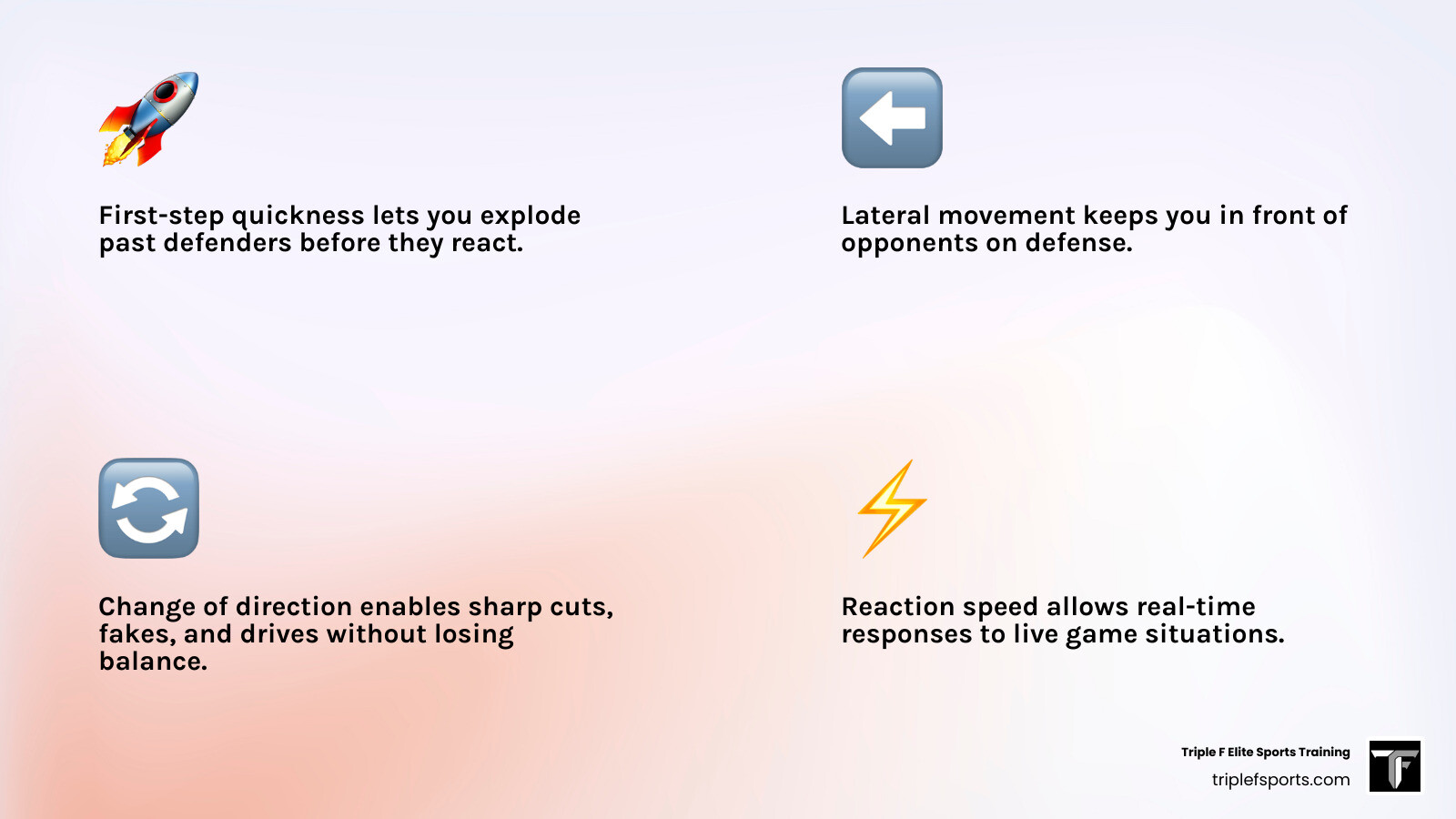
Agility training for basketball is the fastest way to improve your on-court performance — here’s what it involves at a glance:
| Agility Component | What It Means on the Court |
|---|---|
| First-step quickness | Exploding past your defender before they can react |
| Lateral movement | Staying in front of your opponent on defense |
| Change of direction | Cutting, faking, and driving without losing balance |
| Reaction speed | Responding to live game situations in real time |
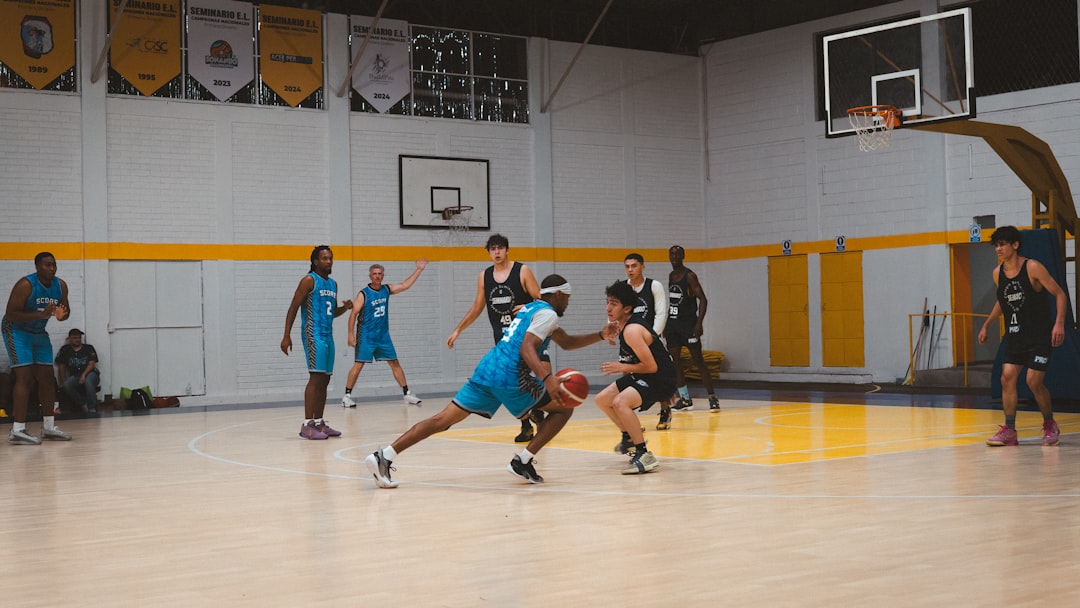
Basketball moves fast. Every possession involves sprinting, stopping, cutting, and reacting — often all within seconds. Research shows that elite players execute 50-60 changes of direction per game, on top of 40-60 maximal jump efforts. That’s not a game you win with straight-line speed alone.
The players who get their ankles broken? They’re usually the ones who can’t change direction quickly enough to stay in front. The players doing the ankle-breaking? They’ve trained their first step, their lateral quickness, and their body control until it becomes instinct.
Modern basketball is also increasingly position-less. Guards need to defend in the paint. Forwards need to operate on the perimeter. Everyone needs to move — and move well — in every direction.
Agility isn’t just about being fast. It’s about being fast, balanced, and in control at the same time.
I’m Kevin O’Shea, a Certified Strength and Conditioning Specialist and wide receiver coach whose athletic development background has given me a deep appreciation for how agility training for basketball translates directly to game-winning performance. I’ll walk you through exactly how to build it.
Agility training for basketball terms to know:
Why Agility Training for Basketball is Essential for Modern Players
In the modern game, pure speed is a tool, but agility is the engine. According to the National Strength and Conditioning Association, training should mirror the energy systems and movement patterns of the sport. For us, that means short, explosive bursts followed by rapid deceleration and immediate re-acceleration.
The physiological demands are staggering. Beyond the 50-60 changes of direction mentioned earlier, basketball relies heavily on the anaerobic lactic system. This is what powers your ability to sprint coast-to-coast, get a stop on defense, and immediately fill the lane on a fast break.
Furthermore, roughly 70% of NBA strength and conditioning coaches prioritize agility training for basketball because it serves as a form of “movement rehearsal.” By practicing these sharp cuts in a controlled environment, you’re actually performing prehabilitation. You are teaching your ligaments and tendons—especially around the ankles and knees—how to handle the torque of a high-speed crossover. This skilled-based training is what keeps players on the floor rather than on the bench with an ice pack.
Mastering Lateral Movement and Defensive Slides
If you want to stop getting “cooked” on the perimeter, you have to master the lateral slide. It’s the bread and butter of defense, yet so many players do it inefficiently.
The key is staying low. We’re talking about a “sit-in” stance where your hips are back and your chest is up. A wide base is non-negotiable; your feet should stay wider than your knees to maintain a low center of gravity. This position allows you to exert maximum force into the ground to push off.
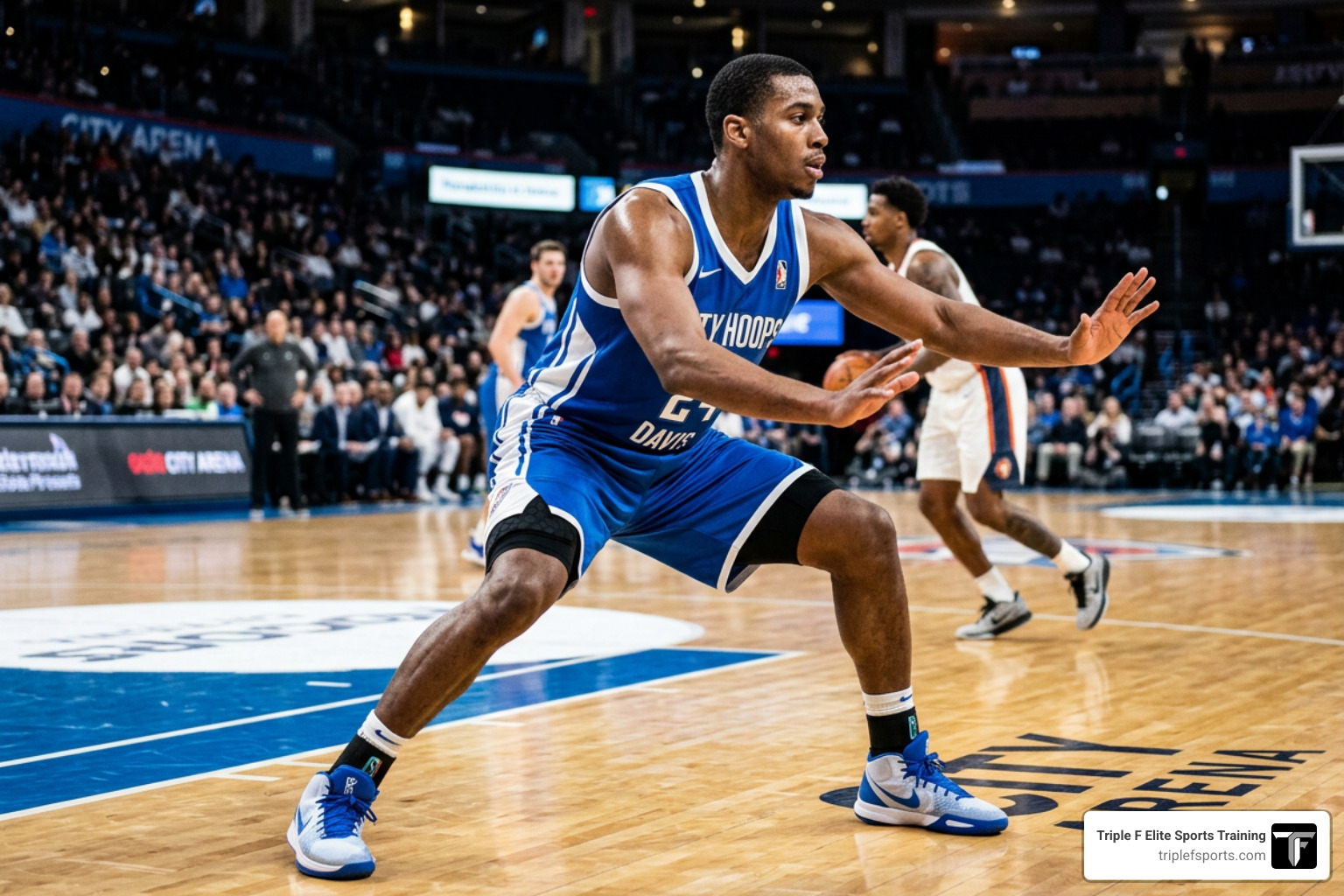
When sliding, focus on “pushing” with the trailing leg rather than “reaching” with the lead leg. Reaching pulls your center of gravity off-balance, making you vulnerable to a counter-move. By pushing, you keep your weight centered and your hips mobile, allowing you to react instantly if the ball-handler crosses over.
Improving First-Step Quickness and Deceleration
On offense, the first five yards decide most 1-on-1 battles. To win those possessions, you need to master your shin angles. For maximum acceleration, your shins should be at a 45–55 degree angle relative to the floor. This projects your force horizontally, propelling you forward rather than just upward.
However, a fast first step is useless if you can’t stop. High-level agility training for basketball emphasizes “stop-and-go” speed. Think of it like a sports car; the better the brakes, the faster you can afford to drive into a turn. When you decelerate, you should use short, choppy “breakdown” steps to lower your center of gravity before making your next move. This is especially vital for youth training 12 to 18, where learning to control the body’s momentum is the first step toward elite athleticism.
The Best Drills to Improve Footwork and Speed
To see real results, your basketball agility drills need to be performed at game speed. Doing them at 50% effort only trains you to be slow. We recommend a mix of closed drills (where you know the pattern) and open drills (where you have to react).
| Drill Type | Primary Focus | Best For |
|---|---|---|
| Ladder Drills | Foot speed & coordination | Rhythm, “fast feet,” and neurological firing |
| Cone Drills | Change of direction | Planting, cutting, and maintaining balance |
| Shuttle Runs | Deceleration & acceleration | Conditioning and stop-and-go power |
| Box Drills | Multi-directional movement | Defensive transitions and closeouts |
One of our favorites is the 5-10-5 Shuttle (also known as the Pro Agility Drill). Set three cones five yards apart. Start at the middle cone, sprint 5 yards to the right, touch the line, sprint 10 yards back to the far left, touch the line, and finish by sprinting 5 yards through the middle. This drill forces you to plant, turn, and explode—exactly what happens when you’re navigating a screen.
Essential Ladder Drills for Agility Training for Basketball
Ladder drills are often criticized for not being “game-like,” but their value lies in coordination and rhythm. They teach your brain to communicate with your feet faster.
- In-and-Outs: Step both feet into a square, then both feet out. Move laterally down the ladder. This mimics the quick foot-repositioning needed for a jab step.
- Crossover Steps: Step into the square with your outside foot, crossing over the lead foot. This is vital for recovery defense when you’ve been beaten and need to sprint to catch up.
- Ickey Shuffle: A classic 1-2-3 rhythm that builds the lateral coordination required for elite Euro-steps.
Keep your head up! If you’re staring at the ladder, you aren’t training for a game where you need to see the open teammate or the help defense.
Advanced Reactive Agility Training for Basketball Techniques
True agility is reactive. In a game, there are no cones telling you where to go; there is only a defender or a ball. This is where reactive drills come in.
Partner Mirror Drills are the gold standard here. Stand five feet away from a teammate. They are the “leader,” and you are the “shadow.” Whatever direction they shuffle, sprint, or backpedal, you must mirror them exactly. This forces your brain to process visual cues and translate them into physical movement instantly.
Another great tool is the Reaction Ball. This is a multi-sided rubber ball that bounces unpredictably. Tossing it against a wall and trying to catch it on the first bounce develops elite hand-eye coordination and “twitch” muscles. It’s a fun, high-intensity way to sharpen the reflexes needed to snag a loose ball or poke away a steal.
How to Structure Your Weekly Agility Routine
You shouldn’t be doing high-intensity agility work every single day. Because these drills tax the central nervous system (CNS), quality is always better than quantity.
For most players, 2-3 days per week is the sweet spot. You want to perform these drills when you are “fresh”—usually at the beginning of a workout after a thorough warm-up, but before you’ve spent all your energy on heavy lifting or a two-hour scrimmage.
When you assess your athletic edge, look for improvements in your “time to speed.” We recommend 60-90 seconds of rest between reps. Why so much? Because we aren’t training endurance here; we are training maximum explosiveness. If you’re huffing and puffing, your feet will be slow, and you’ll be reinforcing bad habits.
Common Mistakes to Avoid During Drills
Even the best drills won’t work if your form is sloppy. Watch out for these common pitfalls:
- Standing Upright: As soon as you get tired, your hips will want to rise. Stay low! A high center of gravity is an invitation to get crossed over.
- Crossing Your Feet: In a defensive slide, never let your heels touch or your feet cross. This “ties” your legs together, making it impossible to react to a change in direction.
- Training Too Slow: If you aren’t moving at 95-100% of your max speed, you aren’t getting faster. You’re just going through the motions.
- Poor Landing Mechanics: On plyometric jumps or sharp cuts, land softly on the balls of your feet. Landing “flat-footed” sends a shockwave through your joints and slows down your next movement.
Frequently Asked Questions about Basketball Agility
How often should basketball players incorporate agility training?
We recommend 2 to 3 sessions per week during the off-season. During the season, you can drop this to 1 or 2 shorter sessions to maintain your “twitch” without overtaxing your body between games. Consistency over a long period is the key to seeing those “lightning-fast” improvements.
What equipment is needed for effective agility drills?
You don’t need a professional gym to get better. While an agility ladder and cones are great, you can use lines on a court, water bottles as markers, or even a jump rope. The most important “equipment” is a flat surface and the willingness to push yourself to max effort.
Can agility training help prevent common basketball injuries?
Absolutely. Most non-contact basketball injuries (like ACL tears or ankle sprains) happen during deceleration or landing. By training your body to handle these forces through proper agility training for basketball, you build the “neuromuscular control” needed to keep your joints stable under pressure.
Conclusion
At Triple F Elite Sports Training in Knoxville, we believe that every athlete has an untapped gear. Whether you’re a middle schooler looking to make the varsity team or an advanced player eyeing the college level, our professional, Christ-centered coaching is designed to help you reach your full potential.
We don’t just run drills; we build athletes. Our Knoxville facility offers a comprehensive approach that combines speed, strength, and skilled-based training to ensure you’re the quickest player on the court.
Ready to stop getting your ankles broken and start breaking them instead? Come see us at Triple F. We offer a free first session to help you your peak performance starts here and see exactly how our programs can transform your game. Let’s get to work.