

Why Every Serious Football Player Needs a Dedicated Strength Program
A football strength program is the foundation of elite on-field performance — here’s what the best ones include:
| Component | What It Does | Example |
|---|---|---|
| Maximal Strength | Builds force production for blocking and tackling | Squat, Deadlift |
| Explosive Power | Converts strength into speed off the line | Box Jumps, Power Cleans |
| Speed & Agility | Improves acceleration and change of direction | Sled Sprints, Cone Drills |
| Conditioning | Sustains repeated high-output efforts | Sprint Intervals, HIIT |
| Recovery & Mobility | Prevents injury and keeps you on the field | Foam Rolling, Dynamic Stretching |
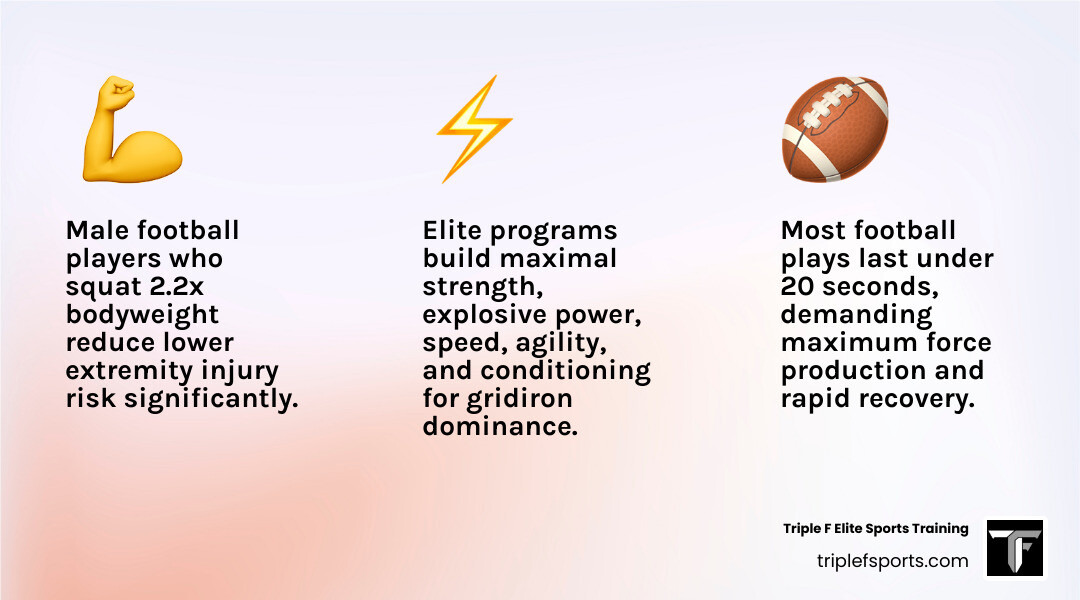
Football is a sport built on short, violent bursts. Most plays last no more than 20 seconds. That means every snap demands maximum force production — and then the ability to do it again. And again. Whether you’re driving a defender off the line or exploding out of a route break, the weight room is where that ability is built.
The physical demands are real. Research shows that male players who can squat at least 2.2 times their body weight face a significantly lower risk of lower extremity injury. Strength isn’t just about performance — it’s about staying on the field.
But not all programs are created equal. A well-designed football strength program trains the whole athlete: absolute strength, explosive power, speed, agility, and the conditioning to sustain it across four quarters.
I’m Kevin O’Shea — a Certified Strength and Conditioning Specialist, former college wide receiver, and high school football coach whose hands-on experience spans both sides of a football strength program, from designing it to living it. That background shapes everything we do at Triple F Elite Sports Training in Knoxville.
Football strength program basics:
- Bench press combine
- Football specific training
- NFL pre draft training
The Science of a Modern Football Strength Program
In the modern era of 2026, football is faster and more violent than ever. We don’t just lift weights to get “big”; we lift to manipulate the force-velocity curve. To be a dominant player, you need absolute strength—the maximum amount of force you can exert regardless of time. However, football is played in milliseconds, which is why we also focus on the rate of force development (RFD).
Scientific research consistently highlights the link between lower-body strength and durability. As mentioned in the Strength and Conditioning Program for Soccer – Vitruve research, a higher 1RM (one-rep max) in the squat is directly linked to a lower risk of injury during the season. For male athletes, hitting that 2.2x bodyweight squat marker isn’t just a vanity metric; it’s a biological insurance policy for your ACLs and ankles.
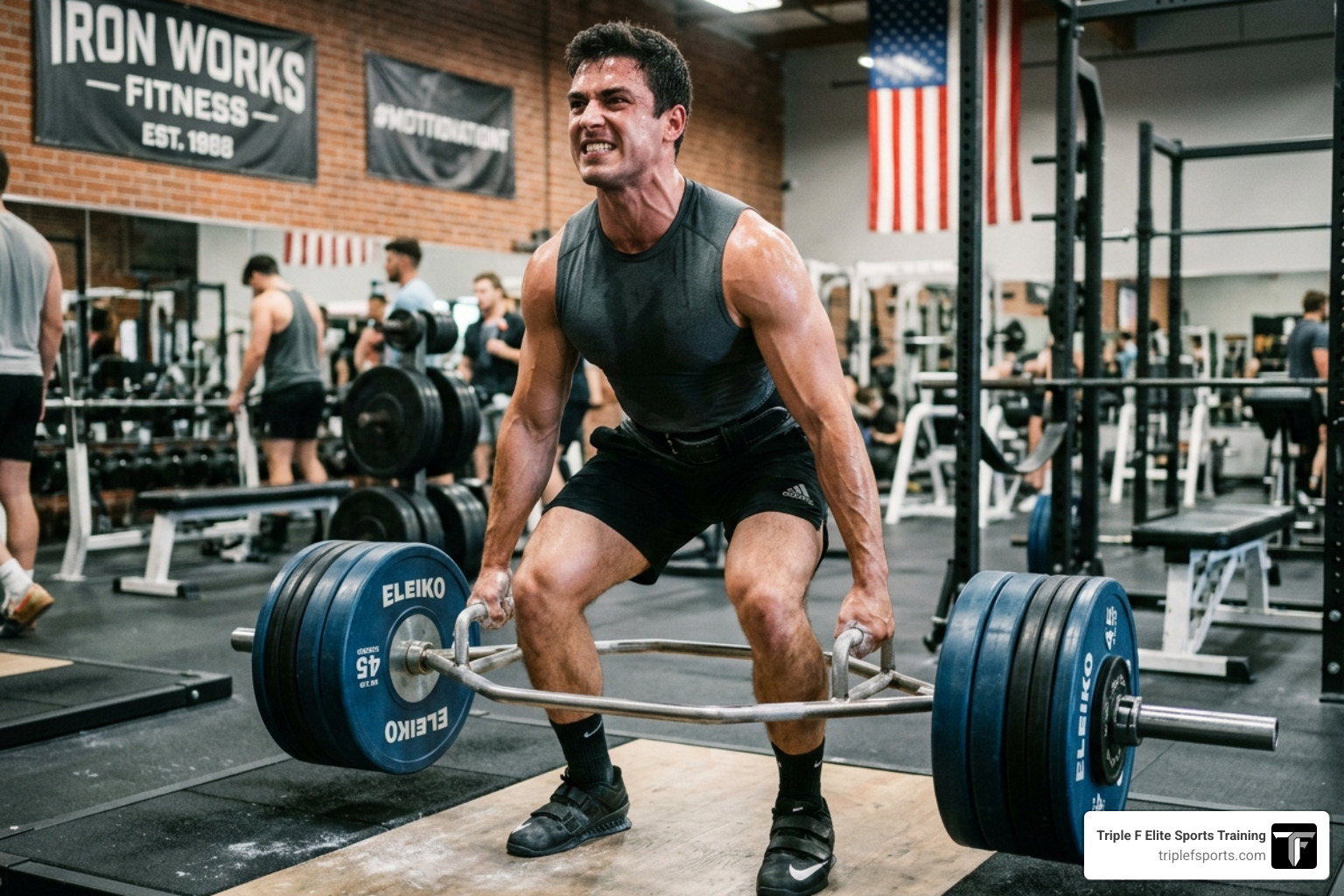
One of our primary tools for building this force is the trap bar deadlift. Research indicates that athletes can typically lift more weight and move it at higher velocities with a trap bar compared to a traditional straight bar. This translates to greater ground reaction force—the literal “push” you give the earth to move your body forward or upward.
Furthermore, a modern football strength program must prioritize the posterior chain (hamstrings, glutes, and lower back). Hamstring injuries remain a top concern in explosive sports. By focusing on heavy eccentric loading and muscle hypertrophy in these areas, we increase bone density and soft tissue resilience, making you “harder to break” when the pads start popping.
Core Components of Elite Performance Training
Building a Foundation with a Football Strength Program
An elite program doesn’t just throw random exercises at a wall. We utilize structured methodologies like the Conjugate Method, which allows us to train multiple athletic qualities (like max strength and explosive speed) simultaneously. This prevents the “detraining” effect often seen in old-school linear programs.
The foundation is built on compound lifts: squats, presses, and pulls. We break these down into:
- Max Effort Days: Lifting heavy loads (90%+ of 1RM) to build absolute strength and nervous system efficiency.
- Dynamic Effort Days: Lifting sub-maximal loads with maximum bar speed to build “fast strength.”
To see how this looks in practice, you can reference this 6-Week Football Strength & Plyometrics Plan. At Triple F, we supplement these main lifts with accessory work designed to fix structural imbalances. This might include “Triphasic” principles—focusing specifically on the isometric and eccentric phases of a lift—to ensure you are strong in every inch of your movement.
Speed, Agility, and Explosive Power
Strength in the weight room is useless if it doesn’t transfer to the grass. This is where plyometrics and triple extension drills come in. Triple extension—the simultaneous extension of the hips, knees, and ankles—is the “secret sauce” behind every great 40-yard dash and vertical jump.
We use box jumps and depth drops to teach the body how to absorb and redirect force rapidly. For those looking to take it to the next level, our NFL pre draft training protocols emphasize acceleration mechanics. This involves more than just running; it’s about the “push” phase of the first 10 yards.
Sled pushes are another staple. They force an athlete into the optimal 45-degree lean required for acceleration while building the specific conditioning needed for football. We also integrate reactive agility drills. Unlike pre-planned cone drills, reactive drills require you to change direction based on a visual cue, mimicking the split-second decisions made during a live play.
Position-Specific Adaptations for the Gridiron
While the “Big Three” lifts are universal, a linebacker doesn’t train exactly like a quarterback. As athletes progress toward college and professional levels, position-specific nuances become vital.
Linemen and the Trenches
For the “Hogs” up front, the game is about isometric strength and short-area bursts. Trench warfare is won by the player who can maintain their posture under immense pressure.
Our offensive line sports training focuses heavily on sled pulls and grip strength. If you can’t control your opponent’s jersey, you can’t control the block. We also look at the specific biomechanics used by pros, such as the offensive line training by Jon Feliciano, which emphasizes a wide base and “pancake” power. Linemen need to be able to exert force from a dead stop (the snap) repeatedly, making their football strength program heavily focused on lower-body “anchoring” and upper-body punching power.
Skill Positions and Quarterbacks
Wide receivers and defensive backs live and die by their linear speed and ability to “sink their hips” into a break. Our wide receiver training by Amari Rodgers focuses on the “top of the route” mechanics—using strength to decelerate and re-accelerate instantly.
Quarterbacks, on the other hand, require immense rotational power and deep core stability. A QB’s power doesn’t come from the arm; it comes from the ground, through the hips, and out the shoulder. We use medicine ball throws and anti-rotation holds to build this “kinetic chain.”
For the “hybrids” in the middle of the field, our defensive line linebacker sports training blends the heavy-set strength of a lineman with the footwork drills of a skill player. Ball security and the ability to tackle while off-balance are trained through loaded carries and staggered-stance lifts.
Periodization: Structuring Your Football Strength Program
You cannot train at 100% intensity year-round. If you try, you’ll hit a wall of neural fatigue and injury. We use a periodized approach to ensure you peak when the lights are brightest.
| Phase | Duration | Primary Goal | Training Volume |
|---|---|---|---|
| Off-Season | 12-20 Weeks | Hypertrophy & Max Strength | High |
| Pre-Season | 6-8 Weeks | Power & Speed Conversion | Moderate |
| In-Season | 12-16 Weeks | Maintenance & Freshness | Low |
During the Off-Season, the goal is building the engine. We want muscle hypertrophy (size) and absolute strength. As we move into the Pre-Season, we shift toward “Strength-Speed.” The weights might get slightly lighter, but the intent is faster. We follow principles found in the Football (Soccer) Fitness Training Guide – Football Fitness Lab to ensure our conditioning matches the energy systems used in a game (short sprints vs. long jogs).
In-Season training is the most misunderstood. Many players stop lifting once the season starts. This is a mistake! To maintain your gains, you need 1–2 days a week of high-intensity, low-volume lifting. This keeps the nervous system “primed” without adding excessive soreness. We use microcycles and deload weeks to manage the total physical load, ensuring you have your best legs on Friday nights or Saturday afternoons.
Recovery, Mobility, and Injury Prevention
The best ability is availability. You can have a 500-pound squat, but if you’re on the training table with a torn hamstring, it doesn’t help the team.
Hamstring health is our number one priority for speed athletes. We utilize Nordic curls and Romanian deadlifts to build eccentric strength. This is backed by the University of Tennessee performance staff insights, who emphasize that a resilient posterior chain is the best defense against non-contact injuries.
Our recovery protocol includes:
- Dynamic Stretching: To lubricate joints and activate the nervous system before sessions.
- Hip Mobility & Ankle Stability: Essential for “playing low” and changing direction without rolling an ankle.
- Myofascial Release: Using foam rollers and lacrosse balls to manage “knots” and blood flow.
- Sleep Hygiene: The most underrated “supplement.” We aim for 8–9 hours of quality sleep to allow for hormonal repair.
We preach load discipline. This means knowing the difference between “good” muscle soreness and “bad” joint pain. If your metrics (like vertical jump height) drop significantly, it’s a sign to deload and recover.
Frequently Asked Questions about Football Training
How much should a football player be able to squat?
Male athletes should aim for 2.2 times their body weight, while female athletes should target 1.6 times their body weight to significantly reduce lower extremity injury risk. These numbers aren’t just for show; they represent the force-absorption capacity required to handle high-speed collisions and sudden cuts safely.
How many days a week should I follow a football strength program?
During the off-season, 4–5 days is optimal for building mass and power. This allows for a split that covers upper body, lower body, and dedicated speed/plyometric days. However, this should drop to 1–2 days of high-intensity maintenance during the peak season to avoid overtraining and ensure you are fresh for game day.
What is the best exercise for football speed?
While the squat builds the force foundation, the trap bar deadlift and resisted sprints (using sleds or bands) are the gold standards for transferring weight room strength into on-field acceleration. The trap bar allows for a “peak power” output that closely mimics the mechanics of a sprint start.
Conclusion
Building a “pro-ready” body doesn’t happen by accident. It requires a scientifically backed football strength program, a relentless work ethic, and a commitment to recovery. At Triple F Elite Sports Training in Knoxville, we are dedicated to providing a professional, Christ-centered environment where athletes can reach their full potential.
Whether you are a youth player just starting your journey or a college standout looking for NFL pre draft training, our staff is here to guide you. We combine elite-level coaching with a holistic approach to athletic development, ensuring you are strong, fast, and resilient.
Ready to take the first step toward the gridiron of your dreams? Come see us in Knoxville and experience the Triple F difference. Your first session is on us. Let’s get to work.