
Why Football Basic Drills Are the Foundation of Every Great Player
Football basic drills are the building blocks every player needs — no matter their age or skill level. Before you can run complex plays or dominate a game, you have to master the fundamentals.
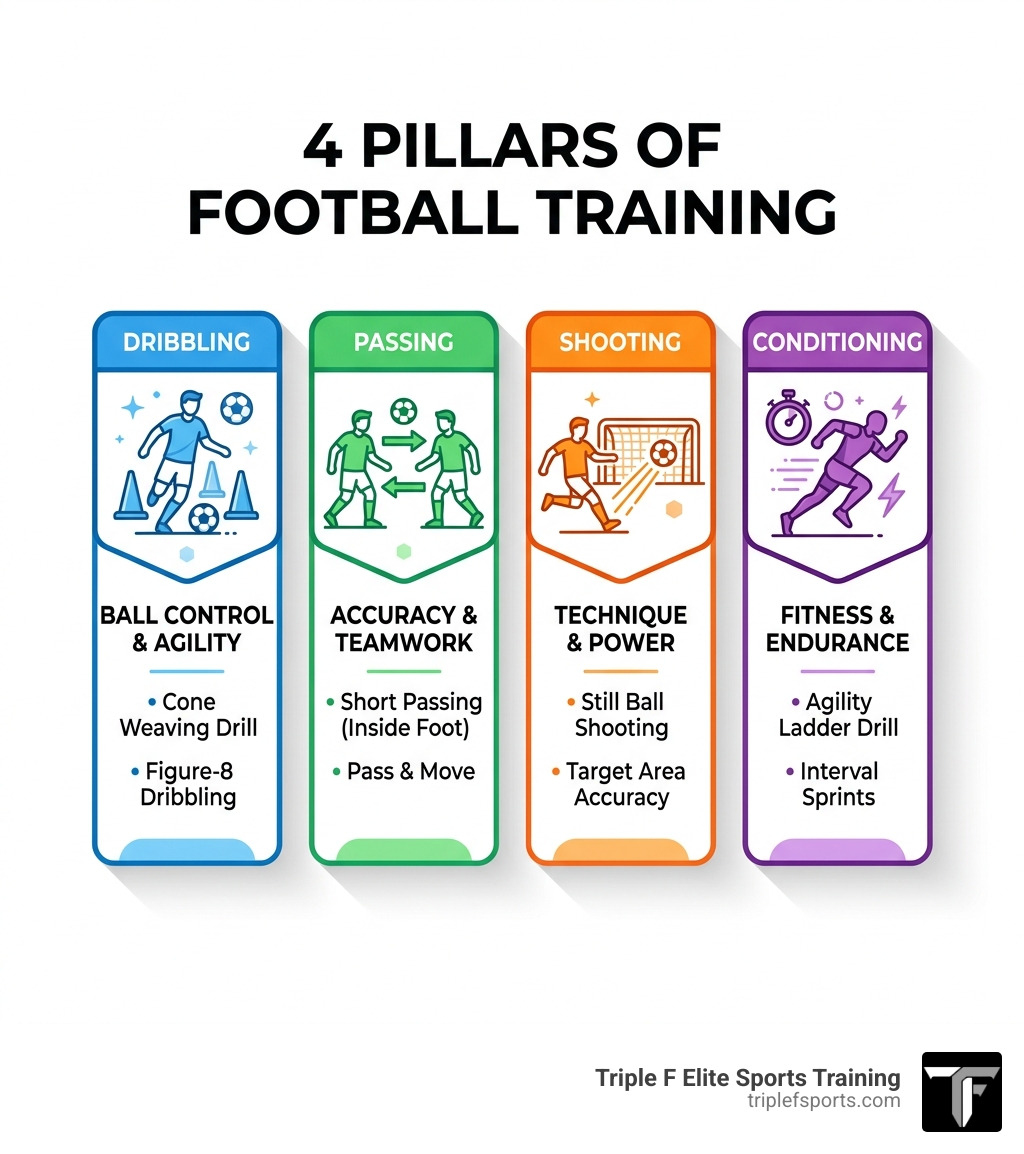
Here are the core football basic drills every beginner should know:
- Cone Weaving Drill – Dribble in and out of cones to build close ball control
- Short Passing Drill – Pass and receive using the inside of the foot at 5 metres
- Pass and Move Drill – Pass to a teammate, then immediately move to a new position
- Still Ball Shooting Drill – Strike a stationary ball from 15-20 metres to develop technique
- Rondo/Possession Circle – Keep the ball in a small group to sharpen first touch and awareness
- Agility Ladder Drill – Move through a ladder pattern to improve footwork and coordination
These six drills cover the four pillars of player development: dribbling, passing, shooting, and conditioning. Practice them consistently — 2 to 3 times per week for 30 to 45 minutes — and you can expect to see real improvement in your touch, speed, and accuracy within 3 to 4 weeks.
I’m Kevin O’Shea, a Certified Strength and Conditioning Specialist and Wide Receiver Coach who played college football and has spent years coaching players at every level — and football basic drills have been at the core of every training program I’ve built. My experience developing athletes from the ground up is exactly what shapes the approach we take here at Triple F Elite Sports Training.
Essential Equipment and Session Structure for Football Basic Drills
To get the most out of your training, you don’t need a professional stadium, but you do need the right tools. Setting up football basic drills effectively ensures that players stay engaged and that every minute on the field counts toward their development.
The Starter Kit
Before we dive into the grass, let’s look at the gear. Most of these drills can be run with minimal equipment:
- Cones and Markers: These are your best friends. They define boundaries and create obstacles for dribbling.
- Scrimmage Vests (Pinnies): Essential for dividing groups during possession drills or small-sided games.
- Soccer Balls: Ideally, one ball per player. Beginners need as many touches as possible.
- Agility Ladders: Great for developing that “first-step burst” we talk about so often in Knoxville.
If you are looking for a deeper dive into the mechanics of how your feet should interact with the ball, check out A Beginner’s Guide to Soccer Footwork.
Structuring the Session
A common mistake beginner coaches and parents make is training for too long or without a plan. We recommend a 30-45 minute session. Here is a sample structure we use to keep things moving:
- The Warm-Up (10 Minutes): Never skip this. Use dynamic movements like high knees, butt kicks, and light jogging. You can even incorporate a “Ladder Drill” here to wake up the nervous system.
- Technical Focus (15 Minutes): This is where you implement your football basic drills for dribbling or passing. Focus on “quality over quantity.”
- Game-Like Application (15 Minutes): Take the skill you just practiced and put it into a small-sided game or a rondo. This helps players understand why they are doing the drill.
- Cool Down (5 Minutes): Light stretching and a quick recap of the day’s “coaching points.”
For those working with younger athletes specifically in a flag football context, we have a specialized resource on Youth Flag Football Drills Fun Effective Ways to Master the Game that complements these soccer-based fundamentals beautifully.
Top Dribbling and Footwork Drills for Beginners
Dribbling is often the first skill a beginner falls in love with. It’s the art of keeping the ball close while moving through traffic. At our Knoxville Football Camp, we emphasize that a strong foundation in dribbling beats “fancy tricks” every single day.

The Cone Weaving and Slalom Drills
These are the bread and butter of football basic drills.
- Setup: Place 5 to 6 cones in a straight line, spaced about 2 to 3 feet apart.
- Execution: The player weaves through the cones as fast as possible without knocking them over.
- Coaching Point: Use both the inside and outside of the foot. Beginners often rely only on their “big toe,” but using the “pinky toe” (outside of the foot) allows for sharper turns.
A great resource for the absolute basics of this is the Soccer Dribbling Basics guide, which is perfect for the U4 to U8 age group.
The “Look Up” Rule
One of the hardest habits to break in beginners is staring at their feet. We teach players to keep their gaze straight ahead or at least slightly up. If you’re looking at the ball, you can’t see the defender coming to take it!
Mastering Ball Control with Football Basic Drills
Once a player is comfortable moving with the ball, we introduce “ball mastery” exercises. These can be done in a very small space—even in a backyard in Knoxville.
- Push and Pull: Using the sole of the foot to pull the ball back and the laces to push it forward. This builds a “feel” for the ball’s weight.
- Juggling: It’s not just for show! Juggling improves your aerial control and helps you learn how to take the “sting” out of a hard pass.
- The Cruyff Turn: Named after the legendary Johan Cruyff, this involves faking a pass or shot, then hooking the ball behind your standing leg to change direction 180 degrees.
- Agility Ladder (The Icky Shuffle): This is a classic footwork drill. Moving laterally through the ladder helps with coordination and balance, which are essential for beating opponents 1v1.
For a comprehensive list of these movements, 11 Fundamental Football Drills To Boost Performance on the Pitch offers excellent technical breakdowns that we often reference when building our own training blocks.
Passing, Receiving, and Possession Fundamentals
Football is a team sport, and you can only be as good as your ability to connect with your teammates. Passing isn’t just about hitting a target; it’s about the “weight” of the ball and the movement that happens after the ball leaves your foot.
The “Pass and Move” Philosophy
In many football basic drills, players stand still after they pass. We want to kill that habit early. The Soccer Pass and Move Drill is a fantastic way to teach awareness.
- Setup: Create a circle with cones.
- Execution: Players inside the circle pass to players on the outside, then immediately sprint to a different part of the circle to receive a pass from someone else.
- The Goal: Keep the ball moving and keep your “head on a swivel.”
This concept of “spatial awareness” isn’t just for soccer. It’s a core component of our Wide Receiver Training by Amari Rodgers, where understanding how to find “green grass” after a catch is the difference between a 5-yard gain and a touchdown.
Receiving Between Opponents
As players progress, they need to learn how to receive the ball under pressure. The 2.1 Passing activation: Playing and receiving in-between opponents – FIFA Training Centre drill is a professional-standard exercise that can be simplified for beginners.
- Concept: Use “mannequins” or even just extra cones to represent defenders.
- Action: The player must move into the “gap” between the defenders to receive the pass.
- Coaching Point: Receive on the “back foot.” This means if the ball is coming from your left, you control it with your right foot. This naturally opens your body up to the rest of the field.
Improving Accuracy Through Football Basic Drills
Accuracy is born from repetition. We use several high-rated drills to keep this fun:
- Four Corners Passing Game: (Rated 4.21 with over 800,000 views!) This drill involves four teams in the corners of a square passing through a central “hot zone.” It teaches players to find passing lanes in a crowded area.
- The Rondo (4v1 or 5v2): This is perhaps the most famous drill in the world. A small circle of players tries to keep possession while one or two “defenders” try to intercept the ball. It’s great for sharpening a player’s “first touch.”
- Split the Defenders: A passing game where players earn points by passing the ball between two defenders. This teaches “penetrative passing.”
| Technique | Distance | Part of Foot | Best Used For |
|---|---|---|---|
| Short Pass | 5-10 Metres | Inside (Arch) | Accuracy and control in tight spaces |
| Long Pass | 15-20+ Metres | Laces (Instep) | Switching play or clearing the ball |
| First Touch | Immediate | All surfaces | Controlling the ball into “green grass” |
Shooting, Finishing, and Game-Like Scrimmages
At the end of the day, everyone wants to score. But shooting is more than just kicking the ball hard toward the net. It requires composure and technique.
Still Ball vs. Moving Ball Shooting
We always start beginners with the Still Ball Shooting Drill.
- Setup: Place the ball 15 metres from the goal.
- Execution: Focus on the approach (a slight angle), the plant foot (pointed toward the target), and the strike (using the laces).
- Progression: Once they can hit the target consistently, we move to shooting off a dribble or finishing a cross.
Speaking of crosses, the Football crossing skills drill is essential for teaching wingers how to put the ball into the “danger zone” and teaching strikers how to time their runs.
Small-Sided Games (SSGs)
The best way to test football basic drills is in a game-like environment.
- 4v4 Soccer to Small Gates: This is the smallest version of a full game. It forces every player to be involved. With fewer players on the field, everyone gets more touches on the ball.
- The 4-Goal Game: Instead of one goal at each end, place two small goals in the corners. This teaches players to “switch the point of attack” if one side of the field is too crowded.
- 7v7 Scrimmage: As players get older (U10-U12), we move to 7v7. This introduces more complex positions like center-backs and wing-backs.
For our defensive-minded players, focusing on spatial positioning is key. We often integrate concepts from our Defensive Line Linebacker Sports Training to teach young athletes how to “read and react” to the movement of the ball, whether they are on a soccer pitch or a football field.
Frequently Asked Questions about Beginner Training
How often should beginners practice these drills?
We generally recommend practicing football basic drills 2 to 3 times per week. Each session should last between 30 and 45 minutes. Consistency is much more important than intensity. A player who practices for 30 minutes three times a week will improve much faster than someone who does one three-hour marathon session.
If you are looking to build strength alongside these skills, our Offensive Line Sports Training programs emphasize that same “slow and steady” approach to building a physical foundation.
What are the best drills for U6 to U12 age groups?
- U6-U8: Focus almost entirely on dribbling and “ball mastery.” At this age, the ball is like a magnet—everyone wants it. Let them have it! Drills like “Red Light, Green Light” or simple cone weaving are perfect.
- U10-U12: This is where “tactical awareness” begins. Introduce rondos, pass-and-move drills, and 7v7 scrimmages. Players should start learning how to play as a unit.
For parents of linemen or those looking for position-specific fundamentals, check out our guide on Offensive Line Training by Jon Feliciano for insights into how we scale training for different development stages.
How can I measure improvement in basic skills?
Numbers don’t lie! We use several metrics to track progress:
- 10-Yard Splits: We time how fast an athlete can sprint 10 yards. We look for a 1-3% reduction in time over a few weeks.
- Juggling Counts: How many times can the player keep the ball up?
- Passing Accuracy: Out of 10 passes to a small gate, how many go in?
We actually host a Triple F Spring Break Combine right here in Knoxville where we put these metrics to the test, helping athletes see exactly where they stand and where they can grow.
Conclusion
Mastering football basic drills isn’t a one-time event; it’s a lifelong commitment to the fundamentals. Whether you’re weaving through cones in your backyard or competing in a high-stakes scrimmage, these skills are what will set you apart on the pitch.
At Triple F Elite Sports Training in Knoxville, we are dedicated to helping athletes of all ages unlock their full potential. We believe in a Christ-centered approach to athletic development that focuses on the whole person—mind, body, and spirit.
If you’re ready to take your game to the next level with professional coaching and a community that cares about your growth, we’d love to have you join us. We even offer a free first session so you can experience our training firsthand.
For more information on how we structure our sessions, you can find More info about skilled-based training on our website. Keep practicing, stay consistent, and we’ll see you on the field!