
What Is Athlete Performance Training – and Why It Matters in 2026
Athlete performance training is a structured, science-based approach to improving the physical and mental qualities that drive success in sport – speed, strength, power, agility, and resilience.
Here’s a quick breakdown of what it covers:
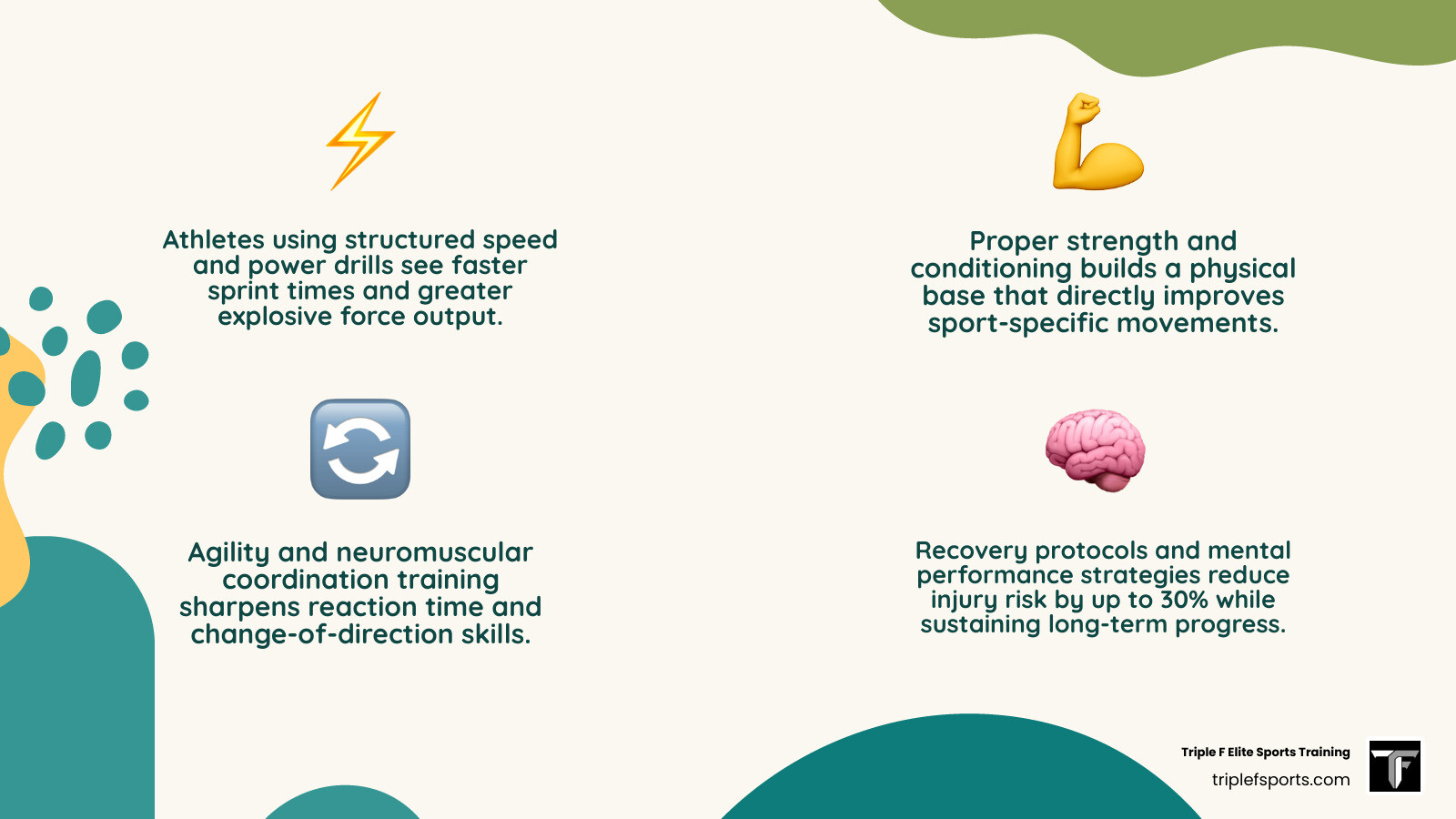
- Speed & Power – developing explosive movement through sprint mechanics and force production
- Strength & Conditioning – building a physical foundation that transfers directly to your sport
- Agility & Coordination – improving reaction time, change of direction, and neuromuscular control
- Recovery & Mental Performance – managing fatigue, injury risk, and competitive mindset
This is different from general fitness. Every session has a purpose tied to real athletic outcomes.
Whether you’re a youth athlete just learning proper movement patterns or an adult competitor looking to stay sharp and add years to your career, the right training program can change everything. Research shows that athletes following structured, periodized programs see up to 23% greater performance gains than those training without a plan – and structured recovery alone can cut injury risk by 30%.
The challenge most athletes in the Knoxville area face isn’t motivation. It’s finding a facility that combines elite coaching, proven systems, and a values-driven environment – all under one roof.
I’m Kevin O’Shea, a Certified Strength and Conditioning Specialist, former college wide receiver at Franklin & Marshall, and co-founder of Triple F Elite Sports Training, with nearly a decade of experience designing athlete performance training programs for youth and adult athletes. In the sections ahead, I’ll walk you through everything you need to build, track, and sustain real athletic progress.
To explore related topics, check out our guides on athlete training centers, our athletic workout program PDF, and learn more about periodization and how it drives long-term athletic development.
Core Components of Athlete Performance Training
At its best, athlete performance training is not random hard work. It is organized development. We build athletes by improving the qualities that matter most in competition:
- Speed mechanics
- Strength
- Power
- Agility and change of direction
- Endurance for the athlete’s sport
- Mobility and movement quality
- Recovery capacity
- Mental performance

Speed starts with mechanics. An athlete does not get faster just by “trying harder.” Sprinting is a skill built through body position, front-side mechanics, stiffness at ground contact, and the ability to apply force quickly. Research consistently shows elite speed depends on high force output in very short contact times. That is why we coach acceleration, posture, arm action, shin angles, and projection instead of turning speed work into conditioning.
Strength is the base. If an athlete cannot produce force, they cannot express power. In simple terms: no engine, no horsepower. Compound lifts, unilateral work, trunk stability, and progressive overload all help athletes create force they can use in jumping, sprinting, cutting, hitting, and absorbing contact.
Power is strength expressed fast. This includes jumps, throws, Olympic-derivative lifts, explosive medicine ball work, and contrast training. Power training helps bridge the gap between “strong in the weight room” and “dangerous in competition.”
Agility is not cone-drill theater. Real agility includes deceleration, body control, re-acceleration, and reaction to an outside stimulus. Athletes need to stop safely before they can change direction explosively. This is huge for knee and ankle health.
Sport endurance matters too, but it must match the sport. A volleyball player, soccer midfielder, baseball player, and football lineman do not need the same conditioning. Energy system training should reflect work-to-rest ratios, movement demands, and game pace.
If you want a deeper look at how athletic qualities connect to sport performance, our guide on skilled-based training is a great next read.
General Fitness vs. Sport-Specific Athlete Performance Training
General fitness improves health and work capacity. That is valuable. But it is not the same thing as training for sport.
A general fitness program usually focuses on:
- Burning calories
- Improving general strength
- Boosting cardiovascular fitness
- Building routine and consistency
A sport-specific performance program focuses on:
- Movement patterns used in the athlete’s sport
- Position-specific demands
- Force production in the right directions
- Speed and reaction under game-like conditions
- The right energy systems
- Transfer of training to competition
That difference matters. A basketball guard needs repeat acceleration, lateral reactivity, and vertical power. A baseball player needs rotational power, deceleration capacity, and arm-care support. A volleyball athlete needs elastic power, landing mechanics, and quick first-step movement.
We also need to train in all three planes of motion, not just straight ahead. Sports happen forward, sideways, and rotationally. If training only looks good on Instagram but does not transfer to the court or field, it is just fancy exercise.
Our article on building better athletes one program at a time dives deeper into how individualized structure leads to better transfer.
Designing Individualized Programs for Long-Term Development
No serious coach should hand every athlete the same program and call it customized because they changed the rep scheme.
Good program design starts with a needs analysis:
- Age
- Sport and position
- Training age
- Injury history
- Current strengths and weaknesses
- Season phase
- Goals
- Schedule and stress load
A youth athlete needs fundamentals first. That means landing, skipping, sprint posture, balance, bodyweight strength, coordination, and confidence. We do not rush advanced loading before movement quality exists.
A middle or high school athlete can begin progressing into more structured strength, speed, and power work. At this stage, coaching quality matters a lot because habits form quickly, good and bad.
Older and more advanced athletes often need more specific programming:
- More precise loading
- More individualized speed work
- More strategic recovery
- Better KPI tracking
- Tighter alignment with competition calendars
Training age matters as much as actual age. A 17-year-old who has never trained may need a simpler progression than a 14-year-old who has moved well for three years.
Long-term development also requires patience. Athletes should not chase every shiny trend. They need a plan that builds one quality on top of another. If you want a practical look at this progression, check out Level Up Your Game with Advanced Athletic Training.
The Science of Periodization and Data-Driven Progress
Periodization is one of the biggest reasons structured programs outperform random training. It is simply the planned organization of training over time.

Instead of maxing out everything at once forever, periodization changes volume, intensity, and focus across phases. That helps athletes adapt, avoid plateaus, and peak at the right time.
At a high level, we usually think in:
- Macrocycles: the big season or annual plan
- Mesocycles: multi-week training blocks
- Microcycles: the weekly structure
A simple phase model may look like this:
| Phase | Main Goal | Typical Features |
|---|---|---|
| Accumulation | Build work capacity and technical base | Moderate loads, more total volume, movement development |
| Intensification | Increase force and strength output | Heavier lifting, lower reps, higher neural demand |
| Peaking | Convert training to performance | Lower volume, high quality, faster movement, more sport transfer |
Research in the performance space shows structured progressive overload can improve outcomes by up to 23% over unstructured training. That makes sense. The body adapts best when stress is organized, not chaotic.
A good periodized plan also includes deloads. This is where many athletes go wrong. They think backing off is weakness. It is not. It is strategy. Deloads help restore the nervous system, reduce accumulated fatigue, and prepare the body for the next productive block.
For a more complete framework, see The Triple F Performance Protocol: A Comprehensive Training Framework.
Leveraging Data in Athlete Performance Training
If we do not measure, we guess. And guessing is a bad performance strategy.
Modern athlete performance training uses testing to establish baselines, guide programming, and show whether progress is actually happening. Useful testing may include:
- 10-yard sprint
- 20-yard or 30-yard sprint splits
- Vertical jump
- Broad jump
- Pro agility shuttle
- Push-up or strength endurance tests
- Movement screening
- Mobility and asymmetry checks
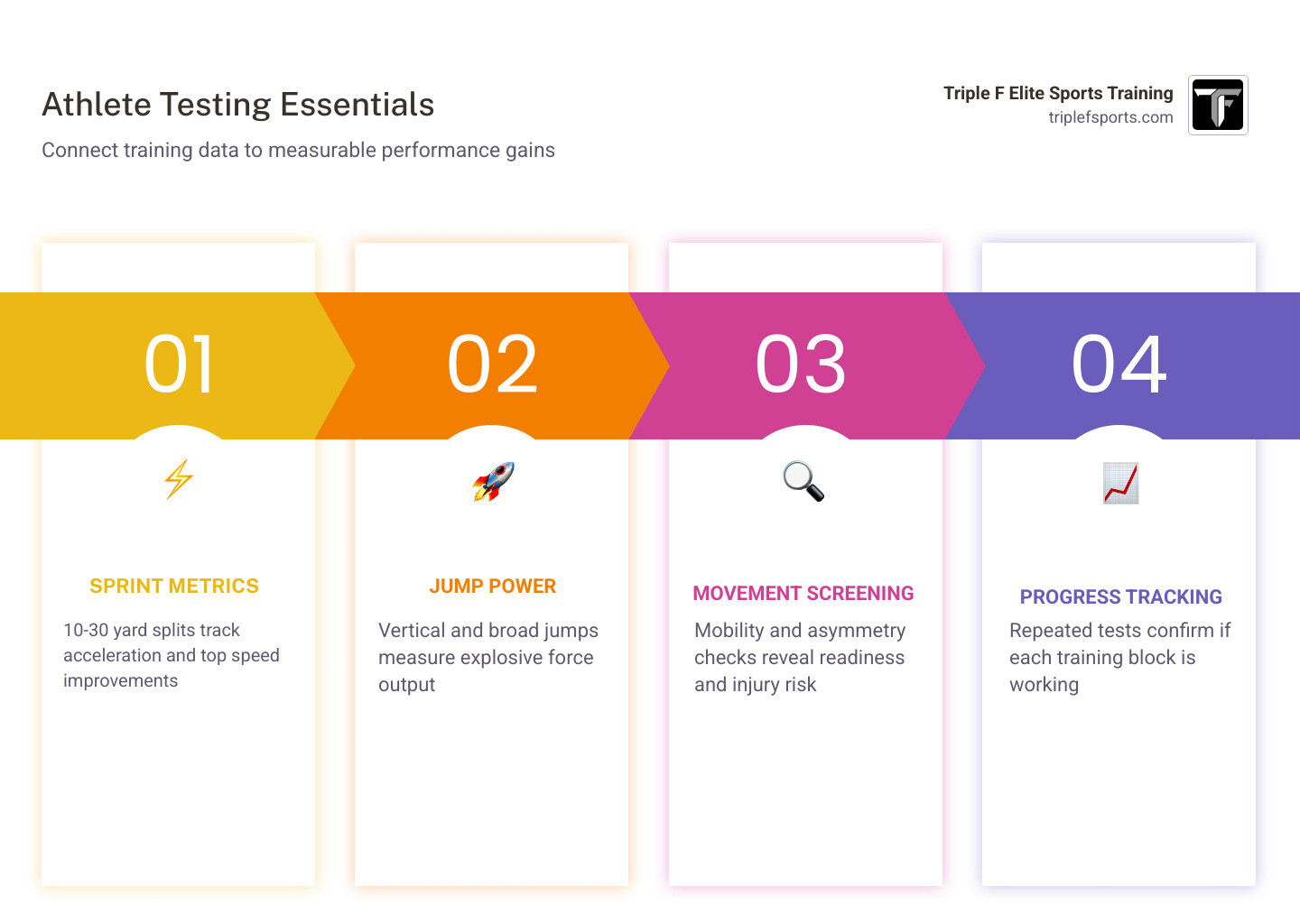
These tests matter because they connect training to real outputs:
- Faster sprint times show improved acceleration
- Better jump scores reflect explosive power
- Cleaner movement data may reveal reduced asymmetry or improved readiness
- Repeated testing shows whether a block is working
In the broader industry, data-driven systems can include force plates, jump profiling, bar-speed tracking, wearable sensors, and movement assessment tools. Those tools can help identify imbalances, monitor readiness, and refine return-to-play decisions. Velocity-based training, or VBT, is especially useful for advanced athletes because it tracks how fast a load moves, not just how heavy it is. That gives us a better picture of power and fatigue.
But the tool is not the magic. The coaching is. A force plate without a plan is just an expensive rectangle.
We believe the best data is actionable data. The number should tell us what to adjust:
- More force work?
- Better mechanics?
- More recovery?
- Less volume?
- Different timing in the week?
For athletes who want a practical resource, our ultimate athletic training program PDF is a helpful place to start.
Balancing High-Intensity Training with Recovery and Nutrition
Hard training only works if the athlete can recover from it. Improvement happens after the session, not during it. During the session, you are just creating the reason to adapt.
This is where many motivated athletes sabotage themselves. They stack intense sessions, sleep too little, under-eat, and wonder why they feel flat. The answer is rarely “more grind.” Usually it is “better recovery.”
Structured recovery protocols can reduce injury risk by up to 30%. That is a major performance edge.
Key recovery pillars include:
- Sleep
- Nutrition
- Hydration
- Active recovery
- Soft tissue work
- Stress management
- Smart scheduling
Sleep is the foundation. Most athletes perform best with 8 or more hours of quality sleep. Sleep supports motor learning, hormone regulation, tissue repair, reaction time, and mood. In 2026, more high-level programs are using individualized sleep routines and readiness markers like HRV trends to monitor recovery quality.
Nutrition supports training adaptation. For athletes in harder training phases, daily protein intake around 1.6-2.2 g/kg is a strong evidence-based target. Post-training protein in the range of 0.3-0.5 g/kg can also help support recovery and muscle repair. Carbohydrates matter too, especially for speed, repeated efforts, and high-volume training.
Hydration affects power, focus, cramp risk, and repeat sprint ability. Mild dehydration can make athletes feel like their legs got replaced with old couch cushions.
Micronutrients matter more than many athletes realize. Iron, vitamin D, magnesium, sodium, potassium, and calcium all influence performance and recovery. Supplementation can help when there is a clear need, but it should support the basics rather than replace them.
For a broader look at building real athletic strength, read our guide on mastering athletic strength training beyond the gym.
For most youth and adult athletes, the best long-term results come from mastering training, sleep, fueling, recovery habits, and consistent coaching first.
Mental Performance and Injury Prevention
Physical performance and mental performance are not separate worlds. They overlap every day.
Athletes need cognitive resilience:
- Focus under pressure
- Emotional control
- Confidence after mistakes
- Consistent routines
- Better decision-making speed
One simple but powerful tool is video review. Weekly visual feedback helps athletes connect what they feel with what actually happened. That can improve tactical awareness and reinforce learning much faster than vague memory.
Mental rehearsal matters too. Research has shown that imagery can help prime neural pathways for execution. In plain English: your brain benefits from quality reps, even before your body moves.
Injury prevention should also be built into the plan, not added as an afterthought five minutes before practice. Good prehab often includes:
- Eccentric loading
- Landing mechanics
- Deceleration drills
- Trunk stability
- Hip and ankle mobility
- Rotator cuff and scapular work where needed
- Foot and lower-leg strength
- Proprioception and balance training
Neuromuscular control is a big piece here. Athletes who can control joint position, absorb force, and react efficiently are usually safer and more effective.
We also coach stress management. An overwhelmed athlete does not recover well. School load, social stress, travel, poor sleep, and competition anxiety all affect readiness. The goal is not just to train hard. It is to train hard enough, recover well enough, and compete with clarity when the moment matters.
Frequently Asked Questions about Performance Training
How do I measure if training translates to the field?
The weight room is not the final exam. Performance in sport is.
That means we track both physical metrics and sport outcomes. Useful on-field or on-court KPIs may include:
- Sprint wins to the ball
- First-step success
- Jump performance in games
- Repeat-effort quality late in competition
- Shot speed or exit velocity
- Serve accuracy
- Change-of-direction efficiency
- Decision-making speed
- Skill quality under fatigue
We also like video review because it shows whether improved athletic traits are being expressed in real competition. An athlete might jump higher in testing, but the key question is whether they now rebound better, close faster, or finish more explosively.
Performance profiling works best when we compare:
- Baseline testing
- Re-test results
- Practice performance
- Game statistics
- Coach feedback
- Athlete self-report
If those trend together, training is transferring.
What are common mistakes in speed and strength training?
We see the same issues over and over:
- Training speed while fatigued
- Doing too much volume and not enough true intensity
- Neglecting sprint mechanics
- Using the same loads for too long
- Chasing soreness instead of adaptation
- Copying advanced programs without the foundation
- Ignoring recovery cycles
- Treating agility ladders like a personality trait
Speed should be trained fresh. Full recovery between high-quality sprint reps is often necessary. If rest is too short, the session becomes conditioning instead of speed development.
Strength training mistakes usually involve poor progression. Progressive overload matters, but so does variation. If an athlete never changes stimulus, progress stalls. If they change everything every week, there is no consistent adaptation. We need enough consistency to improve and enough variation to keep adapting.
Another common problem is skipping the basics. Strong trunk control, single-leg strength, landing mechanics, and proper hinge patterns are not glamorous, but they create the base for bigger outputs.
How often should an athlete train for peak results?
It depends on age, training age, schedule, and season.
A strong general guideline for many athletes is 3-4 performance sessions per week. That is often enough to build speed, strength, and power while still allowing recovery and sport practice.
A simple pattern may look like:
- 2 strength and power days
- 1-2 speed or agility emphasis days
- 1 recovery or mobility focus day
In-season, the goal shifts from building everything to maintaining key qualities while staying available. Volume usually drops, but intensity often stays moderate to high so the athlete does not detrain.
Off-season is where we can push development more aggressively, often using planned intensification blocks and re-testing every few weeks.
Recovery windows matter. True speed endurance and heavy neural sessions may require 48-72 hours before the athlete is fully ready again. Deload timing also matters. A common approach is three progressively challenging weeks followed by one lower-load week, though this should always be individualized.
Conclusion
Great athlete performance training is not about crushing athletes for social media clips. It is about building better movers, stronger bodies, sharper minds, and more resilient competitors over time.
At Triple F Elite Sports Training in Knoxville, we take that seriously. We offer Christ-centered development for youth and adults, combining performance training with physical therapy support and a volleyball club environment designed to help athletes grow on and off the field.
Whether your goal is better speed, more power, safer movement, or a clearer long-term plan, we are here to help you train with purpose. And yes, your first session is free, which is a pretty good deal for finding out what your real ceiling might be.
If you’re ready to take the next step, explore our Level up your game with skilled-based training.