
Why Most Athletes Train Hard But Struggle to Perform When It Counts
Sports skill training is the process of developing athletic abilities so they hold up — not just in practice, but at full speed, under fatigue, and when the game is on the line.
If you want a quick answer on what effective sports skill training looks like, here it is:
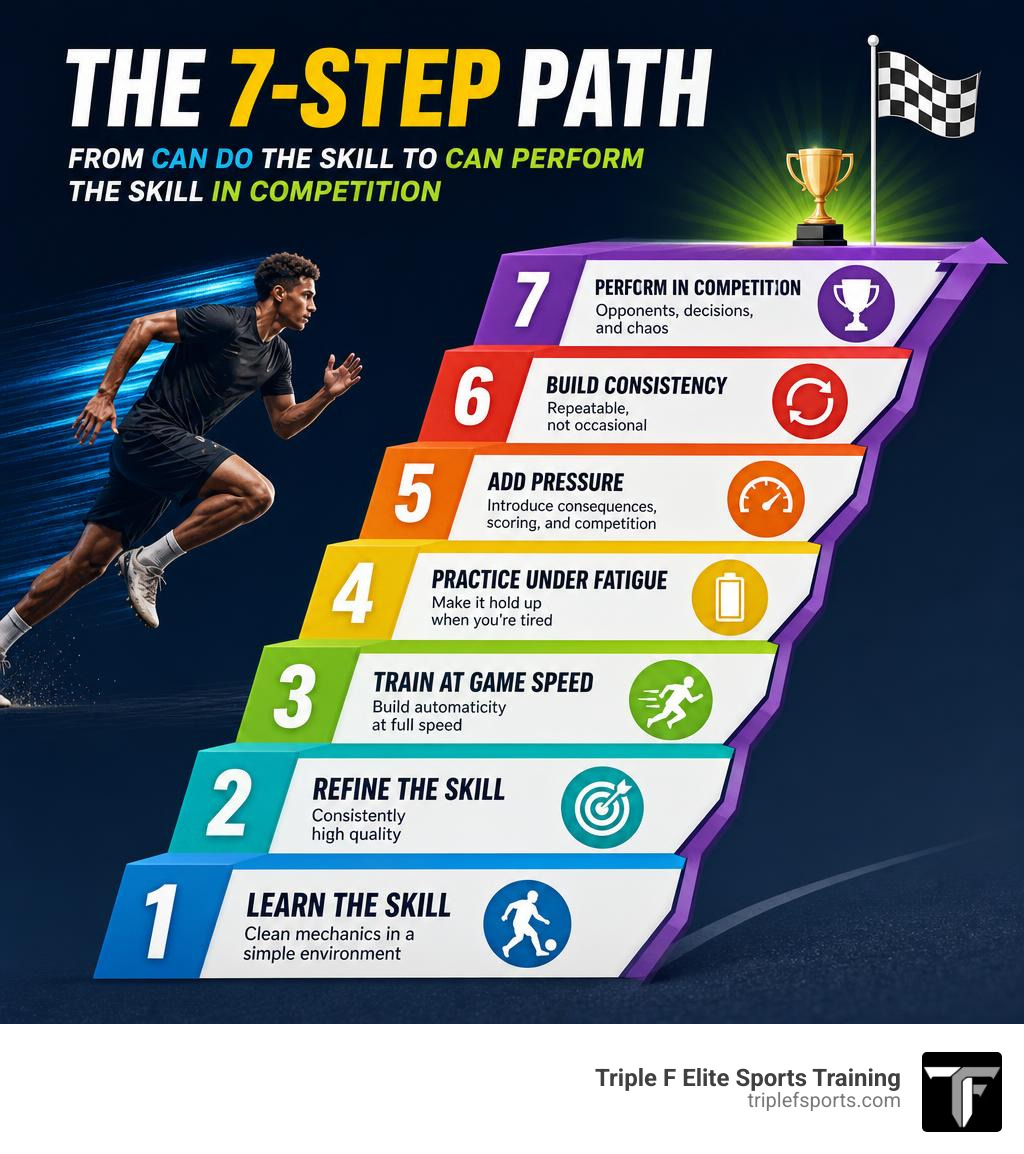
- Learn the skill with clean mechanics in a simple environment
- Refine the skill until it is consistently high quality
- Train the skill at game speed so it becomes automatic
- Practice under fatigue so it holds up late in competition
- Add pressure through consequences, scoring, and competition formats
- Build consistency so the skill is repeatable, not occasional
- Perform in competition conditions with opponents, decisions, and chaos
Most athletes stop at step one or two. That is where the gap between training and game performance comes from.
Here is the hard truth: you can look great in drills and fall apart when it matters. Many athletes have a “training brain” and a completely different “competition brain.” The goal of smart sports skill training is to close that gap — building skills that transfer to the scoreboard, not just the practice field.
That is exactly what this guide walks you through.
I’m Kevin O’Shea, a Certified Strength and Conditioning Specialist and Wide Receiver Coach with hands-on experience in athletic development at every level — from high school football to adult performance training. My approach to sports skill training is rooted in building complete athletes: technically sharp, physically resilient, and mentally ready to compete. Let’s get into it.
Basic sports skill training vocab:
- agility training for basketball
- arm wrestling techniques
- example of mental skills training for athletes
What Sports Skill Training Really Means: From Learning a Move to Owning It
Sports skill training is not just learning a move. It is learning when, where, how fast, and under what conditions to use that move.
A basketball player may be able to dribble through cones. That is useful. But the game asks a harder question: can that athlete change speed, read a defender, protect the ball, absorb contact, stay balanced, and make the right pass while tired?
That is the difference between basic skill acquisition and competition transfer.
For a deeper starting point, we recommend reading A Quick Start Guide to Skill Training for Athletes.
| Basic Skill Practice | Performance-Ready Practice |
|---|---|
| Closed environment | Game-like environment |
| Low speed | Full speed or changing speed |
| No pressure | Scoring, time, defenders, consequences |
| Repeating one pattern | Reading cues and adapting |
| Looks clean | Works in competition |
| Focuses on technique only | Blends technique, decision-making, and physical readiness |
Why sports skill training is not the same as looking technically perfect
Textbook technique matters, but sports are not played in textbooks. No defender waits politely while you get into perfect position. No match pauses because your foot angle was slightly off. Sad, but true.
The goal is not robotic perfection. The goal is adaptable movement.
A technically sound athlete still needs to adjust to:
- Timing changes
- Opponents
- Contact
- Bad bounces
- Visual distractions
- Pressure moments
- Fatigue
- Limited space
Great skill is clean enough to be efficient and flexible enough to survive chaos.
The difference between learning a skill and performing it consistently well
Learning a skill means the athlete can do it. Owning a skill means the athlete can do it repeatedly when the situation is hard.
That requires:
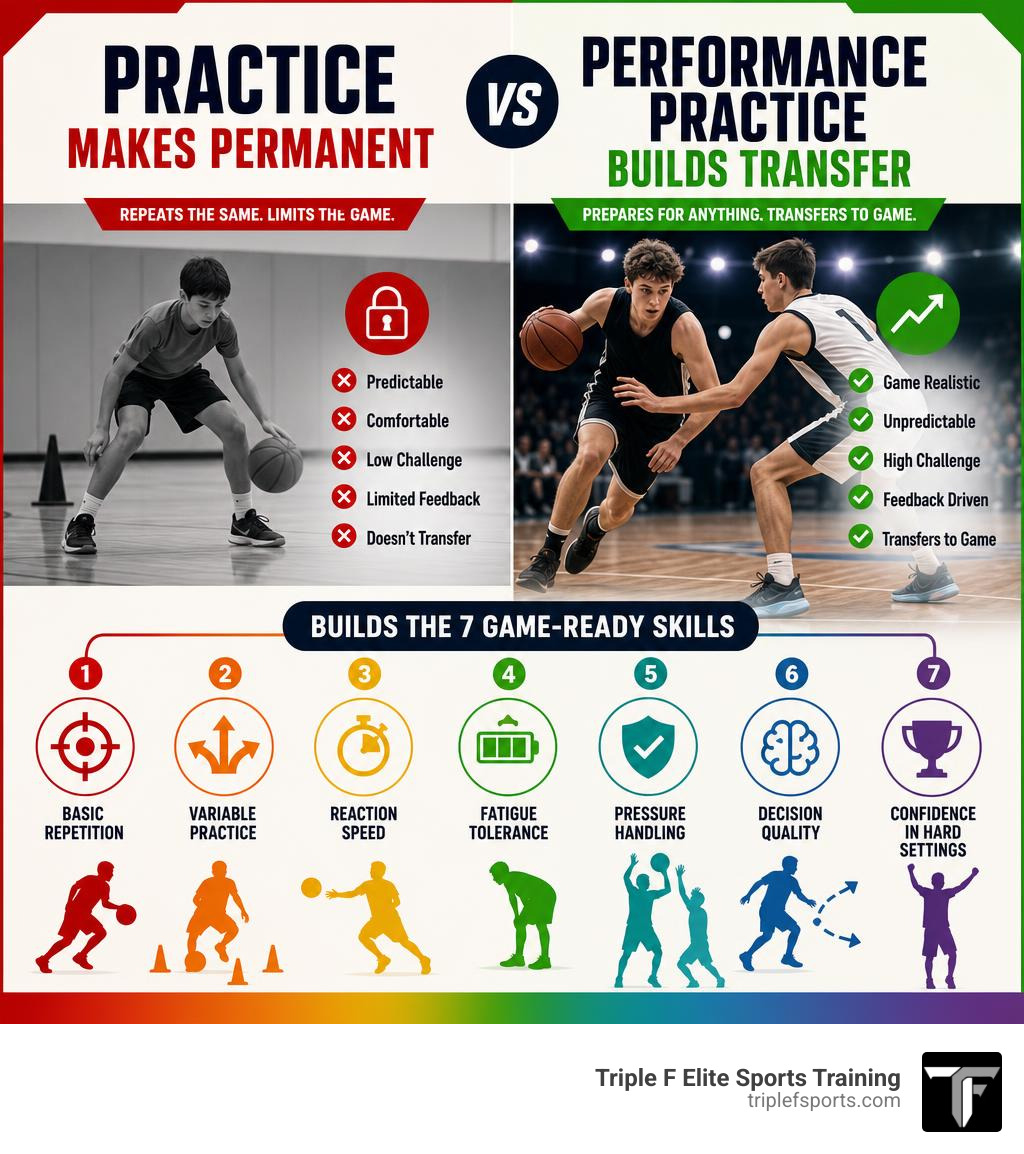
- Basic repetition to build coordination
- Variable practice to handle different situations
- Reaction speed to respond quickly
- Fatigue tolerance to maintain mechanics late
- Pressure handling to stay composed
- Decision quality to choose the right action
- Confidence from repeated success in hard settings
If an athlete can only perform a skill when rested, alone, and unguarded, the skill is not game-ready yet.
Why “Practice Makes Perfect” falls short
Practice does not automatically make perfect. Practice makes permanent.
If athletes practice slowly, casually, or with poor standards, they may simply become better at performing poorly. That sounds harsh, but every coach has seen it: 200 lazy reps, followed by one shocked face when it does not work in a game.
Performance Practice is different. It asks:
- Is the athlete focused?
- Is the rep realistic?
- Is the challenge high enough?
- Is there feedback?
- Is there a consequence?
- Does it transfer to competition?
The 7 Steps of Performance Practice for Sports Skill Training
Performance Practice is a progression. We do not throw athletes into chaos on day one, and we do not keep them in comfortable drills forever.
The goal is to move from simple execution to competition readiness. You can also explore our related breakdown on Sport Skill.
Step 1: Perform the skill
First, the athlete must be able to do the movement.
This is the slow, simple, clean stage. A volleyball athlete learns the passing platform. A football player learns a route break. A basketball athlete learns shooting form. A golfer learns the movement pattern.
At this stage, we want:
- Simple environment
- Clear instruction
- Clean mechanics
- Early confidence
- Frequent feedback
Step 2: Perform the skill very well
Next, we improve quality.
This is where athletes build rhythm, accuracy, and body control. We look for repeatable technique, not random success.
Examples include:
- Hitting a target consistently
- Landing in a stable position
- Keeping posture under control
- Repeating a clean release
- Correcting errors quickly
The standard rises. “I did it once” is not enough.
Step 3: Perform the skill at speed
Sports happen fast. Eventually, the skill has to survive tempo.
Speed changes everything. Footwork gets messy. Vision narrows. Timing breaks down. This is why we train fast hands, fast feet, acceleration, deceleration, and reaction.
In golf, for example, clubhead speed matters because every 1 MPH increase can produce roughly 3 extra yards of distance. Some speed-training tools, such as this example speed training tool for golfers, are built around overload and underload concepts to help athletes train speed with intent.
The same principle applies across sports: speed only helps if the skill still works.
Step 4: Perform the skill under fatigue
Late-game skill separates athletes.
Can the player still pass accurately in the fourth quarter? Can the hitter maintain swing mechanics after repeated jumps? Can the goalkeeper track the puck after multiple rapid shots?
Fatigue training should challenge athletes without turning every rep into survival mode. We want tired execution, not sloppy punishment.
Good fatigue design includes:
- Repeated efforts
- Short recovery windows
- Quality standards
- Late-game scenarios
- Coach-controlled volume
Step 5: Perform the skill under pressure
Pressure changes the brain.
A skill that feels easy in practice can suddenly feel impossible when the score is tied, parents are watching, teammates are counting on you, and your legs feel like cooked noodles.
We can train pressure using:
- Time limits
- Score targets
- Elimination rounds
- One-shot challenges
- Defender pressure
- Accountability systems
- Competitive leaderboards
Pressure practice teaches athletes to breathe, focus, and trust their preparation.
Step 6: Perform the skill consistently
Consistency is the bridge between talent and trust.
A coach needs to know what an athlete can repeat. Not once. Not on a good day. Repeat.
We like measurable standards such as:
- 8 out of 10 accurate passes
- 7 out of 10 controlled first touches
- 90 percent successful landings
- Reduced turnovers under pressure
- Faster reaction time with equal accuracy
Progress tracking keeps athletes honest and motivated.
Step 7: Perform the skill in competition conditions
This is the final test: can the athlete perform with opponents, decisions, speed, traffic, contact, and chaos?
In hockey, for example, visual traffic is a huge part of the game. Research from hockey training sources notes that a large percentage of NHL goals are scored through traffic, which means goalies must learn to read releases, screens, and movement cues. Tools like VR-based hockey decision and reaction training and goalie-specific VR hockey training show how technology can help athletes add decision-making and reaction training off the ice.
But the key idea is bigger than any tool: athletes must practice reading the game, not just performing isolated movements.
Build the Athlete Before You Specialize the Athlete
Skill matters. But the body performing the skill matters too.
If an athlete lacks balance, coordination, strength, mobility, and stability, technical training has a low ceiling. It is like trying to install high-performance software on a laptop from 2007. It may work, but everyone involved will suffer.
Long-term athletic development starts with building the athlete first. For more on this idea, read Unlocking Athletic Potential: A Deep Dive into Sport Specific Training.
Why non-sport-specific training improves sport-specific skills
Non-sport-specific training includes qualities like:
- Linear speed
- Change of direction
- Rotational power
- Strength
- Coordination
- Mobility
- Agility
- Endurance
These qualities transfer across sports.
A soccer player and a baseball player both need acceleration. A swimmer and a golfer both use rotational patterns. Volleyball and basketball athletes both need jumping, landing, deceleration, and body control.
Better athletes usually become better skill learners because they have more movement options available.
Why movement competency is the foundation for skill development
Movement competency is the ability to control the body through basic athletic patterns.
That includes:
- Balancing
- Falling safely
- Landing
- Jumping
- Crawling
- Throwing
- Climbing
- Rotating
- Bracing the core
- Controlling joints through motion
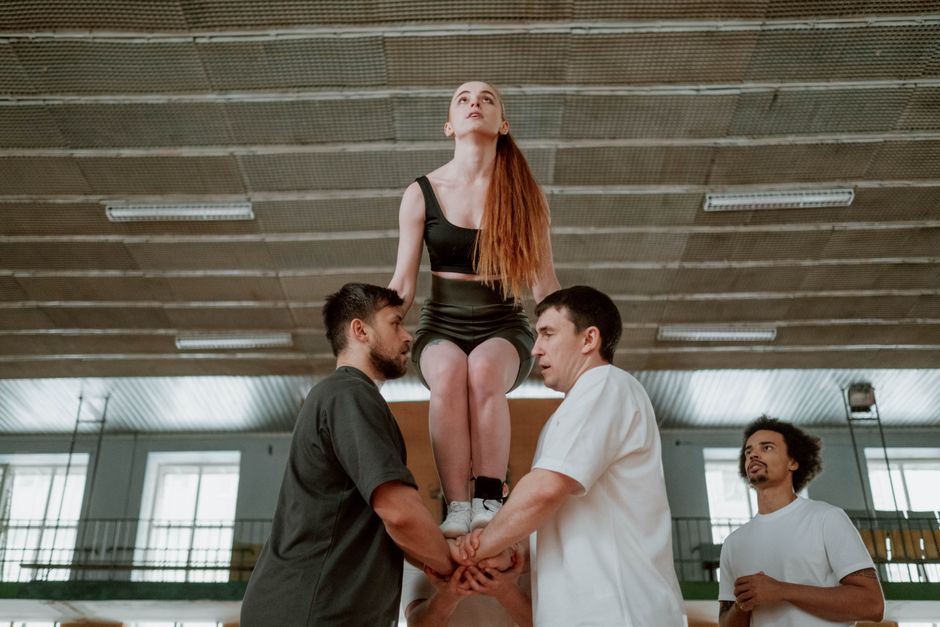
When athletes can move well, they can absorb force, produce force, and adapt to unexpected positions. That helps performance and reduces injury risk.
The risks of early sports specialization
Early specialization means focusing on one sport year-round too soon, often at the expense of other movement experiences.
The risks include:
- Burnout
- Overuse injuries
- Repetitive stress
- Emotional fatigue
- Loss of motivation
- Muscle imbalances
- Increased load from multiple teams
- Higher injury risk from poor recovery
Youth soccer research has shown that lower-extremity overuse injuries in female players often affect the knee, with risk factors including decreased strength and playing on multiple teams. That does not mean soccer is bad. It means load, strength, and recovery matter.
ACL injuries and stress fractures are not just “bad luck.” They are often connected to force absorption, strength, landing mechanics, training volume, and recovery.
Why varied training protects young athletes
Young athletes benefit from variety, especially during the 6-12 age range when the nervous system is highly adaptable. Athletes who sample multiple sports and movement activities often develop better balance, coordination, speed, and agility than early specialists.
Varied movement activities can include:
- Tag games
- Dodgeball
- Capture the flag
- Jumping and landing games
- Crawling patterns
- Throwing and catching
- Climbing
- Sprint races
- Balance challenges
- Small-sided games
- Reaction games
- Tumbling and rolling
- Footwork challenges
Variety builds creativity. It also keeps kids from feeling like every practice is a job interview.
How Coaches Can Blend Skill Work, Strength, Speed, and Variety Without Losing Technical Progress
The answer is not to stop skill training. The answer is to design better sessions.
We can blend technical development with physical development when every part of the session has a purpose. For more coaching ideas, see From Beginner to Pro: Coaching Secrets for Rapid Sports Skill Development.
Start with movement prep that supports the skill of the day
Warm-ups should prepare athletes for what they are about to do.
If the session involves cutting, warm up deceleration and hip control. If it involves jumping, warm up landing mechanics. If it involves throwing, prepare the trunk, shoulders, and hips.
A strong movement prep may include:
- Dynamic mobility
- Core stability
- Balance work
- Activation drills
- Footwork rhythm
- Low-level jumping
- Landing practice
- Joint preparation
This is not wasted time. It is skill insurance.
Add strength and resistance training for resilient athletes
Resistance training helps build stronger muscles, tendons, bones, and joints. It also improves force production and force absorption.
For youth athletes, this does not mean maxing out heavy lifts on day one. It means age-appropriate loading, great technique, and gradual progression.

Strength training can support:
- ACL injury risk reduction
- Better landing control
- Stronger posterior chain
- Improved trunk stability
- Lower stress fracture risk
- Better sprinting and jumping power
- More confidence in contact situations
Load is not the enemy. Poorly managed load is the enemy.
Use small doses of speed, agility, and coordination inside skill sessions
We do not need to turn every skill session into a full conditioning workout. Small doses work well.
Examples:
- 3 sprint starts before route work
- 5 minutes of reaction footwork before ball handling
- Deceleration reps before defensive drills
- Hand-eye reaction games before catching
- Shuffle-to-sprint patterns before volleyball defense
- Foot-eye coordination before soccer touches
This is called micro-dosing. It keeps athletic qualities improving without stealing the entire session.
Keep training fun without making it random
Fun matters. Random chaos does not.
Structured play gives athletes freedom inside clear rules. We can use relays, constraints, scoring systems, and small-sided games to make training engaging while still targeting the skill.
For example, a footwork tool like the ShinDefender Skill Mat can help athletes practice coordination and ball control at home, especially when paired with clear progressions. The important principle is guided variety: athletes should explore, but the coach should know why the activity is there.
Create Practice Environments That Feel Like Competition
The best sports skill training makes practice feel more like the game.
Not every drill needs to be full chaos. But athletes must regularly face decisions, pressure, fatigue, and realistic timing. Learn more about this approach in Skilled Based Training.
Train decision-making, not just technique
Technique answers, “Can you do it?”
Decision-making answers, “Can you choose the right thing at the right time?”
Athletes need to read:
- Defender positioning
- Passing windows
- Body cues
- Shot releases
- Space
- Teammate movement
- Opponent pressure
- Timing changes
This is called perception-action coupling: seeing the game and acting on what is seen. It is one reason game-like drills are so valuable.
Use fatigue without destroying mechanics
Fatigue should reveal skill, not wreck it.
We use fatigue carefully by adjusting:
- Work-to-rest ratios
- Rep numbers
- Drill duration
- Technical standards
- Recovery time
- Intensity
If mechanics completely collapse, the athlete may be learning bad habits. The goal is to challenge the athlete just enough to build late-game execution.
Add pressure with scoring, consequences, and constraints
Pressure does not require screaming. In fact, please do not build your whole coaching personality around yelling. We have enough noise in the world.
Better pressure tools include:
- Time limits
- Score targets
- Defender pressure
- Small-sided games
- Elimination rounds
- One-rep challenges
- Competitive teams
- Constraint-based rules
- Simulated crowd noise
Pressure teaches composure. It also helps athletes discover what their skills look like when emotions rise.
Track progress so athletes know what is improving
Athletes need feedback. Parents need clarity. Coaches need data.
Track things like:
- Baseline testing
- Pre- and post-session scores
- Accuracy percentages
- Sprint times
- Jump height
- Strength measures
- Reaction time
- Consistency rates
- Video review notes
- Training journal entries
Progress does not always look like a highlight play. Sometimes it looks like fewer mistakes, better decisions, cleaner landings, or more confidence under pressure.
Frequently Asked Questions About Sports Skill Training
How often should athletes do sports skill training?
It depends on age, training age, sport season, and recovery.
Most athletes do well with 2-4 focused skill sessions per week, depending on their schedule. Younger athletes usually need more variety and less volume. Older or more advanced athletes may need more specialized work, but recovery still matters.
A balanced week may include:
- Skill training
- Strength training
- Speed or agility work
- Mobility and recovery
- Free play or low-pressure movement
- Rest
Quality beats volume. Ten focused reps are better than 100 tired, careless ones.
Should young athletes specialize early if they want to be elite?
Usually, no.
Some sports reward early technical exposure, but most young athletes benefit from sampling multiple sports and movement patterns before specializing. Multi-sport exposure can improve coordination, speed, agility, creativity, and long-term motivation.
Early specialization can increase the risk of burnout and overuse injuries, especially when athletes train one pattern year-round without enough strength, recovery, or variety.
The better goal is to build a complete athlete first, then specialize when the athlete is physically, mentally, and emotionally ready.
How do you know if sports skill training is working?
Sports skill training is working when skills transfer into competition.
Look for:
- Better consistency
- Fewer breakdowns under pressure
- Improved speed without loss of control
- Better decision-making
- More confidence
- Cleaner mechanics under fatigue
- Improved game performance
- Measurable progress in tracked skills
- Coach observation matching athlete results
If an athlete only looks better in drills but not in games, the training environment may need to become more realistic.
Conclusion
Great athletes are not built by repeating easy drills forever. They are built through smart progression.
Effective sports skill training teaches athletes to perform with clean technique, then challenges them with speed, fatigue, pressure, consistency, and competition conditions. It also builds the body behind the skill through strength, movement competency, speed, agility, and variety.
At Triple F Elite Sports Training in Knoxville, TN, we believe in developing complete athletes. Our approach is professional, Christ-centered, and focused on helping youth and adults unlock their full potential through performance training, physical therapy, and sport-specific development.
If you are ready to train smarter, build resilience, and stop losing your mind over practice-to-game transfer, we would love to help.
Start here: Continue with skilled-based athlete development. Your first session is free.