What Is Professional Fitness Training — and Is It Right for You?
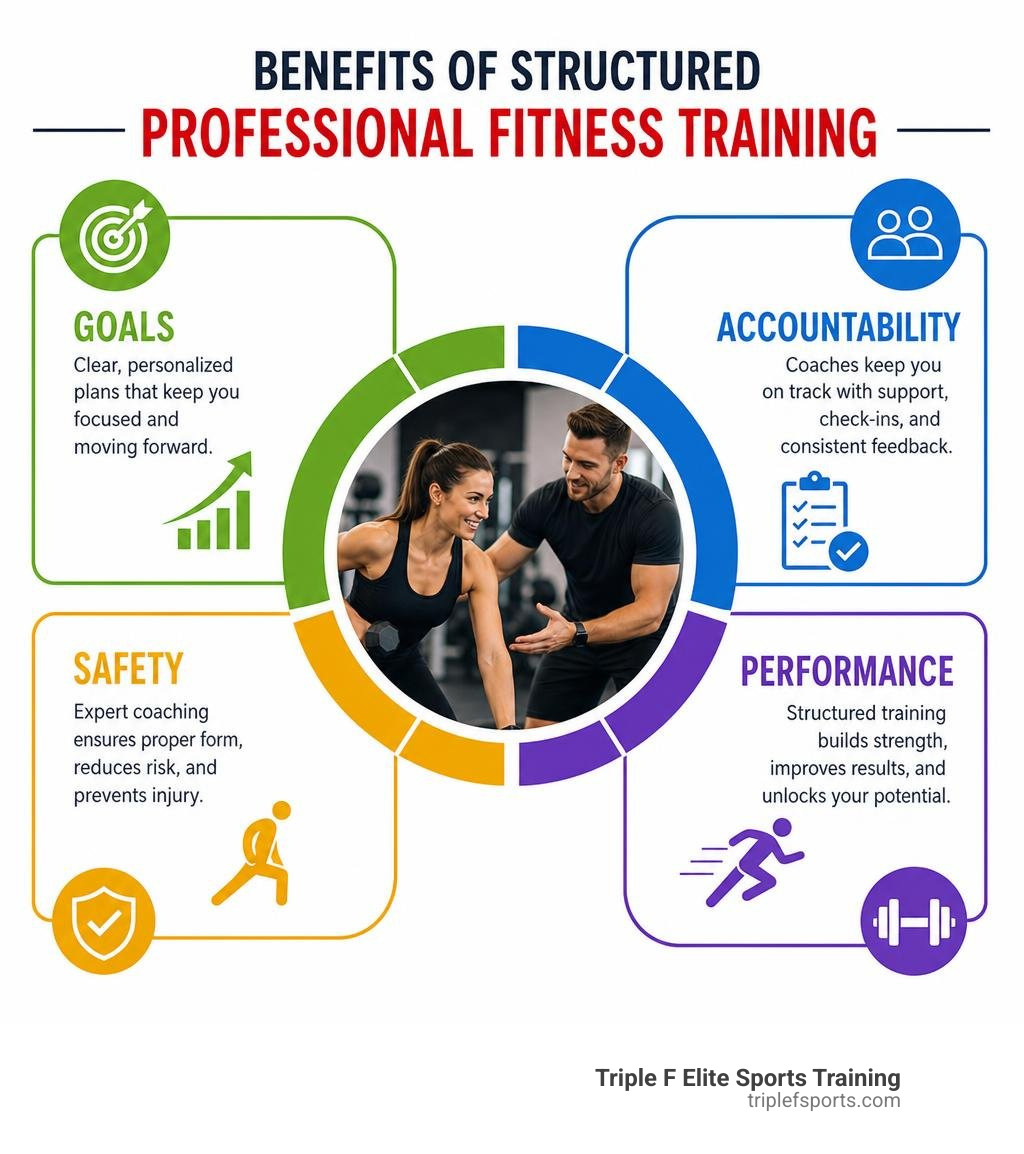
Professional fitness training is a structured approach to exercise led by certified coaches who design programs, track progress, and keep you safe — whether you’re training one-on-one or in a group setting.
Quick answer for athletes and adults in Knoxville looking for professional training:
| What You Want | What Professional Training Offers |
|---|---|
| Faster results | Personalized programs based on your goals |
| Accountability | Regular check-ins and progress tracking |
| Safety | Certified coaches who correct form and prevent injury |
| Group energy | Classes that build motivation through community |
| Expert guidance | Trainers backed by NCCA-accredited certifications |
The fitness industry is growing fast. Employment of fitness trainers and instructors is projected to grow 12% from 2024 to 2034 — much faster than most occupations. About 74,200 new job openings are expected each year over that same period. That growth reflects a simple truth: more people are realizing that self-guided exercise only gets you so far.
Whether you’re a youth athlete chasing a starting spot, an adult trying to rebuild strength, or someone recovering from injury, working with a trained professional changes the outcome.
I’m Kevin O’Shea — a Certified Strength and Conditioning Specialist and Co-Founder of Triple F Elite Sports Training in Knoxville — and my background in athletic development and behavioral health has given me a front-row seat to what professional fitness training can do when it’s done right. From coaching wide receivers to supporting clients through mental and physical transformation, I’ve seen that the best results come from training the whole person, not just the body.
Professional fitness training word list:
The Core Pillars of Professional Fitness Training
At its core, professional fitness training is built on a foundation of exercise science, systematic programming, behavioral coaching, and injury prevention. It is not just about writing a list of exercises on a whiteboard; it is about understanding how the human body moves, adapts, and recovers.
When we work with clients, we focus on several foundational pillars:
- Comprehensive Client Assessment: Understanding where your body is starting from, including mobility limitations, past injuries, and current strength baselines.
- Scientific Program Design: Utilizing evidence-based progression models to ensure you build muscle, lose fat, or increase power without hitting a plateau.
- Technique and Injury Prevention: Teaching the mechanics of movement so you can lift heavier and run faster without putting your joints at risk.

Working with an expert helps bridge the gap between where you are and where you want to be. For a deeper look at how a coach keeps you on track, check out our guide on Why You Need a Fitness Coach in Your Corner.
Personal Coaching vs. Group Fitness Instruction
While both personal coaching and group fitness instruction aim to improve health, they deliver very different experiences. Understanding these differences helps you choose the path that aligns with your goals, budget, and personality.
- Personal Coaching (One-on-One): This is the gold standard for customization. Your coach focuses entirely on you. Every set, rep, and rest period is designed for your specific body, goals, and daily energy levels. If you have past injuries, specific athletic goals, or need high accountability, personal coaching is the best choice.
- Group Fitness Instruction: Group classes leverage collective energy and community motivation. While the workouts are less customized, a skilled instructor offers modifications for different fitness levels. Group training is excellent for building consistency, enjoying social support, and conditioning.
Many people find that a hybrid approach—combining structured group classes with targeted personal coaching—delivers the perfect balance of community fun and specific athletic progression.
How Trainers Assess, Program, and Ensure Safety
A professional fitness coach does not guess; they measure. When you begin a program, the first step is always a thorough assessment. This generally includes:
- Health History and Lifestyle Review: Discussing stress levels, sleep quality, nutritional habits, and previous medical conditions.
- Movement and Mobility Screenings: Identifying tight muscles, joint restrictions, or strength imbalances that could lead to injury.
- Baseline Fitness Testing: Measuring cardiorespiratory endurance, core strength, and functional movement capabilities.
Once your baseline is established, coaches use systematic periodization models to progress your training safely. One of the most respected frameworks in the industry is the NASM OPT Model, which guides clients through five progressive phases: Stabilization Endurance, Strength Endurance, Muscular Development/Hypertrophy, Maximal Strength, and Power. By progressing systematically through these phases, you ensure that your joints and connective tissues are strong enough to handle heavier loads, drastically reducing the risk of overtraining.
Career Pathways and Industry Credentials
If you are looking to enter the fitness industry as a career, or if you are a client wanting to ensure your trainer is qualified, understanding credentials is key. The landscape has evolved from unregulated “bro-science” to a highly professional field that values formal education, national accreditations, and continuous learning.
To work at a top-tier facility, trainers must hold a certification accredited by the National Commission for Certifying Agencies (NCCA). This accreditation is the gold standard in health and wellness credentialing, ensuring that the exams are scientifically rigorous and legally defensible.
Choosing the Right Professional Fitness Training Certification
Choosing a certification depends on your career goals, budget, and desired specialty. The table below compares the four most prominent NCCA-accredited certifications in the industry:
| Certification | Best For | Key Features | Exam Focus |
|---|---|---|---|
| NASM-CPT | General population, corrective exercise, and systematic progression | Built on the Optimum Performance Training (OPT) model; highly recognized by commercial gyms | Program design, movement assessments, and behavior change |
| ACE-CPT | Lifestyle coaching, behavior change, and general wellness | Emphasizes the ACE Mover Method and Integrated Fitness Training (IFT) model | Client-centered coaching, lifestyle modifications, and basic programming |
| NSCA-CPT | Strength and conditioning, athletic populations, and clinical settings | Strong focus on sports science; highly respected for training athletes | Exercise technique, anatomy, program planning, and safety/legal guidelines |
| NFPT-CPT | Practical, entry-level trainers wanting affordable, business-focused support | Offers continuous mentorship, business jumpstart tools, and practical exercise libraries | Basic sciences, client assessment, and foundational program design |
For those looking to train high-level athletes or work in performance-focused environments, you can Explore the NSCA-CPT certification to learn more about their rigorous scientific standards.
Specializations, Nutrition, and Behavior Change
An initial personal training certification is just the starting point. To truly help clients succeed, professional coaches often specialize in areas like nutrition, behavior change, and athletic performance.
- Nutrition and Weight Management: While trainers cannot prescribe specific meal plans for medical conditions (which falls under the scope of a Registered Dietitian), they can provide crucial evidence-based nutrition advice. This includes calculating macronutrient needs, discussing energy balance, and helping clients build sustainable dietary habits.
- Behavior Change Coaching: A workout program is only as good as a client’s ability to stick to it. Coaches trained in behavior change help clients overcome mental blocks, build intrinsic motivation, and replace self-sabotaging habits with positive ones.
- Athletic Performance: Training an athlete requires a deep understanding of speed, agility, and power development. If you want to build functional strength that translates directly to the field or court, you can Discover adult athletic training programs designed to unlock your inner competitor.
Job Outlook, Work Environments, and Industry Growth
The demand for qualified fitness professionals is at an all-time high. As public awareness of preventative health, metabolic wellness, and physical longevity grows, trainers are no longer seen as luxury services, but as essential partners in healthcare and lifestyle management.
The work environment for fitness professionals has also diversified. While many still start in commercial fitness centers, others find rewarding careers in athletic performance facilities, corporate wellness programs, physical therapy clinics, or as independent business owners. If you are an active adult looking to train in an environment that prioritizes science-backed coaching, you can Find the best adult sports fitness programs to elevate your routine.
The Rising Demand for Professional Fitness Training
According to the U.S. Bureau of Labor Statistics, the median annual wage for fitness trainers and instructors was $46,180 in May 2024. However, top-tier certified coaches, especially those with specialized credentials or those running successful independent businesses, can earn significantly more. For example, data shows that ACE-certified personal trainers earn an average annual income of $76,000, while NASM-certified trainers earn about 22% more than the industry average.
This earning potential is driven by a massive market demand. Companies are increasingly investing in corporate wellness programs to lower healthcare costs and boost productivity, while aging populations are seeking out trainers to maintain mobility and independence. To see how you can fit structured strength and conditioning into your life, Explore adult memberships that offer professional coaching in a supportive environment.
Frequently Asked Questions about Fitness Careers
Entering the professional fitness space can raise several questions about costs, timelines, and career paths. Here are the answers to some of the most common questions:
What is the average salary for certified fitness trainers?
The median annual wage was $46,180 in May 2024, but your actual earning potential depends heavily on your location, certifications, experience, and employment model. Independent trainers, online coaches, and those working in specialized athletic performance centers often earn higher rates than entry-level staff at budget commercial gyms.
How long does it take to get certified as a personal trainer?
Most NCCA-accredited certification programs are self-paced and take between 3 to 6 months to complete. This allows you to study anatomy, kinesiology, and program design while managing other full-time commitments. Once you feel prepared, you will register for and pass a proctored exam.
Can I work as a fitness trainer part-time or be self-employed?
Absolutely. One of the greatest benefits of a career in fitness is flexibility. Many trainers start part-time, coaching clients in the early mornings or evenings while maintaining a day job. Over time, many transition to self-employment, building their own client rosters, launching online coaching platforms, or opening private training studios.
Conclusion
Your fitness journey is a lifelong investment in your health, strength, and vitality. While self-guided workouts can be a great starting point, working with a certified professional ensures that your hard work translates into real, lasting results without the setbacks of injury or plateaus.
At Triple F Elite Sports Training in Knoxville, we are dedicated to helping youth and adult athletes unlock their full physical potential. Whether you are looking to build foundational strength, recover from an injury, or take your athletic performance to the next level, our expert coaches are here to design the perfect plan for your body and goals.
Are you ready to experience the difference that professional, science-backed coaching can make? Start your fitness journey today and claim your free first training session with us!