
Why Balance Exercises for Athletes Are the Foundation of Peak Performance
Balance exercises for athletes are one of the most underrated tools for improving performance and preventing injury. Here are the most effective options to get started:
Top Balance Exercises for Athletes:
- Single-leg stance – Hold 20-30 seconds per side; progress with eyes closed
- Single-leg Romanian deadlift – Builds hip, hamstring, and core stability simultaneously
- Bosu ball squat – Challenges proprioception through unstable surface training
- Lateral bound to single-leg stick – Develops reactive stability for cutting and landing
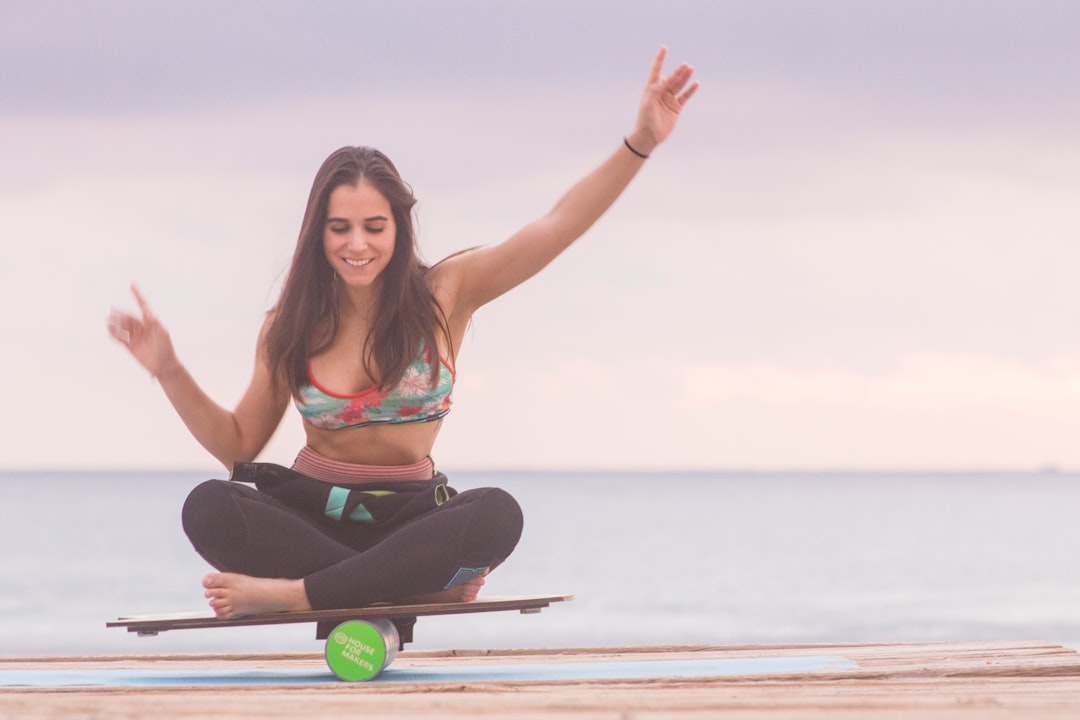
- Balance board holds and squats – Forces real-time multi-directional stabilization
- Bird dog – Trains core stability and body awareness from the ground up
- Triplanar toe taps – Builds hip stability across three planes of movement
- Single-leg hop to hold – Transfers balance training directly to sport demands
Every athlete has experienced that split-second moment – a sharp cut, an awkward landing, an unexpected collision – when the body fights to stay upright. That moment reveals something important: raw strength and speed mean very little without the stability to control them.
Balance isn’t just about standing on one foot. It’s a complex skill that drives cutting ability, landing mechanics, and change of direction. Research backs this up. Studies show that targeted balance training can reduce ankle sprain risk by up to 35%, cut all injuries by 38%, and in some programs, reduce ACL injury rates by as much as 88% in the first year.
Whether you’re a youth athlete building your foundation or a competitive player pushing for the next level, this is training you can’t afford to skip.
I’m Kevin O’Shea, a Certified Strength and Conditioning Specialist (CSCS) and former collegiate wide receiver who has spent years developing athletes at every level – and balance exercises for athletes are a core part of every program I design at Triple F Elite Sports Training. The drills below are the same ones we use to build game-ready stability in Knoxville athletes across all sports.
Balance exercises for athletes terms to remember:
What Balance Really Means for Athletes
In sports, balance is defined as the ability to maintain your center of gravity within your base of support. But for an athlete, the “base of support” is rarely fixed. It might be a single foot planted during a soccer cut or the balls of your feet during a volleyball block.
There are two primary types of balance we focus on:
- Static Balance: The ability to maintain control while stationary (e.g., a gymnast holding a pose).
- Dynamic Balance: The ability to maintain postural control while moving or reacting to outside forces (e.g., a running back staying upright after a hit).
Why balance is critical for athletic performance
Without balance, power is wasted. If your stabilizers can’t handle the force your big muscles produce, you’ll “leak” energy. Elite balance allows for better force transfer from the ground through the core and into the ball or opponent. It’s the difference between a shaky landing and a “stuck” landing that allows for an immediate secondary jump.
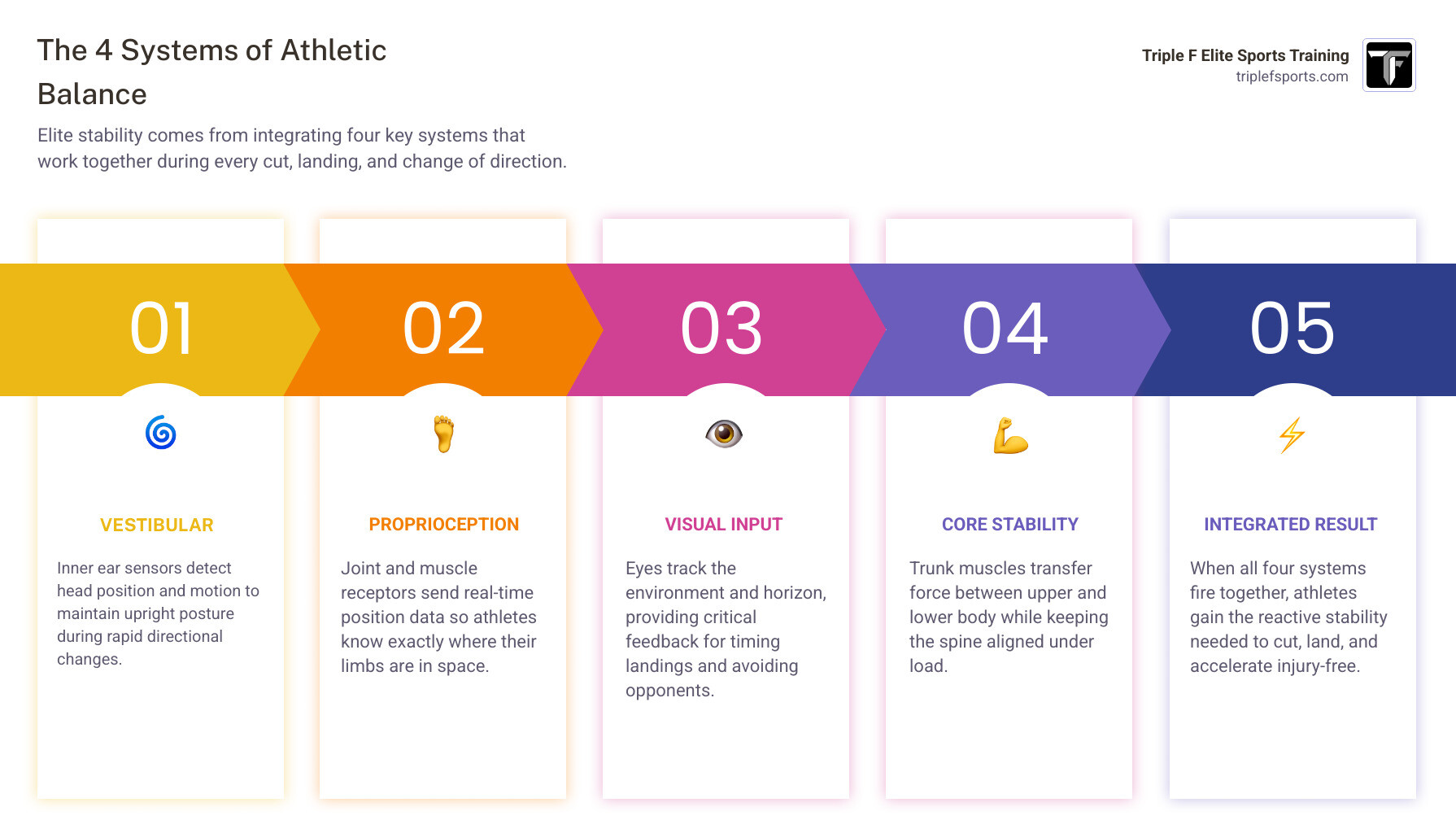
The 4 systems behind elite balance
Your brain uses a “triad” of sensory systems, plus your core, to keep you upright:
- Proprioception: Millions of sensors in your joints and skin that tell your brain where your limbs are in space.
- Vestibular System: The “inner ear” sensors that detect head movement and spatial orientation.
- Visual Input: Your eyes provide a constant horizon line and feedback on your surroundings.
- Core Stability: The muscular “anchor” that stabilizes the spine so the limbs can move efficiently.
How poor balance raises injury risk
When an athlete has poor neuromuscular control, their joints are at the mercy of physics. Research shows that limb asymmetries exceeding 10% significantly correlate with increased lower-extremity injury risk. Without proper balance training, the body’s “time-to-stabilize” after a jump is slower, leaving the ACL and ankle ligaments vulnerable to noncontact tears and sprains.
The Best balance exercises for athletes Start With These Foundations
Before we get to the flashy Bosu ball drills, we have to master the basics. Foundation training focuses on “quieting” the body and teaching the nervous system to fire correctly.
Single-leg balance exercises for athletes
The single-leg stance is the king of foundations.
- Single-Leg Stand: Start on flat ground, hands at sides. Aim for 30 seconds.
- Tree Pose: A yoga classic that improves hip opening and focus.
- Single-Leg Calf Raises: Perform these on a flat surface first to build ankle “stiffness.”
- Toe Taps: While standing on one leg, tap your other foot forward, side, and back without letting your weight shift.
Core-driven balance exercises for athletes
Balance isn’t just a foot issue; it’s a core issue.
- Bird Dog: On all fours, extend the opposite arm and leg. Keep your back so flat you could balance a glass of water on it.
- Dead Bug: Lying on your back, slowly lower the opposite arm and leg while keeping your lower back pressed into the floor.
- Pallof Press: Use a resistance band to pull you sideways while you resist the rotation, standing in an athletic stance.
How to progress safely from easy to hard
We follow a strict hierarchy of progression:
- Stable to Unstable: Master the floor before moving to a foam pad or balance board.
- Eyes Open to Eyes Closed: Removing visual input forces the vestibular and proprioceptive systems to work harder.
- Slow to Reactive: Start with controlled holds, then add “perturbations” (like a coach lightly pushing your shoulder).

12 Best Balance Drills to Build Game-Ready Stability
Once foundations are set, we integrate these 12 drills into our advanced athletic training sessions to simulate the chaos of competition.
Floor-based drills with the best carryover
- Single-Leg Romanian Deadlift (RDL): Hinge at the hips while holding a weight. This is one of the best moves for glute strength and balance.
- Reverse Lunge with Rotation: Step back into a lunge and rotate your torso over the front leg.
- Triplanar Toe Taps: Use a cone as a marker and tap in three directions with high control.
- Single-Leg Sit-to-Stand: Use a bench or chair. Lower yourself slowly on one leg and stand back up without letting your knee cave in.
Unstable-surface drills that challenge proprioception
- Bosu Squat: Flip the Bosu ball so the flat side is up. Perform slow, controlled squats.
- Foam Pad Single-Leg Stance: The squishy surface forces the small muscles in the feet to “search” for stability.
- Wobble Board Rotations: Stand on a balance board and try to keep the edges from touching the floor while rotating your hips.
- Stability Ball Plank: Place your forearms on a Swiss ball while holding a plank. The “shake” you feel is your core working overtime.
Reactive and explosive drills for sport transfer
- Lateral Bound to Stick: Jump sideways and land on one leg, “sticking” the landing for 3 seconds.
- Single-Leg Hop to Hold: Jump forward and stabilize immediately.
- Agility Ladder Side Shuffles: Focus on quick feet while keeping your center of gravity low.
- Crossover Step to Balance: Mimic a defensive slide, then snap into a single-leg balance.
Mind-body methods that improve control
Don’t overlook the power of Tai Chi or Yoga. These disciplines emphasize body awareness and breathing, which help athletes maintain composure and balance during high-stress game moments.

What the Science Says About Balance Training Programs
We don’t just guess at Triple F; we use evidence-based protocols. Systematic reviews of over 50 studies have helped us narrow down exactly what works.
Best evidence-based protocol for most athletes
Research suggests that an 8-week program is the “sweet spot” for significant neural adaptation.
- Frequency: 2–3 sessions per week.
- Duration: 45 minutes per session (or 20 minutes if integrated into a larger workout).
- Effect: Significant improvements in postural control and a marked reduction in injury risk.
When integrative neuromuscular training works even better
Integrative neuromuscular training (INT) combines strength, plyometrics, and balance. Studies show that INT is more effective for team sport athletes than balance training alone because it replicates the multi-faceted demands of the game. This approach is a staple in our youth athletic development programs.
What studies show for immediate warm-up effects
Can you “turn on” your balance instantly? Research on oculomotor and bimanual coordination suggests that a 5-minute warm-up involving eye-tracking exercises and coordinated hand movements can immediately stabilize balance before a game.
Injury reduction numbers coaches should know
The data is clear:
- 35% reduction in ankle sprains in basketball players.
- 43% reduction in acute-onset injuries in youth soccer.
- 88% reduction in ACL injuries over two years when using specific neuromuscular programs.
How to Use balance exercises for athletes in a Weekly Training Plan
Integrating balance doesn’t mean you have to stop lifting heavy. In fact, a perfect athlete training program blends both.
Where balance work fits in a workout
- Warm-up: Use low-level static holds to “wake up” the nervous system.
- Skill Block: Perform reactive drills (like lateral bounds) before you get too fatigued.
- Finisher: Training balance while fatigued mimics the end of a game, which is when most injuries occur.
Sport-specific differences in balance training
- Soccer/Handball: Focus on single-leg stability and deceleration.
- Basketball: Focus on landing mechanics and ankle “stiffness.”
- Baseball: Focus on “ground-up” energy and rotational balance. Check out our pitcher blueprint for more.
- Volleyball: Focus on vertical landing stability and core control.
Best equipment and when to use it
You don’t need a million dollars in gear. A simple foam mat, a few cones, and a stability ball are enough for most sport-specific training. For advanced athletes, we use spring-loaded balance boards and force plates to measure stability in real-time.
Safety rules and common mistakes
- Don’t go too heavy: Never perform maximal lifts on unstable surfaces. It’s dangerous and doesn’t build “athletic” balance.
- Quality over quantity: If you are wobbling uncontrollably, the drill is too hard. Regress to a simpler version.
- Watch for fatigue: Balance is a neural skill. Once your form breaks down, the training benefit stops.
Frequently Asked Questions About balance exercises for athletes
How often should athletes do balance training?
For most athletes, 2–3 sessions per week is optimal. Each session should last between 20 and 45 minutes, depending on whether it’s a dedicated session or integrated into a strength workout.
Are unstable surfaces better than floor exercises?
Not necessarily. Floor exercises are better for building “stiffness” and force production. Unstable surfaces are better for “searching” and proprioceptive awareness. A good program uses both.
What tests show whether balance is improving?
We use the Star Excursion Balance Test (SEBT) and the Y-Balance Test. These involve reaching as far as possible in different directions while standing on one leg. We also use the BESS (Balance Error Scoring System) to track improvements in static stability.
Conclusion
Mastering balance exercises for athletes is about more than just staying upright; it’s about building a body that is resilient, explosive, and efficient. From reducing ACL risks to sharpening your change-of-direction speed, balance is the “secret sauce” of elite performance.
At Triple F Elite Sports Training in Knoxville, we specialize in taking these scientific principles and turning them into results on the field. Whether you are looking for in-depth youth strength training or professional-level performance coaching, we are here to help you unlock your full potential.
Ready to level up? Come see us in Knoxville for your free first session and let’s start building your foundation today.