
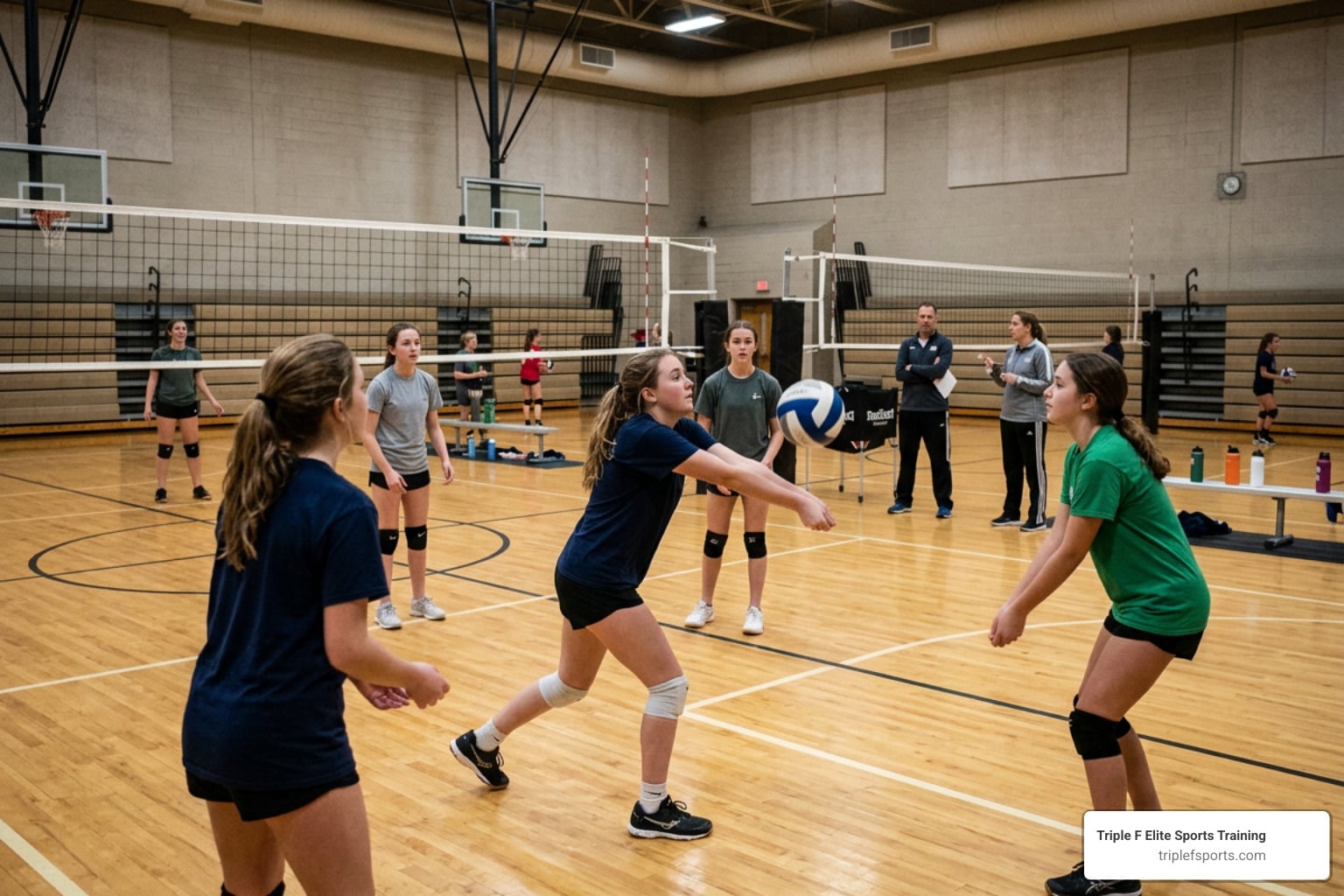
What to Know Before Joining a Volleyball Club
Joining a volleyball club is one of the best decisions a young athlete can make — but not all clubs are the same.
Here’s a quick overview to help you decide:
| What You Need | What to Look For |
|---|---|
| Beginner-friendly entry | Rec leagues, free clinics, or prep leagues |
| Skill development | Qualified coaches, structured drills, position training |
| Competitive growth | Travel teams, national bids, tournament play |
| College pathway | Alumni success, recruiting support |
| Community fit | Family culture, values alignment, athlete support |
The right club does more than teach volleyball. It builds confidence, discipline, and a foundation that carries into college and beyond. Top-tier clubs have sent athletes to over 150 USAV Junior National bids and placed hundreds into Division I, II, and III programs. That kind of track record starts with one good decision early on.
But for beginners especially, the first priority isn’t trophies — it’s finding an environment where learning feels safe and growth feels possible.
I’m Kevin O’Shea, a Certified Strength and Conditioning Specialist based in Knoxville, and while my background is in athletic performance training rather than running a volleyball club, I’ve spent years helping youth athletes build the physical foundation — speed, power, agility, and strength — that makes every club experience more rewarding. Whether you’re just starting out or preparing for tryouts, what happens off the court matters just as much as what happens on it.
Key Features to Look For in a Beginner-Friendly Volleyball Club
When your child is just starting out, stepping into a massive sports facility can feel incredibly intimidating. The sounds of dozens of balls slamming against the hardwood, whistle blasts echoing off the walls, and older athletes flying through the air for blocks can make any beginner want to turn right back toward the car.
That is why finding a beginner-friendly club environment is so critical. You aren’t just looking for court space; you are looking for a culture that nurtures growth.
Holistic Growth Over “Winning at All Costs”
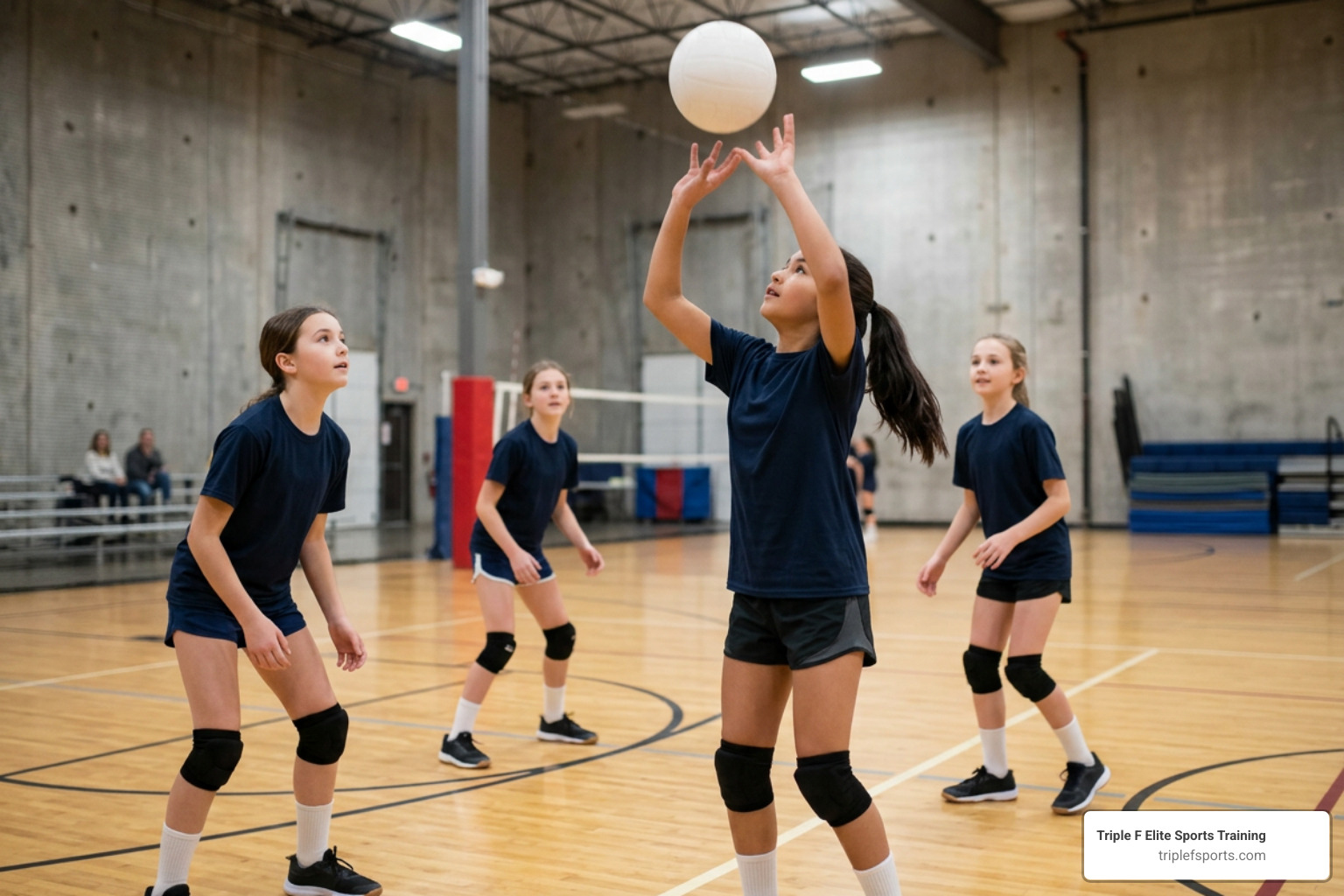
For a beginner, the primary goal of joining a club is to fall in love with the game while developing fundamental motor skills. If a club’s only metric of success is their trophy cabinet, a beginner may quickly get left behind on the bench.
Instead, look for clubs that emphasize holistic growth—focusing on values like responsibility, sportsmanship, and teamwork. The best clubs realize that they are using sports to build great human beings, not just great volleyball players. When you evaluate local options, ask how they handle playing time for developmental teams and how they measure progress.
To help you navigate this initial decision, we have put together a comprehensive guide on Don’t Drop the Ball When Choosing a Youth Volleyball Club to ensure you ask the right questions before signing any contracts.
Coaching Quality and the “Patience Factor”
At the elite level, coaches focus on complex defensive systems and high-tempo offenses. At the beginner level, the most important coaching trait is patience. A beginner-friendly coach must be an expert in breaking down biomechanics into simple, digestible cues. They need to teach a player how to form a solid passing platform without bruising their forearms, how to track a ball through the air, and how to safely land after a jump to protect their knees.
A Supportive Family Atmosphere
A club should feel like a community. When a young athlete feels supported by their coaches, teammates, and other parents, they are far more willing to take physical risks—like diving for a ball or trying a new serving technique—without the fear of embarrassment. This family-like support system is what keeps players coming back season after season.
Structuring Programs for New Players
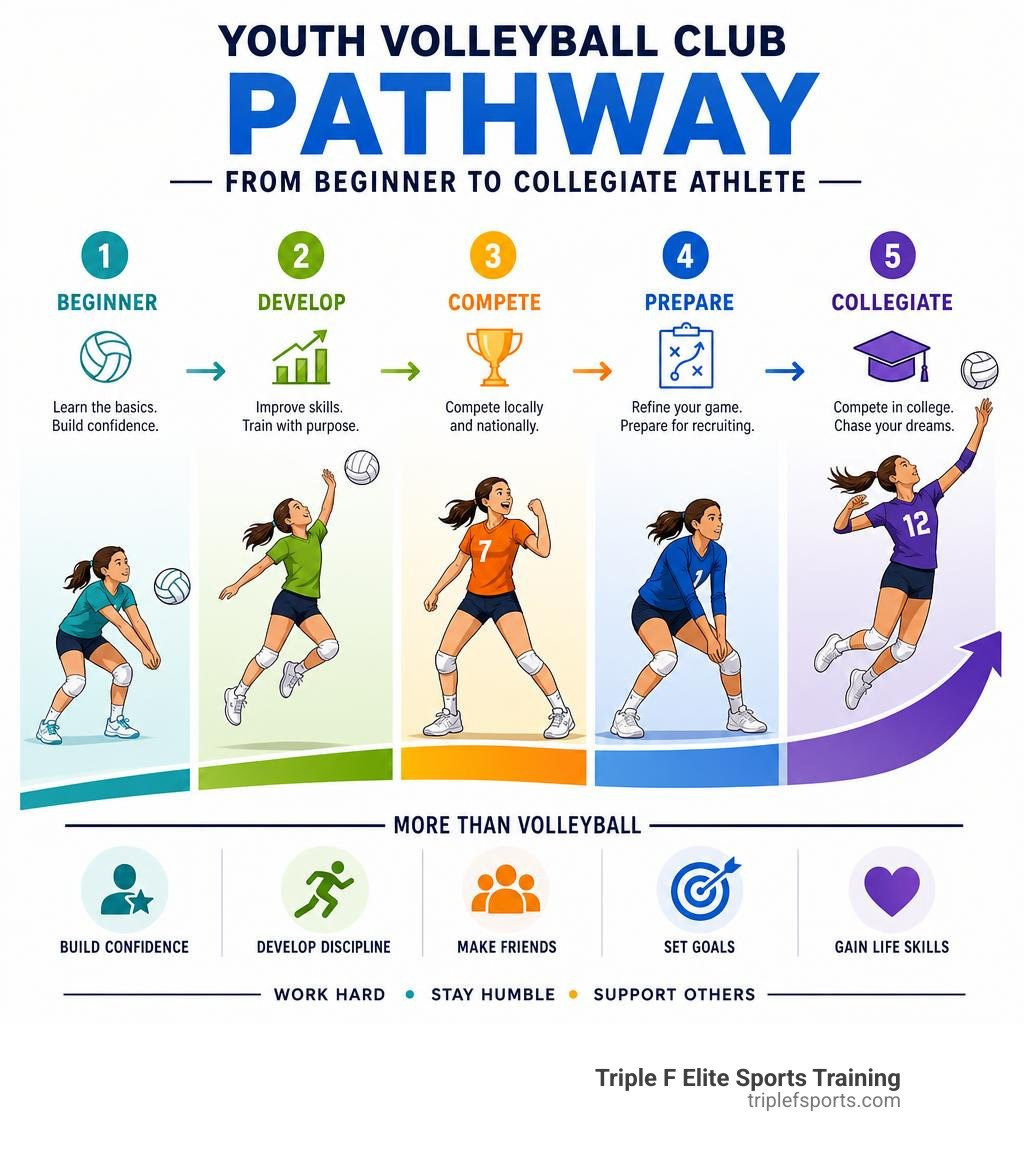
A great volleyball club does not have a one-size-fits-all approach. Instead, it offers a clear, structured pathway that meets athletes exactly where they are in their development. For beginners, this pathway usually starts with low-commitment, high-fun programs and gradually scales up as the player’s skills and interest grow.
Typically, club structures are divided into several tiers:
- Grassroots & Minis (Ages 6–10): Focuses on basic coordination, running, catching, and light-ball volleyball play to build spatial awareness.
- Developmental/Prep Leagues (Ages 11–14): Introduces formal court positions, basic rotation rules, and fundamental skill refinement (passing, setting, serving, attacking).
- Regional/Local Club Teams (Ages 12–18): Low-to-moderate travel commitments. Players compete in local tournaments to gain match experience without the stress of multi-state travel.
- National/Travel Teams (Ages 13–18): High-level competition aiming for national bids, college recruitment, and intensive training schedules.
By offering these distinct tiers, clubs ensure that a 12-year-old who has never touched a volleyball isn’t forced to try out against athletes who have been playing competitively for four years.
Recreational Leagues vs. Joining a Volleyball Club
Many parents wonder whether they should sign their child up for a local recreational league or make the jump to a structured volleyball club. Both have their place, but they serve very different purposes.
| Feature | Recreational Leagues | Volleyball Club Teams |
|---|---|---|
| Primary Focus | Fun, basic participation, social play | Skill mastery, athletic development, competitive drive |
| Coaching | Often parent volunteers or part-time staff | Professional, certified coaches with competitive experience |
| Time Commitment | 1 practice and 1 game per week; no travel | 2–3 practices per week, weekend tournaments, regional travel |
| Cost | Budget-friendly; minimal equipment needed | Higher investment (club fees, travel expenses, uniforms) |
| Training Depth | General play; limited position-specific instruction | Deep technical drills, position training, strength conditioning |
| Pathways | Great for casual play or testing interest | Prepares players for high school and Volleyball Club Team opportunities |
For families in our local area, checking out the Volleyball Programs – City of Knoxville is a fantastic, low-pressure way to introduce your child to the sport. If they spend a season in a rec league and find themselves constantly practicing in the backyard, wanting more court time, and asking to play more competitively, that is your cue that they are ready to transition to a dedicated club environment.
Specialized Training and Pre-Tryout Clinics
The transition from recreational play to club tryouts can be nerve-wracking. To bridge this gap, premier clubs and specialized training facilities offer short-term programs designed to build confidence before the official evaluation day.
- Pre-Tryout Clinics: These clinics are specifically designed to mimic the exact drills and physical tests athletes will face during official club tryouts. They allow players to get comfortable with the court layout, meet the coaches, and shake off their pre-tryout jitters. If you want to give your athlete a competitive edge and reduce their anxiety, enrolling them in Volleyball Pre-Tryout Clinics is an incredibly smart step.
- Private Lessons: If an athlete has a specific bottleneck in their game—such as an inconsistent overhand serve or difficulty setting with clean hand contact—one-on-one lessons provide the rapid feedback loop needed to make quick corrections.
- Position-Specific Camps: As players transition out of the absolute beginner phase, they begin to specialize. Dedicated clinics for setters, hitters, or liberos allow them to dive deep into the unique mechanics of their chosen position.
Training Methodologies and Athlete Development
At Triple F Elite Sports Training in Knoxville, we look at volleyball through a long-term athletic development lens. The physical demands of volleyball are highly unique and incredibly intense. It is a game of constant, explosive acceleration, rapid changes of direction, and repetitive, high-velocity jumping.
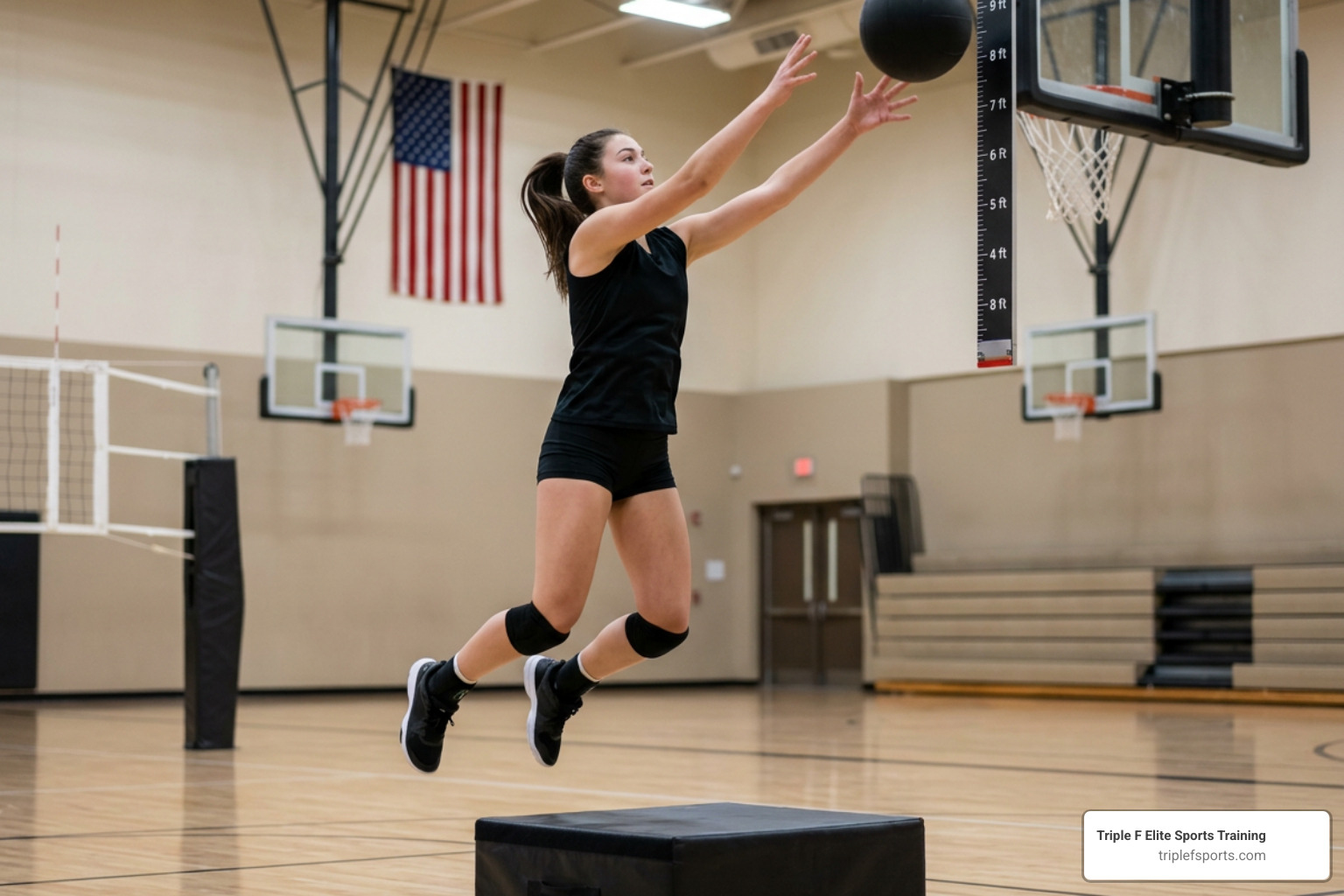
Because of this, we cannot separate volleyball skill development from physical conditioning. If an athlete does not have the strength to stabilize their knees during a landing, or the core power to transfer energy from their approach into their swing, their skills will suffer—and their risk of injury will skyrocket.
Our training methodologies focus heavily on:
- Landing Mechanics: Teaching athletes how to absorb force through their hips and glutes, rather than their knees and ankles, to prevent ACL tears and patellar tendonitis.
- Rotational Power: Developing core strength to support the violent twisting motions involved in spiking and serving.
- Shoulder Prehab: Strengthening the rotator cuff and scapular stabilizers to handle the repetitive overhead swinging motions.
Science-Based Conditioning in a Volleyball Club
To truly unlock an athlete’s potential, their strength and conditioning program must align with their team’s court schedule. You cannot have players performing heavy, exhausting leg workouts the day before a major multi-day tournament.
We utilize a science-based approach to periodization, mapping our training splits directly to the club calendar:
- The Preseason Ramp-Up: This is where we build our physical engine. We focus on developing foundational strength, explosive power, and jumping endurance. To learn how to structure this crucial phase, check out The Ultimate Guide to Volleyball Training for a complete breakdown of lifts, plyometrics, and recovery protocols.
- The In-Season Maintenance: Once tournaments begin, our focus shifts. We transition to shorter, high-intensity sessions designed to maintain power and speed while prioritizing joint mobility, soft-tissue recovery, and load management.
- Load Management (The 10% Rule): To prevent overuse injuries, we closely monitor training volume. A simple rule of thumb is never to increase an athlete’s weekly jump count or training volume by more than 10% week-over-week. If an athlete experiences a sudden spike in physical stress without adequate recovery, their performance drops, and their risk of injury spikes.
Benchmarking Success in Youth Volleyball Development
How do you know if a club’s training program is actually working? While parent testimonials and local tournament wins are great, elite clubs often benchmark their success using tangible, long-term metrics:
- National Bids & Tournament Placements: Consistent appearances and top-five finishes at USAV Junior Nationals or AAU Nationals indicate a deep, club-wide commitment to player development.
- Collegiate Commits: A strong track record of placing 100+ athletes into collegiate programs shows that college coaches trust the club’s training standards.
- Alumni Outcomes: Having a robust network of over 300 alumni who have gone on to play collegiate or professional volleyball provides current players with mentors and clear pathways to the next level.
- Global Benchmarks: If you look at the absolute pinnacle of volleyball development, organizations like Turkey’s Eczacıbaşı Spor Kulübü | Eczacıbaşı Sports Club (which has won 15 Sultanlar Ligi titles) and About Us (holding 7 CEV Champions League titles and 4 FIVB Club World Championships) showcase the power of structured youth development schools. Similarly, professional organizations like the Russian club Официальный сайт волейбольного клуба «Енисей» demonstrate how rigorous, science-based training pipelines prepare athletes for the highest levels of global competition.
Locally, Knoxville families have access to high-quality training programs that understand these development standards. Finding a program that provides the right competitive platform, coaching, and exposure is key for local athletes to reach their goals.
Frequently Asked Questions About Joining a Volleyball Club
Deciding to join a club is a major milestone for any sports family. Here are some of the most common questions parents ask when navigating the youth volleyball landscape.
How much does it cost to join a youth volleyball club?
The financial commitment of club volleyball can vary significantly depending on the level of competition.
- Local/Developmental Teams: Typically range from $800 to $1,500 per season. This usually covers coaching, court rental, local tournament entry fees, and a basic uniform package.
- Regional/Travel Teams: Typically range from $2,000 to $4,000+ per season.
- Additional Expenses: It is important to budget for travel costs, including hotel stays, flights or gas, meals on the road, and spectator admission fees for national qualifiers. Many clubs offer fundraising opportunities or payment plans to help families manage these costs.
What age should a child start playing club volleyball?
There is no “perfect” age, but most competitive club programs begin offering formal travel teams around the 10U or 11U (Under 10/11) age groups.
- Ages 6 to 9: This is the ideal window for grassroots programs, “mini” volleyball (using lower nets and lighter, softer balls), and general athletic coordination classes.
- Ages 10 to 12: A fantastic time to enter a developmental club league. At this stage, players have developed the physical strength to serve overhand and can grasp basic court rotations.
- Ages 13 and Up: It is never too late to start! Many athletes transition from other sports (like gymnastics, basketball, or soccer) in middle school and quickly catch up due to their existing athletic foundation.
How do volleyball club tryouts and evaluations work?
Tryouts typically take place in the mid-to-late summer (July/August) or early fall (October/November), depending on the state and age group.
- The Evaluation Process: Coaches will run players through a series of physical tests (vertical jump, lateral agility, sprint speed) followed by skill-specific drills (passing, setting, hitting, serving) and live scrimmage play.
- Team Placement: Clubs will evaluate athletes based on their current skill level, athletic potential, coachability, attitude, and positional needs. They will then extend “offers” for specific teams (e.g., National, Regional, or Local).
- Preparation is Key: To make sure you and your athlete are fully prepared for this process—and to avoid the common pitfalls of the tryout season—we highly recommend reading our guide on Don’t Get Served by Joining the Wrong Elite Volleyball Clubs.
Conclusion
Finding the right volleyball club for a beginner is all about balancing technical instruction with a supportive, growth-oriented environment. When you find a club that aligns with your family’s values, prioritizes player safety, and teaches the game with patience, your child won’t just become a better volleyball player—they will build friendships, confidence, and life skills that last a lifetime.
If you are looking for the best local options to kickstart your athlete’s journey, take a look at our curated list of the Top Tennessee Girls Volleyball Clubs to Join This Season.
At Triple F Elite Sports Training in Knoxville, we are proud to offer professional, Christ-centered athletic development for youth and adult athletes. Our state-of-the-art facility provides a truly comprehensive sports performance experience, combining elite strength and conditioning, on-site physical therapy, and dedicated volleyball programs designed to unlock every athlete’s full potential.
We believe that every great athletic journey starts with a solid foundation and a single step. That is why we invite you to come experience our training family firsthand.
Sign up for your free first session today and let us help your athlete build the strength, speed, and confidence they need to dominate the court!