
Introduction
Why Youth Sports Performance Enhancement Matters for Every Young Athlete
Youth sports performance enhancement is one of the most powerful investments a parent can make in their child’s athletic future — and it has nothing to do with drugs or shortcuts.
Here’s a quick summary of what it actually means and why it works:
- What it is: Structured, science-backed training that improves speed, strength, agility, and movement quality in young athletes
- What it isn’t: Substances, supplements, or anything unsafe — it’s entirely natural and age-appropriate
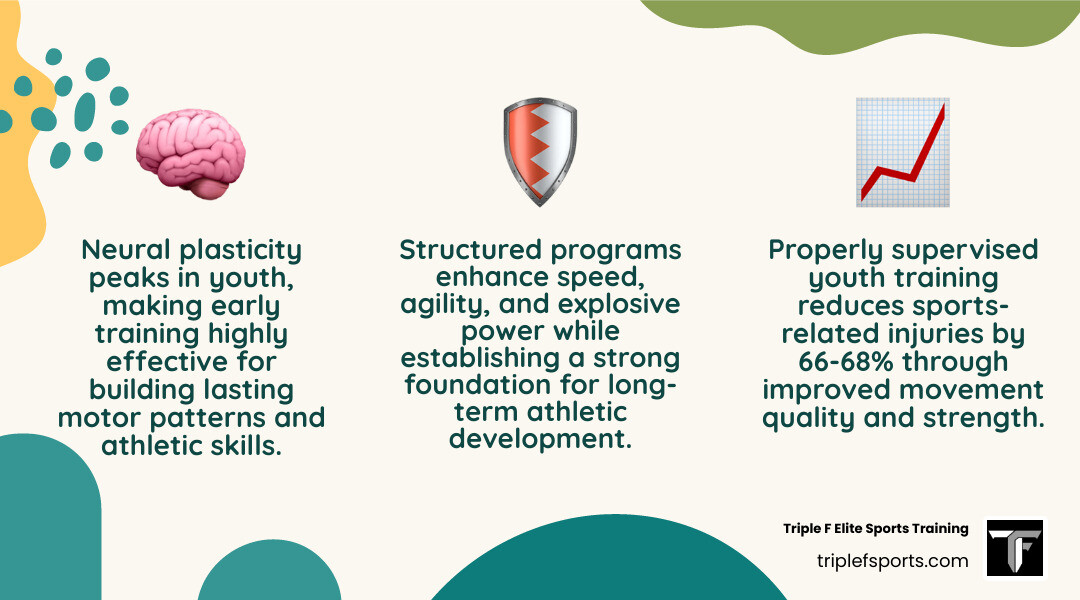
- Why it works: Young athletes are in a critical window of neural plasticity, making early training unusually effective for building lasting athletic skills
- Key benefit 1: Properly supervised resistance training reduces sports-related injuries by 66-68%
- Key benefit 2: Early training builds motor patterns that carry athletes further, longer
- Key benefit 3: It simultaneously improves performance and protects against common injuries like ACL tears
- Who it’s for: Any youth athlete — from recreational players to serious competitors — who wants to develop a strong, durable athletic foundation
Most parents hear “performance enhancement” and think of something risky or controversial. But in youth athletics, the term simply refers to tools and techniques that help young athletes move better, play harder, and stay healthier. The medical and sports science communities are increasingly aligned: teaching kids to train correctly, early, pays dividends for years.
My name is Kevin O’Shea — a Certified Strength and Conditioning Specialist, former college wide receiver, and high school football coach — and youth sports performance enhancement is at the core of everything I do at Triple F Elite Sports Training here in Knoxville. In this guide, I’ll walk you through exactly what the research says and how to apply it practically for your young athlete.
Understanding Youth Sports Performance Enhancement

When we talk about What is Sports Performance Training?, we are discussing the systematic improvement of an athlete’s physical and mental capabilities. For young athletes, this isn’t just about lifting heavy weights or running until they collapse. It is about neuromuscular control—teaching the brain to talk to the muscles more efficiently—and improving movement efficiency.
At its heart, this process is about building a foundation. If an athlete has a “glitch” in their movement pattern at age 10, that glitch becomes a major injury risk at age 16 when they are faster and stronger. By focusing on Youth Athletic Development: What Every Parent and Coach Needs to Know, we ensure that the “software” (the nervous system) and the “hardware” (the muscles and bones) are developing in sync.
Performance Enhancement vs. Performance-Enhancing Drugs
It is vital to clear up the terminology. In professional sports headlines, “performance enhancement” often refers to banned substances. In the context of pediatric health and youth sports, it refers to natural techniques and safety protocols. We focus on substance-free growth, utilizing biomechanics, nutrition, and recovery to help a child reach their genetic potential without shortcuts. Our goal is to enhance gameplay through better mechanics, not chemistry.
The Importance of Early Youth Sports Performance Enhancement
Why start young? The answer lies in neural plasticity. Children are like sponges; their nervous systems are incredibly adaptable. This is the “golden age” of skill acquisition. Research shows that From Playground to Podium: Nurturing Young Athletes for Long-Term Success depends on establishing these motor patterns early.
Furthermore, the safety statistics are staggering. Evidence-based resistance training, when properly supervised, reduces sports-related injuries by 66-68%. By strengthening connective tissues and improving balance, we aren’t just making them better players; we’re making them more durable humans.
The Science of Maturation: Training for Pre-PHV and Post-PHV Athletes
One of the biggest mistakes in youth sports is treating a 12-year-old like a miniature 25-year-old. To be effective, training must account for Peak Height Velocity (PHV)—the period during which a child experiences their fastest rate of growth.
Biological maturation dictates how an athlete responds to training. We use Youth Assessments to determine where an athlete sits on the maturation curve.
| Maturation Phase | Focus Areas | Primary Adaptations |
|---|---|---|
| Pre-PHV (Before Growth Spurt) | Motor skill, Coordination, Sprint mechanics | Neural (Brain-to-muscle) |
| Mid-PHV (During Growth Spurt) | Flexibility, Core stability, Deceleration | Managing “growing pains” |
| Post-PHV (After Growth Spurt) | Hypertrophy, Max strength, Power | Structural (Muscle size/Force) |
According to the study Effects of Maturation Status on Physical Performance Adaptations, the same training program can yield wildly different results depending on maturity. For example, Pre-PHV athletes often see the biggest jumps in sprint speed, while Post-PHV athletes see greater gains in absolute strength and hamstring power.
Adapting Youth Sports Performance Enhancement for Maturity Levels
As athletes grow, their bodies change rapidly. During the growth spurt, bones often grow faster than muscles and tendons can stretch, leading to “clumsiness” or increased injury risk. Influence of Biological Maturation on Training Load and Physical Performance Adaptations suggests that we must adjust the “dose” of training.
For Post-PHV soccer players, for instance, focusing on eccentric hamstring strength (like the Nordic Hamstring Exercise) is crucial for preventing tears, whereas Pre-PHV players should spend more time on pure sprint mechanics and “learning how to run.”
Managing Training Load During Growth Spurts
During PHV, we closely monitor internal load—how the athlete’s body feels—using RPE (Rate of Perceived Exertion) monitoring. A workout that felt easy last month might feel exhausting during a growth spurt. By Building Better Ballers with the Long-Term Athlete Development Model, we can prevent overuse injuries by backing off when the body is busy growing and pushing when the window for adaptation is wide open.
Evidence-Based Training Methods for Young Athletes

We don’t guess; we use science. Research indicates that free weight training shows the largest effect sizes (2.97) on muscular strength development in youth. This outperforms machines because it requires the athlete to stabilize the weight, engaging more muscle groups and improving balance.
Furthermore, The effect of plyometric training on physical performance in youth soccer players shows that jump training significantly improves sprint times and leg stiffness in both pre- and post-pubescent athletes. For a deeper look at these protocols, check out our In-Depth Guide to Youth Strength Training.
The NASM-OPT Model and Periodization
To ensure long-term progress, we utilize the NASM-OPT (Optimum Performance Training) model. This is a periodized approach that moves through specific phases:
- Stabilization: Fixing imbalances and strengthening the core.
- Strength: Building the capacity to produce force.
- Power: Teaching the muscles to produce that force quickly.
The study Long-Term Effects of NASM-OPT Periodized Training found that adolescent athletes using this model saw significantly greater improvements in their squat 1RM and vertical jump compared to those using traditional “old school” gym routines. It’s about being systematic, as we explain in our Teen Strength: A Guide to Resistance Training for Young Athletes.
Neuromuscular Training and ACL Injury Prevention
One of the most significant breakthroughs in youth sports performance enhancement is the reduction of non-contact ACL injuries. This is especially critical for young female athletes, who are at a higher statistical risk.
Comparing the Effects of Integrative Neuromuscular Training and Traditional Physical Fitness Training highlights that integrative training—which combines balance, plyometrics, and strength—reduces the “twisting force” on the knee. By teaching an athlete how to land and change direction properly, we can lower the risk of a season-ending injury while simultaneously making them faster on the court.
Key Components of a Comprehensive Performance Program
A truly effective program is well-rounded. It’s not just about how much you can bench press; it’s about how that strength translates to the field. If you want to know How to Make Your 10-Year-Old Faster Than Greased Lightning, you have to look at the “Big Three”: Speed, Agility, and Explosive Power.
Speed and Agility Development
Speed is governed by the Stretch-Shortening Cycle (SSC). This is the “spring” in your child’s step. When they land, their muscles stretch (eccentric phase) and then snap back (concentric phase). Training the SSC through plyometrics is the key to elite Change of Direction (COD) ability.
According to research on the Acute and Delayed Effects of Strength and Plyometric Activation Exercises, “priming” the body with specific exercises can even produce “delayed” performance spikes. For instance, a strength session in the morning can actually lead to better jump performance five hours later. We dive deep into these nuances in Unlocking Athletic Potential: A Deep Dive into Sport-Specific Training.
Recovery and Long-Term Success
You don’t get stronger at the gym; you get stronger recovering from the gym. A comprehensive program must include:
- Hydrotherapy and Compression: To flush out metabolic waste.
- Sleep Hygiene: The #1 performance enhancer for teens.
- Mental Resilience: Developing the “grit” to handle both wins and losses.
Our guide From Injury to Victory: Mastering Athlete Recovery and Rehab explains that recovery is just as “active” as the training itself.
Frequently Asked Questions about Youth Athletic Development
Is resistance training safe for children?
Yes, absolutely. When supervised by professionals and focused on proper form rather than “maxing out,” resistance training is incredibly safe. It improves bone density and, as mentioned, reduces overall sports injury rates by up to 68%.
How does maturation status affect training results?
Biological age (how developed the body is) matters more than chronological age (how many birthdays they’ve had). Pre-PHV kids gain speed through better “brain-to-muscle” wiring, while Post-PHV kids gain speed through increased muscle force and power.
What are the benefits of neuromuscular training?
It improves proprioception (the body’s awareness of where it is in space) and balance. This leads to better movement quality, which is the foundation for both elite performance and ACL protection.
Conclusion
At Triple F Elite Sports Training in Knoxville, we are dedicated to providing professional, Christ-centered athletic development. We aren’t just a gym; we are a community focused on unlocking every athlete’s full potential—physically, mentally, and spiritually.
Whether your child is interested in our comprehensive performance programs, needs the expertise of our on-site physical therapy team, or wants to join our premier Volleyball Training club, we are here to help.
The journey to elite performance starts with a single step. We invite you to come see the difference that science-backed, age-appropriate training can make. Contact us today to schedule your free first session and let’s start building your athlete’s future together.