
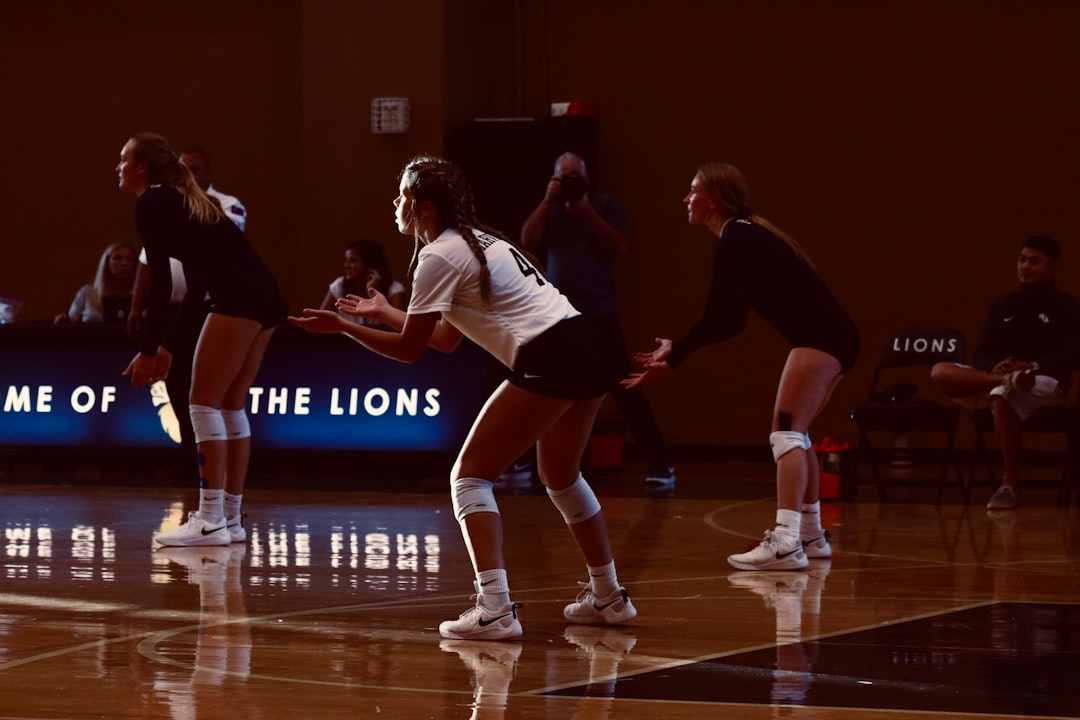
Why Volleyball Skill Development Determines Long-Term Player Success
Volleyball skill development is the foundation every player — from a first-timer in Knoxville to an elite competitor — needs to build before anything else matters.
Whether you’re brand new to the sport or pushing toward your next level, here’s a quick breakdown of the core skills to focus on:
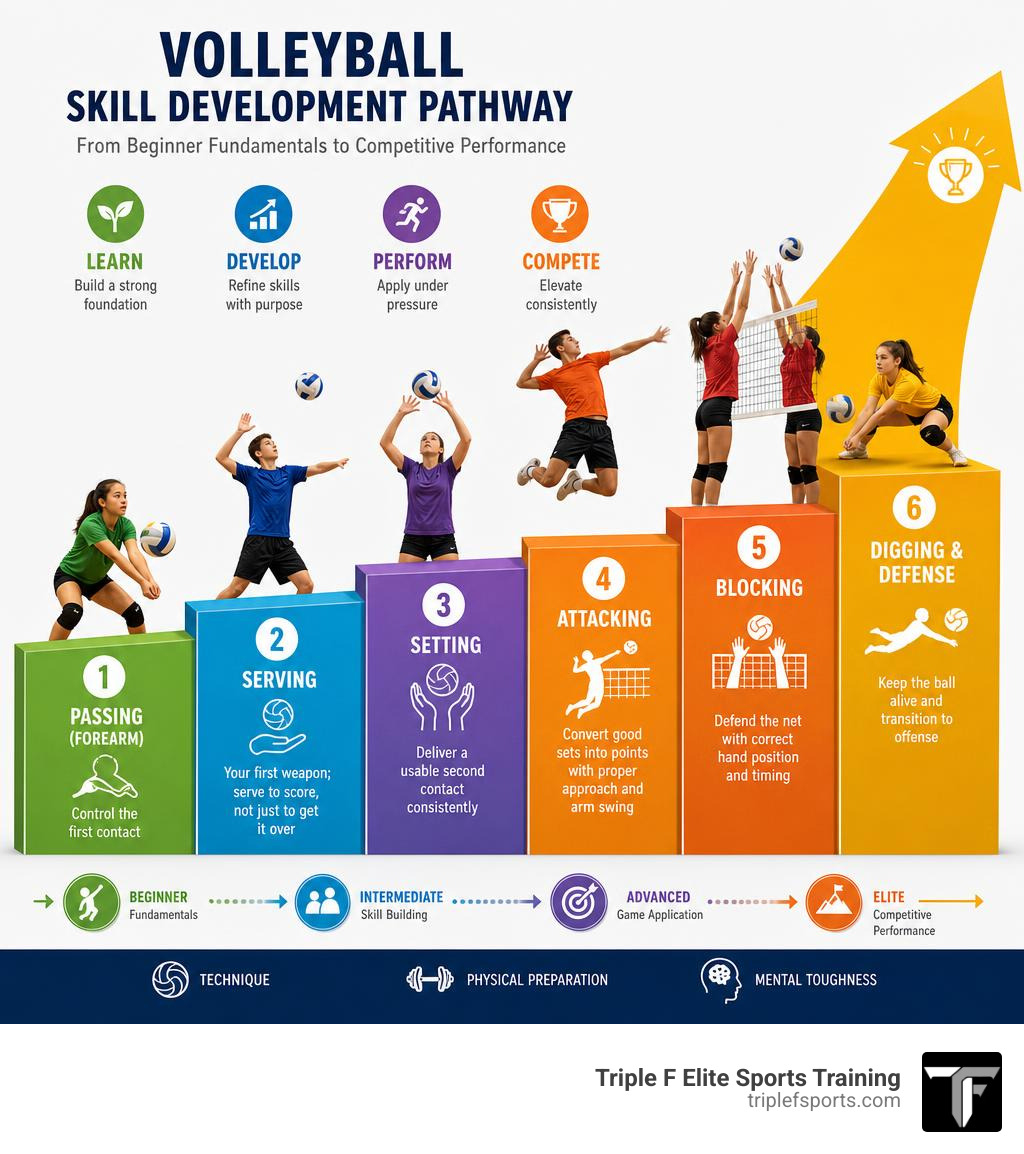
Core volleyball skills to develop, in order of priority:
- Passing (forearm) – Control the first contact; everything starts here
- Serving – Your first weapon; serve to score, not just to get it over
- Setting – Deliver a usable second contact consistently
- Attacking – Convert good sets into points with proper approach and arm swing
- Blocking – Defend the net with correct hand position and timing
- Digging and defense – Keep the ball alive and transition to offense
These skills apply across all three disciplines — indoor, beach, and sitting volleyball — though the priorities and progressions shift depending on the format and stage of development.
This guide covers drills, teaching progressions, practice structures, and the physical and mental foundations that make skills actually stick over the long term.
I’m Kevin O’Shea, a Certified Strength and Conditioning Specialist with a background in athletic performance and behavioral health coaching — experience I bring directly to volleyball skill development at Triple F Elite Sports Training. My work with athletes at every level has shown me that real progress happens when technical skill-building is matched with the right physical preparation and a supportive coaching environment.
Essential Volleyball skill development terms:
Volleyball skill development by LTD Stage and Playing Discipline
To help players reach their highest potential, we must look at player progression through a Long-Term Development (LTD) pathway. A structured approach ensures we do not rush athletes into complex tactical systems before they have mastered basic ball control. By utilizing proven frameworks such as the Volleyball Canada skill pathway resources and the Volleyball Development Matrix, coaches and parents can guide players through age-appropriate milestones.
For a deeper look into how these developmental pathways accelerate growth, check out our guide on From Beginner to Pro: Coaching Secrets for Rapid Sports Skill Development.
Learn to Train: Build Physical Literacy and Ball-Control Confidence
In the Learn to Train stage (typically ages 9–12), the primary objective is to cultivate fundamental movement skills and establish core physical literacy. At this stage, we focus heavily on coordination, balance, and spatial awareness. Players learn the basic “ready position”—knees bent, weight on the balls of the feet, and arms relaxed but ready to form a passing platform.
Technical progressions at this stage emphasize forearm passing, basic overhead setting, and the underhand serve, while slowly introducing the overhand serve. We use catching-to-contact progressions to build confidence; for example, allowing a beginner to catch a ball overhead before pushing it out to a partner helps them feel the correct hand shape. Practice sessions should feature small-sided games (such as 2v2 or 3v3 on smaller courts) that encourage fun competition and maximize individual touches. We teach players to prioritize “3 touches” on their side and introduce basic communication words like “mine,” “got it,” and “out.”
To help young athletes build early confidence without getting discouraged, explore our curated list of Stop Dropping the Ball with These Beginner Volleyball Drills.
Train to Train: Expand Core Skills and Introduce Volleyball IQ
During the Train to Train stage (ages 13–16), the focus shifts toward expanding core technical skills and building on-court intelligence. Players learn to target specific serving zones to keep opponents out of system. In serve receive, we emphasize adjusting platform angles to direct the ball to the target, rather than swinging the arms.
This stage is also where we refine setter footwork and introduce the multi-step attack approach (right-left-right-left for right-handers) paired with a dynamic arm swing. Players learn basic blocking footwork, base defense positioning, and transition movements. Tactically, we introduce rotation awareness and basic team offensive/defensive systems. From a physical conditioning standpoint, this age group aligns with a critical window of opportunity for developing flexibility, mobility, and structural tolerance. We focus on balancing volleyball training with multi-sport participation to prevent overuse injuries and avoid early burnout.
If you are working with players in this age bracket, you can find age-appropriate serving and passing exercises in our guide to Serve Up Success: Fun Drills for 10-13 Year Olds.
Learn to Compete: Refine Technique Under Pressure
At the Learn to Compete stage (ages 17–18), training shifts to refining individual techniques under pressure. Players work on advanced skills like the jump float and jump spin serve, tempo setting, and executing a quick first-ball sideout. Attackers expand their hitting range and shot selection, learning how to tip, roll, or swing hard depending on the block.
Defensively, players learn block reading and floor defense adjustments based on the hitter’s shoulder alignment. Out-of-system play becomes a major focus, as over 50% of game scenarios require teams to make plays from imperfect passes. We introduce scouting basics and run pressure-packed drills where scoring is modified to simulate late-game tension. Position specialization (such as libero, setter, or middle blocker) becomes prominent, and we help athletes develop personal mental reset routines to stay composed after making an error.
For high school athletes looking to dominate their club or varsity seasons, read The Complete Playbook for Girls High School Volleyball.
Train to Compete and Win: Execute at Speed, Precision, and Purpose
In the Train to Compete and Win stages (ages 18–22+), execution must be carried out with speed, precision, and tactical purpose. Teams run advanced offensive and defensive systems tailored to exploit opponent weaknesses identified through video analysis. Serve strategy becomes highly targeted, and offensive tempos are accelerated to beat block setups.
Players at this elite level must master blocking matchups, transition scoring, and tactical serving. Off the court, the focus is on leadership, strict recovery discipline, structured match preparation, and maintaining performance consistency across long seasons. At this level, physical and mental preparation are just as important as on-court drills.
To learn more about the training regimens and tactical demands of collegiate and professional players, read Everything You Need to Know About Elite Volleyball.
Volleyball skill development benchmarks for physical, technical, and tactical growth
To ensure players are on the right track, we monitor specific benchmarks across their physical, technical, and tactical development. These benchmarks help us design individualized training plans that match each athlete’s current readiness.
- Physical Benchmarks: We track acceleration, on-court agility, vertical jump, approach jump height, and landing mechanics. Ensuring balanced shoulder strength and hip mobility is critical for injury prevention.
- Technical Benchmarks: We measure serve accuracy (percentage of serves in target zones), pass ratings (on a 0–3 scale), setting location consistency, and hitting efficiency (kills minus errors divided by total attempts).
- Tactical Benchmarks: We look at block touch percentages, dig quality, communication consistency, and decision-making speed during fast transitions.
To understand how elite performance training can sharpen these physical benchmarks, check out Level Up Your Game with Pro Coaching Secrets.
How Indoor, Beach, and Sitting Volleyball Change Skill Priorities
While the foundational mechanics of contacting a volleyball remain similar, the priorities of volleyball skill development shift significantly between indoor, beach, and sitting formats.
| Skill / Priority Area | Indoor Volleyball | Beach Volleyball | Sitting Volleyball |
|---|---|---|---|
| Court Size & Environment | 18m x 9m; hard wood court | 16m x 8m; deep sand | 10m x 6m; low net (1.15m/1.05m) |
| Number of Players | 6 vs 6 (highly specialized roles) | 2 vs 2 (complete versatility required) | 6 vs 6 (, high contact) |
| Primary Movement Pattern | Explosive vertical jumps, lateral shuffles | Sand resistance running, diving, recovery | Ground-based pelvic sliding, arm-driven movement |
| Setting Standard | Clean overhead hands, quick tempo | Deep-dish hand sets, strict spin rules | Fast overhead release, high bump-set usage |
| Defensive Reading | Block-and-defense systems, designated zones | Reading hitter’s shoulder, pulling off net | Quick reactions, blocking serves is legal |
| Communication Load | System-driven, play-calling signals | Direct partner cues, defensive hand signals | Rapid, constant verbal adjustments |
In beach volleyball, versatility is essential because both players must be able to pass, set, attack, and defend. As U.S. Beach National Team athlete Emily Day demonstrates, clean hand-setting on the beach requires a slightly longer contact time to control the ball in windy conditions.
In contrast, sitting volleyball is played at a much faster pace due to the smaller court and lower net. Players like U.S. Men’s Sitting National Team member Benjamin Aman demonstrate that mastering fast ground movement—sliding and shifting using the arms while keeping pelvis contact with the floor—is the most critical skill for success in the sitting game.
Practice Planning, Season Design, and Player Assessment

A successful season requires careful planning, structured practices, and objective player assessments. Coaches can find excellent local resources and youth leagues through the Volleyball Programs – City of Knoxville page to get their teams involved in competitive play. To explore our local training options, visit our dedicated page on Volleyball training options.
Structuring an Age-Appropriate Volleyball Practice
We structure our training sessions to optimize both skill acquisition and physical readiness. A standard 90-to-120-minute practice plan is broken down into four key phases:
- Dynamic Warm-Up & Movement Prep (15–20 mins): We avoid static stretching at the start. Instead, we use dynamic movements, light plyometrics, and shoulder band work to prepare the body.
- Technical Skill Focus (25–30 mins): High-repetition, focused drills targeting specific skills (e.g., platform control or setter hand positioning). We keep drill blocks short—no more than 10 minutes per drill—to maintain focus and intensity.
- Game-Like Constraints & Transfer (30–35 mins): Transitioning from isolated skills to game-like scenarios (e.g., 3v3 short-court games or wash drills) where players must apply the skill under pressure.
- Cool-Down & Reflection (10 mins): Light stretching, hydration, and a quick team huddle to reflect on what went well and what needs work.
Building an 8-Week Skill Development Season Plan
An 8-week progressive training block ensures that players build a solid foundation before moving on to complex team systems:
- Week 1: Physical & Technical Assessment. Establish baselines for jump height, agility, and basic ball control.
- Week 2: Platform Discipline & Passing. Focus on forearm passing, platform angles, and moving to the ball.
- Week 3: Serving Mechanics & Accuracy. Work on consistent tosses, contact points, and serving to targets.
- Week 4: Setting Hand Shape & Footwork. Introduce overhead setting mechanics and introduce light scrimmage play.
- Week 5: Attacking Progressions. Break down the step-close approach, jump mechanics, and arm swing.
- Week 6: Blocking & Floor Defense. Focus on net posture, hand positioning, and reading the hitter.
- Week 7: Serve Receive Systems. Put passing and setting together to build smooth offensive transitions.
- Week 8: Retesting & Final Scrimmages. Re-assess physical and technical benchmarks to measure progress.
Using Assessments and Normative Data to Individualize Training
To help athletes reach their goals, we use objective testing to track progress and identify areas for improvement. Our assessment protocol includes:
- Physical Testing: Vertical jump, approach jump, pro-agility shuttle, and landing mechanics screens.
- Technical Charting: Tracking serve percentages, passing ratings (0–3 scale), and hitting efficiency over multiple sessions.
- Normative Comparison: Comparing an athlete’s data against age- and position-specific norms to guide their strength and skill training.
Coaching Resources, Video Review, and Feedback Loops
Coaches should utilize high-quality educational resources to keep their practices fresh and effective. The largest volleyball coaching libraries offer over 4,000 instructional videos, including:
- 1,129 skill training videos
- 227 passing drill videos
- 485 team drill videos
- 320 coaching philosophy videos
Using video analysis helps players see their own mechanics in real time. Combining video feedback with simple, one-page skill descriptors allows players to make fast adjustments and take ownership of their development.
Drills and Teaching Progressions for Every Core Volleyball Skill
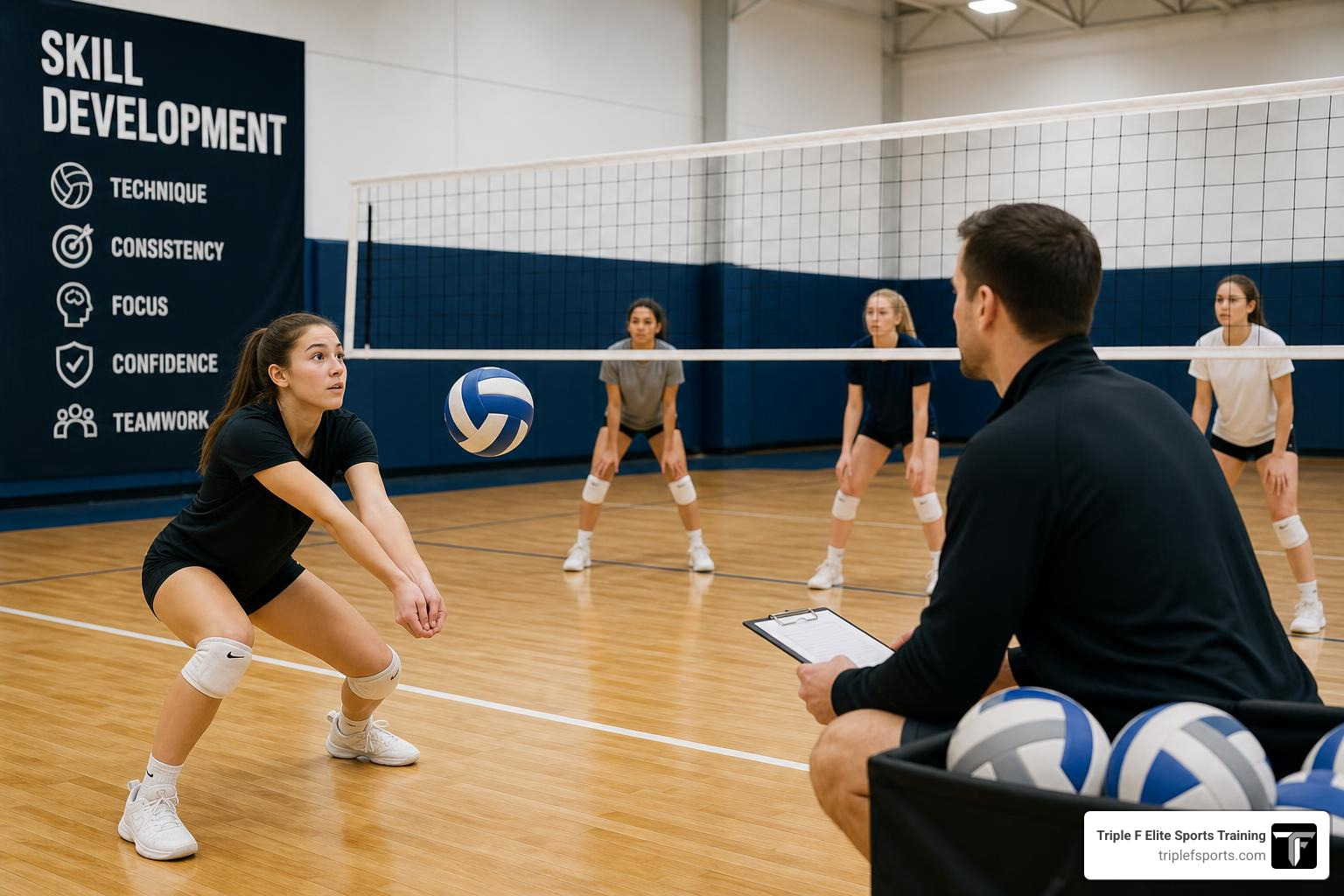
To maximize learning, we use structured drill progressions that scale from basic mechanics to , game-like scenarios. For players looking to accelerate their growth on their own, check out our Private volleyball training guide. You can also find excellent skill-building frameworks in the Volleyball Skills & Drills PDF – Human Kinetics and Volleyball Drills for Champions: Mastering Key Skills with 7 Winning Coaches – Anna’s Archive .
Volleyball skill development drills for serving
Serving is the only closed skill in volleyball, meaning the player has complete control over the execution.
- The Progression: Start with toss-and-catch drills to build a consistent, repeatable toss. Progress to standing float serves close to the net, gradually moving back to the baseline.
- Key Coaching Points: Keep the toss in front of the hitting shoulder, contact the center of the ball with a firm, flat hand, and finish with a strong follow-through without snapping the wrist.
- The Drill (Target Ladder): Place cones or landing mats in deep zones 1, 5, and short zone 6. Players earn points for hitting designated targets, helping them develop a “serve-to-score” mindset.
Passing and Ball-Control Progressions
Passing is the most critical defensive skill, directly impacting a team’s ability to run an offense. For creative ball-control drills, coaches can refer to Skill Development Drills: Ball Control – Volleyball — Championship Productions, Inc. .
- The Progression: Begin with stationary partner toss-and-pass drills to lock in platform mechanics. Progress to lateral shuffle-and-pass drills, and finally to rapid-fire serve receive lines.
- Key Coaching Points: Keep a wide base, keep arms away from the body to create a flat passing platform, and use the legs—not the arms—to direct the ball.
- The Drill (The Antenna Game): A 2v2 short-court game where players can only contact the ball using specific techniques (e.g., pass-set-tip). This drill challenges movement, communication, and angle recognition.
Setting Progressions for Indoor and Beach Players
Setting requires soft hands, quick footwork, and excellent spatial awareness.
- The Progression: Start with self-sets to build hand shape, progress to partner setting with a focus on squaring the hips to the target, and advance to rapid-set drills off live passes.
- Key Coaching Points: Form a clean triangle window with the thumbs and index fingers above the forehead. Catch and release the ball quickly using the wrist and fingers.
- The Drill (Square-Up Drill): Setters start at base defense, sprint to the target area, square their hips to the left antenna, and deliver a high, consistent ball to a target ring or coach standing at the net.
Attacking Progressions from Approach to Shot Selection
Attacking combines explosive power with precise timing.
- The Progression: Break down the footwork approach without a ball (step-close approach). Add the arm swing, progress to hitting off a coach’s toss, and finally hit off live sets in transition.
- Key Coaching Points: Jump vertically rather than broad-jumping forward to avoid hitting the net, reach high at contact, and snap the wrist to create topspin. Land softly on both feet to protect the knees.
- The Drill (Shot Selection Challenge): Attackers receive sets and must hit specific shots (e.g., deep line, sharp cross-court, or tip over the block) based on visual cues or defensive positioning shown by the coach.
Blocking and Defensive Skill Progressions
A strong defense starts at the net and finishes with relentless floor coverage.
- The Progression: Practice blocking posture and hand positioning at the net. Add lateral shuffle and crossover footwork, then transition to reading hitter shoulder angles to make defensive plays.
- Key Coaching Points: Keep hands close together with fingers spread wide, press over the net to take away angles, and time the jump so you reach peak height just as the hitter contacts the ball.
- The Drill (Dig-to-Target): Defenders start in their base positions, read a coach’s hit from a box, drop low to dig the ball, and direct it toward a target at the setter position.
Out-of-System and Game-Like Team Drills
Because more than half of all rallies involve out-of-system plays, teams must learn to stay calm and execute under chaotic conditions. Excellent resources for designing these drills can be found in the Jackie Simpson Kirr Two-Pack .
- The Drill (8-before-2 Challenge): The passing team must execute 8 perfect passes to the setter target before the serving team scores 2 aces or unreturnable serves.
- The Drill (Modified Scoring Scramble): Run a standard 6v6 scrimmage, but reward out-of-system plays with extra points (e.g., +3 points for a successful tip kill, or +5 points for transition plays off a defensive dig).
Whole-Athlete Foundations That Make Volleyball Skills Stick
Even the best drills won’t translate to on-court success if an athlete lacks the physical strength, mobility, and recovery habits to back them up. To build a strong physical foundation safely, read our guide on How to Build Volleyball Strength Without Burning Out. For a broader look at athletic skill acquisition, check out A Quick Start Guide to Skill Training for Athletes.
Physical Literacy, Strength, and Structural Tolerance
To withstand the repetitive demands of jumping, landing, and swinging, volleyball players must build structural tolerance. At Triple F Elite Sports Training, we focus on:
- Landing Mechanics: Teaching athletes how to absorb impact through their hips and knees, rather than landing stiff-legged.
- Rotational Power & Core Strength: Building a strong, stable core to transfer power from the lower body to the arm swing.
- Shoulder Stability: Strengthening the rotator cuff and upper back muscles to keep the shoulder healthy through thousands of swings.
- Ankle & Tendon Capacity: Developing ankle stiffness and patellar tendon capacity through progressive strength training.
Sleep, Nutrition, and Recovery Habits for Long-Term Progress
Skills are reinforced and muscles are built during recovery, not during practice. We encourage our athletes to build healthy, consistent habits:
- Sleep: Aim for 8–10 hours of high-quality sleep per night to support muscle repair and cognitive recovery.
- Nutrition: Fuel up with complex carbohydrates before practice, and rebuild muscles with high-quality protein afterward.
- Hydration: Drink plenty of water and replenish electrolytes, especially during long tournament days.
Connection, Care, and Courage in Volleyball Coaching
At Triple F, we believe in a person-centered coaching philosophy. We prioritize our athletes’ well-being, building a foundation of trust, care, and encouragement. When players feel safe to make mistakes without fear of immediate criticism, they play with more courage, communicate better, and develop faster. Our goal is to build strong, resilient leaders both on and off the court.
Frequently Asked Questions and Conclusion
What is the most important skill for new volleyball players to master?
The absolute most important skill for a beginner is ball control, specifically forearm passing. If a team cannot pass the ball, they cannot set or attack. Developing a quiet, stable passing platform and learning to move your feet to get behind the ball are the building blocks of all volleyball success.
Can shorter or undersized players still become strong volleyball players?
Absolutely! While height is an advantage at the net, shorter players can dominate through elite passing, defense, serving accuracy, and high court IQ. Many undersized players excel as liberos, defensive specialists, or setters, where speed, reading the game, and leadership are the ultimate keys to success.
How can players train without a net, teammates, or a full court?
You can make massive gains right at home with just a ball and a wall.
- Wall Passing & Setting: Practice rapid-fire passing or setting against a brick wall to build hand strength and platform control.
- Footwork Patterns: Practice your approach steps or blocking footwork in your driveway or backyard.
- Mobility & Strength: Focus on core work, shoulder care, and jump mechanics to stay sharp and prevent injuries.
Conclusion: Build Skills the Right Way for Long-Term Success
Mastering volleyball skill development requires a smart, long-term plan that combines technical drills with physical conditioning and a positive, supportive environment.
At Triple F Elite Sports Training in Knoxville, we offer professional, Christ-centered athletic development for youth and adult athletes. With our state-of-the-art performance training, physical therapy, and competitive volleyball club, we are here to help you unlock your full athletic potential.
Ready to elevate your game? Come train with us and get your first session completely free! Start your volleyball development journey with Triple F today.