
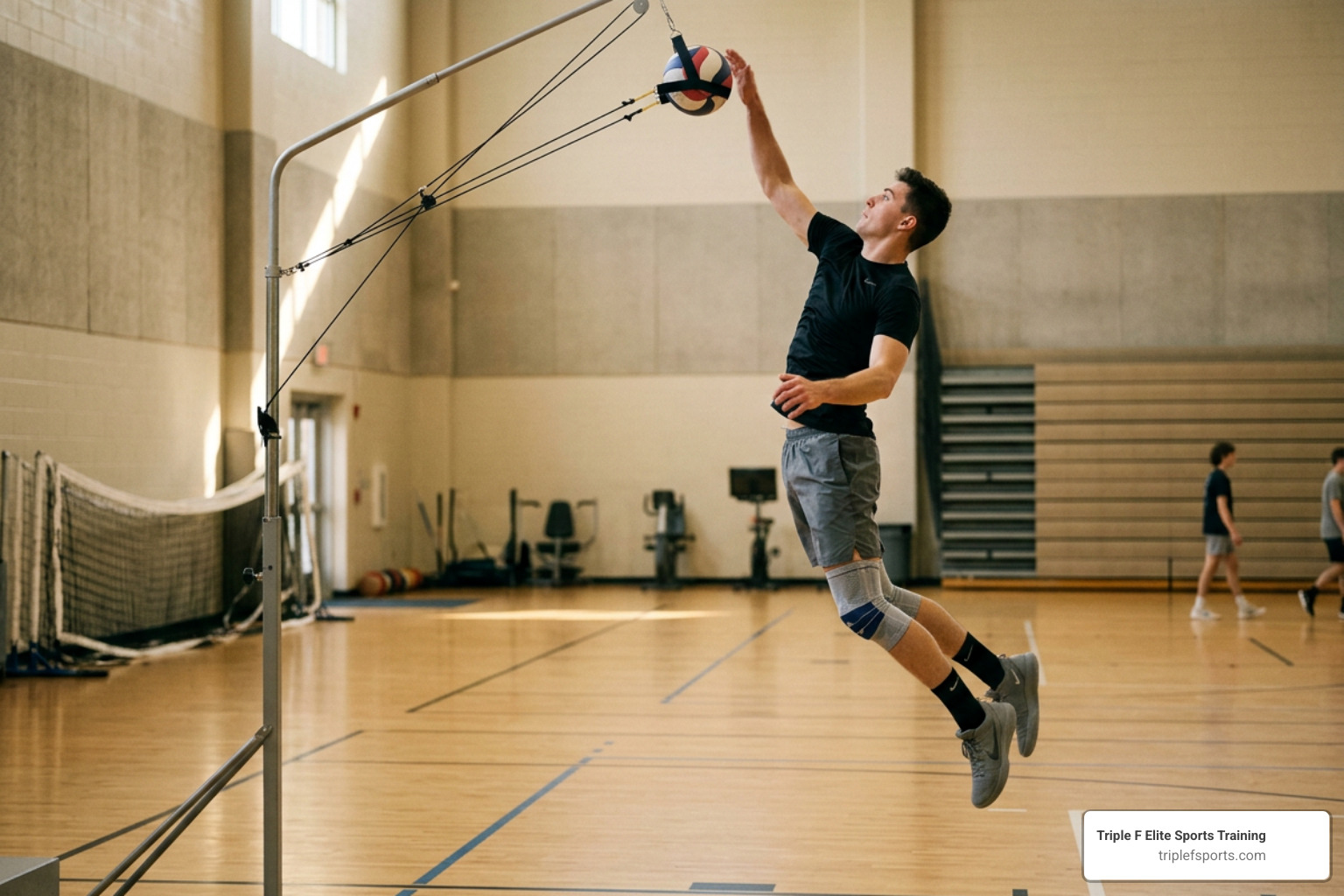
Why Every Volleyball Player Needs a Hitting Trainer
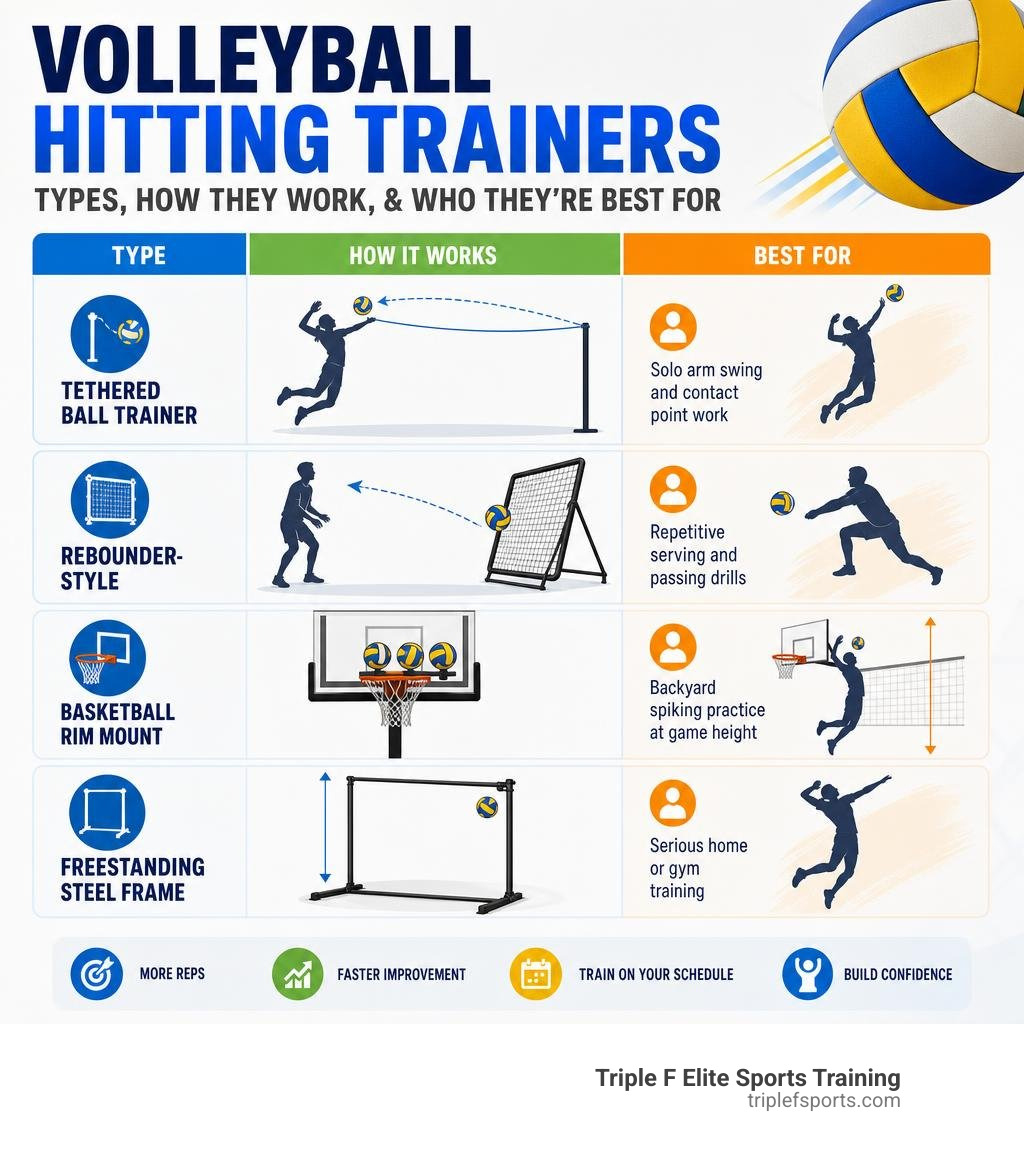
A volleyball hitting trainer lets you practice spikes, serves, and arm swings on your own — no setter, no partner, no problem. Here’s a quick look at what they are and which type might be right for you:
| Type | How It Works | Best For |
|---|---|---|
| Tethered ball trainer | Ball attached by cord or elastic; returns after each hit | Solo arm swing and contact point work |
| Rebounder-style | Net or surface sends ball back to you | Repetitive serving and passing drills |
| Basketball rim mount | Clips onto a standard hoop; holds up to 3 balls | Backyard spiking practice at game height |
| Freestanding steel frame | Adjustable height; stands independently | Serious home or gym training |
Most volleyball players spend way too much time waiting — waiting for a setter, waiting for a coach, waiting for the next rep. That downtime slows progress. A volleyball hitting trainer fixes that by giving you a way to get hundreds of quality reps in on your own schedule.
Whether you’re a youth player just learning your approach or an adult athlete sharpening your power and angles, the right trainer can compress months of skill development into focused solo sessions.
I’m Kevin O’Shea, a Certified Strength and Conditioning Specialist here at Triple F Elite Sports Training in Knoxville, and while my background is rooted in athletic development and football, the same principles of repetition, feedback, and explosive movement that shaped my coaching apply directly to finding the right volleyball hitting trainer for your goals. In this guide, I’ll break down the top options on the market so you can make a smart, confident choice.
Quick volleyball hitting trainer terms:
Understanding the Volleyball Hitting Trainer: Mechanics and Benefits
A volleyball hitting trainer is any specialized device designed to hold, suspend, or return a volleyball so a player can practice hitting mechanics without needing another person to set the ball.
In traditional team training, a hitter is entirely dependent on the quality of the set. If the set is too low, too tight to the net, or completely out of reach, the hitter has to adjust their mechanics just to make contact. While adapting to bad sets is a useful game-day skill, it is a terrible way to build foundational muscle memory.
By using a spike trainer, you eliminate the setter variable. The ball sits in the exact same spot, at the exact same height, rep after rep. This consistency allows you to perform high-repetition drills that isolate your approach, arm swing, and contact point.
Instead of chasing a ball across the gym after every single swing, a hitting trainer keeps the ball tethered or holds a queue of balls ready for rapid-fire hitting. This dramatically increases your training density—meaning you get more quality touches in a 15-minute solo session than you might get in an entire hour of standard team practice.
For more ideas on how to elevate your personal practice, check out our guide on Volleyball Training Aids That Will Actually Improve Your Game or explore specialized setups through Volleyball: Hitting/Spike Trainers & Workouts.
How a Volleyball Hitting Trainer Improves Specific Skills
To understand how a hitting trainer translates to on-court dominance, we have to look at the biomechanics of a successful spike. A perfect hit requires the synchronization of four key phases: the approach footwork, the vertical jump, the arm swing, and the terminal hand-to-ball contact.
- Arm Swing Mechanics: A proper arm swing requires a high elbow, a relaxed shoulder, and a rapid acceleration of the forearm (often called the “bow and arrow” motion). A hitting trainer allows you to stand on the ground and repeatedly practice this whip-like motion, focusing entirely on shoulder rotation and elbow extension without worrying about jumping.
- Vertical Jump and Landing: When you are ready to take to the air, a suspended spike trainer gives you a target to chase. You can measure your reach and set the ball just at the peak of your jump. This teaches your brain exactly when to explode upward relative to where the ball is positioned. Additionally, because you aren’t distracted by a moving ball, you can focus on safe landing mechanics to protect your knees and ankles.
- Approach Footwork: Footwork is the engine of your vertical jump. Whether you use a three-step or a four-step approach, timing is everything. Suspended trainers allow you to practice your approach and plant timing over and over until the steps become second nature.
- The Contact Point: To hit with power and spin, you must strike the upper-back half of the ball with an open, relaxed hand, snapping your wrist upon contact. Tethered systems and suspended ball holders give you instant feedback. If you hit the ball with a flat palm and no wrist snap, the ball will fly straight or float. If you hit it correctly, you will see a clean, downward trajectory.
To dive deeper into the physical mechanics of the sport, read through The Ultimate Guide to Volleyball Training.
The Feedback Loop: Traditional Methods vs. Solo Trainers
In a team environment, players often suffer from “coaching overload.” A coach might shout corrections about your feet, your elbow, your wrist, and your transition all at once. When you use a solo hitting trainer, the equipment itself becomes the coach through a natural feedback loop.
If you hit a tethered ball off-center, the elastic cord will snap back at an angle, immediately telling you that your hand placement was off. If you strike a suspended ball too low, you will feel the painful sting of hitting the plastic holder or the bungee cords instead of the sweet spot of the ball. This immediate physical feedback forces rapid self-correction.
Furthermore, training solo allows you to build functional strength. The repetitive motion of jumping and swinging builds endurance in the rotator cuff, core, and lower body. However, as we often emphasize in our strength programs, you must balance this high-volume work with recovery. Learn how to manage this balance in our guide on How to Build Volleyball Strength Without Burning Out and check out our comprehensive From Benchwarmer to Bench Presser: A Volleyball Strength Guide to build a bulletproof shoulder.
Types of Volleyball Spike Trainers: Rebounders vs. Tethered Systems
When shopping for a volleyball hitting trainer, you will generally choose between two primary designs: rebounders and tethered/suspended systems. Both have unique benefits depending on your space and goals.

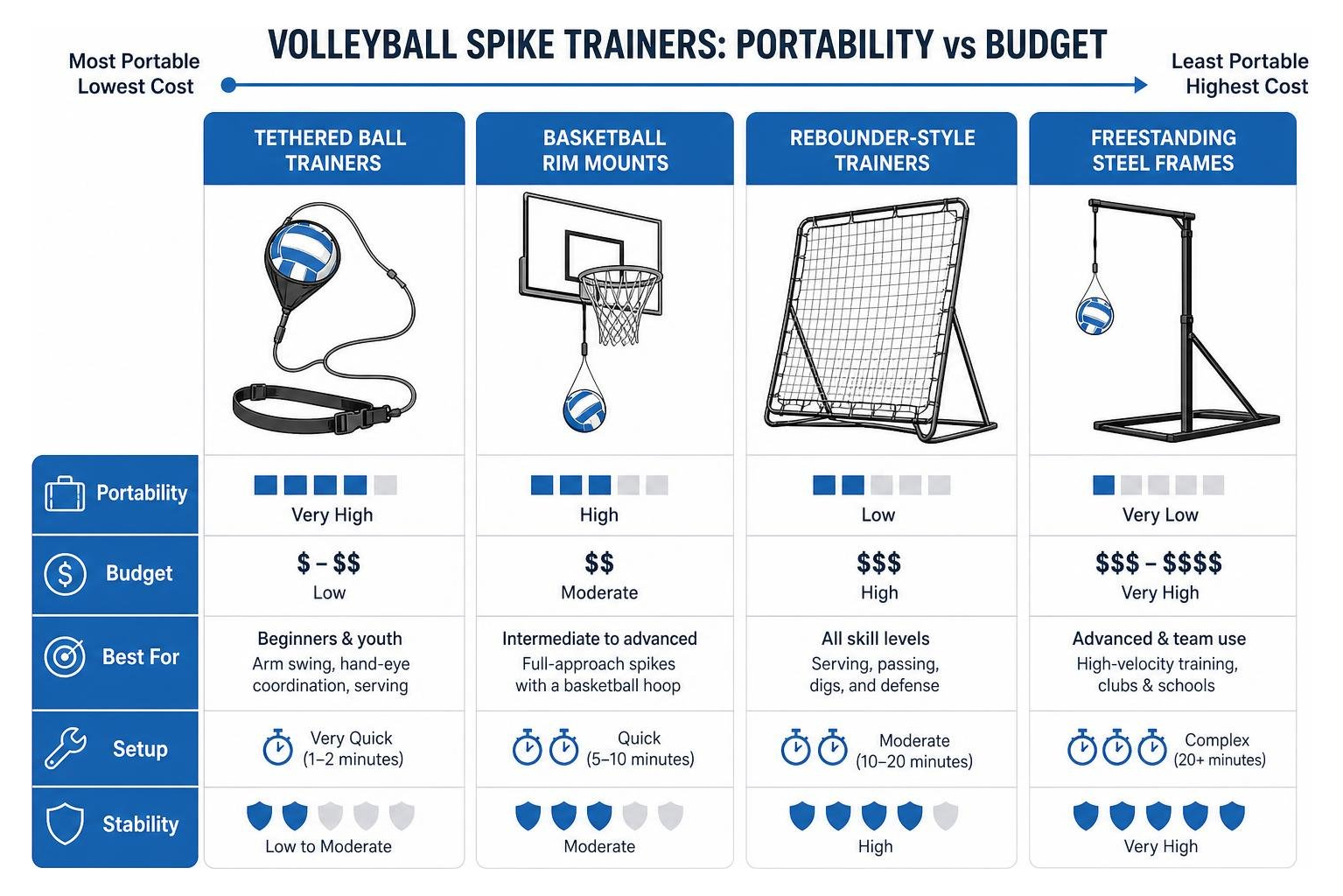
- Tethered Ball Trainers: These systems feature a volleyball wrapped in a sleeve or pouch, connected to elastic bungee cords. The cords can be anchored to a ceiling, a basketball rim, a doorframe, or even worn around the player’s waist (often called a “volleyball pal”). When you hit the ball, the elastic stretches and snaps the ball back toward you. They are highly portable and excellent for high-volume, stationary arm swing practice.
- Rebounder-Style Trainers: These are large, angled nets or rebound boards. You hit or serve the ball into the high-tension net, and it springs back to you. Rebounders are fantastic for practicing serving, passing, and defensive digs because they simulate a live ball coming off a blocker’s hands. However, they are much larger, heavier, and less portable than tethered systems.
- Basketball Rim Mounts: A clever hybrid design, these units mount directly into a standard outdoor or indoor basketball hoop. They suspend the ball below the rim, allowing you to practice full-approach spikes at regulation heights without needing a volleyball net.
- Freestanding Steel Frames: These are heavy-duty, commercial-grade systems used by clubs and high schools. They feature a heavy steel base and an adjustable telescoping pole that holds a ball-suspension mechanism. They are incredibly stable and durable but require a dedicated storage space and a larger budget.
Choosing the Right Volleyball Hitting Trainer for Your Skill Level
Your age, experience, and training environment should dictate which equipment you buy.
For beginners and youth players, portability and ease of use are paramount. A waist-tethered trainer is an affordable, low-risk way to develop hand-eye coordination and basic arm swing mechanics in the backyard or garage. It keeps the ball close, eliminating frustration and keeping the focus on fun and repetition. You can pair these tools with our recommended Volleyball Skill Development Drills and Strategies for Success.
For advanced and competitive players, a simple waist-tether won’t cut it because it doesn’t allow for a full approach and jump. Advanced players need suspended systems—like a basketball rim mount or a freestanding steel frame—that allow them to jump to their maximum vertical height and swing with 100% power. These athletes need tools that can handle high-velocity impacts without moving or breaking, such as the SKLZ Volleyball Hit N Serve Trainer | Academy.
Top-Rated Volleyball Spike Trainers Compared
To help you navigate the crowded online marketplace, we have broken down the top-rated volleyball spike trainers available in July 2026 based on their real-world performance, design, and user feedback.
| Product Name | Style | Key Feature | User Rating / Popularity | Best For |
|---|---|---|---|---|
| OVANTO Training Aid | Waist-Tethered | Adjustable neoprene pouch, premium elastic cord | 4.4 out of 5 stars (1,134+ reviews) | Beginners practicing serving and arm swings at home |
| TOBWOLF Spike Trainer | Hanging Tether | Durable strap with heavy-duty carabiner | 949+ customer reviews | Budget-friendly solo hitting on a tree branch or goalpost |
| DynamicSpike System | Rim-Mounted | Holds up to 3 balls with auto-delivery; weighs 6 lbs | Highly rated for solo backyard play | Intermediate to advanced players with a basketball hoop |
| AugFir Spike Trainer | Hanging Tether | Question mark hook design for easy hanging | 100+ units bought in the past month | Quick setup in backyards and gyms |
| Mikasa V300W-AT-TR | Tethered Ball | Official size, built-in screw-eye tethers | 247+ customer reviews | Elite players wanting a true game-ball feel during drills |
| VEVOR Setter/Spike Net | Rebounder/Target | 7.5ft to 11.5ft height, 45-180° adjustable angle | Heavy-duty steel frame, highly versatile | Club teams, multi-skill training, and setters |
Key Features to Look For: Durability, Adjustability, and Setup
When investing in a volleyball hitting trainer, don’t just buy the cheapest option. Look closely at these three factors:
- Durability: A volleyball hit by an advanced teenager or adult can easily travel over 50 mph. Cheap plastic clips and thin elastic bands will snap under this stress. Look for heavy-duty metal carabiners, double-stitched neoprene sleeves, and furniture-grade PVC or powder-coated steel frames.
- Adjustability: Your training needs will change as you grow. A good trainer must feature adjustable heights. For instance, the VEVOR Volleyball Setter Training Aids – Adjust 7.5ft-11.5ft allows you to mimic everything from youth net heights to professional men’s net heights.
- Ease of Setup: If a trainer takes 30 minutes to assemble every time you want to use it, it will end up gathering dust in your garage. Look for “no tool” setups. The Volleyball Spiking Trainer | DynamicSpike Hitting Trainer simply slides onto a standard basketball rim in seconds, while hanging tethers with a “question mark hook” can be thrown over a bar or net instantly.
- Target Simulation: If you want to practice hitting around blockers, look for tools that allow you to position targets or simulate defensive hands, like the options found at Hitting – Sethitpass.
Frequently Asked Questions About Volleyball Spike Trainers
What is the best volleyball hitting trainer for home use?
For indoor home use, space is your biggest constraint. If you have low ceilings (8 to 9 feet), a waist-tethered trainer like the OVANTO is best because you can practice your arm swing and contact point while kneeling or standing without hitting the ceiling. If you have high ceilings in a garage or basement, a hanging tether attached to an overhead beam works beautifully. Always ensure you have at least 6 to 8 feet of clear space in front of you to prevent the ball from bouncing off furniture or walls.
Can a spike trainer help increase my vertical jump?
Yes, but indirectly. A spike trainer itself does not build explosive leg power—that requires plyometric and strength training. However, a spike trainer does teach you how to translate your physical power into actual jump height. By setting the suspended ball at your absolute peak reach, you train your body to jump with a full arm swing and coordinate your approach. To build the raw explosive power needed to jump higher, you should pair your spike trainer workouts with a dedicated athletic performance program.
How do I set up a basketball rim-mounted spike trainer?
Most rim-mounted systems (like the DynamicSpike) require absolutely no tools. They feature a lightweight frame (usually around 6 pounds) that hooks directly over the edge of a standard 18-inch basketball rim.
- Lower your adjustable basketball goal to a comfortable height (or keep it at 10 feet if you want a 9-foot hitting height).
- Lift the trainer and place the mounting hooks over the back and sides of the rim.
- Secure any safety straps if provided.
- Load up to three volleyballs into the gravity-fed ramp.
- Ensure the landing area beneath the hoop is completely clear of rocks, cracks, or obstacles before you begin jumping.
Conclusion
A high-quality volleyball hitting trainer is one of the most effective investments you can make in your athletic journey. It bridges the gap between structured team practices and the endless hours of solo dedication required to master the art of the spike. By stripping away the variables and giving you instant, honest feedback, these tools help you build clean, powerful, and injury-resistant mechanics.
However, equipment is only half of the equation. To truly unlock your potential on the court, you need to pair your solo reps with professional coaching, science-based strength training, and injury-prevention strategies.
At Triple F Elite Sports Training in Knoxville, TN, we provide a holistic, Christ-centered environment designed to develop the complete athlete. Whether you are looking for elite sports performance training, physical therapy to protect your hitting shoulder, or a competitive club volleyball team to showcase your skills, we are here to help you succeed.
Ready to take your game to the next level? We invite you to experience the Triple F difference firsthand. Contact us today to schedule your free first training session and let’s start building your path to the varsity lineup or the collegiate stage!
Learn more about our programs and start your journey at Volleyball/Volleyball Training.