
Why Strength for Athletes Is the Foundation of Every Sport
Strength for athletes is one of the most well-researched performance factors in all of sports science — and the evidence is clear: stronger athletes run faster, jump higher, change direction more efficiently, and get injured less often.
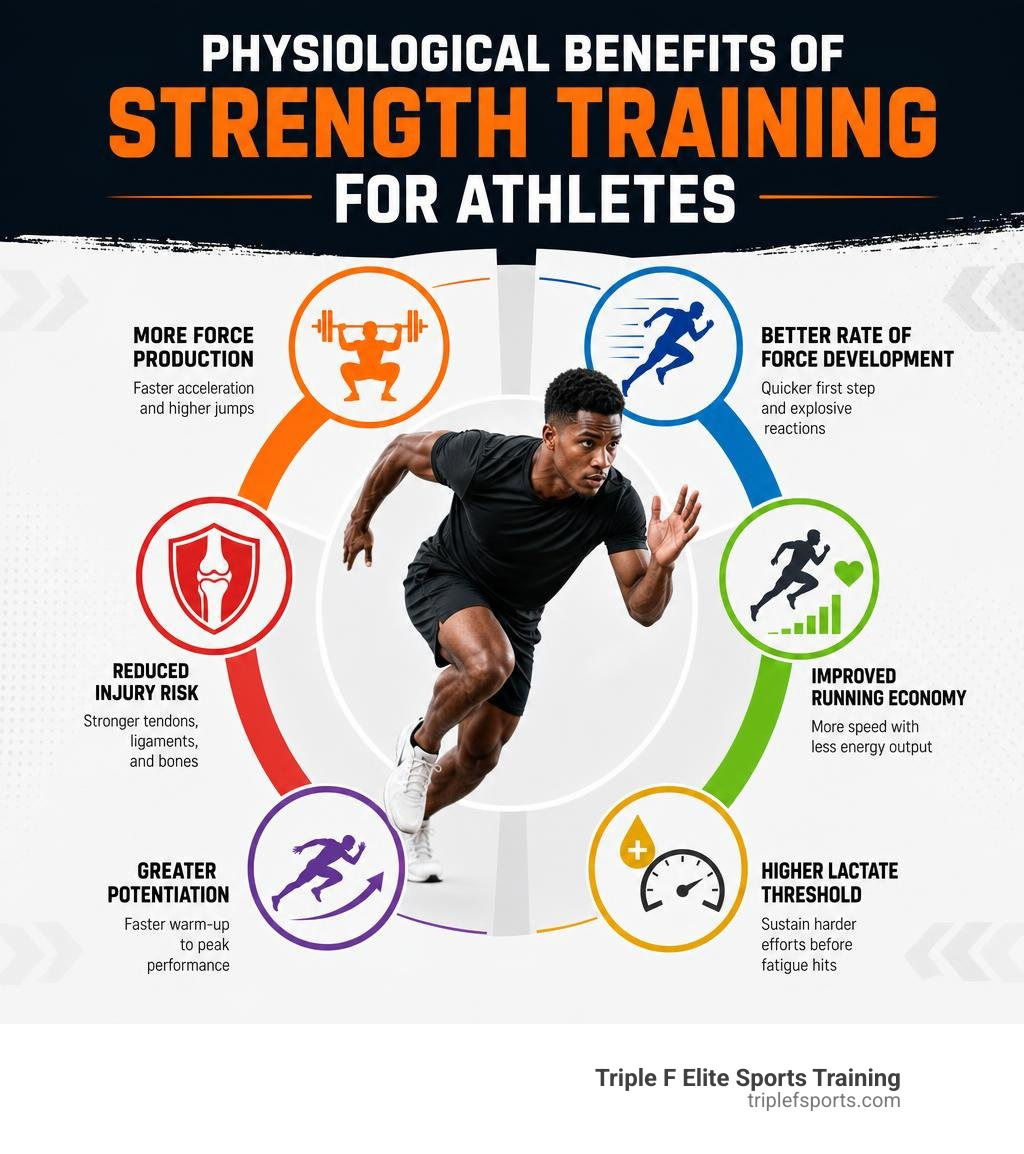
If you want the short answer on what strength training does for athletes, here it is:
| Benefit | What It Means in Practice |
|---|---|
| More force production | Faster acceleration and higher jumps |
| Better rate of force development | Quicker first step and explosive reactions |
| Improved running economy | More speed with less energy output |
| Reduced injury risk | Stronger tendons, ligaments, and bones |
| Greater potentiation | Faster warm-up to peak performance |
| Higher lactate threshold | Sustain harder efforts before fatigue hits |
Strength is not just about how much you can lift. It is about how effectively your body produces and transfers force — on the field, on the track, and in competition.
Most athletes already know they should be strength training. The harder question is how — which exercises, which phases, how heavy, and when during the season. That is exactly what this guide answers, drawing from current sports science and real-world programming principles.
I’m Kevin O’Shea, a Certified Strength and Conditioning Specialist and former college wide receiver whose passion for strength for athletes grew out of years of coaching, training, and watching athletes unlock levels of performance they didn’t think were possible. This guide brings together what the research says and what actually works in practice, so you can train with purpose — not just effort.
Related content about Strength for athletes:
- Agility training for sports
- Sports specific conditioning
- Rehab for athletes
The Science of Strength for Athletes: Force, Speed, and Power
To understand why strength for athletes is so critical, we have to look past the mirror. While bodybuilding focuses on muscle size and aesthetics, athletic strength training focuses on neuromuscular adaptations. When we train for athletic performance, we are teaching the central nervous system (CNS) to communicate with our muscles more efficiently.
This efficiency boils down to two main neural mechanisms:
- Motor Unit Recruitment: Your brain recruits motor units (a motor neuron and the muscle fibers it activates) based on the demand of the task. Heavy lifting trains your brain to recruit high-threshold motor units—the fast-twitch fibers responsible for explosive power.
- Rate Coding: This refers to the firing frequency of those motor units. The faster your brain can send signals to the muscle, the quicker you can produce force.
The relationship between muscular strength and athletic success is deeply explored in Scientific research on muscular strength and athletic performance. The data demonstrates that greater maximal strength directly improves an athlete’s force-time characteristics.
In simple terms, force-time characteristics dictate how much force you can produce and how quickly you can produce it. This second part is known as the Rate of Force Development (RFD). Because most sports movements—like sprinting or jumping—happen in less than 250 milliseconds, you do not have time to reach absolute maximal force. However, athletes with higher maximal strength can produce a much higher percentage of their force in those crucial milliseconds, giving them a massive competitive edge.
Enhancing Sport-Specific Skills: Jumping, Sprinting, and Change of Direction
Every dynamic movement on the court or field relies on the stretch-shortening cycle (SSC). Think of the SSC like a rubber band: when you dip down before a jump, you stretch the muscle-tendon unit (eccentric phase), store elastic energy (amortization phase), and then release it explosively (concentric phase).
To optimize this cycle, you need:
- Triple Extension: The simultaneous, explosive extension of the hips, knees, and ankles. This is the universal movement pattern for jumping, sprinting, and driving through an opponent.
- Minimal Ground Contact Time: In sprinting, the faster you can apply massive force into the ground and get your foot off it, the faster you move.
- Force Absorption: Before you can change direction, you must decelerate. This requires incredible eccentric strength to absorb gravity and momentum without losing structural integrity.
When an athlete builds a deep reservoir of strength, they improve their ability to stiffen their joints upon impact. This stiffness prevents “energy leaks,” allowing elastic energy to transfer seamlessly through the kinetic chain.
For a deeper look into how these mechanics translate to game-day results, check out More info about athlete performance training.
Why Relative Strength for Athletes Dictates On-Field Speed
While absolute strength (the maximum amount of weight you can lift regardless of body size) is critical for sports like football or shot put, relative strength (how strong you are compared to your body weight) is the king of speed and agility.
If two soccer players both squat 300 pounds, but Player A weighs 150 pounds and Player B weighs 200 pounds, Player A has significantly higher relative strength. Player A will accelerate faster because they have more force-producing capacity to propel their body weight through space.
We can categorize an athlete’s current physical state into three distinct phases:
- Strength Deficit Phase: The athlete lacks foundational strength. Their sport-specific skills (like sprinting) are limited simply because they cannot produce enough ground force. For these athletes, basic heavy lifting yields massive performance jumps.
- Strength Association Phase: The athlete has a solid foundation. Here, gains in gym strength show a high correlation with improvements in speed and power.
- Strength Reserve Phase: The athlete is highly strong (e.g., squatting 2x body weight or more). At this point, chasing a heavier squat has diminishing returns. Instead, they must focus on transferring that strength into velocity.
To master this transition from general gym strength to explosive power, read More info about mastering athletic strength training.
The 4-Phase Strength Training System for Athletic Development

We don’t just throw random workouts at the wall and hope they stick. To build a resilient, powerful athlete, we utilize a structured, phased periodization system. Each phase builds a physiological bridge to the next, systematically driving progressive overload while managing fatigue.
| Phase | Primary Focus | Rep Range | Intensity (% of 1RM) | Key Adaptations |
|---|---|---|---|---|
| Phase 1: Structural Balance | Mobility, stability, unilateral strength | 10–12 | 60–70% | Joint integrity, correcting muscle imbalances, tendon health |
| Phase 2: Hypertrophy | Build lean muscle mass | 8–12 | 70–80% | Increased cross-sectional area of muscle, tissue tolerance |
| Phase 3: Max Strength | Force-producing capacity | 3–6 | 80–90% | High-threshold motor unit recruitment, CNS efficiency |
| Phase 4: Strength-Speed | Power, rate of force development | 1–5 | 30–60% (explosive) | Speed-strength, explosive triple extension, sport transfer |
Phase 1 & 2: Structural Balance and Hypertrophy
Before we build a high-performance engine, we have to make sure the chassis can handle the horsepower. That is the purpose of Phase 1: Structural Balance.
In this phase, we heavily utilize unilateral (single-leg and single-arm) exercises. Why? Because sport is played primarily on one leg. If an athlete has a massive strength discrepancy between their left and right leg, it is a ticking time bomb for injuries like ACL tears. Unilateral work builds pelvic stability, corrects muscle imbalances, and prepares the joints for heavier loading.
Once structural balance is established, we transition to Phase 2: Hypertrophy. The goal here is to trigger protein synthesis and increase the physical size of the muscle fibers. A larger muscle has a higher potential for force production. We focus on compound movements with controlled tempos (slower eccentrics) to build tissue tolerance and strengthen tendons.
This foundational work is especially critical for younger athletes who are still developing. For guidance on structuring these early phases safely, see More info about youth strength training.
Phase 3 & 4: Maximal Strength and Strength-Speed Transfer
Once the structural foundation and muscle tissue are built, we teach the nervous system how to recruit those new fibers with maximum effort.
In Phase 3: Maximal Strength, we lift heavy. We manipulate eccentric loading (lowering the weight slowly to build tendon stiffness) and isometric stability (holding a position statically) to maximize motor unit recruitment. This is where we build the raw capacity to produce force.
Finally, we transition to Phase 4: Strength-Speed and Transfer. Raw strength is useless if it takes you a full second to produce it. In this phase, we use lighter loads moved at maximum velocity, alongside Olympic weightlifting derivatives.
According to the NSCA Position Statement on Weightlifting for Sports Performance, weightlifting movements like cleans, snatches, and pulls produce some of the highest power outputs recorded in sports science. These movements force the athlete to perform rapid triple extensions, mimicking the exact biomechanics of sprinting and jumping.
Exercise Selection and Programming for Peak Performance

A successful strength program is built around compound, multi-joint exercises that train movement patterns rather than isolated muscles. If you want to perform like an athlete, you need to train movements that require coordination, balance, and total-body tension.
We categorize our primary exercises into six fundamental movement patterns:
- Squat: Front squats, back squats, and goblet squats.
- Hinge: Deadlifts, Romanian deadlifts (RDLs), and snatch-grip deadlifts.
- Push: Push presses, bench presses, and overhead presses.
- Pull: Chin-ups, barbell rows, and lat pulldowns.
- Unilateral: Bulgarian split squats, step-ups, and lunges.
- Explosive/Power: Power cleans, hang pulls, and push jerks.
For a comprehensive breakdown of how to execute these movements with perfect technique and manage training variables like volume and intensity, refer to the Barbell Medicine Strength Training Guide.
Periodizing Strength for Athletes Across a Competitive Season
An athlete cannot be at peak performance year-round. To prevent overtraining and ensure peak performance when it matters most, we break the training year down into structured cycles:
- Macrocycle: The entire training year (e.g., preparing for the 2026 season).
- Mesocycle: Blocks of 4 to 8 weeks focusing on a specific quality (such as Hypertrophy or Max Strength).
- Microcycle: A single week of training, balancing work and recovery.
During the off-season (accumulation phase), sport-specific training volume is low, meaning we can ramp up the strength training volume and intensity. This is when we build new muscle and push maximal strength to its limits.
As the in-season (maintenance phase) approaches, the priority shifts entirely to sport performance and tactical practice. We reduce gym volume significantly but maintain intensity. Research shows that lifting heavy just 1 to 2 times per week is the minimal effective dose required to preserve your hard-earned strength gains during a long competitive season.
For a sport-specific example of how to balance high-intensity sports demands with smart weight room periodization, read More info about volleyball strength training.
Managing Concurrent Training: Balancing Strength and Conditioning
Many athletes must develop strength and cardiovascular endurance simultaneously—a practice known as concurrent training. The challenge here is the “interference effect,” where high volumes of endurance training can potentially blunt the molecular signals that trigger muscle growth and strength.
Additionally, heavy strength training is highly demanding. A single intense session can deplete muscle glycogen by an average of 38%, which can impair high-intensity endurance workouts for days if recovery is neglected.
However, when programmed correctly, strength training actually improves endurance performance. For example, strength work builds tendon stiffness and motor unit coordination, which directly improves running economy. This can lead to a 13-minute advantage in a marathon PR, even among athletes with identical VO2 max values. It also improves your lactate threshold, allowing you to sustain higher intensities before fatiguing.
To successfully navigate concurrent training without burning out, explore More info about the ultimate athletic training program.
From Protein to Power: Nutritional and Recovery Foundations
You do not get stronger in the gym; you get stronger while you sleep and recover. Without the proper nutritional building blocks, your body cannot repair the micro-tears created during training, leaving you in a chronic state of under-recovery.
- Protein Intake: To support muscle repair and hypertrophy, athletes should aim for 1.6 to 2.2 grams of protein per kilogram of body weight daily (or up to 2.0–2.5 grams per pound for heavy training phases). This protein should be distributed evenly throughout the day, aiming for roughly 0.4 g/kg per meal.
- Amino Acids: Branched-chain amino acids (BCAAs), particularly leucine, act as the chemical “on-switch” for muscle protein synthesis.
- Creatine: Supplementing with 5g of creatine daily is one of the most thoroughly researched ways to increase muscle phosphocreatine stores, directly improving power output during short, explosive bursts of exercise.
Beyond these basics, natural extracts and micronutrients play a massive role in performance. According to the Frontiers Scoping Review on Nutritional Factors and Natural Extracts, specific compounds target distinct pathways:
- Strength-Type Sports: Benefit from creatine, HMB, Vitamin D (which regulates calcium levels for muscle contraction), and vasodilators like L-citrulline to optimize blood flow.
- Shared Pathways: Both strength and endurance athletes benefit from reducing systemic inflammation and oxidative stress through targeted nutrition, optimizing the gut-liver-muscle axis for energy metabolism.
Mitigating Injury Risk and Enhancing Performance Potentiation
A stronger muscle is a more resilient muscle. Resistance training increases bone mineral density, strengthens tendons and ligaments, and improves joint stability. This is particularly vital for athletes in sports with repetitive, non-weight-bearing patterns. For instance, adult road cyclists who train regularly often show surprisingly low bone mineral density in key regions due to the lack of impact, which significantly increases their fracture risk during a crash. Heavy squats and deadlifts stimulate bone remodeling, protecting against this risk.
Furthermore, strength training enhances post-activation potentiation (PAP). When you perform a heavy lift, your nervous system is temporarily excited. If you follow that heavy lift with an explosive movement (like a jump), you can produce more power than you would have without the heavy lift. Stronger athletes potentiate faster and to a much greater extent than weaker athletes.
To see how we apply these injury-prevention and performance-boosting principles to younger populations, read More info about training young athletes.
Frequently Asked Questions about Athletic Strength Training
How do athletes assess if they are in a strength deficit or strength reserve?
Coaches use several testing protocols to determine an athlete’s physical profile:
- Isometric Mid-Thigh Pull (IMTP): A safe, highly reliable test performed on force plates to measure peak force and rate of force development.
- Dynamic Strength Testing: Assessing a 1-Repetition Maximum (or 3-RM) in foundational lifts like the squat or trap-bar deadlift.
- Reactive Strength Index (RSI): Measured during a drop jump, this assesses how well an athlete transitions from eccentric deceleration to concentric propulsion.
- Force-Velocity Profiling: Compares an athlete’s force capabilities at low speeds against their power output at high speeds to see if they need more heavy strength work or light velocity work.
What is the minimal effective dose of strength training for endurance athletes?
For endurance athletes, the absolute minimal effective dose to maintain strength and improve running economy is two sessions per week. These sessions do not need to be long—30 to 45 minutes of focused, compound movements (squats, hinges, and core stability) is enough to trigger neuromuscular adaptations without causing excessive fatigue that interferes with sport-specific conditioning.
Can youth athletes safely participate in heavy strength training?
Yes, absolutely. Modern sports science has thoroughly debunked the myth that weightlifting stunts growth or damages growth plates. Under qualified supervision and with age-appropriate programming, strength training is highly safe and beneficial.
The focus for youth must be on long-term athlete development (LTAD), prioritizing movement quality, coordination, and bodyweight control before adding heavy external loads. For a closer look at how we program strength for competitive youth sports, read More info about youth wrestler strength training.
Conclusion
At the end of the day, building strength for athletes is not about chasing gym-bro aesthetics or lifting heavy weights with poor form just to look good on social media. It is about building a resilient, powerful, and highly efficient athletic engine that translates directly to game-day dominance.
At Triple F Elite Sports Training in Knoxville, TN, we provide professional, Christ-centered athletic development for youth and adult athletes alike. Our state-of-the-art facility integrates comprehensive performance training, physical therapy, and specialized sports coaching to help you unlock your absolute full potential.
Ready to experience the science of strength training firsthand? We invite you to join us for a free first session and start your journey toward becoming a stronger, faster, and more durable athlete.
Unlock your athletic potential with Triple F Elite Sports Training