
Why Every Catcher Needs a Position-Specific Workout Plan
A solid baseball catcher workout plan is one of the most important tools a catcher can have — and one of the most overlooked.
Here’s what a complete catcher workout plan covers:
- Lower body strength — squats, trap bar deadlifts, and split squats to survive nine innings in a crouch
- Core and rotational power — med ball throws and Pallof press variations for throwing velocity
- Shoulder and rotator cuff care — band external rotations and arm care drills to protect your throwing arm
- Agility and blocking drills — ladder block drills and knee throws to cut pop time
- Mobility and recovery — hip, ankle, and thoracic work to keep your body healthy across a long season
Catching is arguably the hardest job in baseball. You crouch for nine or more innings, receive every pitch, block balls in the dirt, and still need a cannon for an arm when a runner tries to steal. No other position puts that kind of combined physical and mental demand on a single player. Yet most generic baseball programs treat catchers the same as outfielders — and that’s a mistake.
The shoulder joint has a greater range of motion than any other joint in the body, which makes it uniquely vulnerable to injury without targeted strengthening. Add in the prolonged squatting, the explosive rotational demands of throwing, and the sheer volume of a 162-game MLB season — and it becomes clear that catchers need a training plan built specifically for them.
I’m Kevin O’Shea, Certified Strength and Conditioning Specialist at Triple F Elite Sports Training in Knoxville, and while my athletic background is in wide receiver play and athletic development, I’ve worked directly with baseball athletes on the same foundational principles — explosive power, rotational strength, and injury prevention — that make a baseball catcher workout plan effective. In the sections below, we’ll break down exactly how to build that plan from the ground up.
Handy baseball catcher workout plan terms:
The Unique Physical Demands of the Catcher Position
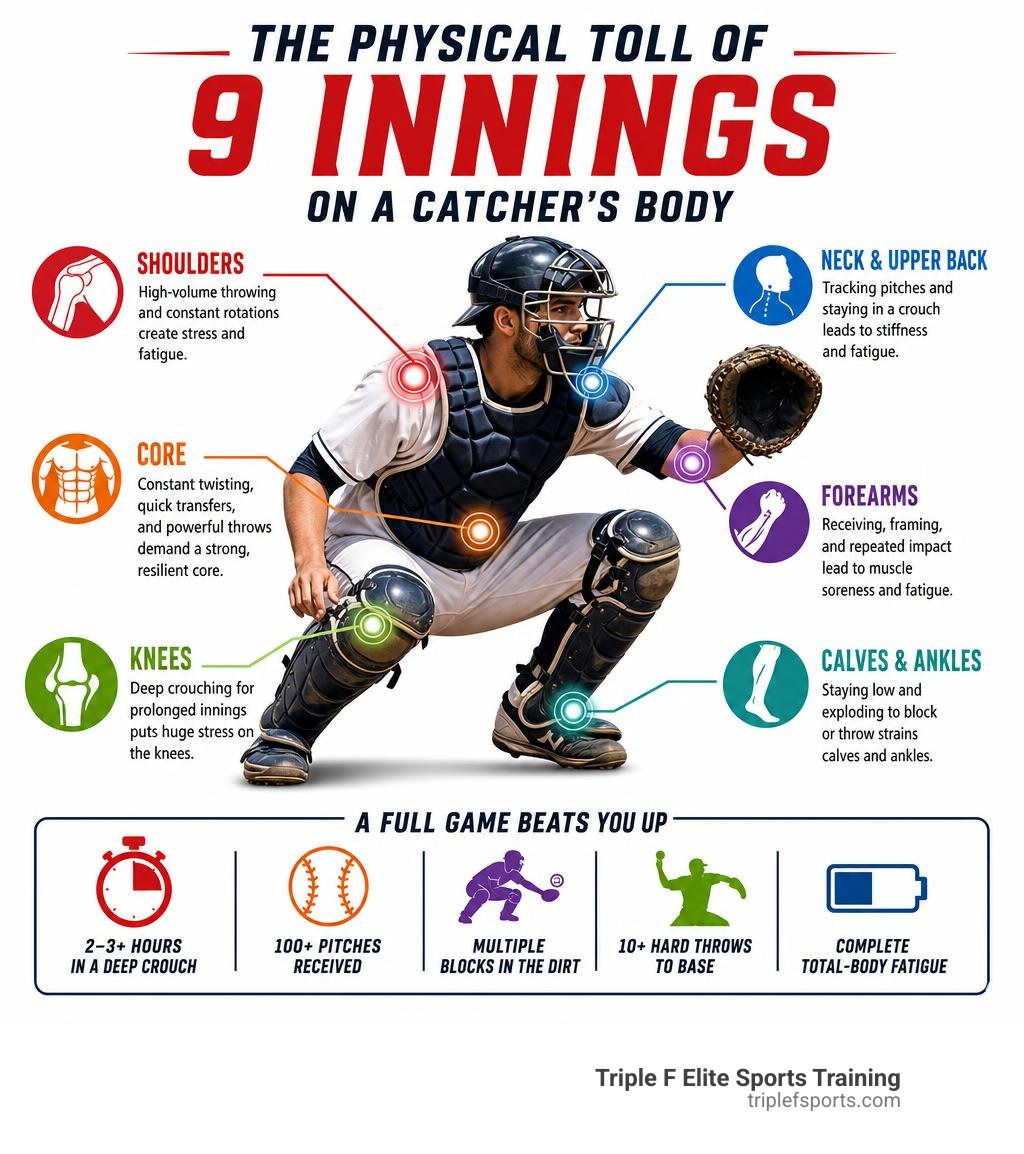
To build an elite catcher, we first have to understand the sheer physical chaos of the position. While a shortstop or outfielder might stand, walk, or jog for most of a game, catchers are constantly locked in a deep, loaded squat. This prolonged squatting places massive isometric demands on the quadriceps, glutes, and calves, while requiring exceptional hip mobility and ankle dorsiflexion to prevent the lower back from taking the brunt of the load.
When a catcher has to block a wild pitch, they must explosively drop to their knees and recover instantly. When a runner attempts to steal second, they must transition from a deep crouch to a high-intent throw in under two seconds. This requires an incredible amount of rotational power, lateral agility, and dynamic joint stability.
Without targeted training, this constant stress leads to joint wear and tear, patellar tendonitis, and shoulder impingement. Understanding these specific demands is what we focus on in Unlocking Athletic Potential: A Deep Dive into Sport-Specific Training.
| Physical Demand | Baseball Catcher | General Baseball Positions (Outfield/Infield) |
|---|---|---|
| Primary Lower Body Stance | Prolonged, deep isometric squatting (9+ innings) | Standing, dynamic ready positions |
| Ankle & Hip Mobility Needs | Extreme dorsiflexion and deep hip flexion | Moderate mobility for sprinting and lateral steps |
| Throwing Mechanics | Explosive throws from knees or a quick, compact rise | Full-crow hop, long-arc throwing motions |
| Joint Stress Profile | High knee joint compression, high spinal loading | Moderate joint wear, primarily deceleration stress |
| Agility Requirements | Rapid lateral blocking, immediate recovery to feet | Wide-ranging lateral sprints and base-running cuts |
The Ultimate 16-Week Baseball Catcher Workout Plan
To build a durable, high-performing catcher, we utilize a structured 16-week periodization model. Trying to build maximum strength, explosive speed, and throwing velocity all at once is a recipe for overtraining and injury. Instead, we break the training program down into four distinct 4-week phases, scheduling 2 training days per week. This frequency is highly effective because it allows catchers to build elite physical capacities without interfering with their crucial technical skill work.
For a comprehensive layout of how we structure overall development, you can check out the Get Stronger Faster: The Ultimate Athletic Training Program PDF. By mapping out your training, you ensure that every lift transfers directly to the diamond, which is the cornerstone of Building Better Athletes One Program at a Time.
Our 16-week macrocycle is structured across three primary phases of the baseball calendar:
- Off-Season (Weeks 1-8): Focuses heavily on building structural tissue quality, correcting muscle imbalances, and developing maximum lower-body strength.
- Pre-Season (Weeks 9-12): Shifts the focus toward explosive power development, speed, and position-specific plyometrics.
- In-Season (Weeks 13-16 and beyond): Prioritizes strength maintenance, rotator cuff durability, and joint mobility to keep the athlete fresh during competitive play.
Phase 1 & 2: Building Foundational Strength and Mobility
In the first eight weeks of our program, the goal is to build an unbreakable physical foundation. We emphasize long eccentric phases and strategic isometric holds to strengthen the tendons and ligaments around the knees, hips, and shoulders.
For instance, when performing squats, we often program a slow, 6-second eccentric (lowering) phase followed by a 2-second isometric pause at the very bottom of the squat before exploding upward. This specific tempo targets the exact positions catchers endure during a game, building incredible squatting endurance and tissue quality.
During these phases, we also focus on ankle dorsiflexion mobility and joint stability to prepare the body for the high-velocity demands of the upcoming pre-season. This foundational approach is highly supported by proven protocols, such as those found in the Spring Training Strength Program for Baseball Catchers.
Phase 3 & 4: Developing Explosive Power and Pop Time
Once the foundational strength is locked in, we transition to Phase 3 and 4 (Weeks 9-16). Here, the focus shifts entirely to developing explosive power, lateral velocity, and minimizing ball transfer speed.
We integrate advanced plyometric progressions, unilateral jumps across multiple planes of motion, and high-velocity medicine ball throws to mimic the exact rotational path of throwing out a runner. By teaching the nervous system to produce maximum force in minimal time, we directly improve pop time and defensive agility.
To dive deeper into how we program these advanced athletic progressions, take a look at the insights in the No BS Strength Training For Catchers Pt. 2 – Overtime Athletes Blog.
Catcher-Specific Strength Exercises for Lower Body and Core
The weight room is where a catcher builds their armor. To withstand the physical toll of a long season, we prioritize compound movements that target the posterior chain, quadriceps, and core.
Our go-to lower body exercises include:
- Trap Bar Deadlift: Excellent for building maximum lower body force while keeping the spine in a safer, more neutral position than a traditional barbell deadlift.
- Goblet Squat: Forces the athlete to maintain an upright torso, directly translating to a strong, active receiving posture.
- Reverse Lunges & Bulgarian Split Squats: Unilateral movements that correct left-to-right strength imbalances and build single-leg stability for explosive throwing stances.

Focusing on these foundational movements is essential for any serious athlete, which we cover extensively in Beyond the Gym: Mastering Athletic Strength Training.
Rotational Power and Core Stability for Throwing
A catcher’s throwing power does not come from the arm alone; it is generated from the ground, transferred through the hips, and delivered through a stable core. To develop this rotational power, we integrate medicine ball scoop throws and shot-put throws (using 3-5 kg med balls) executed at maximum intent.
We pair these explosive movements with anti-rotational core exercises like the Pallof press and heavy plank variations. This combination ensures that the core can both generate and absorb high-velocity rotational forces, protecting the lower back while adding serious velocity to your throws. For more on structuring these core routines, read the Catcher Technique, Part 10: The Baseball Workout.
Rotator Cuff and Shoulder Care for Arm Durability
Because catchers throw from a variety of awkward angles and must decelerate their arms rapidly, comprehensive shoulder care is non-negotiable. The rotator cuff muscles are relatively small and easily overpowered by the larger pressing muscles of the chest and shoulders.
To maintain muscular balance and joint health, we recommend performing 3 sets of 10-15 repetitions for band external rotations and dynamic shoulder stabilization movements. We also maintain a strict 2:1 pulling-to-pressing ratio in the weight room to counteract the forward shoulder posture common in baseball players. You can find excellent visual guides and structured arm-care programs within the Workouts – Catching-101 resource page.
Integrating Defensive Drills and Agility into Your Training
While building strength in the weight room is vital, that strength must be translated into positional skill. The key to a successful baseball catcher workout plan is finding the perfect balance between strength training and on-field skill work.
Overtraining occurs when athletes try to redline both their lifting and their catching drills simultaneously. To avoid this, we carefully sequence high-intent throwing and blocking days with our lower-body lifting sessions, ensuring the central nervous system has adequate time to recover. This seamless integration of physical and mental preparation is what we specialize in at Triple F, and you can learn more about it in Level Up Your Game with Advanced Athletic Training.
The Ladder Block Drill and Quick Recovery
To improve lateral quickness and blocking reflexes, we utilize the Ladder Block Drill. In this drill, the catcher wears their full catcher’s gear and works through an agility ladder, executing rapid lateral footwork before dropping instantly into a perfect blocking position.
To build both technical mastery and conditioning, this drill should be repeated 3 to 5 times in a row. This teaches the body to remain explosive even when fatigue begins to set in during the late innings of a game. For a visual breakdown of how to execute this and other high-level catching flows, watch the Master the Art of Catching with this 10 Minute Routine – YouTube video.
Knee Throws and Transfer Drills for a Faster Pop Time
To throw out elite base runners, a catcher must master the transfer from the glove to the throwing hand and the subsequent release. We practice knee throws to emphasize proper weight transfer from the back leg to the front leg without relying solely on raw arm strength.
Additionally, we practice daily grip drills to build the muscle memory required to instantly find a 4-seam grip on the ball. This combination of quick hands and efficient lower-body power is what slashes fractions of a second off your pop time.

Mobility, Recovery, and Nutrition Protocols for Longevity
No workout plan is complete without a dedicated strategy for recovery. Because catchers spend so much time in extreme joint angles, daily mobility work is essential. We recommend a movement circuit that includes the 90/90 hip stretch, ankle rocks for dorsiflexion, and targeted thoracic spine foam rolling to keep the upper body moving freely.
On the nutrition side, catchers must fuel their bodies to support intense muscle repair. This means prioritizing a high daily protein intake (aiming for 0.7 to 1.0 grams of protein per pound of bodyweight) and maintaining precise hydration levels.
For a real-world look at how the pros handle this preparation, you can read Inside the Routine: A Catcher’s Game-Day Preparation with Carlos Narvá – KGS Baseball®.
Our Essential Recovery Protocols for Catchers:
- Post-Workout Foam Rolling: 5-10 minutes targeting the quadriceps, glutes, and thoracic spine.
- Daily Mobility Flow: Focusing on hip internal/external rotation and ankle dorsiflexion.
- Targeted Nutrition: Consuming 30-40 grams of high-quality protein within 60 minutes post-training.
- Optimal Sleep: Aiming for 8-9 hours of sleep in a cool room (60-67°F) to maximize growth hormone release and tissue repair.
Frequently Asked Questions about Catcher Training
How does a baseball catcher workout plan differ from a pitcher’s routine?
While pitchers focus heavily on linear acceleration, mound mechanics, and high-volume throwing deceleration, a catcher’s routine is centered around squat endurance, rapid lateral blocking agility, and throwing from compact, non-traditional angles (such as from the knees). Catchers require much higher isometric lower body strength to survive hours of squatting, whereas pitchers require more unilateral explosive power to drive off the mound.
How often should a catcher perform a baseball catcher workout plan?
We highly recommend a frequency of 2 days per week for dedicated strength and conditioning. This allows catchers to make significant gains in power and mobility while leaving ample recovery time for team practices, bullpens, and game play, preventing the onset of overtraining.
What is the best way for youth catchers to start strength training?
For young athletes, the focus should always be on bodyweight mastery, mobility, and perfect movement form before adding heavy external weights. To ensure a safe and highly effective start to an athletic journey, check out our In-Depth Guide to Youth Strength Training and explore Teen Power: The Best Workout Plans for Young Athletes. For those looking to see how these principles cross over into other demanding sports, you might also enjoy reading about The Football Strength Program for Future Pros.
Conclusion
Building a cannon behind the plate doesn’t happen by accident. It requires a dedicated, position-specific approach that balances lower-body strength, explosive rotational power, and diligent arm care. At Triple F Elite Sports Training in Knoxville, TN, we specialize in providing professional, Christ-centered athletic development designed to unlock your full potential on the diamond.
Whether you are a youth athlete just starting out or an advanced player looking to catch the eyes of college scouts, our elite trainers and physical therapists are here to guide you every step of the way. Ready to take your defensive game to the next level? Schedule a free session to elevate your catching game with us today!