
Why Most Baseball Players Gas Out Before the Final Inning
Baseball conditioning drills are the difference between a player who dominates all nine innings and one who fades when the game is on the line.
Here are the most effective baseball conditioning drills to build speed, power, and game-ready stamina:
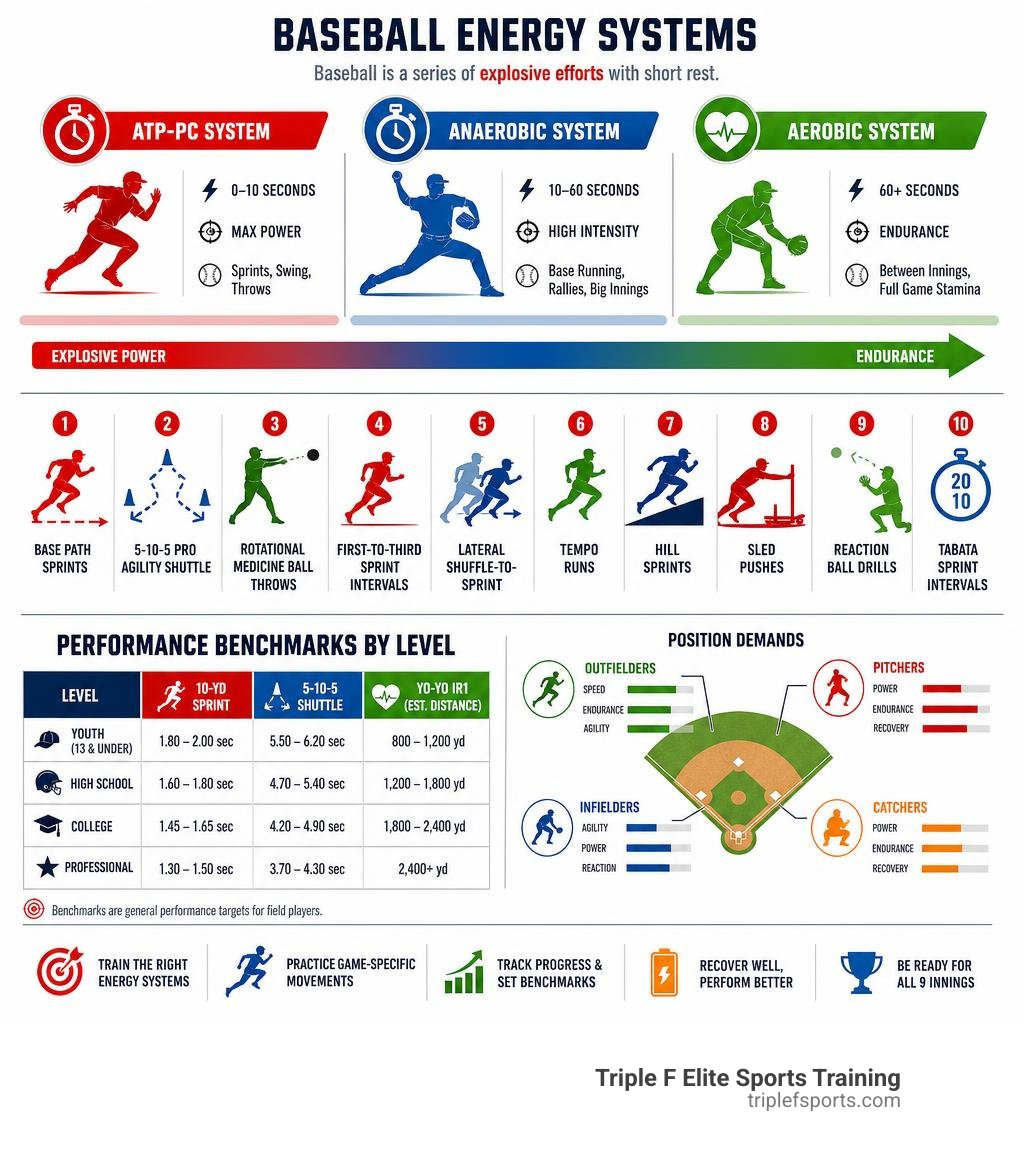
- Base Path Sprints – 90-foot intervals that train explosive acceleration and repeatable speed
- 5-10-5 Pro Agility Shuttle – builds lateral quickness and change-of-direction control
- Rotational Medicine Ball Throws – develops hip-shoulder separation and bat speed
- First-to-Third Sprint Intervals – simulates real baserunning demands with full-effort bursts
- Lateral Shuffle-to-Sprint – trains the transition from defensive positioning to explosive movement
- Tempo Runs – builds aerobic base without killing power output
- Hill Sprints – improves acceleration mechanics and conditioning with lower CNS stress
- Sled Pushes – builds lower-body drive and GPP with zero soreness risk
- Reaction Ball Drills – sharpens first-step quickness and hand-eye coordination
- Tabata Sprint Intervals – can improve VO2 max by up to 14% and anaerobic capacity by up to 28% in six weeks
Baseball looks like a slow game from the stands. But for the players on the field, it is a series of all-out explosive efforts — sprints, throws, swings — separated by short rest periods. A nine-inning game covers roughly 1.5 to 2 miles, but almost none of that is continuous running.
That is exactly why generic cardio and distance running fall short. They train the wrong energy system for the way the game is actually played.
Pitchers with poor conditioning lose 1.5 to 2.2 mph of velocity between the first and sixth inning. Position players lose lateral quickness and reaction speed in late-game situations. The fix is not running more miles — it is training smarter with drills that match what baseball actually demands.
I’m Kevin O’Shea, a Certified Strength and Conditioning Specialist who has spent years helping athletes build the kind of sport-specific fitness that shows up when the game is on the line — and baseball conditioning drills are a core part of what we do at Triple F Elite Sports Training here in Knoxville. Let’s break down exactly what works, position by position and season by season.
Related content about baseball conditioning drills:
Why Traditional Cardio Fails: The Science of Baseball Conditioning Drills
For decades, the standard conditioning prescription in baseball was simple: “Go run poles.” Pitchers and position players alike would spend hours jogging long distances under the assumption that it built the “aerobic base” needed to survive a long season.
But modern sports science tells a completely different story. Baseball is fundamentally an anaerobic sport.
To understand why traditional, long-distance cardio fails, we have to look at the three primary energy systems our bodies use:
- The Phosphagen (ATP-CP) System: This is your body’s rocket fuel. It powers short, maximum-effort bursts lasting under 10 seconds—like sprinting from home to first, throwing a 95-mph fastball, or diving for a line drive.
- The Glycolytic System: This system takes over for moderate-intensity efforts lasting between 10 seconds and 2 minutes.
- The Aerobic System: This is your long-term energy producer. While it doesn’t power your explosive movements, a well-developed aerobic system is crucial because it dictates how quickly you recover between those explosive bursts.
When you force a baseball player to run long, slow distances, you actively train their muscles to be slower and less explosive. This is known as the “interference effect.” If you want to Level Up Your Game with Advanced Athletic Training, your conditioning must mirror the demands of the sport.
Baseball players cover roughly 1.5 to 2 miles during a nine-inning game, but this distance is accumulated almost entirely through short, high-intensity sprints followed by complete or near-complete recovery. By focusing on sport-specific conditioning, we train the phosphagen system to deliver maximum power, the glycolytic system to handle repeated efforts, and the aerobic system to flush waste products and restore energy during down times. This is the core philosophy behind Unlocking Athletic Potential: A Deep Dive into Sport Specific Training.
Top Speed, Agility, and Quickness Drills for Baseball Players

Speed in baseball isn’t just about straight-line velocity. It is about how quickly you can read a ball off the bat, change directions without losing momentum, and accelerate to top speed in three steps.
Agility Ladder and Cone Setups for Baseball Conditioning Drills
To build elite footwork and rapid deceleration, we use structured agility ladder and cone setups. These drills train the brain and nervous system to coordinate rapid movements while maintaining a low, athletic center of gravity.
- The 5-10-5 Pro Agility Shuttle: Set three cones in a straight line, 5 yards apart. Start at the center cone in a baseball-ready stance. Sprint 5 yards to the right, touch the line, change directions and sprint 10 yards to the far left, touch the line, and sprint 5 yards back through the center cone. Elite players finish this in under 4.4 seconds.
- The Lateral Shuffle-to-Sprint: Set two cones 15 feet apart. Start at Cone A in a defensive fielding posture. Shuffle laterally to Cone B as fast as possible, touch the cone, and immediately transition into an explosive forward sprint for 10 yards. This mimics an infielder ranging for a ground ball and throwing to first.
- The Shakedown Drill: Set up 6 cones in a rectangle, 10 to 12 feet apart. Perform diagonal sprints, breaking down your feet with small, choppy steps at each cone. To increase the challenge, use resistance bands placed just above the knees to force active hip engagement. Perform 4 to 6 resisted reps per side, followed by 2 un-resisted sets to feel the explosive “pop” in your steps.
To master these movement patterns, check out our guides on Unlock Your Speed: Top Agility Ladder Drills for All Levels and How to Move Like a Pro with Agility Training.
Base Path Sprints and First-Step Quickness
Stealing a base or tracking down a deep fly ball requires elite first-step quickness. These drills focus on pure acceleration mechanics.
- Home-to-First Sprints: Sprint 90 feet from a simulated batter’s box. Focus on driving your hips forward and maintaining a low projection angle for the first 10 yards.
- First-to-Third Sprint Intervals: Run from first to third base, simulating a hard turn at second. Perform 6 to 8 repetitions, using the walk-back recovery time to fully restore your ATP-CP system.
- Ball Drop Reaction Drill: Stand 5 yards away from a partner who holds a tennis ball or baseball at shoulder height. The moment they drop the ball, sprint forward and attempt to catch it before it bounces twice. This trains visual reaction time and explosive first-step acceleration.
Building Rotational Power and Core Strength

Power in baseball is generated from the ground up. Whether you are throwing a ball or swinging a bat, force travels from your feet, through your legs and hips, across your core, and finally out through your upper body. This sequence is known as the kinetic chain.
Rotational Medicine Ball Throws and Core Stability
To maximize bat speed and throwing velocity, we must train the body to transfer energy efficiently across this kinetic chain. This requires both rotational power and anti-rotational core stability.
- Rotational Medicine Ball Throws: Stand sideways to a solid wall, holding a 2 to 6-pound medicine ball. Load your back hip, coil your upper body slightly to create a sequenced hip-shoulder separation (aiming for 45 to 60 degrees of separation), and explosively throw the ball against the wall. Perform 3 sets of 10 throws per side.
- Thoracic Rotation Drills: A stiff mid-back limits your swing and places excessive stress on your lower back and shoulders. We use half-kneeling cable chops, open books, and seated thoracic rotations to maintain 45 to 60 degrees of rotation per side.
- Medicine Ball Slams & Planks: Traditional sit-ups won’t cut it. We use planks, side planks, and medicine ball chops to build a rigid core that prevents energy leaks during the swing.
For a complete breakdown of power-building programs, explore our resources on Teen Power: The Best Workout Plans for Young Athletes.
Lower-Body Power Drills for Explosive Speed
A powerful lower body provides the foundation for all baseball movements. We use compound lifts and plyometrics to build explosive leg drive.
- Trap-Bar Deadlifts & Front Squats: These exercises build absolute strength in the posterior chain (glutes and hamstrings) and quads, which directly transfers to sprinting and pitching power.
- Half-Kneeling Lateral Jumps: Start in a half-kneeling position, facing perpendicular to your target. Push off your planted foot and jump laterally as far as possible, landing softly on both feet. This builds the lateral power needed for pitching off the mound and driving through the batter’s box.
- Lunge Jumps: Perform explosive vertical jumps from a lunge position, switching legs in mid-air. This builds unilateral strength and deceleration control.
Learn how to safely integrate these movements into a routine with our guide: Teen Strength: A Guide to Resistance Training for Young Athletes.
Tailoring Your Workouts: Position-Specific Adaptations
A catcher does not move the same way an outfielder does. Therefore, their conditioning should look entirely different. To maximize performance and prevent injuries, we must adapt our baseball conditioning drills to meet the specific movement patterns and physical demands of each position.
Position-Specific Adaptations of Baseball Conditioning Drills
- Pitchers: The strength of the throwing arm is actually the least important aspect of a pitching conditioning program. Pitching power is generated by the lower body and core. Because pitchers face high central nervous system (CNS) fatigue, we avoid heavy sprint work on days they throw. Instead, we use sled pushes, mobility circuits, and light tempo runs to maintain conditioning. This prevents the late-game fatigue that causes a 1.5 to 2.2 mph drop in fastball velocity.
- Catchers: Catchers require incredible hip mobility, deep-squat endurance, and rapid lateral blocking quickness. We focus their conditioning on lateral shuffles, band-resisted defensive slides, and single-leg stability exercises to protect their knees and lower back.
- Infielders: Infielders need elite lateral range and quick hand-eye coordination. We emphasize reaction ball drills, short-distance agility shuttles (like the 5-10-5), and low-center-of-gravity lateral movements.
- Outfielders: Outfielders must master drop steps, speed turns, and running at top speed while tracking a ball. We utilize the 12-Step Cone Drill | Outfield Footwork, which uses a 5-cone setup to simulate 12 distinct outfield movements, including shoestring catches, overhead fly balls, and speed turns.
No matter your position, custom athletic development is essential. Discover how we tailor our approach in our guide on Level Up Your Game with Advanced Athletic Training.
Structuring Your Program: In-Season vs. Off-Season Conditioning
Conditioning is not a one-size-fits-all, year-round grind. To avoid overtraining and ensure players peak at the right time, coaches must program workouts based on the competitive calendar.
| Training Phase | Primary Focus | Weekly Volume | Intensity Level | Key Methods |
|---|---|---|---|---|
| Off-Season (GPP) | Build aerobic base, strength, and work capacity | High (3-4 sessions/wk) | Moderate to High | Sled work, hill sprints, heavy lifting, high-volume med ball throws |
| Pre-Season | Transition to explosive speed and position-specific agility | Moderate (2-3 sessions/wk) | Very High | Base path sprints, 5-10-5 shuttles, game-simulation circuits |
| In-Season | Maintain power and speed while prioritizing recovery | Low (1-2 sessions/wk) | High effort, low volume | Short sprint repeats, mobility flows, light sled walks, tempo runs |
Weekly and Seasonal Program Design
During the off-season, the goal is General Physical Preparation (GPP). This is the time to build a robust aerobic system using low-impact methods like sled work and hill sprints, which prepare the body for the intense workloads of the spring.
As we transition into the pre-season, the focus shifts to sport-specific speed and agility. We integrate 2 to 3 high-intensity conditioning drills into regular practices rather than running players into the ground at the end of the day.
In-season conditioning is all about maintenance and recovery. We keep conditioning sessions under 25 minutes of actual work time to prevent the “interference effect” from stripping away in-season muscle and power. We also monitor players for signs of overtraining, such as a drop in sprint times, decreased exit velocity, persistent joint soreness, or poor sleep quality.
To learn how to balance physical conditioning with skill acquisition, read A Quick Start Guide to Skill Training for Athletes.
Low-Impact Recovery and Aerobic Capacity Methods
To build conditioning without beating up our athletes’ joints, we rely heavily on low-impact methods:
- Sled Work: Pushing or pulling a weighted sled has zero eccentric (lowering) stress. This means athletes can build incredible lower-body strength and cardiovascular conditioning without getting sore, making it perfect for in-season training.
- Hill Sprints: Running up a moderate incline naturally shortens an athlete’s stride, which improves acceleration mechanics and reduces the impact forces on their joints. It provides a loaded sprint effect with much lower CNS fatigue.
- Tempo Runs: These are relaxed runs performed at or below 75% of maximum sprint speed over 40 to 100 yards, using controlled rest periods. They build aerobic capacity and promote blood flow to aid recovery.
- Dynamic Neuromuscular Stabilization (DNS): Rooted in developmental kinesiology, DNS-based movement flows help athletes retrain fundamental motor patterns, restore joint mobility, and improve breathing mechanics for faster recovery.
For more on how we build long-term athletic success, see our framework on Building Better Athletes One Program at a Time.
Frequently Asked Questions about Baseball Conditioning
Should pitchers run long distance (poles) after they pitch?
No. The old school belief was that running long distances helped “flush lactic acid” from the pitching arm. However, lactic acid clears the body naturally within an hour of exercise anyway.
Long-distance running actually converts fast-twitch muscle fibers (which generate velocity) into slow-twitch fibers. Instead of running poles, pitchers should focus on a 10 to 15-minute routine of light jogging or tempo runs, active mobility work, foam rolling, and targeted arm care to restore shoulder and hip range of motion.
What equipment is needed for top baseball workouts?
You do not need a gym full of expensive machines to execute a pro-level conditioning program. The most effective tools are simple, portable, and versatile:
- Cones: Essential for marking out agility shuttles, base paths, and route-running drills.
- Agility Ladder: Perfect for warming up the nervous system and developing quick feet.
- Medicine Balls (2 to 6 lbs): Crucial for building rotational power and core stability.
- Weighted Sleds/Prowlers: The ultimate tool for low-impact, high-intensity conditioning.
- Resistance Bands: Used for warm-ups, arm care, and adding resistance to lateral movement drills.
How do you adapt conditioning drills for youth versus high school or college players?
Conditioning must follow an age-appropriate developmental roadmap:
- Youth Players (Ages 8-12): At this stage, conditioning should focus on foundational movement patterns—running, jumping, landing, and throwing. We make conditioning engaging by using competitive games like base-running relay races, reaction ball drops, and tag.
- High School Players (Ages 13-18): We introduce structured strength training, rotational power work, and sport-specific speed drills.
- College/Pro Players (Ages 18+): Training becomes highly individualized, focusing on position-specific metabolic demands, advanced velocity-based tracking, and precise recovery protocols.
For more information on youth development, read our guide on Building Future Champions: Age-Appropriate Strength Training for Youth Wrestlers (which applies foundational movement principles perfect for young baseball players too).
Conclusion
At the end of the day, you can have the cleanest swing mechanics and the sharpest breaking ball in the state, but if your body gases out by the fifth inning, your skills won’t matter. Real, game-ready fitness is built through smart, explosive, and sport-specific training.
At Triple F Elite Sports Training in Knoxville, TN, we specialize in helping athletes reach their absolute peak. Our professional, Christ-centered athletic development programs combine cutting-edge sports science, custom physical therapy, and expert coaching to unlock your full potential on the diamond.
Whether you are a youth player just starting out, a high school prospect aiming for a college scholarship, or an advanced athlete looking to maximize your performance, we are here to support your journey.
Ready to take your game to the next level? We offer your first training session completely free. Come experience the Triple F difference.
- Learn more about our local community impact: Beyond the Gym: Discovering Health and Fitness in Knoxville
- Get started today: Skill-Based Training at Triple F