
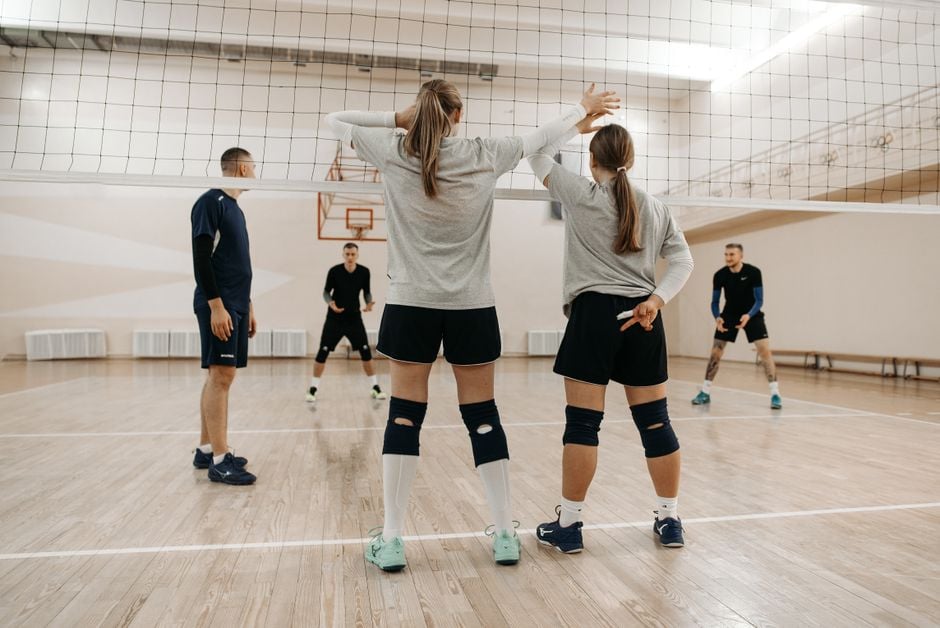
The Best Volleyball Training Aids to Improve Your Game Fast
The best volleyball training aids available right now include:
| Training Aid | Best For | Price Range |
|---|---|---|
| Solo hit and serve trainers | Serving, spiking reps | $18 – $30 |
| Weighted setting volleyballs | Setting strength and precision | $20 – $35 |
| Portable adjustable nets | Serving, passing, team drills | $50 – $580 |
| 2-in-1 net systems with ball return | Solo spiking and blocking | $100 – $200 |
| Resistance bands | Explosive power, injury prevention | $10 – $40 |
| Jump training platforms | Vertical leap development | $200+ |
| Agility ladders | Footwork and coordination | $15 – $40 |
| Professional ball machines | High-volume team training | $1,500 – $3,600+ |
Volleyball is a game built on repetition. The more quality touches you get, the faster your skills develop. But gym time with a coach is limited — and chasing balls around an empty court isn’t exactly efficient training.
That’s where the right gear makes a real difference. Whether you’re working on your serve, sharpening your sets, or building the explosive power to get above the net, targeted training tools let you get more reps in less time — on your own schedule, at your own pace.
The market has grown significantly, with options ranging from a $18 elastic spike trainer to a $3,600 professional ball machine. Knowing which tools actually move the needle — and which ones just collect dust — is what this guide is about.
I’m Kevin O’Shea, Certified Strength and Conditioning Specialist at Triple F Elite Sports Training, and my background in athletic development and sports performance gives me a clear-eyed view of which volleyball training aids deliver real results versus marketing hype. Let’s break down exactly what’s worth your money.
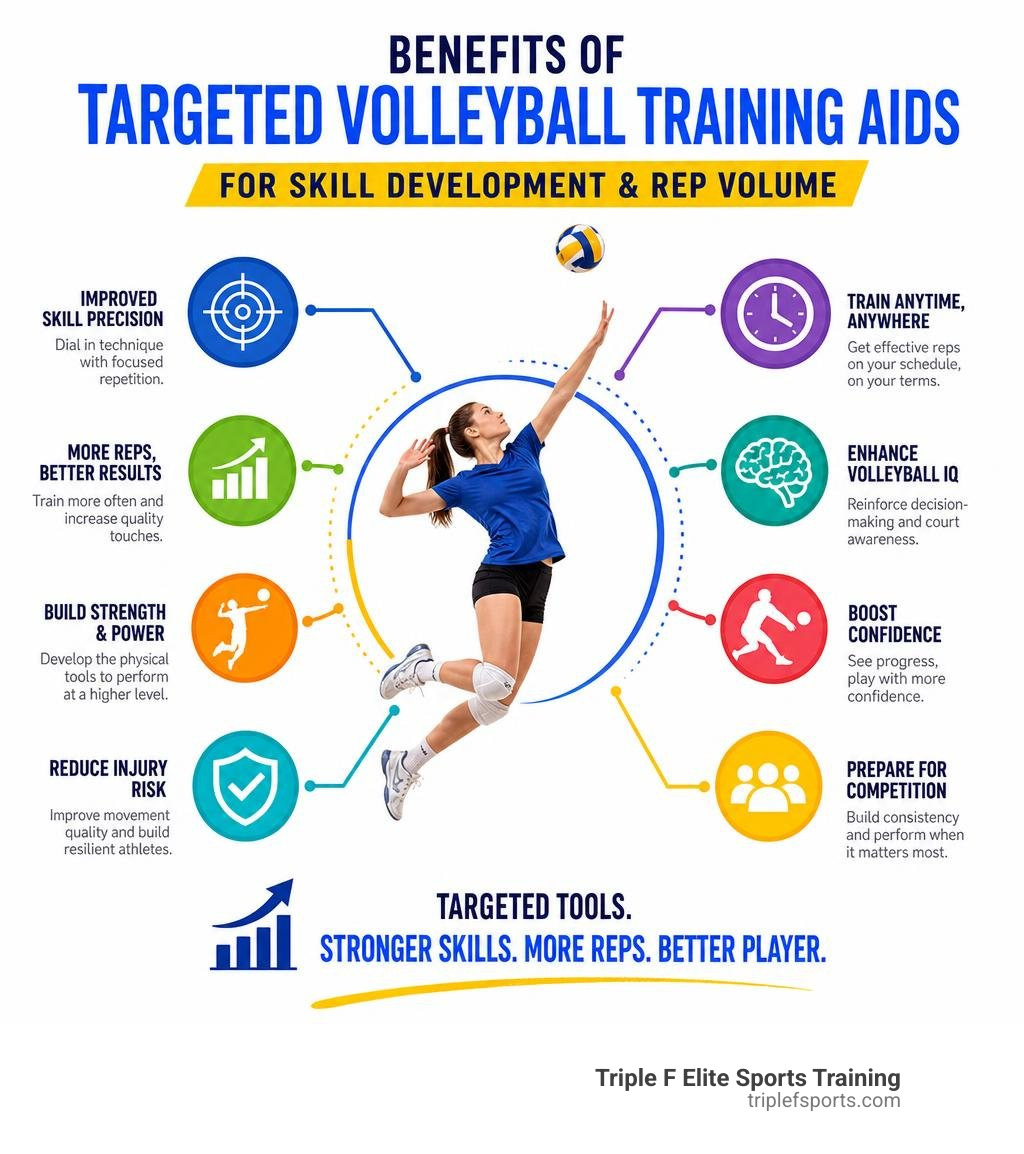
Volleyball training aids vocab to learn:
Top Types of Volleyball Training Equipment

When building out your personal or facility gear collection, it is helpful to categorize volleyball training aids by what they isolate. Are you trying to perfect a physical movement pattern, or are you hoping to maximize the number of ball contacts you can get in a 20-minute driveway session?
The best tools on the market focus heavily on muscle memory and skill isolation. By removing complex game variables—like an inconsistent setter or a chaotic defense—players can concentrate entirely on their own biomechanics. If you want to dive deeper into how these physical mechanics translate to on-court performance, check out The Ultimate Guide to Volleyball Training.
When choosing specialized training equipment, you will generally look at three categories:
- Solo Mechanics Trainers: Devices that secure the ball via elastic cords or straps, allowing you to hit, serve, or set without needing a partner to return the ball.
- Target and Rebounder Nets: Large, angled, or pocketed nets designed to catch your passes, sets, and serves, returning them to a central point so you spend less time retrieving gear.
- Athletic Development Tools: Equipment like resistance bands, agility ladders, and jump platforms that build the physiological engine behind your volleyball skills.
Let’s look at how these specific tools help you isolate and improve your game.
Essential Volleyball Training Aids for Solo Practice
Solo training is where mechanical breakthroughs happen. Without the pressure of a live scrimmage, your brain can focus entirely on the pathway of your arm swing or the positioning of your hands.
For serving and attacking, solo hit and serve trainers are incredibly popular. These training systems use an adjustable neoprene sleeve that wraps securely around any standard size 4 or size 5 volleyball. The sleeve is anchored by a high-quality elastic bungee cord that connects to an adjustable waistband.
When you toss and strike the ball, the bungee cord stretches and snaps the ball back to your torso. This design completely eliminates ball chasing, turning a session where you might get 20 hits into one where you easily smash out 100 to 150 reps. Brands like PowerNet and SKLZ dominate this space, with the PowerNet Solo Trainer holding an impressive 4.89 out of 5-star rating across hundreds of verified reviews. Users love the padded waistband, which prevents chafing during aggressive jumps and swings.
For hand-eye coordination and setting precision, weighted setting volleyballs are an absolute must-have. These balls look and feel like a standard volleyball but weigh significantly more—typically around 17 ounces (compared to a standard 9.5-ounce ball).
By practicing your sets with a weighted ball, you build the intrinsic hand, wrist, and finger strength required to push the ball from antenna to antenna with clean, quiet contact. Transitioning back to a regulation ball after a weighted session makes the standard ball feel incredibly light, instantly improving your setting distance and control. If you are just starting out and want to build a solid technical foundation, take a look at our guide on how to Stop Dropping the Ball with These Beginner Volleyball Drills.
How to Integrate Volleyball Training Aids into Team Drills
While solo gear is fantastic for home use, high-quality team training gear is what keeps group practices running at a rapid, productive pace. In a team setting, training aids should serve two purposes: creating clear visual targets and keeping ball transitions seamless.
Target nets are highly effective for this. Brands like Bownet offer specialized volleyball setting nets and practice stations that feature deep, pocketed nets. During passing or setting drills, coaches can set these target nets up in specific zones (such as target zone 3 for setters, or deep corners for servers). Instead of a player standing in the target zone to catch balls, the net does the work. This keeps every single athlete active in the drill and prevents accidental collisions.
Blocking pads are another crucial tool for team practices. These are padded, handheld shields or stationary frames that extend above the net tape. Coaches or players can hold these pads to simulate a massive, solid block without requiring players to constantly jump and risk landing on a teammate’s foot. This allows hitters to practice “tooling the block” (hitting off the hands out of bounds) or hitting around seam block setups safely.
Integrating these tools into your daily practice structures is key to maximizing team growth. For ideas on how to structure these sessions, read through our breakdown of Volleyball Skill Development Drills and Strategies for Success.
Choosing the Right Volleyball Training Aids for Your Skill Level
Not all volleyball training aids are created equal, and what works beautifully for an elite collegiate prospect might frustrate a middle school beginner. When selecting gear, you must balance skill level, budget, and portability.
To help you decide where to invest, we have put together a comparison of the most effective training aids based on player development stages:
| Skill Level | Recommended Gear | Primary Benefit | Key Feature to Look For |
|---|---|---|---|
| Beginner (Ages 8-12) | Light scrimmage vests, basic solo bungee trainers, lightweight volleyballs | Builds basic hand-eye coordination and spatial awareness without physical fatigue | Soft, adjustable waistbands and light materials |
| Intermediate (Ages 13-16) | net extender devices, weighted setting balls, portable target nets | Refines accuracy, increases serve power, and establishes proper platform control | Height adjustability and easy setup |
| Advanced / Elite | Jump platforms, heavy resistance bands, professional-grade ball machines | Develops explosive vertical jump, reaction speed, and high-velocity ball control | Heavy-duty steel frames and high-tension resistance cords |
If you are working with younger players, it is vital to keep training engaging and physically appropriate. For a collection of drills tailored specifically to this age group, check out our guide on Serve Up Success: Fun Drills for 10-13 Year Olds.
For intermediate and advanced players looking to master their hitting angles, a net extender is a game-changer. These elastic bands stretch across the top of your existing net, creating a visual “window” above the tape. Hitters must drive the ball through this specified plane, which trains them to hit deep, aggressive angles rather than simply hitting the ball down into the net or out of bounds.
Comparing Portable Nets vs. Professional Training Machines
If you are a coach, club director, or a highly dedicated player, you will eventually face a choice: do you invest in a versatile, portable net system, or do you save up for a heavy-duty, professional-grade training machine?
Let’s look at how these two categories match up across key performance indicators:
Portable Net Systems
Portable systems, such as the adjustable 2-in-1 net system, offer incredible versatility. These systems can be adjusted from youth heights up to regulation adult heights (6.5 feet to 8 feet) using simple locking knobs.
Many of these modern portable nets feature a built-in gravity funnel ball return system. When you serve or spike into the net, the ball rolls down a sloped mesh funnel and drops into a neat pile at your feet, allowing for continuous, high-volume practice.
- Durability: High-quality portable nets use powder-coated, rust-resistant steel frames and fiberglass tension poles. They are stable enough for both indoor gyms and backyard grass (often secured with sandbags).
- Value: At a price point of $100 to $200, these systems offer immense value for families and local clubs. They pack down into a single carrying bag and can be set up in under ten minutes.
Professional Training Machines
On the other end of the spectrum are professional training aids, such as the Total Attack Volleyball Machine. Priced around $3,599, these heavy-duty machines use spinning throwing wheels to launch volleyballs at precise speeds, angles, and spin rates.
- Versatility: These machines can replicate float serves, hard-driven topspin serves, and precise sets. This allows defensive players to practice serve receive and digging against elite-level pace without exhausting a coach’s shoulder.
- Durability: Built with industrial-grade steel and heavy-duty motors, these machines are designed to last decades in high-use facilities.
- Value: While highly expensive, they are an invaluable asset for competitive high school, club, and collegiate programs that require thousands of precise repetitions weekly.
No matter which equipment route you choose, building the physical strength to handle high-volume training is essential. To learn how to condition your body safely, explore our resources on How to Build Volleyball Strength Without Burning Out.
Frequently Asked Questions About Volleyball Training Gear
Choosing the right gear can feel overwhelming with so many options available. Here are answers to the most common questions we hear from athletes and parents.
What are the best training aids for improving vertical jump?
To build an explosive vertical leap, you need to focus on rate of force development—how quickly your muscles can produce maximum power. Jump platforms (such as the VertiMax platform) and heavy-duty resistance bands are the gold standard here.
By anchoring resistance bands to a platform or waist harness, you force your body to work against downward tension during your approach and takeoff. When you remove the resistance, your central nervous system fires more rapidly, resulting in a significantly higher jump. For a deeper look into what it takes to reach this level of play, see our guide on Everything You Need to Know About Elite Volleyball.
How do weighted volleyballs help setters?
Weighted volleyballs (typically 17 ounces) act as a strength-conditioning tool specifically for the small muscles in your hands, wrists, and forearms.
Regularly setting a weighted ball forces you to use proper, clean hand shape. Because the ball is heavier, you cannot rely on lazy wrist action; you must use your entire upper body and core to push the ball. This builds muscle memory, increases finger strength, and ensures that when you switch back to a standard ball, your sets are faster, cleaner, and push further across the court.
Can solo training aids replace coach-led drills?
While solo training aids are incredible for building repetition efficiency and muscle memory, they cannot completely replace coach-led training. Solo aids lack a feedback loop. A bungee trainer will return the ball to you even if your elbow drop was too low or your hand contact was sloppy.
Coaches provide technical correction, tactical understanding, and real-time adjustments that a machine or elastic cord simply cannot replicate. Think of solo gear as a way to hammer home the mechanics you learn during your coaching sessions. For tips on how to get the most out of your structured training, read our Volleyball Private Lessons: Your Survival Guide.
Conclusion
Investing in the right volleyball training aids is one of the fastest ways to accelerate your skill development, build athletic confidence, and get more enjoyment out of the sport. From simple solo bungee cords that maximize your driveway reps to advanced team target nets, the right gear helps translate hard work into real, on-court success.
At Triple F Elite Sports Training in Knoxville, Tennessee, we believe in a comprehensive, science-backed, and Christ-centered approach to athletic development. Our state-of-the-art facility offers professional performance training, physical therapy, and a dedicated volleyball club designed to unlock every athlete’s full potential.
Whether you are a beginner looking to master your first serve or an elite player striving for a collegiate roster spot, we are here to help you reach your goals. We invite you to experience our training firsthand—your first session with us is completely free.
Ready to take your skills to the next level? Elevate your game with professional volleyball training at Triple F Elite Sports Training today!