
Why At Home Catching Drills for Football Actually Matter
The best at home catching drills football players can do right now — no full field, no quarterback, no problem:
| Drill | What You Need | Key Benefit |
|---|---|---|
| Tennis Ball Wall Bounce | Tennis ball, wall | Reaction speed, soft hands |
| Fingertip Push-Ups | Football | Grip strength, ball security |
| Self-Toss High/Low | Football | Trajectory adjustment |
| One-Hand Wall Catches | Tennis ball, wall | Hand-eye coordination |
| Over-the-Shoulder Self-Toss | Football | Tracking the deep ball |
You know the feeling. The ball hits your hands perfectly — and you drop it. It happens at every level, from youth leagues to college. And most of the time, it’s not a talent problem. It’s a technique problem you can fix at home, today, with nothing but a ball and a wall.
The good news? Research from coaches at every level confirms that daily repetition of simple drills — fingertip catches, wall bounces, high-and-low ball work — builds the muscle memory and hand-eye coordination that eliminates drops over time. One widely shared coaching insight puts it plainly: catching success is 25% technique, 25% want, and 50% concentration. All three are trainable.
I’m Kevin O’Shea, a Certified Strength and Conditioning Specialist and Wide Receiver Coach who played college football at Franklin & Marshall — the same at home catching drills football players often overlook were foundational to my own development as a receiver. Let’s get into exactly what works.
Essential at home catching drills football terms:
The Science Behind At Home Catching Drills Football Players Need
To stop dropping passes, we have to look at what actually happens when a football meets your hands. Many players assume that great catchers are simply born with massive hands or supernatural reflexes. While having giant hands is certainly a nice genetic head start, catching is primarily an engineered, repeatable process.
When you commit to a routine of at home catching drills football athletes can perform solo, you are essentially training your central nervous system. You are building what we call the “visual-motor loop.”
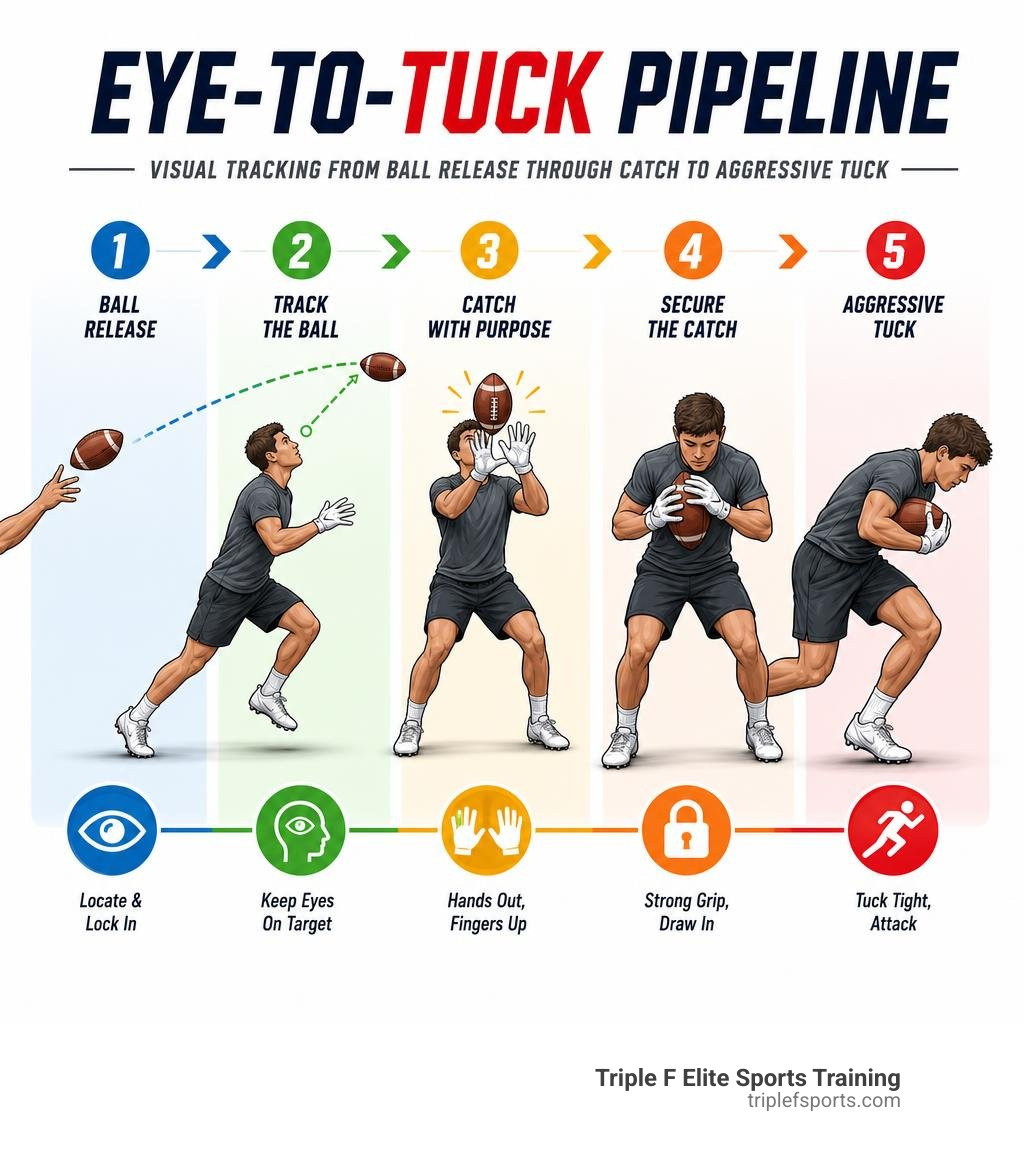
Most drops do not happen because a player has “bad hands.” Instead, research shows that nearly 90% of drops occur during the transition phase—the split second between the ball making contact with the hands and the receiver tucking it away. When you are worried about an oncoming defender or looking upfield to run before securing the ball, your eye-to-tuck pipeline breaks down.
By practicing at home in a controlled, low-stress environment, you remove the distraction of defenders. This allows you to isolate and perfect your hand positioning, fingertip control, and visual tracking. Over time, this deliberate practice turns a conscious effort into an automatic reflex. When you master these basic movements, you lay the foundation for advanced playmaking. You can explore how these fundamentals integrate into your overall development in The Ultimate Beginner Guide to Football Basic Drills.
Furthermore, we must address the grip itself. Many young athletes make the mistake of catching the ball with their palms. When the ball hits your palms, it bounces. Palms are hard, unforgiving surfaces. Fingertips, however, are soft, adjustable, and act like natural shock absorbers. To dive deeper into the mechanics of why fingertip catching is superior, check out this comprehensive guide on How to Catch a Football Better: Receiver Drills That Actually Work.
Essential Solo Drills for Soft Hands and Fingertip Control
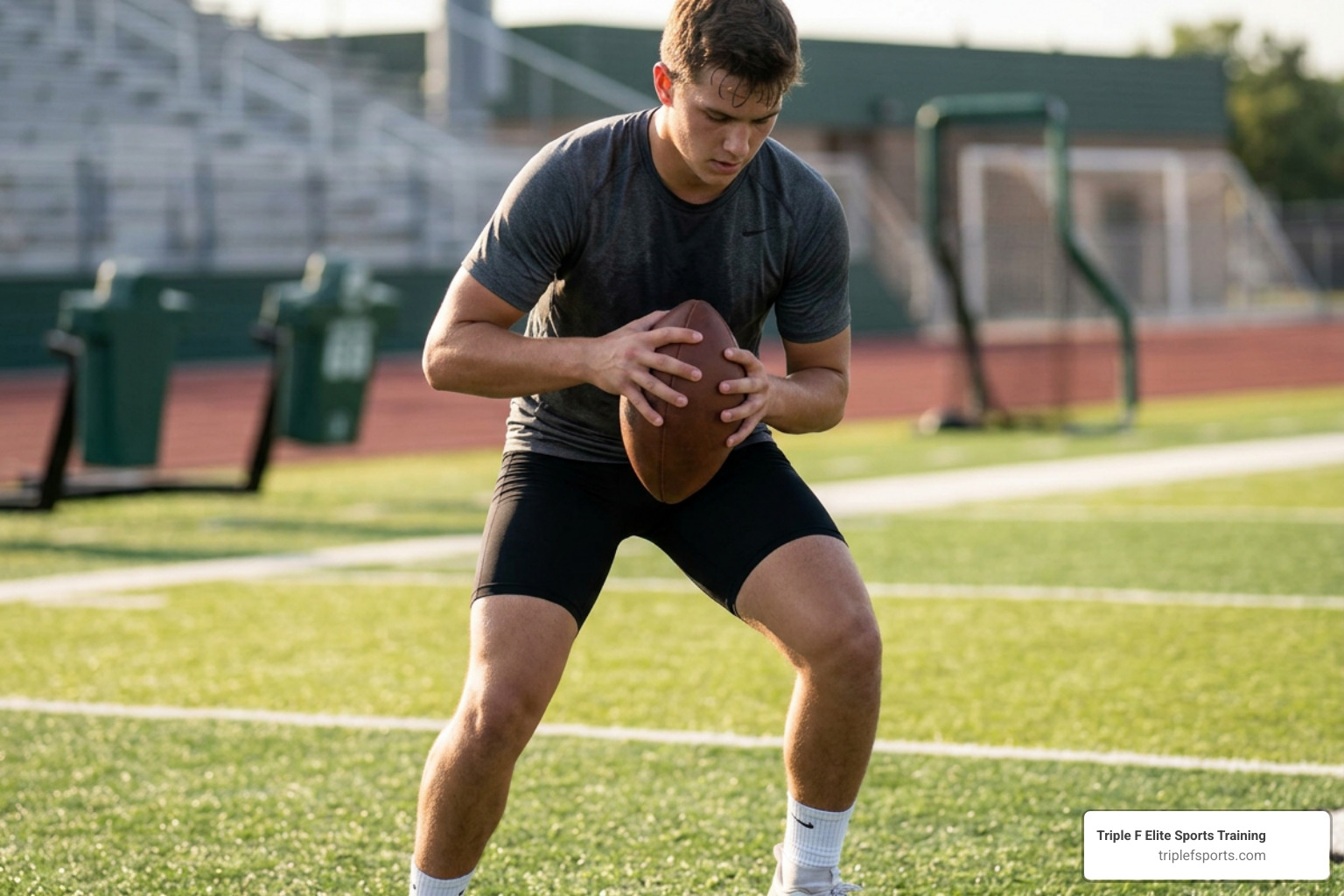
To develop “soft hands”—meaning hands that absorb the momentum of the ball quietly rather than clapping against it—you must train your fingers to do the heavy lifting. If your catches sound like a loud slap, you are catching with your palms. We want our catches to be nearly silent.
To accelerate this transformation, you can utilize specialized training aids. For example, the Great Catch – SKLZ US is a fantastic tool that features rubberized micro-balls that sit in the palms of your hands. This physically prevents you from using your palms, forcing your fingertips to secure the football.
If you don’t have specialized gear, do not worry. You can achieve incredible results using simple household items like tennis balls or even just a standard wall. Dedicating just 10 to 15 minutes a day to these drills will yield noticeable improvements. For a structured approach to elevating your overall game, take a look at our guide on How to Improve Your Football Skills in 30 Days.
Solo At Home Catching Drills Football Players Can Do with a Wall
The wall is your ultimate, tireless training partner. It never throws a bad pass (unless you do), it never gets tired, and it always returns the ball.
1. The Tennis Ball Wall Bounce
- How to do it: Stand roughly 5 to 8 feet away from a sturdy brick or concrete wall. Hold a tennis ball in one hand. Toss the ball underhand against the wall and catch it with the same hand on the rebound.
- The Focus: Catch the tennis ball using only your fingertips. Avoid letting it smash into your palm. Keep your eyes locked on the ball until it is securely in your grasp.
- Repetitions: Perform 50 reps with your dominant hand, then switch and do 50 reps with your non-dominant hand.
- Progression: To make this drill more challenging, try catching the ball with one eye closed, or stand closer to the wall to force a faster reaction time.
2. The Alternating Wall Shuffle
- How to do it: Face the wall and throw the tennis ball with your right hand, but catch it with your left. Immediately throw it back with your left hand and catch with your right.
- The Focus: This drill forces your brain to rapidly switch focus from throwing to catching, which dramatically improves hand-eye coordination.
- Repetitions: 3 sets of 30 seconds.
Fingertip Push-Ups and Grip Taps for Ball Security
Grip strength is the unsung hero of ball security. If your hands are weak, defenders will easily strip the ball, and heavy passes will slip through your fingers. You can build elite grip strength right in your bedroom.
1. Fingertip Push-Ups
- How to do it: Assume a standard push-up position, but instead of placing your palms flat on the floor, elevate yourself onto the tips of your fingers and thumbs. If this is too difficult at first, perform them with your knees on the ground.
- The Focus: Keep your fingers strong and spread wide. Do not let your knuckles collapse toward the floor.
- Repetitions: 3 sets of 8 to 10 repetitions.
- Why it works: This builds immense strength in the small muscles of your hands and forearms, directly translating to a stronger grip on the football.
2. Grip Taps and Ball Squeezes
- How to do it: Hold a football out in front of you with both hands. Rapidly tap the ball back and forth between your fingertips, moving it up and down from your chest to above your head. After 30 seconds of tapping, hold the ball with one hand and squeeze it as hard as you can for 10 seconds, attempting to “pop” it.
- Repetitions: Repeat this sequence 3 times for each hand.
- Connection: Developing this foundational strength is a key component of youth athletic growth, which we discuss in detail in Youth Football Training 101.
Mastering Different Pass Trajectories Alone
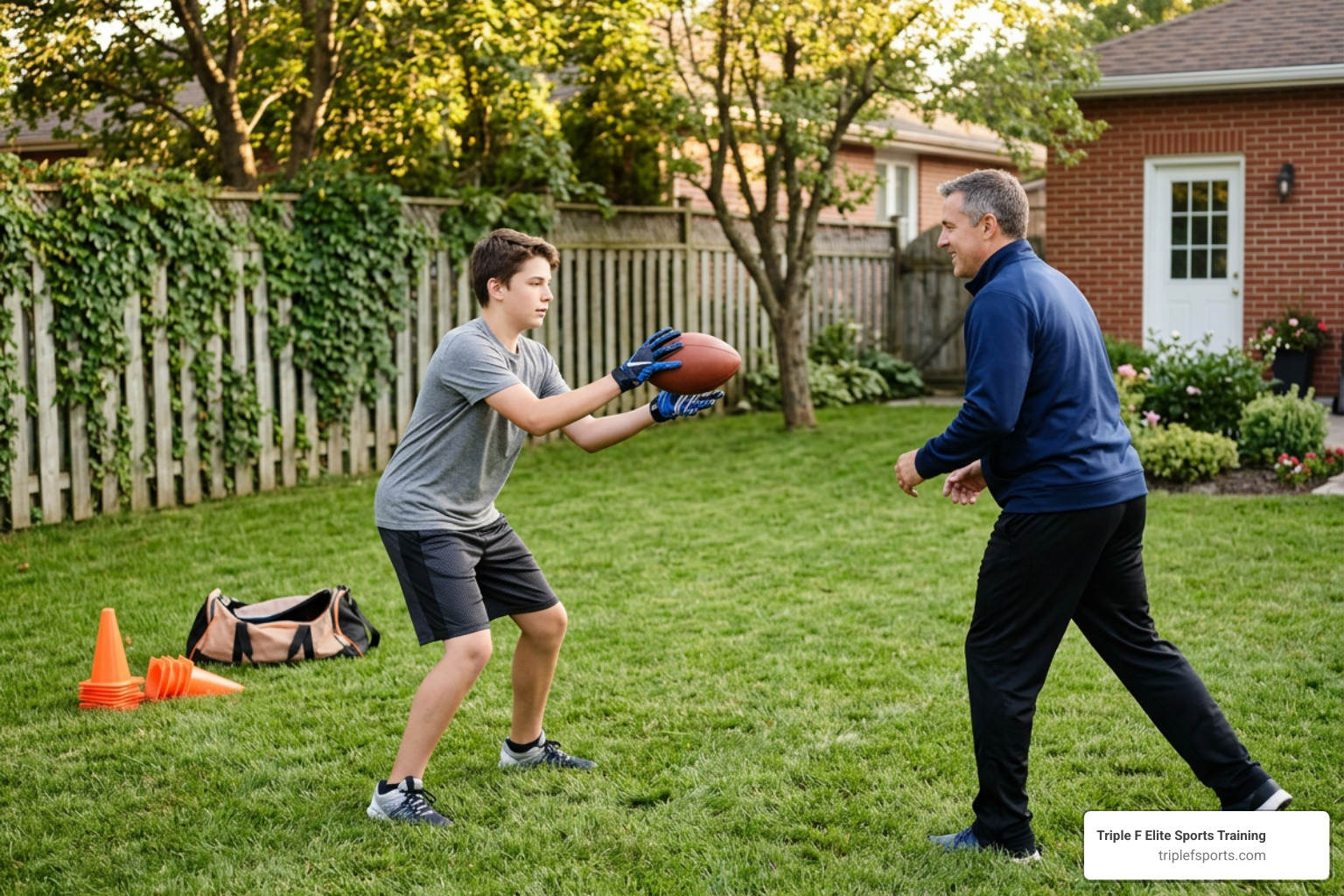
In a real game, you will rarely receive a perfect, chest-high spiral while standing completely still. You must be prepared to adjust your body to catch passes thrown high, low, or over your shoulder while running at full speed.
Training for these varied trajectories requires you to understand proper body alignment and hand configuration. When you master these shapes, you can adjust to poorly thrown balls on the fly. To understand how trajectory adjustment fits into a comprehensive training regimen, explore our insights on Beyond the Basics: Key Components of Football Sports Specific Training.
High and Low Ball Adjustments: Diamond vs. Basket Techniques
Your hands must adapt to the height of the incoming ball. There are two primary hand positions that every receiver must master:
The Diamond Technique (Above the Waist)
When a ball is thrown above your waist, your hands should form a diamond shape.
- How to form it: Extend your arms toward the ball. Bring your index fingers and thumbs close together, creating a diamond-shaped window.
- Why it matters: This positioning ensures that the nose of the football is stopped by the strongest part of your hands. If your hands are spread too wide, the ball will fly straight through your arms and hit you in the chest or face.
- Drill: Stand in place, toss the football high into the air yourself, and focus on securing it at its highest point using the diamond technique.
The Basket Technique (Below the Waist)
When a ball is thrown low (below your waist) or when you are running a deep route where the ball is dropping over your shoulder, you must use the basket technique.
- How to form it: Keep your pinky fingers together and cup your hands, creating a natural “basket” to catch the ball.
- Why it matters: Trying to use a diamond shape on a low ball forces your wrists into an unnatural, stiff position, leading to drops. Cupping your hands allows you to scoop the ball safely.
- Drill: Perform self-tosses where you deliberately throw the ball low and away from your body, forcing yourself to bend at the knees and scoop the ball with your pinkies together. For more foundational catching tips, see How to Catch a Football.
Advanced Progressions for At Home Catching Drills Football Athletes
Once you have mastered the basic wall bounces and self-tosses, it is time to increase the difficulty. We want to simulate the chaotic nature of a football game.
1. The “Behind the Doorframe” Drill (At-Home Goalpost Adaptation)
This is an excellent home adaptation of the classic college “Behind the Goalpost” drill.
- How to do it: Stand behind a doorframe or a sturdy outdoor post at your house. Extend your arms past the frame so your hands are on the other side, but your face and body are shielded by the post. Have a family member throw passes to you, or toss the ball against a nearby wall so it rebounds past the post.
- The Focus: Because the post blocks your view of the ball until the very last microsecond, this drill forces your eyes to snap to the target instantly. It also prevents you from body-catching, as your hands must reach out to secure the ball before it hits the frame. You can learn more about the mechanics of this classic drill in Master the Fundamentals: The “Behind the Goalpost Drill” for Polished Wide Receiver Hands.
2. Self-Toss with Distraction Claps
- How to do it: Toss the football high into the air. Before you catch it, you must clap your hands behind your back, touch the ground, and then quickly bring your hands back into position to make the catch.
- The Focus: This drill trains rapid hand redeployment and simulates the sudden adjustments needed when a defender hand-swipes at you.
- Repetitions: 3 sets of 10 successful catches.
- Strength Connection: Maintaining body control during these quick movements requires a strong athletic foundation. Learn how to build that foundation in The Football Strength Program for Future Pros. For additional solo catching variations, check out Four Drills for Catching a Football – CoachUp Nation.
Frequently Asked Questions About Football Catching Drills
How can I improve my catching if I don’t have large hands?
Hand size is an advantage, but fingertip control and grip strength are far more important. If you have smaller hands, focus on building elite grip strength through fingertip push-ups and grip squeezes. Additionally, spend extra time on tennis ball wall drills. Because a tennis ball is much smaller than a football, it forces your visual system and fingers to work with extreme precision. When you return to a regulation football, it will feel much larger and easier to secure.
What is the “Eye-to-Tuck” pipeline and why does it prevent drops?
The Eye-to-Tuck pipeline is the continuous visual tracking of the football from the air all the way into your secure arm tuck. Most drops occur because a receiver looks away to run before the ball is fully secured. To train this, use the Two-Whistle Drill: after making a solo catch, hold the ball tucked tightly against your ribs and stare directly at the ball’s laces for a slow count of three before moving. This trains your brain to separate the act of catching from the act of running.
Can I practice catching drills at home without a partner?
Absolutely. At least 50% of your catching development can happen entirely solo. By utilizing a solid brick wall, tennis balls, and self-toss variations, you can easily get 150 to 200 quality catches in a single 15-minute session. This high-volume repetition is actually much harder to achieve in a team practice setting where you have to wait in line for your turn.
Conclusion
Becoming a receiver with “glue hands” doesn’t happen by accident. It is the result of consistent, daily execution of the boring fundamentals. By taking just 15 minutes out of your day to work on these at home catching drills football players can perform solo, you will build the muscle memory, grip strength, and visual tracking necessary to dominate on game day.
At Triple F Elite Sports Training in Knoxville, TN, we specialize in helping athletes unlock their full potential through science-backed, professional athletic development. Whether you are looking to improve your speed, power, or position-specific skills, our expert coaches are here to design a personalized pathway to your success.
Ready to take your skills to the next level? Come visit our state-of-the-art facility in Knoxville and experience our elite training programs firsthand. Claim your free first training session with us today!