
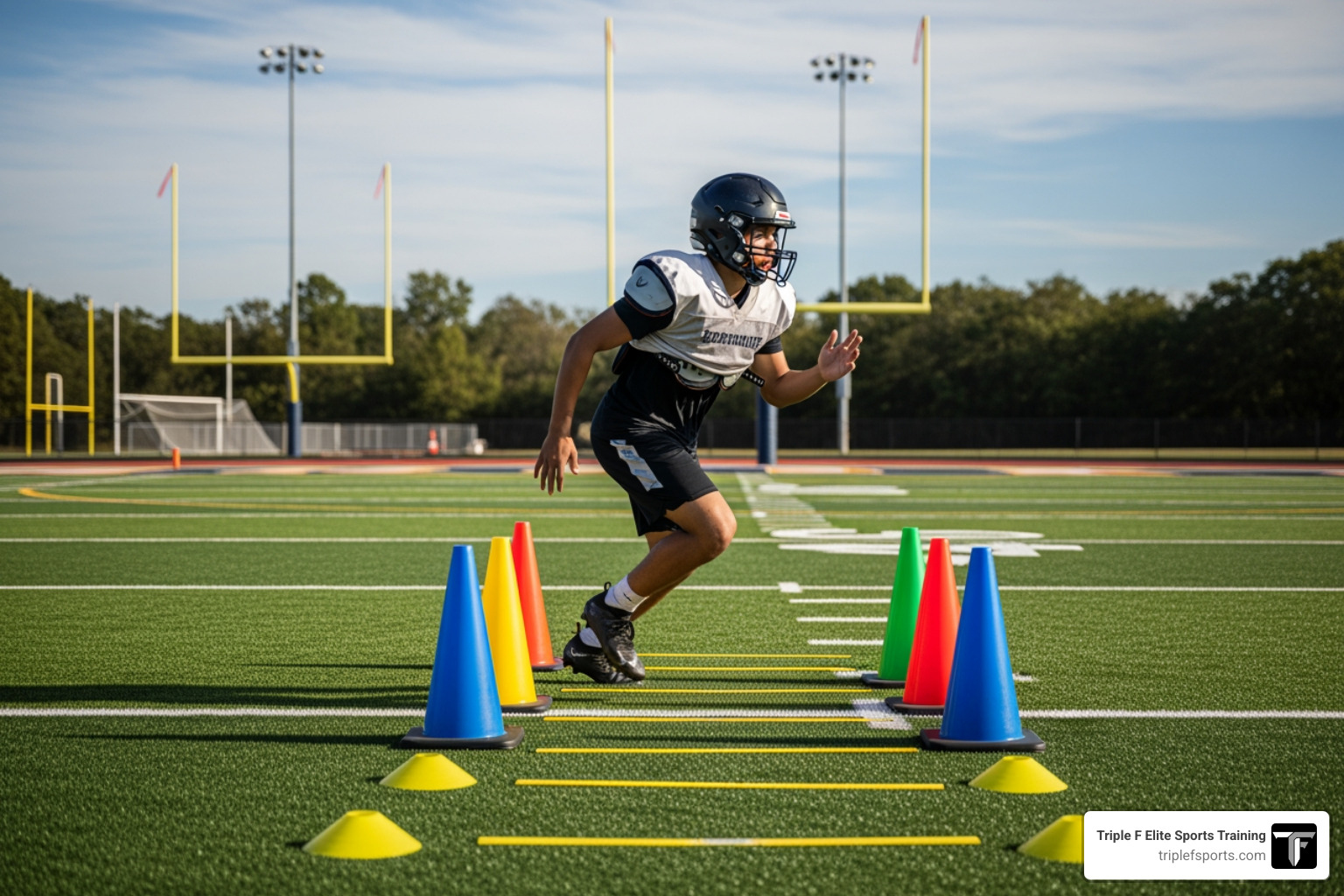
Why Football Skills Training Is the Fastest Path to Leveling Up Your Game
Football skills training is the structured practice of the physical, technical, and tactical abilities that make athletes better on the field — and if you want to improve fast, here is exactly what it involves:
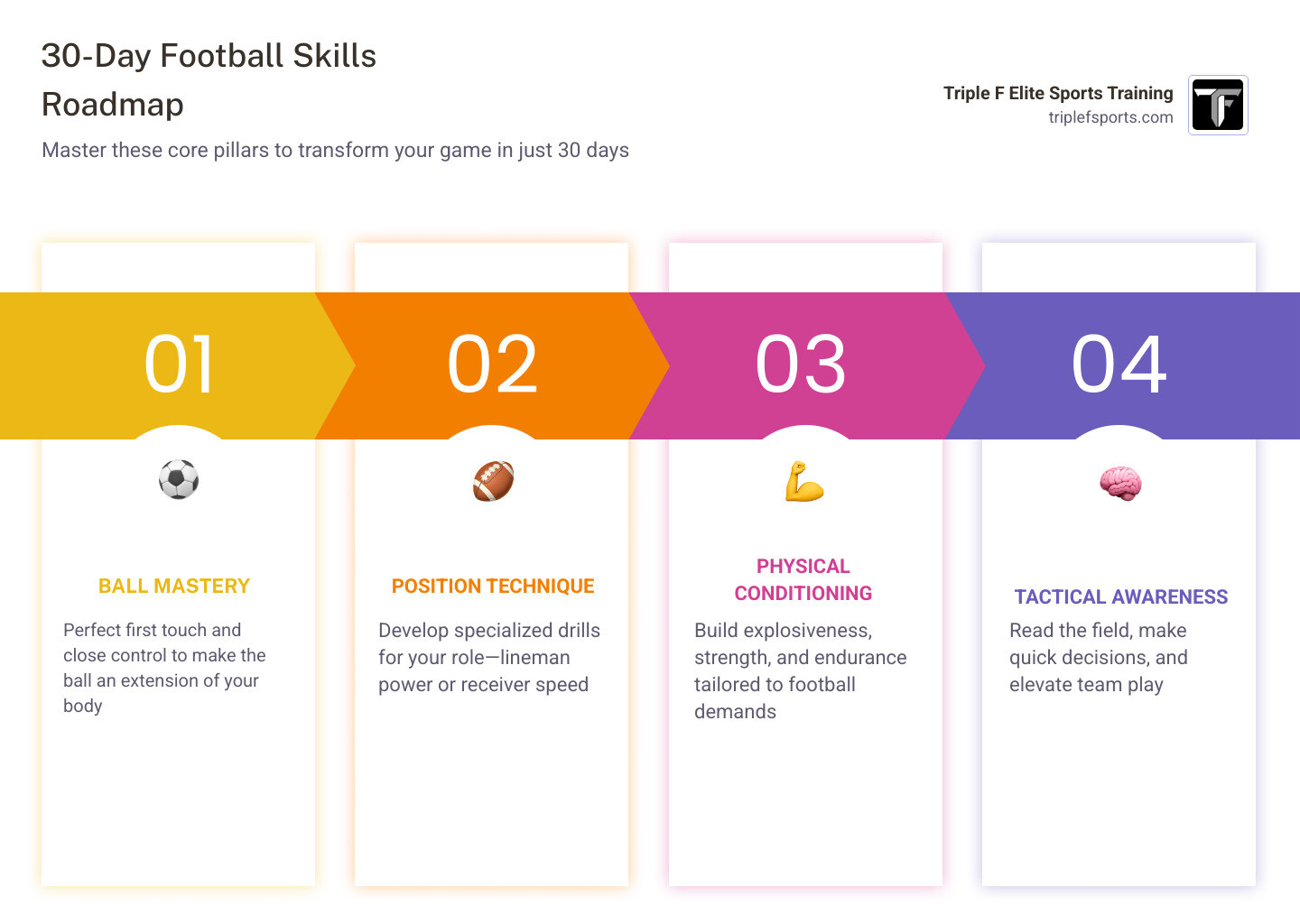
The core pillars of effective football skills training:
- Ball mastery and first touch — control the ball before you can do anything else with it
- Position-specific technique — linemen, receivers, backs, and defenders all train differently
- Physical conditioning — explosiveness, endurance, and strength built for the demands of the game
- Tactical awareness — reading the field, pressing as a unit, and making faster decisions
- Mental preparation — visualization, consistency, and confidence under pressure
- Film study and game analysis — understanding why plays succeed or fail
The difference between a good player and a great one often comes down to a single moment — a first touch that sets up a score, or a first step that beats a defender. According to coaching research, that first touch is the most critical skill in football because it dictates everything that happens next.
This guide gives you a complete 30-day roadmap to improve across all of these areas — whether you are a youth athlete just getting started or a high schooler pushing toward the next level.
I’m Kevin O’Shea, a Certified Strength and Conditioning Specialist and former college wide receiver at Franklin & Marshall College, with additional experience as a Wide Receiver Coach and Passing Game Coordinator at the high school level — all of which directly informs my approach to football skills training at Triple F Elite Sports Training. That combination of playing experience, coaching success, and certified athletic development gives me a unique lens for building complete, confident football players.
The Foundation of Football Skills Training: Ball Mastery and Control
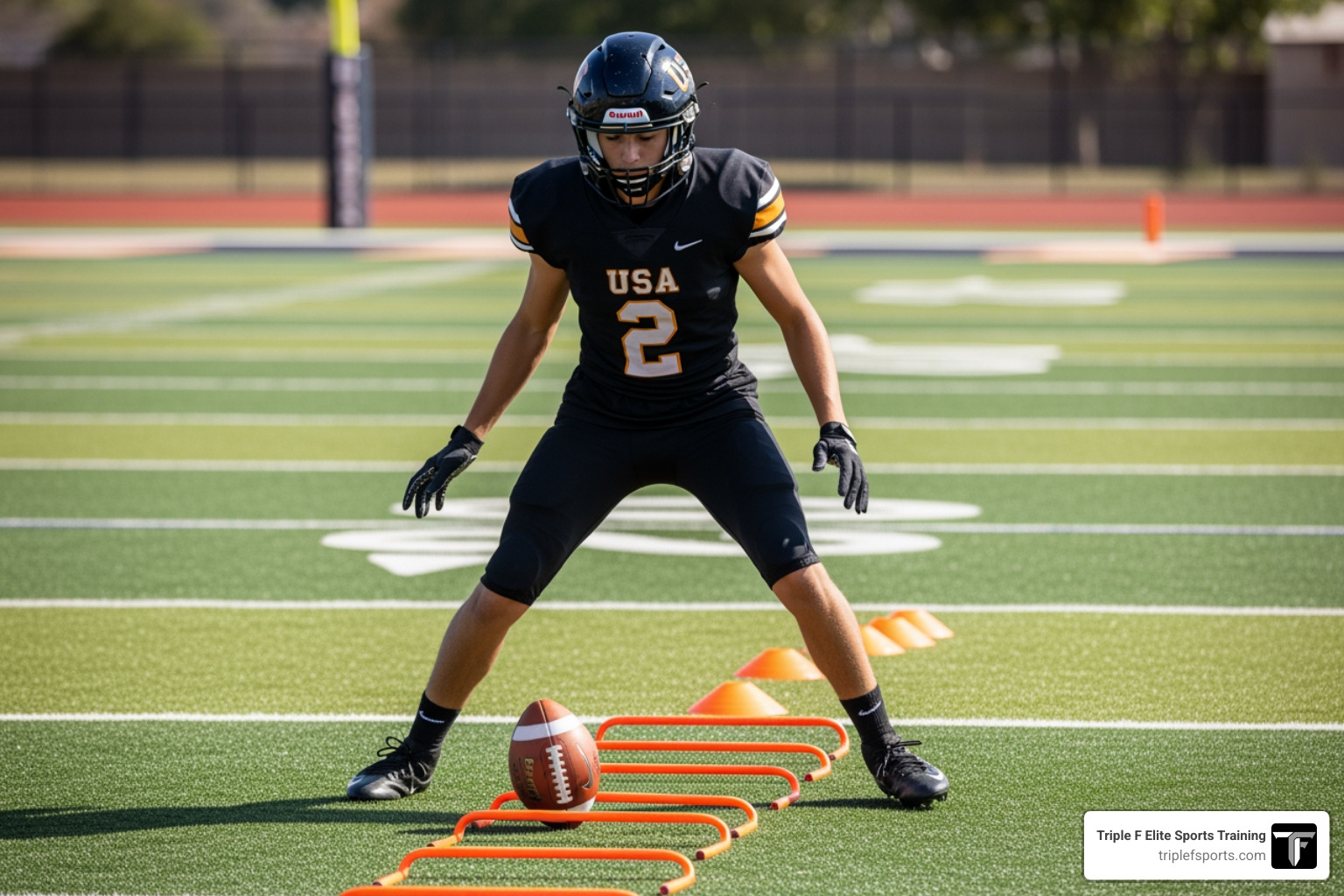
Before we can talk about deep routes or complex blocking schemes, we have to talk about the ball. In May 2026, the game is faster than ever, and the athletes who stand out are the ones who look like the ball is an extension of their own body. This is where ball mastery comes into play.
Ball mastery is the technical foundation of the game. It is the difference between a player who controls the game and a player who is controlled by it. While “dribbling” refers to moving with the ball past an opponent, ball mastery is the broader comfort level you have with the ball using every surface of your foot—the inside, outside, sole, laces, and even the heel.
At Triple F, we believe that basic drills are the “secret sauce” to elite performance. If you can’t cushion a high-velocity pass or maintain close-control while sprinting, your tactical knowledge won’t matter. We focus on the “cushioning” technique, where you meet the ball and retract slightly upon impact to kill its momentum, keeping it within your “playing circle.”
Mastering the Fundamentals of Football Skills Training
To see real gains in 30 days, your football skills training must prioritize these five core technical areas:
- Control-Receiving: Learning to use the inside of the foot to create a large surface area for the ball to hit.
- Passing Accuracy: Using the instep for short, controlled passes and the laces for long-range power.
- Shooting Power: Driving through the center of the ball while keeping your non-kicking foot pointed toward the target.
- Tackling Mechanics: Focusing on “breakdown” position—knees bent, chest up—to ensure safety and leverage.
- Heading Safety: Using the forehead (the hairline area) and the power of the core, rather than just the neck, to redirect the ball.
For those training at home, Nike’s essential drills suggest that consistency beats intensity. Practicing these fundamentals for 30 minutes, three times a week, can lead to measurable improvements in touch and speed within just 21 to 28 days.
Correcting Common Faults in Receiving and Ball Control
Even elite athletes fall into bad habits. One of the most common faults we see in youth football training is the “heavy touch”—where the ball bounces several feet away upon contact. This usually happens because the ankle isn’t locked or the player is “stabbing” at the ball rather than cushioning it.
Another major fault is “ball watching.” If your head is down, you are playing blind. We teach our Knoxville athletes to “scan” the field before the ball even reaches them. By checking your shoulder, you know exactly where the defender is, allowing your first touch to move the ball away from pressure and into open space.
Position-Specific Development and Tactical Intelligence
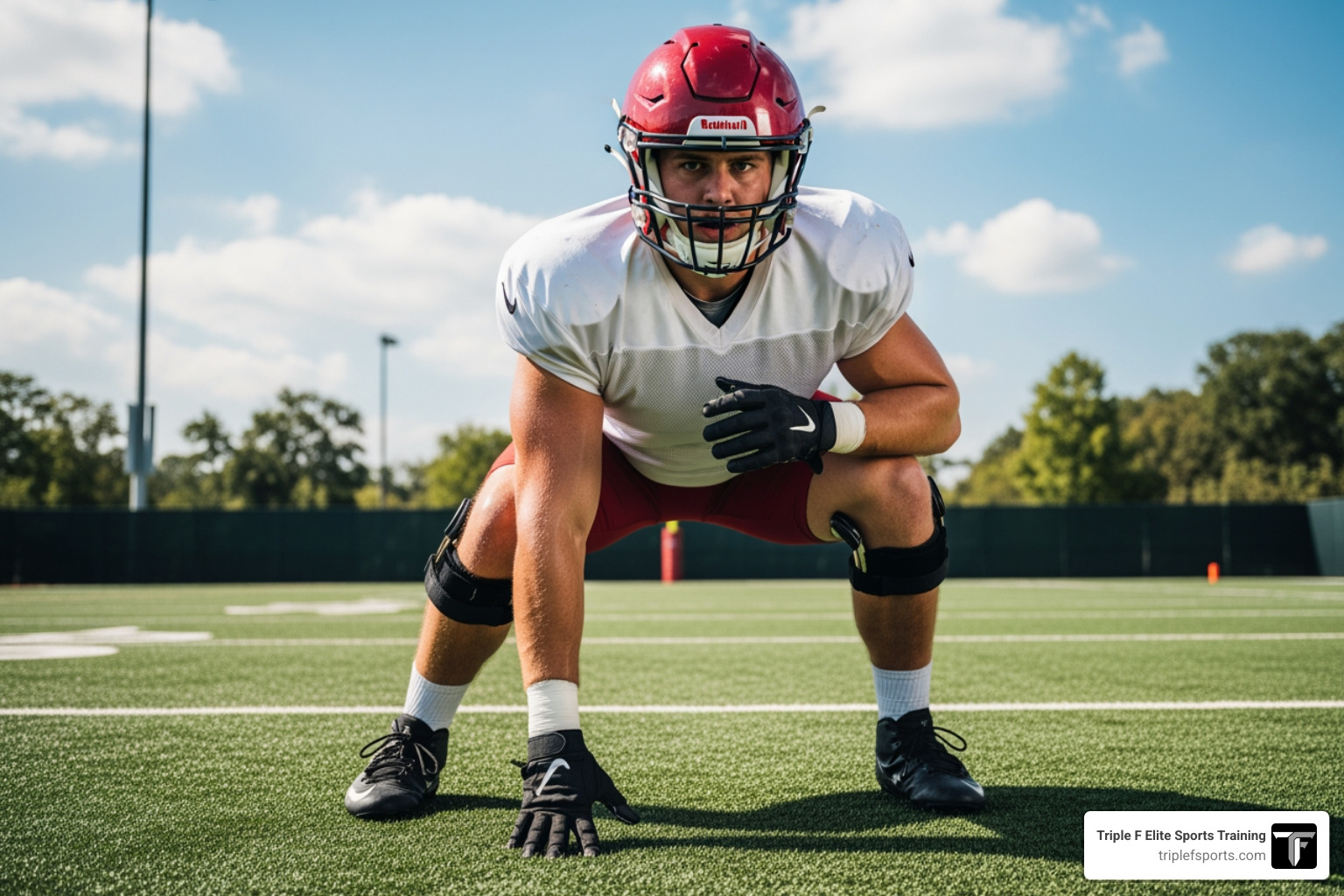
As players move from the “play phase” into competitive levels, general training isn’t enough. You need to understand the “how” and “why” of your specific role on the field. This is why position-specific football skills training is the gold standard for development.
Whether you are looking for wide receiver training to master your route tree or offensive line training to improve your pass protection sets, the focus should be on “game-speed” reps. In 1-on-1 sessions, we can break down the biomechanics of a release or a pull-block. In group sessions, we introduce the chaos of the game, forcing you to apply those techniques against a live opponent.
Defensive Drills for Pressing, Marking, and Intercepting
Defense isn’t just about effort; it’s about geometry and synchronization. Sports-specific training for defenders focuses on “coverage shells” and pressing zones.
For younger players or those in flag leagues, we emphasize “flag pulling” as a technical skill—positioning the body so the opponent is funneled toward the sideline. For tackle football, we focus on “intercepting the line of scrimmage,” teaching linebackers how to read the “guards’ keys” to anticipate whether the play is a run or a pass. The goal is to move as a single unit; if one player presses, the rest must cover the space behind them.
Elite Finishing and Goalkeeping Fundamentals
For the attackers, finishing drills should focus on using momentum. A great striker doesn’t stop to beat a defender; they use a “shoulder feint” to off-balance the opponent and then drive into the space created.
Goalkeepers, on the other hand, require a unique blend of neuroscience and physics. We train our keepers to reduce “visual latency”—the time it takes for the brain to process the ball’s flight. By using a “micro-hop” (a tiny 2–3 Hz bounce) in the set position, a keeper stays in a state of “elastic readiness,” allowing for explosive diving. Furthermore, distribution must be fast; a keeper should look to release the ball within 1.5 to 2.0 seconds to catch the opposition before they can reset their defense.
Physical Conditioning: Explosiveness, Strength, and Recovery
You can have all the skill in the world, but if you’re gassed by the fourth quarter, those skills will fail you. A comprehensive strength program is about more than just lifting heavy weights; it’s about building a body that can withstand the specific stresses of football.
A proper session must begin with a 25-minute warm-up. This isn’t just jogging; it’s about “active” preparation. We start with 5 minutes of aerobic movement, followed by 10 minutes of dynamic stretching (focusing on the hip flexors, hamstrings, and calves), and ending with 10 minutes of high-intensity drills.
Post-training, the cool-down is non-negotiable. This is when we disperse lactic acid to prevent that next-day stiffness. Skipping the cool-down is the fastest way to invite injury.
Plyometrics, Rhythm Drills, and Explosive Speed
Explosiveness is won in the “trenches” and on the perimeter through lineman-specific workouts and speed drills. We focus on “shin angles”—specifically a 35–45 degree forward lean during acceleration. This angle allows you to project force horizontally, driving your center of mass forward.
Plyometrics, like box jumps and lateral bounds, should be “micro-dosed” throughout the week. We aim for high-quality reps with ground contact times under 120 milliseconds. If you’re spending too long on the ground, you’re not being explosive; you’re just jumping. We also monitor Central Nervous System (CNS) fatigue, ensuring athletes have 48–72 hours between high-intensity speed sessions to fully recover.
Aerobic vs Anaerobic Fitness for Modern Football
Football is a game of “stop and go,” which means you need both aerobic and anaerobic fitness.
- Aerobic Fitness: Built through steady-pace runs (20-30 minutes) to improve your overall engine.
- Anaerobic Fitness: Built through “Fartleks” (speed play) or shuttle runs.
For flag football drills, we often use 30-second sprint intervals followed by 1-minute rests. This mimics a real drive on the field. If you don’t have a gym, you can build core stability at home with planks and Russian twists, which improve your ability to rotate explosively during a tackle or a throw.
Advanced Performance: Film Study and Recruiting
At the elite level, the game is played between the ears. Mastering coaching and training involves more than just physical reps; it requires film study. By reviewing your own gameplay, you can identify “false steps” in your footwork or “tells” in your stance that give away the play to the opponent.
We also assist athletes with collegiate recruiting consulting. This includes breaking down opponent scouting reports to understand their tendencies. If you know a defensive back always bites on the first move, you can use a double-move to leave them in the dust.
Age-Appropriate Football Skills Training Progressions
Training must match the athlete’s developmental stage. We follow a structured playbook for young players:
- Ages 4-6 (Play Phase): Focus on imaginative games (like “Aliens and Asteroids”) to build a love for the ball.
- Ages 7-11 (Foundation Phase): This is the “golden age” of technical excellence. We focus on thousands of touches to build “automatic” ball control.
- Ages 12-16 (Youth Development): We move into tactical application—understanding formations, pressing as a team, and specialized position work.
The 30-Day Weak Foot Challenge
One of the best ways to transform your game in a month is to master your weak foot. Being two-footed makes you unpredictable. If a defender knows you can only go right, they’ve already won.
Our 30-day challenge involves 15 minutes of daily focused work:
- Days 1-7: Foundation (sole rolls, toe taps, and simple wall passing).
- Days 8-15: Dynamic control (dribbling in figure-eights).
- Days 16-23: Pressure (practicing weak-foot shots while moving).
- Days 24-30: Refinement (using the weak foot in small-sided games).
Consistency is more important than intensity here. Five minutes of weak-foot passing against a wall every single day will do more for your coordination than one three-hour session once a week.
Frequently Asked Questions
How long should a proper football warm-up and cool-down last?
A high-quality warm-up should last at least 25 minutes to properly increase core temperature and prime the nervous system. The cool-down should last 10–15 minutes, focusing on static stretching and deep breathing to aid recovery.
Can I improve my football strength without access to a weight room?
Absolutely. Bodyweight exercises like lunges, push-ups (with a “clap” for explosiveness), planks, and “suicide” shuttle runs can build significant functional strength and stability.
Why is position-specific training better than general athletic drills?
General drills make you a better athlete; position-specific training makes you a better football player. It teaches you the exact biomechanics, sightlines, and reaction patterns you will face on Friday nights or Saturday afternoons.
Conclusion
Improving your football skills in 30 days isn’t about luck; it’s about a commitment to the “how” and “why” of the game. At Triple F Elite Sports Training in Knoxville, Tennessee, we offer professional, Christ-centered athletic development designed to help you reach your full potential. Whether you’re a “Young Dawg” just starting out or an elite athlete preparing for a college combine, our staff—with over 30 years of professional experience—is here to guide you.
Ready to see the difference specialized training can make? Unlock your potential with professional football skills training and sign up for your free first session with us today. Let’s get to work.