

Why Your Agility Training Program Determines Your Athletic Ceiling
A solid agility training program is the difference between an athlete who reacts and one who hesitates — and in sports, hesitation costs you.
Quick Answer: What Should an Agility Training Program Include?
| Component | What to Do | How Often |
|---|---|---|
| Dynamic warm-up | Skips, shuffles, hip openers, ankle pogos | Every session |
| Footwork drills | Ladder, line, and dot drills | 2-3x per week |
| Change-of-direction drills | Cone drills (T-test, 5-10-5, 3-cone) | 2-3x per week |
| Acceleration/deceleration | Wall drills, falling starts, stick landings | 2-3x per week |
| Strength + plyometrics | Squats, bounds, box jumps | 2-3x per week |
| Progress tracking | Timed tests every 4-6 weeks | Monthly |
Research shows that athletes following a structured program improve their change-of-direction speed by 5-10% in just 6-8 weeks. That’s not a small edge — that’s the gap between getting beat off the line and making the play.
Most athletes skip the fundamentals. They run random drills, skip warm-ups, and wonder why their feet still feel slow. This guide fixes that. Whether you’re just getting started or looking to sharpen elite-level movement, you’ll find a clear, progressive path here — from your first cone drill to full sport-specific training.
I’m Kevin O’Shea, a Certified Strength and Conditioning Specialist and former college wide receiver who has coached athletes through every level of an agility training program — from foundational footwork to position-specific cutting mechanics. My hands-on background in both athletic development and high school football coaching shapes every recommendation in this guide.
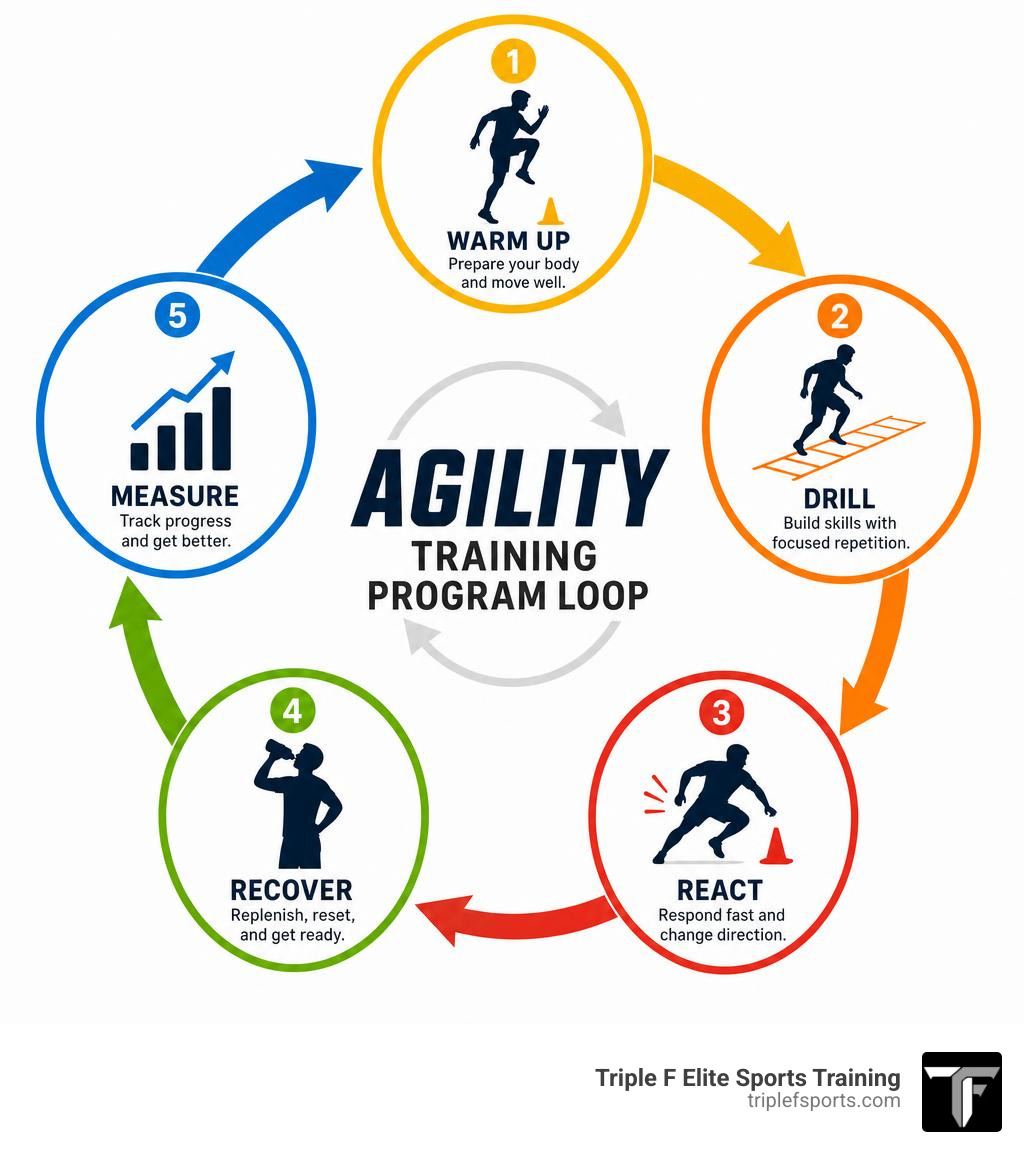
Agility training program terms explained:
What Agility Training Is and Why Athletes Need It
When most people think of agility, they think of fast feet. But true agility is a complex blend of physical and cognitive skills. It is the ability to rapidly change direction, accelerate, and decelerate while maintaining complete body control, balance, and coordination in response to a stimulus.
In the chaos of a live game, you cannot plan your next move. You have to react to an opponent’s cut, a bad bounce of the ball, or a sudden change in play. That is why an effective agility training program does not just train your muscles; it trains your brain to send faster, more precise signals to your body. By keeping a low center of gravity, minimizing ground contact time, and improving your proprioception (your brain’s awareness of where your limbs are in space), you unlock the explosive power required to dominate on the field or court.
Agility vs. Speed vs. Quickness
While these three terms are often used interchangeably, they are distinct athletic qualities:
- Linear Speed: This is your absolute velocity in a straight line (e.g., a 40-yard dash). It is about how fast you can cover distance from point A to point B when there are no obstacles in your way.
- First-Step Quickness: This is your explosive acceleration over a tiny distance. It is your ability to burst out of a static stance before your top-end speed even kicks in.
- Agility: This is speed and quickness combined with cognitive reaction time and cutting mechanics. It includes your shuffle speed, backpedal, hip turn, and foot placement under game-like pressure.
Without agility, straight-line speed is useless the moment a defender steps in front of you. You need to be able to handle sport chaos.
The Athletic Benefits of Agility Training
If you commit to a structured routine 2 to 3 times per week, the physical adaptations are profound. You can expect a 5-10% improvement in change-of-direction speed in as little as 6 to 8 weeks.
Additionally, agility drills develop explosive power and reactive strength, which directly translate to a higher vertical jump and faster sprint performance. By strengthening the stabilizing muscles around your ankles and knees, you build joint control and reduce your risk of non-contact injuries. For youth athletes in Knoxville, developing these movement foundations early builds athletic confidence that lasts a lifetime. For advanced athletes, it refines the micro-movements that make them unguardable. To start building these physical baselines, check out how to Stay on Your Toes with These Pro Balance Drills.
Main Types of Agility Drills and When to Use Each
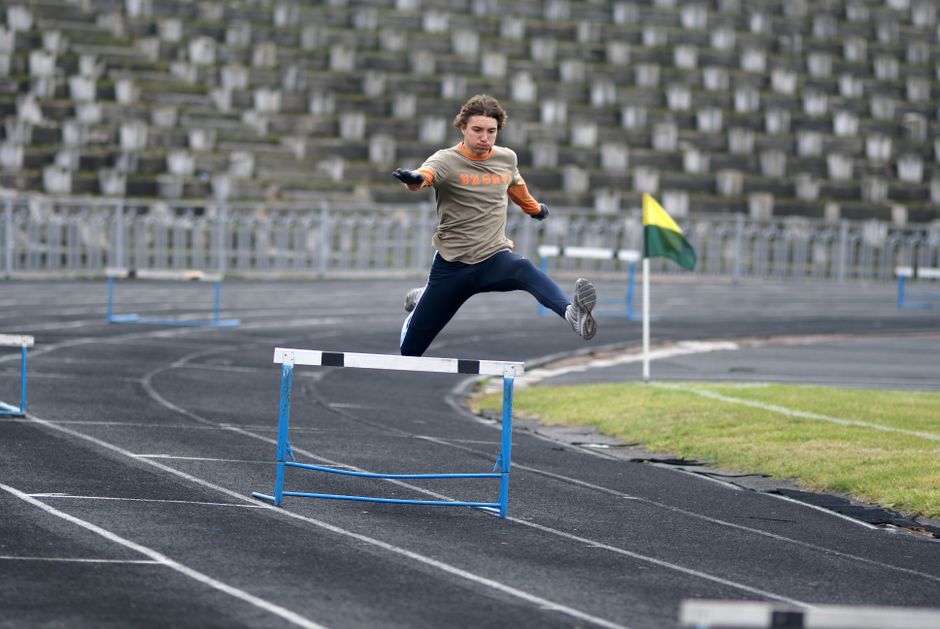
To build a complete athlete, your training should feature a variety of drill styles. Each serves a specific purpose, transitioning you from basic coordination to explosive, reactive power.
| Drill Type | Primary Target | Equipment Needed | Beginner Level | Advanced Progression |
|---|---|---|---|---|
| Cone Drills | Deceleration & Cutting | Cones | Simple 3-Cone L-Drill | Reactive/Partner Cues |
| Ladder Drills | Foot Speed & Rhythm | Agility Ladder | 1-in-the-hole Forward | High-tempo Carioca |
| Line Drills | Lateral Balance | Tape or Chalk line | Two-foot Line Hops | Single-leg 180-degree Hops |
| Dot Drills | Foot Accuracy & Joint Stability | Dot Mat or Tape Dots | Simple Scissors | Single-leg Figure-Eight |
| Barrier Drills | Vertical Power & Landing Control | Mini Hurdles | Two-foot Hop & Hold | Continuous Lateral Bounds |
Cone Drills for Cutting and Direction Changes
Cone drills are the gold standard for developing deceleration and cutting mechanics. When you run a Pro Agility (5-10-5) or a T-test, your body learns how to drop its hips, plant the inside foot, and drive back in the opposite direction.
Drills like the W Drill, Z Drill, and 5-Cone Star Drill force you to master the sprint-shuffle-backpedal transition. The key to these drills is avoiding “ankle-breaking” slips by keeping your feet wide and your center of gravity low. For a deep dive into mastering these cuts safely, read our guide on How to Stop Getting Your Ankles Broken with Agility Drills.
Ladder and Line Drills for Foot Speed and Rhythm
If cone drills are about power, ladder and line drills are about coordination and rhythm. Using an agility ladder for drills like the Icky Shuffle, high knees, and lateral in-outs teaches your nervous system to fire rapidly.
Similarly, line drills (using a simple chalk or tape line) build elastic strength through your calves and ankles. Doing forward-and-back line hops, scissors, and single-leg variations teaches you to bounce off the ground with minimal contact time. To dial in your footwork, explore our favorite patterns in Unlock Your Speed: Top Agility Ladder Drills for All Levels.
Dot, Barrier, Hoop, and Combination Drills for Coordination
Once you have mastered cones and ladders, dot and barrier drills take your coordination to the next level. Dot patterns (like the five-dot layout) require precise foot placement and rapid hip turns during scissors and command jumps.
Barrier drills using low hurdles or mini-barriers emphasize lateral power and landing control. By combining these elements — such as transitioning from a ladder shuffle directly into a mini-hurdle jump — you build high-level body awareness and rhythm control that transfers directly to the field.
(A quick side note: We love dogs, and while programs like Dog Agility Training in Knoxville, TN. DTE, Fenzi Dog Sports Academy – AG105: Agility Foundations: Where Function and Fun Meet!, and [AU-087] MaxPup 1 Performance Foundations: SUPERSIZED Edition! – Agility University are fantastic for your four-legged companions, our mission here at Triple F is to get human athletes moving with elite-level precision!)
How to Build an Agility Training Program That Actually Progresses
You cannot just throw random drills together and call it a program. To see real results, your agility training program must follow a logical progression. You start by mastering movement quality, progress to speed and power, and finally add reactive chaos.
We recommend structuring your plan in 6-to-8-week cycles. This allows your nervous system and connective tissues to adapt without overloading them.
Beginner Agility Training Program: 2–3 Days Per Week
For beginners, the goal is to build a movement foundation. Workouts should focus on quality over quantity, keeping work intervals short (10 to 20 seconds) to prevent fatigue from ruining your form.
- Frequency: 2 days per week (e.g., Tuesday and Thursday)
- Warm-Up: 5-10 minutes of dynamic stretching and light skipping
- Drill Selection: 3 to 4 simple drills (e.g., 1-in-the-hole ladder drills, basic forward/backward line hops, and a simple 3-cone L-drill)
- Volume: 3 sets per drill with 60-90 seconds of rest between sets to ensure full recovery
- Focus: Perfecting foot placement, maintaining a low athletic stance, and learning how to land softly
Advanced Agility Training Program: 3 Days with Strength, Plyometrics, and Reaction Work
Advanced athletes need to train under game-like conditions. This means integrating resisted starts, reactive cutting (where a partner or coach signals when to turn), and heavy plyometric bounds.
To maximize power, we pair agility sessions with strength training. Using Reps in Reserve (RIR) and autoregulation, you can adjust your weight room intensity based on how explosive you feel during your movement work. To take your performance to this level, read about how we Level Up Your Game with Advanced Athletic Training and combine it with Beyond the Gym: Mastering Athletic Strength Training.
Sample Weekly Schedule for Agility, Strength, and Conditioning
To keep your body fresh and fast, follow a high-low training model that alternates intense nervous system days with recovery and mobility days:
- Monday (High): Acceleration work + lower-body strength training
- Tuesday (Low): Active recovery, mobility, and core work
- Wednesday (High): Change-of-direction agility drills + upper-body strength
- Thursday (Low): Dynamic mobility and light aerobic conditioning
- Friday (High): Reactive agility drills + full-body power training
- Saturday (Low): Light conditioning or outdoor activities (like a local Hiking Training Challenge | Outdoor Adventure Training to build lower-body endurance)
- Sunday: Complete rest and recovery
Safety, Warm-Ups, Equipment, and Recovery Rules
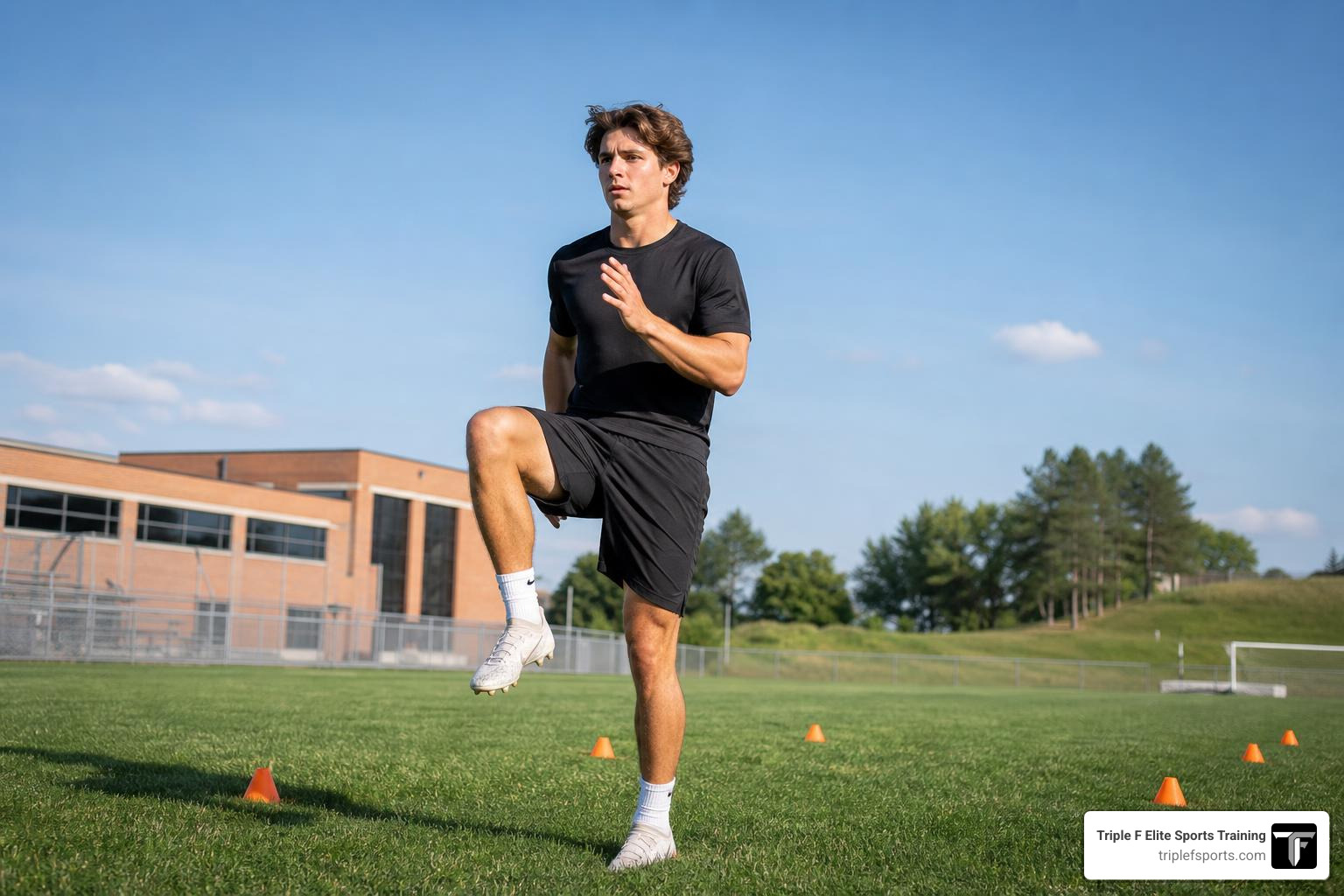
Agility training places immense stress on your joints and nervous system. If you try to cut at full speed with cold muscles or tired legs, you are asking for an injury. Safety must always come first.
The Best Warm-Up Before Agility Training
Never static stretch before an agility session. You need to wake up your nervous system and prepare your muscles for explosive movement. Spend 10 minutes on this dynamic progression:
- Light Jog: 2 minutes to raise core body temperature.
- Dynamic Skips & Shuffles: A-skips, lateral shuffles, and carioca (50 yards each).
- Joint Mobilizers: Hip openers (gate swings), lunges, and inchworms.
- Ankle Pogos: 2 sets of 10 seconds to prime your spring mechanics.
- Nervous System Prep: 3-4 falling starts or short 10-yard build-up sprints.
Equipment Needed and Low-Cost Alternatives
You do not need a million-dollar facility to get faster. While professional gear is great, DIY alternatives work incredibly well:
- Cones: Use water bottles, small rocks, or old sneakers.
- Agility Ladder: Draw one on a driveway with sidewalk chalk, or lay down strips of painter’s tape on a garage floor.
- Line Drills: Use any existing line on a tennis court, track, or field.
- Mini Hurdles: Set up small cardboard boxes or rolled-up towels that you can jump over.
- Dot Drills: Draw five dots on the ground with chalk in an “X” pattern.
Recovery and Rest Protocols That Keep Athletes Fast
Agility is about quality, not conditioning. If you are breathing so hard that you cannot stand up straight, you are no longer training speed — you are training endurance, and your movement mechanics will fall apart.
Keep your work-to-rest ratio at 1:5 or 1:10. If a drill takes you 6 seconds to complete, rest for 45 to 60 seconds before your next rep. Between different drills, take 2 to 3 minutes of complete rest. Use box breathing (inhale for 4 seconds, hold for 4, exhale for 4, hold for 4) to quickly calm your heart rate.
If you are preparing for high-volume challenges like the CrossFit | Murph Workout Training Plan, building a baseline of movement efficiency through proper rest is what keeps you moving safely when fatigue eventually sets in.
Best Agility Drills for Change of Direction, Acceleration, Deceleration, and Sport Transfer
To unlock your true athletic potential, you must train the four key phases of field movement: deceleration (braking), changing direction, accelerating out of the cut, and reacting to live play.
Best Drills for Change of Direction
- The 5-10-5 Shuttle (Pro Agility): Set three cones 5 yards apart in a straight line. Start at the center cone. Sprint 5 yards to your right, touch the line, change direction and sprint 10 yards to the far left, touch that line, and sprint back through the center cone. Focus on keeping your hips low during the turns.
- The T-Test: Set up four cones in a “T” shape. Sprint forward 10 yards, lateral shuffle 5 yards to the left, shuffle 10 yards to the far right, shuffle 5 yards back to the center, and backpedal 10 yards to the start.
Best Drills for Acceleration
- Falling Starts: Stand with your feet together. Lean forward until you feel like you are about to fall, then explode into a sprint for 10 yards. This forces your body into the perfect forward drive angle.
- Belly-to-Sprint: Lie flat on your stomach on the turf. On a whistle, jump up as fast as possible and sprint forward 10 yards. This builds incredible first-step power.
Best Drills for Deceleration and Braking Control
- Sprint-to-Stop: Sprint at 100% effort for 10 yards, then try to come to a complete, balanced stop within a 2-yard window. Keep your ankles, knees, and hips stacked to absorb the force.
- Lateral Bound-and-Stick: Leap laterally off one foot as far as you can, landing on the opposite foot. Hold (or “stick”) the landing for 2 seconds without wobbling before leaping back. Learn more about these mechanics with A Quick Start Guide to Skill Training for Athletes.
How to Adapt Agility Training for Soccer, Basketball, Football, Volleyball, and More
Every sport has its own unique movement demands. Your training should reflect that:
- Soccer & Lacrosse: Focus on wide-angle cuts, curved runs, and maintaining ball control while changing direction.
- Basketball & Tennis: Emphasize rapid lateral shuffles, short deceleration stops, and explosive vertical jump transitions.
- Football: Prioritize sharp hip turns, backward-to-forward transitions, and explosive first-step acceleration.
To see how we tailor these movements to your specific sport, check out Unlocking Athletic Potential: A Deep Dive into Sport Specific Training.
How to Measure Progress and Avoid Common Agility Training Mistakes
What gets measured gets managed. If you aren’t tracking your performance, you are just guessing.
Simple Tests to Track Agility Progress
Every 4 to 6 weeks, run a testing day to measure your growth. Use these simple benchmarks:
- Timed 5-10-5 Shuttle: Use a stopwatch (or video analysis) to track your change-of-direction speed.
- Standing Broad Jump: Measures horizontal power and explosive hip extension.
- Single-Leg Hop Test: Jump forward on one leg and stick the landing. Compare your left and right legs to check for strength imbalances.
Record your times and distances in a training log. If you are consistently getting faster while keeping your landing mechanics stable, your program is working.
Common Mistakes Beginners Make
Avoid these common pitfalls to stay healthy and fast:
- Standing Too Tall: High hips ruin your balance and slow down your cuts. Keep your knees bent.
- Heel Striking: Landing on your heels slows you down and sends harsh shockwaves up your spine. Stay on the balls of your feet.
- Too Much Ladder Work: Ladders are great for coordination, but they do not build the explosive power needed for deep cuts. Do not make them your entire workout.
- Skipping Rest: Trying to turn agility training into a conditioning circuit will ruin your form and slow your progress.
How Coaches and Athletes Should Progress Drills
To keep progressing without hitting a plateau, follow this simple hierarchy:
[Master Basic Mechanics]
 │
 ▼
[Add Absolute Speed]
 │
 ▼
[Introduce Sharp Angles]
 │
 ▼
[Add Reactive Cues (Partner/Whistle)]
 │
 ▼
[Add Sport Chaos (Balls, Opponents)]
Always master the mechanics of a drill before trying to do it faster. If your form breaks down, stop the rep immediately. For more tips on keeping your training on track, see our guide on Building Better Athletes One Program at a Time.
Frequently Asked Questions About Building an Agility Routine
How often should athletes do agility training each week?
For most athletes, 2 to 3 sessions per week is the sweet spot. This provides enough stimulus to trigger neural adaptations while leaving plenty of time for recovery, strength training, and sports practice.
Can agility training be done at home with no equipment?
Absolutely! You can tape lines on your driveway, use water bottles as cones, or draw dot patterns with sidewalk chalk. Your body does not care how much your equipment cost; it only cares about the force you apply to the ground.
Should agility training come before or after strength training?
Always do your agility work before lifting weights. Agility requires a completely fresh central nervous system. If you try to run complex cutting drills after a heavy squat session, your coordination will be shot and your risk of injury will skyrocket.
Start Unlocking Your Athletic Potential Today
A great agility training program is about more than just moving your feet quickly — it is about moving with purpose, power, and complete control. By starting with a dynamic warm-up, mastering your mechanics, and progressively adding reactive speed, you will build the athletic foundation needed to dominate your sport.
At Triple F Elite Sports Training in Knoxville, TN, we specialize in helping athletes of all levels unlock their true potential. Our Christ-centered facility offers professional athletic development, sports-specific training, and physical therapy designed to keep you performing at your absolute best.
Are you ready to stop tripping over your own feet and start blowing past the competition? Build your next phase with skilled-based training and sign up for your free first session at our Knoxville facility today! Let’s work together to start Building Better Athletes One Program at a Time.