
Why the Best Soccer Workouts Cover More Than Just Running
If you want a quick answer, here are the best soccer workouts by training goal:
| Goal | Top Workouts |
|---|---|
| Explosive power | Box jumps, single-leg jumps, trap-bar jump squats |
| Strength | Front squats, trap-bar deadlifts, Nordic hamstrings |
| Agility & speed | Cone drills, shuttle runs, ladder drills |
| Endurance | HIIT intervals, Fartlek runs, 50/50 lap runs |
| Core stability | Planks, Copenhagen planks, Russian twists |
| Injury prevention | Dynamic warm-ups, glute bridges, single-leg stabilizers |
Soccer is one of the most demanding sports on the planet. A single match lasts 90 minutes of near-nonstop action — requiring explosive sprints, jumps, sharp cuts, and powerful shots, all while managing fatigue. Research shows elite players execute over 700 changes of direction per match, along with 30 to 40 maximal accelerations and up to 40 jumps.
That kind of output demands a training program built on more than just running laps.
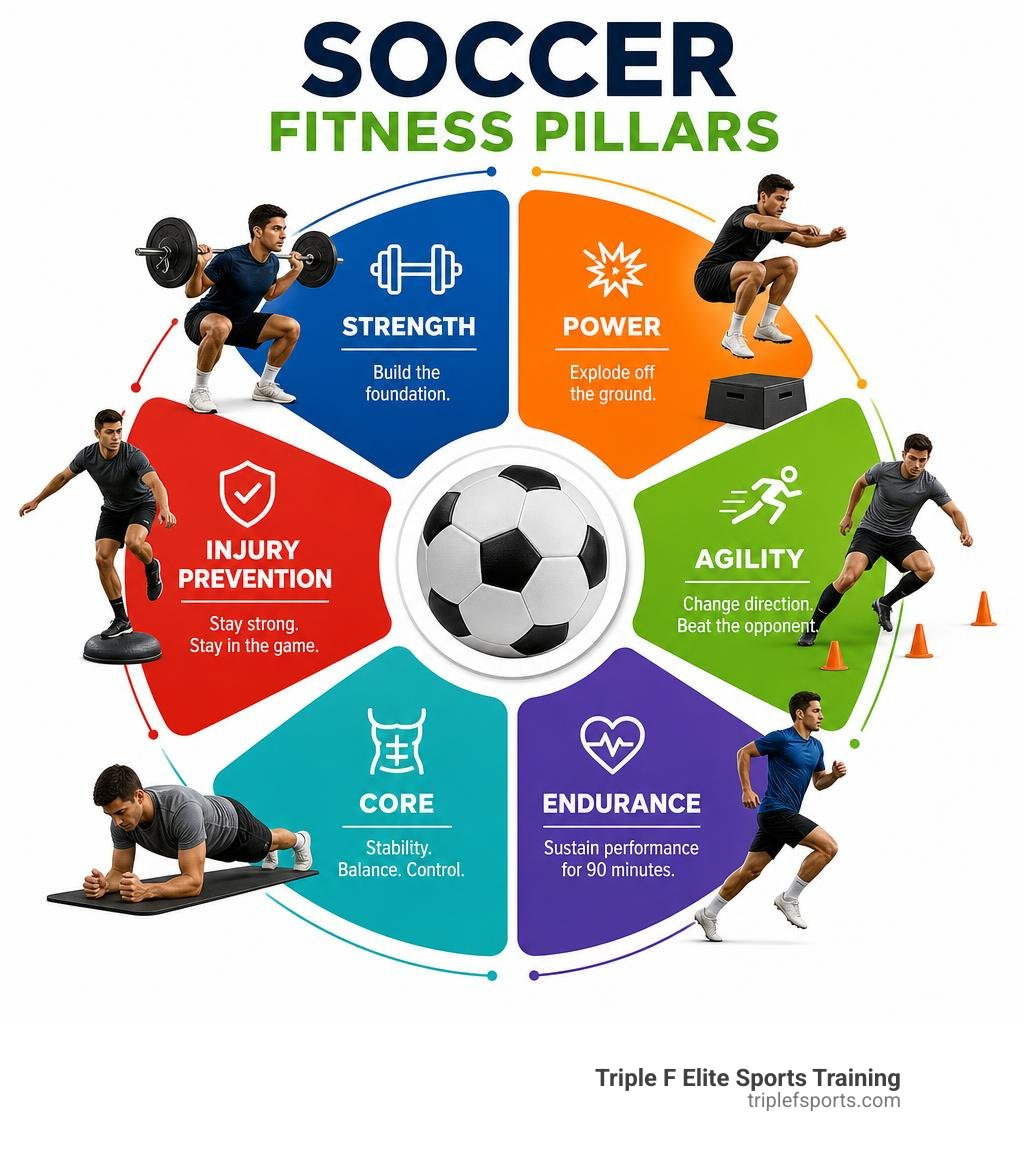
The best programs combine strength, power, agility, endurance, and injury prevention — all layered together in the right order and at the right intensity. Get that balance right, and you’ll step onto the field faster, stronger, and more resilient than ever.
I’m Kevin O’Shea, a Certified Strength and Conditioning Specialist and wide receiver coach with years of experience designing athletic development programs — and helping athletes discover the best soccer workouts is central to what we do at Triple F Elite Sports Training in Knoxville. Let’s break down exactly what your training program should look like.
Common best soccer workouts vocab:
The Core Pillars of the Best Soccer Workouts

To build a truly elite soccer athlete, we cannot rely on a one-dimensional training program. Many old-school coaches still hand out long-distance running plans and call it a day, but that approach leaves players slow, weak, and highly susceptible to non-contact injuries.
To dominate on the pitch, we must design our best soccer workouts around four core pillars:
- Explosive Power (Plyometrics): Building the spring-like quality in your tendons to out-jump defenders and accelerate instantly.
- Agility and Multi-Directional Speed: Training your body to change directions, decelerate safely, and explode out of a cut.
- Functional Strength: Developing the muscular foundation to hold off defenders, win 50/50 physical duels, and pack more power into your shots.
- Cardiovascular Stamina (Endurance): Conditioning both your aerobic and anaerobic energy pathways so you can sprint just as hard in the 89th minute as you did in the 1st.
When we integrate these pillars into a cohesive, science-backed schedule, we unlock a player’s true physical ceiling. For a deeper look at how we structure these elements for maximum on-field transfer, check out our guide on Unlocking Athletic Potential: A Deep Dive into Sport Specific Training.
Building Explosive Power with Plyometrics
In soccer, leg power is decided less by absolute, slow-speed strength than by how quickly you can accelerate force. In fact, most athletic movements on the pitch occur within a tiny window of 0.2 seconds. Plyometric training teaches your neuromuscular system to recruit muscle fibers rapidly and maximize what coaches call the Stretch-Shortening Cycle (SSC).
To build this explosive bounce, we rely on a progression of key jumping movements:
- Box Jumps: Performing jumps onto a 12-to-24-inch box helps build vertical power while minimizing landing stress on your joints.
- Single-Leg Jumps (and Hops): Soccer is played almost entirely on one leg at a time. Single-leg jumps build unilateral power, mimicking the exact movement pattern of leaping for a header or taking a powerful stride.
- Drop Jumps: Stepping off a box and immediately exploding upward upon hitting the ground. This develops “eccentric stiffness” — the ability of your muscles and tendons to absorb force and instantly redirect it.
To safely build this spring-like athleticism without burning out your nervous system, we highly recommend reviewing the Soccer Explosive Leg Power Plan. Always prioritize quality over quantity: landing softly with bent knees and proper alignment is far more important than how high the box is.
Agility and Speed Drills for Match Day
Sprinting in a straight line is great, but soccer is a game of chaotic, multi-directional movement. You have to react to a bouncing ball, avoid a slide tackle, and immediately transition from defending to attacking.
To build match-day agility, we incorporate these highly effective drills into our weekly sessions:
- Shuttle Runs (5-10-5 Drill): Set three cones 5 yards apart. Start at the center cone, sprint 5 yards to the right, touch the line, sprint 10 yards to the far left, and sprint 5 yards back to the center. This builds incredible lateral deceleration and acceleration.
- Three-Cone “L” Drill: This drill forces you to bend around corners and transition from a linear sprint to a lateral shuffle.
- Sprint-to-Lateral-Shuffle Intervals: Sprint 5 meters, immediately transition into a low, athletic lateral shuffle for 5 meters, and repeat for a total of 20 meters.
These drills do more than just make you look fast in training; they actively build the neuromuscular control and proprioception needed to protect your knees and ankles during sudden cuts. If you are ready to take your footwork to the next level, read about how we implement these drills in Level Up Your Game with Advanced Athletic Training.
Strength Training: Building a Powerful Foundation

There is a persistent myth in the soccer world that lifting weights will make you “bulky” and slow. Let’s bust that myth right now. Elite Norwegian soccer players boast an average back squat of 330 lbs. This level of lower-body strength directly correlates with faster 5-meter acceleration times and higher vertical jumps.
When we program strength training, we focus on myofibrillar hypertrophy (building dense, functional muscle fibers) rather than sarcoplasmic hypertrophy (bodybuilding-style training that simply floods the muscle with fluid for size). By focusing on compound movements and controlling our lifting tempo — such as using a 3-second lowering phase followed by an explosive upward phase — we build strong, dense muscles that act as armor on the pitch.
To understand how heavy lifting transfers directly to athletic dominance, check out our resource on Beyond the Gym: Mastering Athletic Strength Training.
Essential Strength Exercises in the Best Soccer Workouts
A truly effective soccer strength routine focuses on compound, multi-joint movements that target the hips, glutes, hamstrings, and quadriceps. Here are the non-negotiable lifts that belong in your program:
- Front Squats: By placing the barbell on the front of your shoulders, you recruit more quadriceps and core stabilizers while keeping your torso upright, reducing strain on the lower back.
- Trap-Bar Deadlifts: The hex bar allows you to distribute the weight closer to your center of gravity. This is the ultimate builder of posterior chain power (glutes and hamstrings), which drives your sprinting speed.
- Single-Leg Romanian Deadlifts (RDLs): Holding a dumbbell or kettlebell while hinging on one leg. This builds balance, targets the hamstrings eccentrically, and directly translates to single-leg kick power.
- Nordic Hamstring Curls: An eccentric-focused exercise that is clinically proven to reduce the risk of hamstring strains — one of the most common injuries in soccer.
For younger players looking to build this foundation safely, we have put together a comprehensive guide: Teen Strength: A Guide to Resistance Training for Young Athletes.
Core Stabilization and Injury Prevention
In soccer, your core is not just about having a visible six-pack; it is the central bridge that transfers force from your lower body to your upper body. When you jump for a header, shield a defender, or strike a ball, a stable core prevents energy leaks and keeps you balanced.
We define the core as everything from your shoulders down to just above your knees. To train it for the specific demands of soccer, we focus on anti-rotation and stabilization:
- Planks (and Physio Ball Planks): Building isometric endurance to hold a strong posture under fatigue.
- Copenhagen Planks: A side-plank variation where your top leg rests on a bench, activating the adductors (inner thighs) which are frequently strained during kicking.
- Russian Twists: To build rotational power and lateral core strength for throwing-ins and twisting to change direction.
By building a core that can absorb and redirect high-impact forces, you significantly lower your risk of non-contact injuries. Learn more about prioritizing injury prevention in our In-Depth Guide to Youth Strength Training.
Conditioning and Endurance: Running for 90 Minutes
You can have the most explosive shot in the league, but if you are gasping for air after ten minutes, you cannot help your team win. Soccer conditioning must prepare your body to handle both aerobic energy production (for jogging and walking during slow periods) and anaerobic capacity (for repeated, high-intensity sprints).
Traditional steady-state jogging has its place for basic cardiovascular health, but it does not prepare you for the chaotic speed changes of a real match. Instead, the best soccer workouts utilize High-Intensity Interval Training (HIIT) and Fartlek running to mimic game conditions. You can explore a great example of this style of training in the HIIT It Like Beckham: Soccer Player Workout.
High-Intensity Interval Training (HIIT) for Soccer
HIIT workouts are incredibly efficient because they force your heart rate into its upper zones, rapidly expanding your lung capacity and accelerating recovery between sprints. Here are our favorite conditioning protocols:
- 50/50 Lap Runs: Around a standard soccer field, jog the short ends (behind the goals) and sprint the long sidelines. Repeat this for 6 to 8 laps to build a powerful aerobic-anaerobic bridge.
- Fartlek Cones: Place five cones at random intervals (ranging from 10 to 30 yards apart) across the pitch. Alternate randomly between walking, jogging, and full-effort sprinting as you navigate the cones. This teaches your body to handle unpredictable changes in pace.
- 400m Repeats: Run 400 meters at a high-intensity pace, followed by an equal-duration recovery jog. Complete 6 to 8 repetitions to build elite cardiovascular stamina.
Integrating Ball Work into the Best Soccer Workouts
Conditioning does not have to be boring. In fact, some of the most effective soccer workouts combine physical conditioning with skill development. By performing technical drills under physical fatigue, you train your brain to maintain focus and execute precise touches when your legs are burning in the final minutes of a match.
- Solo Cone Dribbling: Space 5 to 10 cones just 2 to 3 feet apart. Weave through them as fast as possible using the inside and outside of both feet, sprint 20 yards to a finish line, and jog back.
- Wall Passing Intervals: Stand 5 yards from a brick wall. Pass the ball firmly against the wall, receive it with a clean first touch, and pass it back. Maintain a high tempo for 90 seconds, rest for 45 seconds, and repeat.
- Small-Sided Games: Playing 3v3 or 4v4 on a small pitch forces rapid transitions, constant sprinting, and quick decision-making, providing a massive cardiovascular workout while sharpening your tactical awareness.
At Triple F, we believe in developing the whole athlete. Read about our philosophy on combining skills and conditioning in Building Better Athletes One Program at a Time.
Structuring Your Offseason and In-Season Training
To maximize your performance and avoid overtraining, your workouts must change depending on where you are in the yearly competitive cycle. Trying to lift heavy three times a week while playing two full-length matches on the weekends is a recipe for injury.
| Training Phase | Focus Areas | Weekly Strength Sessions | Plyometric Volume | Cardio Focus |
|---|---|---|---|---|
| Offseason | Hypertrophy, basic strength, rest, and recovery | 3 to 4 sessions | Moderate | Aerobic base & HIIT |
| Pre-season | Explosive power, maximum speed, match fitness | 2 to 3 sessions | High | Sport-specific intervals |
| In-season | Maintenance, joint health, active recovery | 1 to 2 sessions | Low (maintenance) | Match play & light drills |
Properly structuring these phases is known as periodization. To see how we map out long-term athletic growth across multiple seasons, take a look at Building Better Ballers with the Long-Term Athlete Development Model.
Offseason Recovery and Strength Building
The offseason is your golden opportunity to make massive physical gains. However, we always recommend taking up to a full month of active rest immediately after a grueling season ends. Let your joints heal, get plenty of sleep, and enjoy some low-impact activities like swimming or yoga.
Once you are refreshed, the focus shifts to progressive overload in the weight room. This is the time to build lean muscle mass through myofibrillar hypertrophy and address any muscular imbalances. Because you do not have to worry about being sore for a weekend match, you can push your limits safely and lay down the physical foundation that will carry you through the rest of the year.
In-Season Maintenance and Injury Prevention
During the competitive season, the goal of your weight-room work is simple: maintenance and recovery. We want to preserve the strength and power gains you made in the offseason without creating excess neuromuscular fatigue that could hurt your match performance.
- Limit Heavy Lifting: Keep strength sessions to 1 or 2 brief workouts per week, capping loads at around 80% of your 1RM.
- Stop High-Intensity Work Early: Complete all heavy lifting and explosive plyometrics at least 48 hours before kickoff.
- Prioritize Warm-Ups and Cool-Downs: Never skip your dynamic warm-up (including glute bridges, high knees, and lunges) to prep your muscles. After training, spend 10 to 15 minutes on static stretching and foam rolling to jumpstart your recovery.
Frequently Asked Questions about Soccer Workouts
How often should soccer players strength train per week?
During the offseason, we recommend strength training 2 to 3 times per week to build a powerful athletic foundation. During the competitive season, this should drop to 1 to 2 sessions per week focused entirely on strength maintenance and joint stability, leaving plenty of recovery time for match days.
Why do female soccer players have a higher risk of overuse injuries?
Female athletes generally have a higher risk of knee injuries (specifically ACL tears) due to anatomical differences, hormonal factors, and a tendency toward lower baseline muscle mass around the hips and knees. To combat this, we recommend that female players increase their focus on single-leg stabilizers, glute activation, and eccentric hamstring work (like Nordic curls) by about 5% to 10% to build dynamic joint stability.
Can youth soccer players safely perform weight training?
Absolutely! When supervised by a certified professional, youth strength training is incredibly safe and highly beneficial for bone density, coordination, and injury prevention. The key is prioritizing proper form and progressive loading over lifting heavy weights too quickly. For a detailed guide on how parents can navigate this safely, check out The Parents Guide to Safe and Effective Youth Athletic Development.
Conclusion
Building a game-ready body takes consistency, smart planning, and hard work. By combining explosive plyometrics, sharp agility drills, functional strength training, and soccer-specific conditioning, you will transform yourself into a dominant force on the pitch.
If you are located in the Knoxville area and want to take the guesswork out of your training, come join us at Triple F Elite Sports Training. We provide professional, Christ-centered athletic development designed to unlock your full potential. Your first training session is completely free!
Ready to dominate? Level up your skills with professional training at Triple F today.