
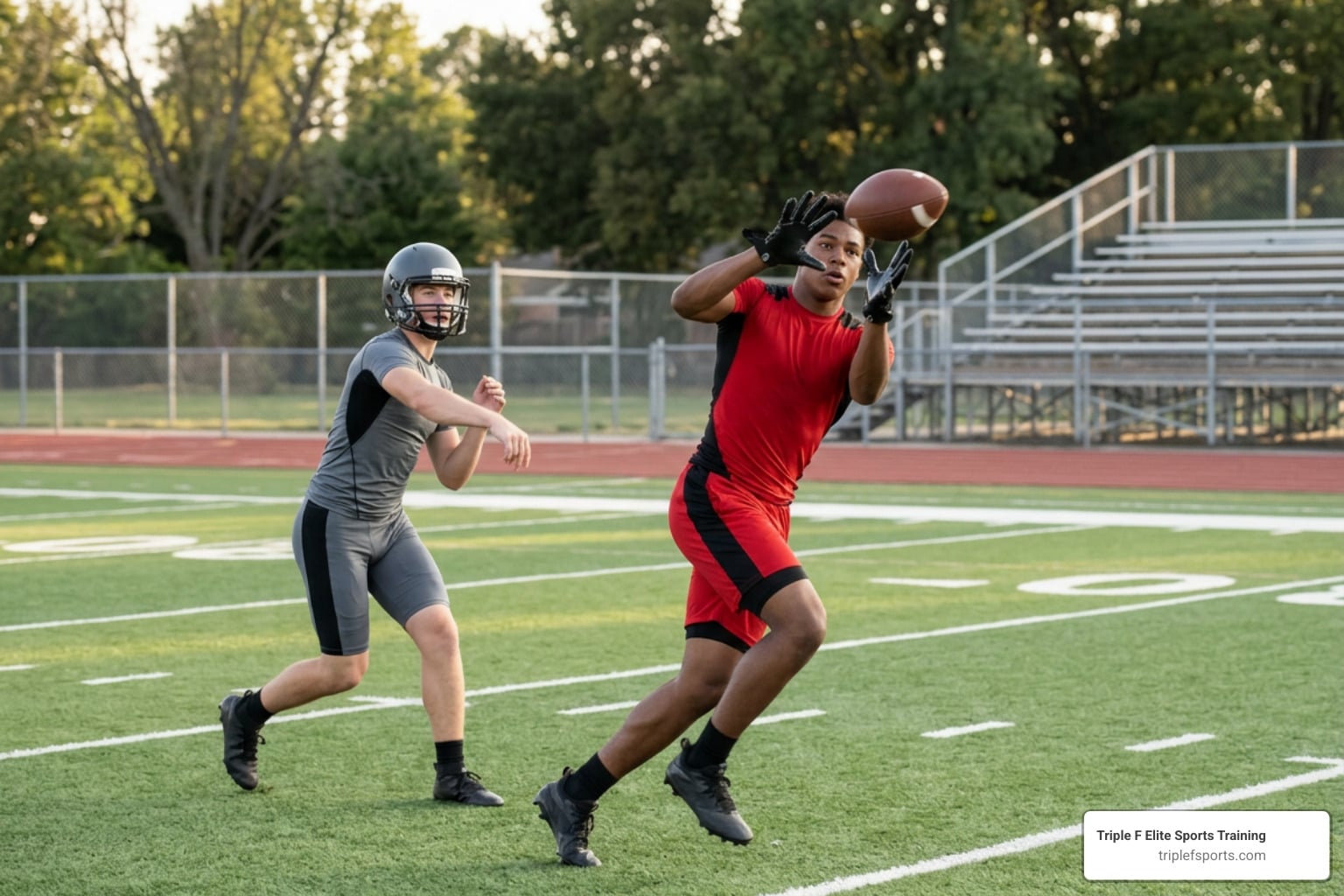
Why the Right Drills to Improve Catching a Football Make All the Difference
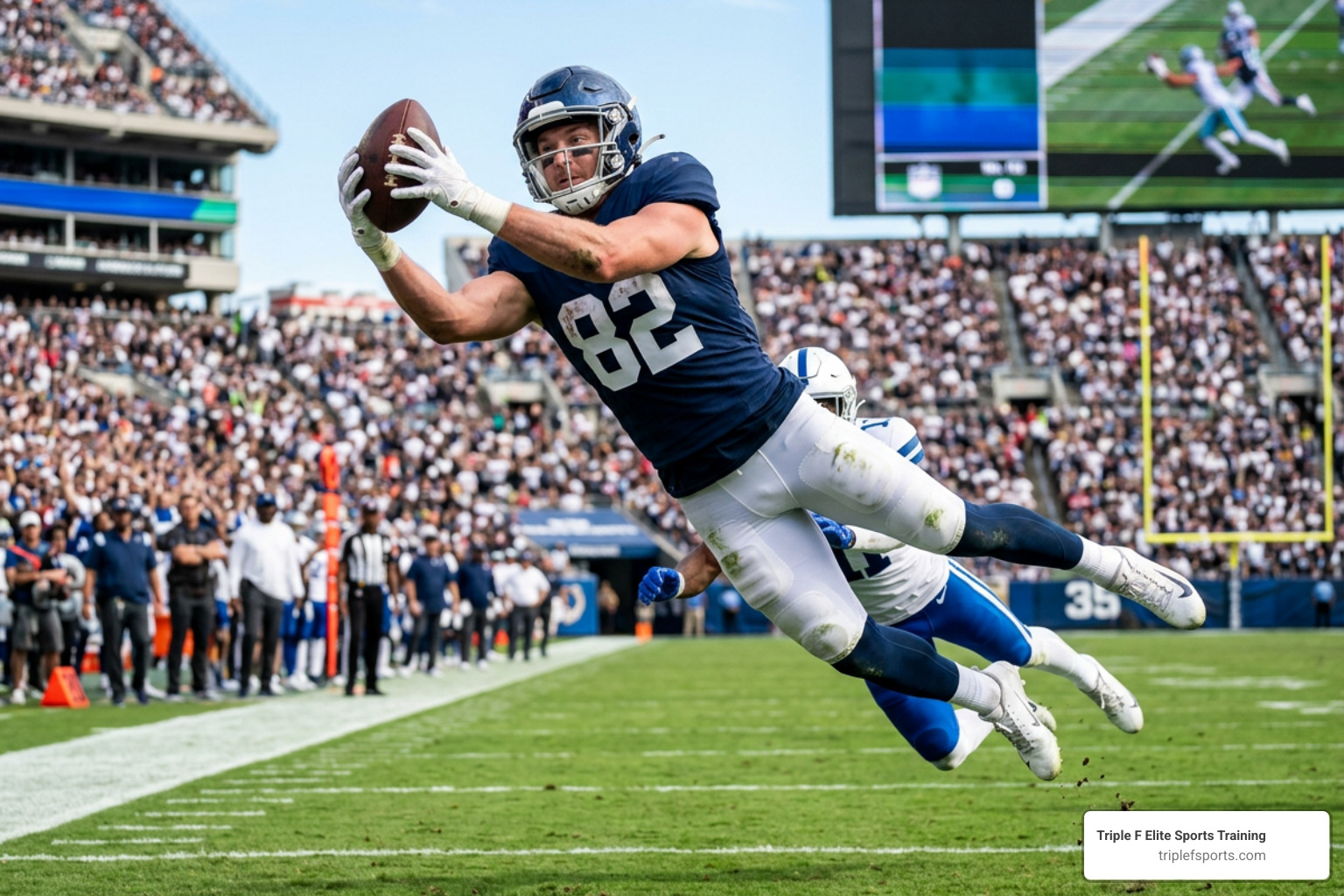
The best drills to improve catching a football — in one quick list:
- Wall ball — builds hand strength and reaction time solo
- Stationary height progression — catches above the head, at chest level, and below the waist
- No-peek drill — trains fast ball-location and soft hands
- Over-the-shoulder drill — simulates go routes and deep throws
- Gauntlet drill — forces rapid hand-position decisions under fatigue
- Distraction drill — defenders wave arms or towels to simulate traffic
- Live 1-on-1 reps against a DB — the closest thing to game conditions
You’ve seen it happen. A receiver is wide open. The ball hits him right in the hands. And he drops it.
It’s one of the most frustrating moments in football — for the player, the coach, and the team. But here’s the thing: drops are almost never a talent problem. They’re a process problem. The eyes leave the ball too early. The hands aren’t in the right position. The receiver hasn’t been trained to handle pressure, bad throws, or a defender in their face.
The good news? Catching is a skill. And like any skill, it can be trained — systematically, progressively, and at any age or level.
I’m Kevin O’Shea, a Certified Strength and Conditioning Specialist and Wide Receiver Coach with hands-on experience coaching the drills to improve catching a football at the high school level — including working with one of the leading receivers in school history. At Triple F Elite Sports Training, I bring that same approach to athletes in Knoxville who are serious about eliminating drops and becoming more reliable pass-catchers.
Easy drills to improve catching a football word list:
The Mechanics of a Perfect Catch: Hand and Eye Discipline
Before you run a single route, you have to master the physics of securing the football. Unlike a round basketball or soccer ball, a football is an oblong, pointed projectile spinning on an axis. Its flight path is highly dynamic, and the surface area you have to grasp is narrow.
If you try to catch a football with stiff, flat palms or by clapping your hands against the leather, it will bounce away almost every time. To secure it, you must build a bulletproof visual and physical sequence.

Mastering the Eye-to-Tuck Pipeline
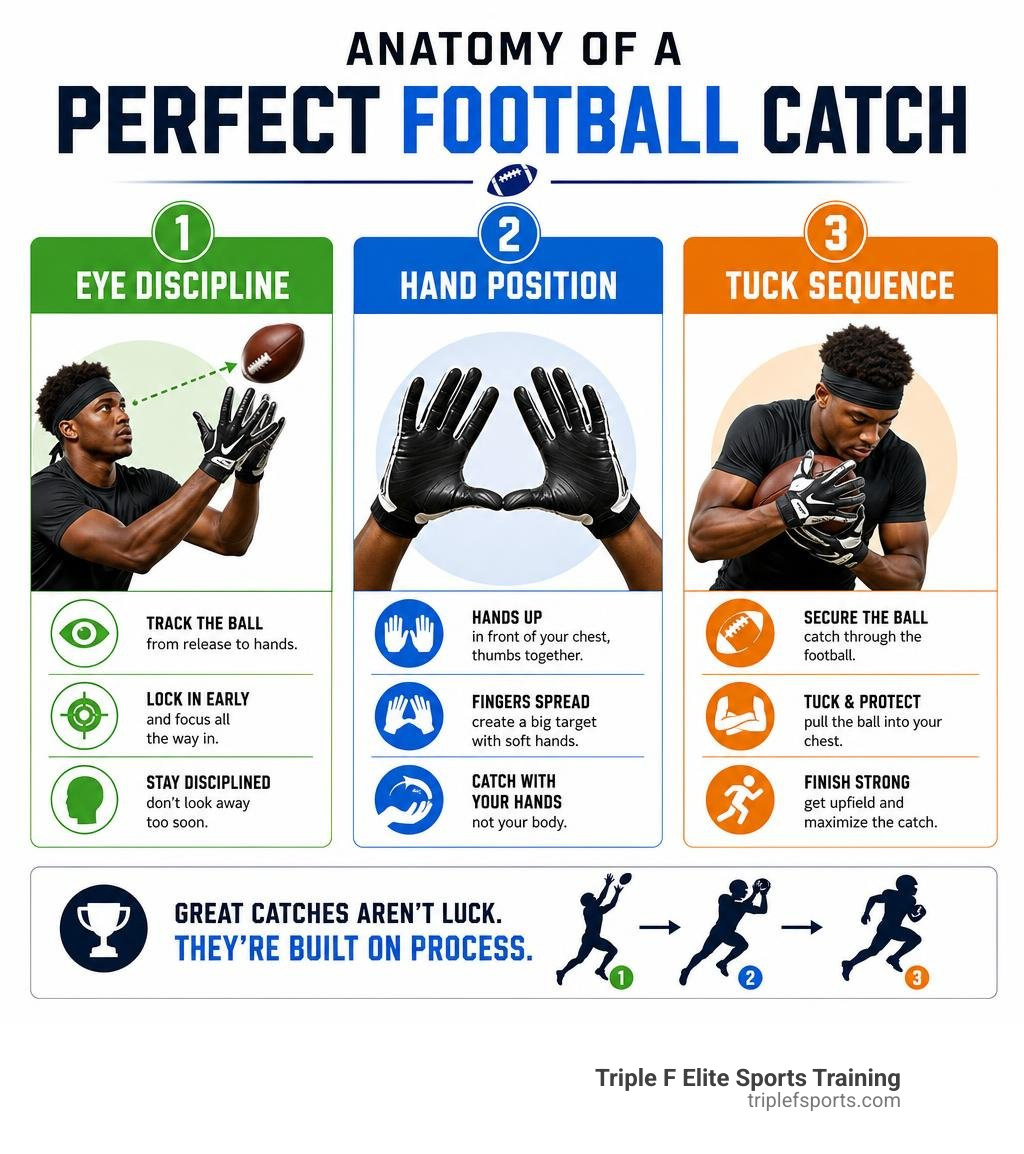
The transition between when the football contacts your fingers and when it is secured against your ribcage is where 90% of drops occur. This is known as the “eye-to-tuck pipeline.”
Many wide receivers suffer from “peek-ahead syndrome.” They look upfield to spot incoming defenders or plan their running lane before the ball is actually secured. The split second they take their eyes off the ball, their hand position shifts slightly, leading to an open-field drop.
To combat this, coaches teach receivers to focus on a highly specific target: the nose (or front tip) of the football. You should track the tip of the ball all the way into your fingers.
Once hand contact is made, you must physically and visually guide the ball into your ribcage. A highly effective technique to build this habit is the five-count tuck drill.
When practicing basic catches, do not immediately toss the ball back. Instead, catch the ball away from your body, tuck it firmly under your arm (fingertips covering the nose, elbow locked against your side), and hold it for a full five seconds while keeping your eyes locked on the ball. Only after the five-count can you look up. This separates the mental act of catching the ball from the act of running upfield, making the tuck reflex automatic. For more details on catching fundamentals, check out this guide on How to Catch a Football.
The Three Essential Hand Positions
Depending on where the quarterback throws the ball, your hands must adapt instantly. There are three primary hand positions that cover every possible trajectory:
- The Diamond Position (Above the Numbers): When a pass is thrown at chest height or higher, your hands should form a diamond or triangle shape. Bring your thumbs and index fingers close together, leaving a small gap. Your palms should face outward toward the incoming ball. When the ball arrives, your fingers absorb the impact, and your thumbs prevent the nose of the ball from slipping through your hands.
- The Shield Position (At the Numbers): For balls thrown directly at your chest, you cannot easily form a diamond without jamming your wrists. Instead, position your hands like a protective shield. Your thumbs should point slightly upward and outward, with your palms open to absorb the ball. You must catch this ball slightly away from your body rather than letting it crash directly into your chest plate, which often causes a drop.
- The Basket Position (Below the Waist): For low throws, shoestring catches, or over-the-shoulder deep balls, flip your hands so your pinky fingers are touching. This creates a soft “basket” or cradle. Keep your wrists relaxed to absorb the velocity of the ball.
No matter which position you use, elite catching relies on fingertip control, not your palms. Your fingertips have the sensory receptors and grip friction necessary to stop the ball’s spin instantly.
For more solo ideas you can practice in your backyard, take a look at Home Alone: The Ultimate Solo Football Catching Drills, and read through How to Catch a Football Better: Receiver Drills That Actually Work as well as these Four Drills for Catching a Football to refine your hand placement.
Stationary to Game-Speed: A Progressive Catching Protocol
You cannot expect a player to make a leaping, contested grab on Friday night if they haven’t mastered the progression from a stationary stance to full game speed. We utilize a highly structured, multi-phase progression to build confidence and coordination step-by-step.
Beginner Drills to Improve Catching a Football
For younger players or those new to the position, the goal is high repetition in a controlled environment to build hand strength and coordination.
- Wall Ball: You don’t even need a quarterback for this. Stand 3 to 5 yards away from a brick or concrete wall. Using a football (or a tennis ball to over-train hand-eye coordination), toss the ball against the wall and catch the rebound. Perform 50 two-handed catches, then progress to 25 single-handed catches with each hand. This builds rapid reaction times and hand endurance.
- Stationary Height Progression: Stand 5 yards away from a partner. The thrower will deliver 10 passes to three distinct target zones: above the head (diamond position), at chest level (shield position), and below the thighs (basket position). The receiver remains stationary, focusing entirely on perfect hand mechanics and looking the ball into a tight tuck.
- Short Spiral Drill: Stand just 2 to 3 meters apart and exchange quick, tight spirals. This helps beginners get comfortable with the rotation of the ball without the fear of high-velocity impacts.
To learn more about introducing these concepts to younger athletes, read The Ultimate Playbook of Football Drills for Young Players and explore these 6 Drills to Improve Hand-Eye Coordination with a Football.
Intermediate Drills to Improve Catching a Football
Once a receiver can catch 95% of stationary throws, we introduce movement, spatial awareness, and blind tracking.
- The No-Peek Drill: The receiver stands 10 yards away from the quarterback, facing completely away. The quarterback yells “Ball!” and throws the pass. The moment the receiver hears the call, they must snap their head around, locate the ball in mid-air, adjust their body, and secure the catch. This trains the brain to rapidly process visual cues and coordinate the hands in a split second.
- Sideline Throw Drill: This drill develops body control and boundary awareness. The receiver runs parallel to the sideline. The quarterback throws the ball slightly out of bounds. The receiver must reach out, secure the ball using proper hand positioning, and tap both feet (or drag the back toe) inbounds while falling out of bounds.
- Moving Side-to-Side (Lateral Shuffle): The receiver shuffles laterally across the field while the quarterback delivers passes. This forces the receiver to catch while their head and body are in motion, simulating crossing routes.
To take your intermediate skills to the next level, check out Football 201: How to Catch a Football Intermediate Drills – Ball to Life.
Advanced Drills to Improve Catching a Football Under Pressure
In a real game, you will rarely have a clean, unobstructed view of a perfect spiral. You will have defensive backs pulling at your jersey, safeties closing in, and hand-fights at the catch point. Advanced training must simulate these high-stress environments.
Distraction and Traffic Drills
To build mental toughness and focus, we use targeted distraction methods that force the receiver to block out external noise and focus entirely on the nose of the ball.
- The Gauntlet Drill: Line up 5 to 6 players in two parallel rows, spaced about 3 yards apart. The receiver sprints down the middle of the “gauntlet.” As they run, quarterbacks standing on either side fire rapid-fire passes to them every 1.5 seconds. The receiver must catch, tuck, drop the ball, and immediately turn to catch the next one. This forces rapid hand-position transitions under extreme physical fatigue.
- Towel Waving & Arm Pumping: During standard route-running drills, have a coach or another player stand directly in front of the receiver’s path. As the ball approaches, the defender waves a towel or pumps their arms directly in front of the receiver’s eyes without touching the ball. The receiver must maintain absolute eye discipline to track the ball through the physical clutter.
- Live 1-on-1s with a Defender: There is no substitute for live pressure. Running routes against a defensive back who is actively trying to disrupt the pass is the ultimate test of a receiver’s catching ability. This forces the receiver to use physical hand combat to gain separation before the ball arrives.
For more insights on integrating these pressure situations into youth programs, see our guide on Youth Football Training 101 and learn how to implement these drills with How To Improve Your Wide Receivers’ Catching Ability – vIQtory Sports.
Net Drills and Bad Ball Recovery
Quarterbacks make mistakes. High-performing wide receivers are judged by their ability to salvage poorly thrown balls.
- The Shoelace Special (Low Ball Recovery): Practice catching balls thrown directly at the ankles. Instead of scooping the ball, the receiver must drop their hips, place one hand behind the nose of the ball, and the other hand underneath to form a secure cradle.
- The Neck Breaker (High and Behind): The quarterback intentionally throws the ball high and behind the receiver’s break. The receiver must plant, twist their torso while maintaining high body control, and leap to secure the ball at its highest point.
- The Soccer Net Drill: Position the receiver sideways about 5 yards in front of a soccer goal or large net. The quarterback throws highly challenging, irregular passes (high, low, wide). The net acts as a backstop, allowing for rapid, high-volume repetitions of difficult, acrobatic catches in a safe environment.
To master these off-target throws, explore Conquer Any Throw: The “Net Drills” Variations for Versatile and Confident WRs.
How to Structure Practice for Maximum Catching Development
To see real improvement on game day, catching drills cannot be an afterthought at the end of practice. They must be woven into a structured, highly efficient practice plan.
| Practice Segment | Time Allocation | Primary Focus | Key Drills |
|---|---|---|---|
| Warm-Up & Hand Prep | 10 Minutes | Neurological activation, hand-eye coordination | Wall ball, fingertip pushups, light tennis ball drops |
| Individual Skill Work (Edgework) | 15 Minutes | Pure catching mechanics, hand positioning, tucking | Stationary height progression, No-peek drill, Net drills |
| Position-Specific Route Work | 20 Minutes | Route running, timing with QB, boundary control | Route tree (slants, outs, curls), sideline toe-tap drill |
| Group / Competitive Work | 20 Minutes | Catching under pressure, tracking in traffic | Distraction drills, Gauntlet, live 1-on-1s and 2-on-2s |
| Team Scrimmage / Live Play | 20 Minutes | Game simulation, execution under fatigue | Full team scrimmage, 11-on-11 situational drives |
Balancing Individual Skill Work and Team Scrimmage
A common mistake coaches make is spending 90% of practice in full team scrimmages. While scrimmaging is important for overall scheme execution, a wide receiver might only see 2 or 3 targets during a 30-minute scrimmage.
By contrast, during a 15-minute individual skill block, that same receiver can get 50 to 100 high-quality catches. Prioritize high-volume, focused skill work early in practice, and then use competitive periods to test those skills under game-like pressure.
For coaches looking to refine their practice planning and leadership, read From the Sidelines to the Spotlight: Mastering Football Coaching Training.
Measuring Catching Reliability and Tracking Drops
If you don’t measure it, you can’t improve it. We recommend coaches track “Drop Rate” during both practice and games.
$$\text{Drop Rate} = \left( \frac{\text{Dropped Passes}}{\text{Catchable Targets}} \right) \times 100$$
A “catchable target” is any pass that hits the receiver’s hands or is within their physical reach. By tracking this metric weekly, you can identify whether a player’s drops are decreasing and pinpoint which specific throws (e.g., low balls, deep passes) require more individual attention during skill periods.
Frequently Asked Questions about Catching a Football
Why do receivers drop wide-open passes?
Drops on wide-open passes are almost always caused by a loss of eye discipline. When a receiver is wide open, they often look upfield to spot running lanes or check for approaching defenders before the ball is securely tucked. This split-second distraction causes their hands to drift, resulting in a drop. Using the five-count tuck drill is the best way to cure this habit.
How often should players practice catching drills?
Catching is a highly perishable motor skill. For best results, players should practice catching drills 3 to 4 times per week. Even short, high-volume sessions of 10 to 15 minutes (such as 100 wall-ball repetitions) can produce massive improvements in hand strength, coordination, and confidence over a 30-day period.
Can youth players use these drills for flag football?
Absolutely! While flag football doesn’t involve tackle contact, catching mechanics remain identical. In fact, because flag football is highly pass-oriented, having “glue hands” is often the single biggest competitive advantage a youth player can develop.
Starting youth players with soft tennis balls or smaller, youth-sized footballs is a fantastic way to build confidence early. To help younger athletes build the speed and agility to pair with their new catching skills, check out How to Turn Slow Youth Football Players into Speed Demons.
Conclusion
Eliminating drops and becoming a dominant wide receiver isn’t about luck or natural-born talent. It is about committing to a systematic, progressive routine of drills to improve catching a football that turn conscious mechanics into automatic, game-speed reflexes. From mastering the eye-to-tuck pipeline to performing under the pressure of live defenders, consistent preparation is what separates elite playmakers from the rest.
At Triple F Elite Sports Training in Knoxville, Tennessee, we provide professional, Christ-centered athletic development designed to help athletes of all ages unlock their full potential. Whether you are a youth player looking to dominate flag football or an advanced high school athlete aiming for the college level, our comprehensive performance training, skilled-based coaching, and physical therapy programs are here to elevate your game.
Are you ready to stop dropping passes and take your skills to the next level? Come train with us. Your first training session is completely free.
Claim your free first session and start your Skilled-Based Training today!