
Why Agility Football Drills for Youth Are the Fastest Path to a Better Player
The right agility football drills for youth can turn a hesitant, flat-footed player into a quick, confident athlete in just a few weeks of consistent practice.
Here are the most effective agility drills for youth football players:
- T-Drill – Builds cutting ability and lateral movement in a small space
- 5-10-5 Pro Agility Shuttle – Trains explosive acceleration and sharp direction changes
- Zig-Zag Cone Drill – Improves route running and close-quarters footwork
- Agility Ladder Runs – Develops fast feet, rhythm, and coordination
- 4-Corner Cone Drill – Combines sprinting, shuffling, and backpedaling in one circuit
- Mirror Drill – Sharpens reaction time and defensive footwork
- Gate Sprint – Builds decision-making speed and change-of-direction under pressure
Research shows that structured agility training can improve change-of-direction speed by 5–10% in just 6–8 weeks. And youth players who train agility 2–3 times per week see up to a 15–20% reduction in lower-limb injury risk.
The problem? Most youth coaches either skip agility work entirely or run the same tired cone drill until kids lose interest. Neither approach builds real game-speed athleticism.
Young players don’t get better by standing in lines waiting for a turn. They get better by moving, reacting, and repeating — with drills designed for their age, attention span, and physical development.
That’s exactly what this guide covers.
I’m Kevin O’Shea — a Certified Strength and Conditioning Specialist, high school wide receiver coach, and former college football player — and I’ve spent years designing and coaching agility football drills for youth athletes at every level. In the sections below, I’ll walk you through the best drills, age-specific progressions, and coaching cues to help your players move faster, cut sharper, and compete with confidence.
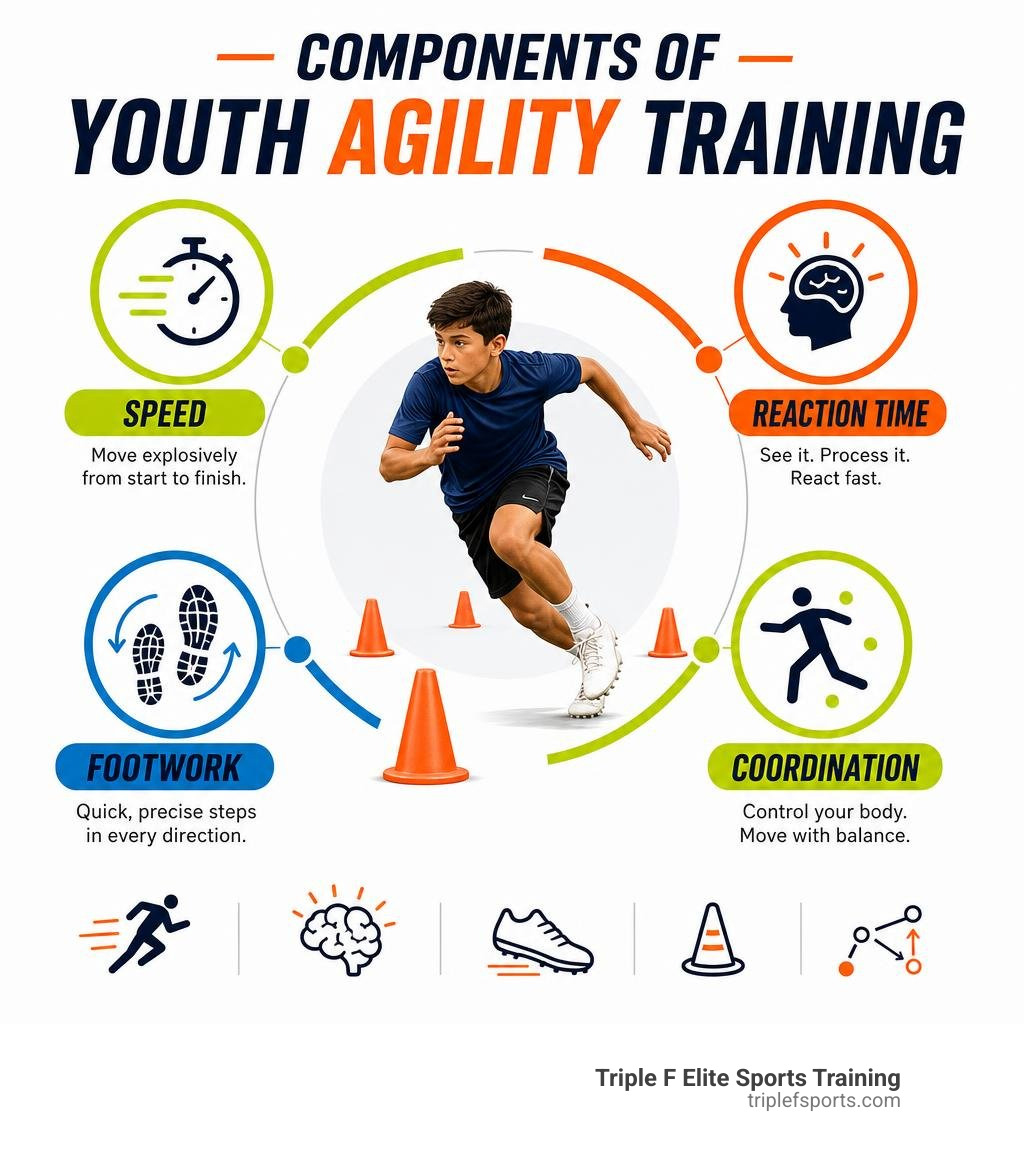
Terms related to agility football drills for youth:
The Core Mechanics of Agility Football Drills for Youth
Before we throw a bunch of cones on the grass, we need to understand what agility actually is. It is not just running fast in a straight line. True agility is the ability to change body position, decelerate, plant, and accelerate in a new direction—all while maintaining complete balance.
When young athletes struggle with coordination, they often look like they are fighting their own limbs. They cross their feet, trip over turf beads, and lose momentum during transitions. To stop this, we focus heavily on foundational movement mechanics. If you want your players to stop stumbling during games, check out this guide on how to Stop Tripping Over Your Own Feet with This Agility Guide.
The foundation of all multidirectional movement is a low, athletic base. When players stand too tall, their center of gravity rises, making them easy targets for gravity (and defenders). We teach athletes to keep their knees slightly bent, hips pushed back, and weight distributed over the balls of their feet. By staying active on their toes rather than sitting flat-footed on their heels, they can react to any play in a split second. To build this fundamental balance, you can integrate these Stay on Your Toes with These Pro Balance Drills.
Key Coaching Cues for Agility Football Drills for Youth
Verbally coaching youth athletes can be tricky. If you give a 10-year-old a paragraph of biomechanical instructions, their eyes will glaze over faster than a donut in a microwave. Instead, use short, memorable cues that trigger instant physical adjustments.
- “Light Feet, Quiet Ground”: This cue prevents heavy, stomping strides. We want our players to make minimal noise when their cleats hit the ground, which naturally encourages them to stay on the balls of their feet.
- “Pump the Pistons”: This refers to arm action. Many young players freeze their arms or let them swing wildly like noodles. We teach them to keep their elbows bent at roughly 90 degrees, driving their hands from “hip to pocket” to power their footwork.
- “Sink Your Hips”: Right before a player makes a cut, they must lower their hips to absorb force and prepare for redirection. Sinking the hips keeps their center of gravity low and stable.
- “Punch and Drive”: When planting to change direction, the player should plant their outside foot firmly, “punch” the ground, and drive hard with the opposite knee to accelerate.
Mastering these mechanics is the ultimate insurance policy against on-field embarrassment. To help your players keep their balance and avoid getting juked out of their cleats, read our expert breakdown on How to Stop Getting Your Ankles Broken with Agility Drills.
Top 5 Agility Drills to Build Explosive Speed
To get the most out of your training sessions, you do not need an endless array of expensive equipment. A simple set of high-visibility cones and a standard agility ladder are more than enough to build elite footwork.

When setting up your training space, ensure the surface is flat, dry, and free of debris. Always start slow. We recommend having players run through new drills at a controlled pace (about 50-60% speed) to lock in the correct footwork before letting them loose at full throttle.
To explore a wider variety of footwork patterns, you can read our guide on how to Unlock Your Speed: Top Agility Ladder Drills for All Levels or browse these official Football Agility Drills for extra inspiration.
Here are our top 5 youth agility drills that deliver the highest return on investment:
1. The 5-10-5 Pro Agility Shuttle
Also known as the short shuttle, this is the gold standard for measuring lateral quickness, deceleration, and explosive acceleration.
- Setup: Place three cones in a straight line, exactly 5 yards apart (totaling 10 yards from end to end).
- Execution:
- Start at the middle cone in a three-point or low athletic stance.
- On the whistle, sprint 5 yards to the right, touching the line or cone with your right hand.
- Plant, pivot, and sprint 10 yards all the way to the far left cone, touching it with your left hand.
- Plant, pivot, and sprint 5 yards back through the center starting line.
- Coaching Point: Watch that players do not cross their feet when transitioning. They must plant with the outside foot, sink their hips, and explode out of the turn. Check out this video demonstration of 3 Agility Drills for Youth Football – YouTube to see the mechanics in action.
2. The T-Drill
The T-Drill is fantastic for wide receivers, defensive backs, and open-field ball carriers because it combines forward sprinting, sharp lateral shuffling, and rapid backpedaling.
- Setup: Arrange four cones in the shape of a “T”. Place the starting cone at the bottom. Position another cone 5 yards straight ahead (the intersection of the T). Place two more cones 5 yards to the left and 5 yards to the right of the intersection cone.
- Execution:
- Sprint forward 5 yards from the starting cone to the center cone.
- Lateral shuffle 5 yards to the left cone (do not cross your feet!).
- Shuffle 10 yards all the way to the far right cone.
- Shuffle 5 yards back to the center cone.
- Backpedal 5 yards straight back to the starting cone.
- Coaching Point: Keep the chest up and eyes forward during the backpedal phase. Do not let players look down at their feet.
3. The Zig-Zag Cone Pattern
This drill is designed to simulate route running and sharp cuts to shake off defenders in tight spaces.
- Setup: Place 5 to 6 cones in a staggered zig-zag pattern, spaced roughly 3 to 4 yards apart laterally and 3 yards apart vertically.
- Execution:
- Start at the first cone in an athletic stance.
- Sprint diagonally to the first staggered cone.
- Plant your outside foot, sink your hips, and cut sharply toward the next staggered cone.
- Repeat the cutting pattern through all the cones, accelerating explosively through the final gate.
- Coaching Point: Emphasize a low center of gravity. If players try to cut while standing straight up, they will rounded their turns instead of making sharp, crisp angles. For more positional drills, check out The Ultimate Playbook: Football Drills for Young Players.
4. The 4-Corner Box Drill
This drill teaches players how to transition seamlessly between different movement patterns while maintaining spatial awareness.
- Setup: Place four cones in a perfect square, 5 to 10 yards apart.
- Execution:
- Start at Cone 1 and sprint forward to Cone 2.
- At Cone 2, transition into a lateral shuffle across to Cone 3.
- At Cone 3, drop into a backpedal down to Cone 4.
- At Cone 4, lateral shuffle back to the starting point at Cone 1.
- Coaching Point: Focus on the corners. The transition from a forward sprint to a lateral shuffle requires a hard plant and immediate hip rotation.
5. Agility Ladder “Ickey Shuffle”
Ladder work is the ultimate tool for developing foot-eye coordination, rapid ground contact times, and rhythm.
- Setup: Lay a standard 10-rung agility ladder flat on the turf.
- Execution:
- Start at one end of the ladder, slightly to the left side.
- Step into the first rung with your right foot, followed immediately by your left foot (two feet in).
- Step laterally out of the ladder to the right with your right foot (one foot out).
- Move forward to the next rung, stepping in with your left foot, then your right foot.
- Step out to the left with your left foot.
- Repeat this “two-in, one-out” rhythm all the way down the ladder.
- Coaching Point: Encourage “soft knees” and light foot strikes. If players are hitting the plastic rungs, they are either rushing or lifting their feet too high.
Age-Appropriate Progressions and Injury Prevention
A 6-year-old and a 16-year-old do not train the same way. Trying to run a highly complex, rigid training program with young kids will lead to frustration, while running overly simplistic games with high schoolers will stunt their development.
To keep training safe and effective, we categorize our youth athletic development into three distinct age groups. This structured approach is backed by our philosophy on Youth Athletic Development: What Every Parent and Coach Needs to Know.
| Age Group | Primary Focus | Work-to-Rest Ratio | Recommended Frequency | Key Training Goal |
|---|---|---|---|---|
| U5–U8 | Play, coordination, and basic movement patterns | 1:3 (e.g., 10s work, 30s rest) | 1–2 times per week (15-20 min blocks) | Build body confidence and general motor skills |
| U9–U12 | Structured footwork, spatial awareness, and reaction | 1:2 (e.g., 15s work, 30s rest) | 2 times per week (20-30 min blocks) | Master movement patterns and introduce reaction elements |
| U13–U19 | Power, strength integration, and position-specific speed | 1:1 or 1:1.5 (e.g., 15s work, 15-20s rest) | 2–3 times per week (30-45 min blocks) | Maximize explosive power and match game-speed demands |
By adjusting the complexity and intensity of our training based on biological age, we dramatically reduce the risk of overuse injuries. For a deeper dive into protecting your growing athlete, read The Parents Guide to Safe and Effective Youth Athletic Development.
Gamifying Agility Football Drills for Youth (U5–U8)
For our youngest athletes, the goal is simple: make them fall in love with moving. If a drill feels like a chore, they will check out mentally. We use gamification to disguise high-repetition movement training as play.
One of our favorite games to run is a modified version of the Shark Attack Soccer Drill: The #1 Fun Game for U7s. In our football variation, the players (the “minnows”) must run from one side of a 20×25-yard grid to the other without getting their flags pulled by the coach (the “shark”). To survive, the kids must naturally use lateral cuts, acceleration, and deceleration. If a player gets caught, they don’t sit out; they turn into “seaweed” (standing in place but reaching out to help pull flags), keeping everyone active and engaged.
Another great game is Volcanoes & Ice Cream Cones. Scatter 20 dome cones across a field—half facing up (ice cream cones) and half knocked upside down (volcanoes). Divide the kids into two teams. On the whistle, Team A tries to flip all the cones upright, while Team B tries to flip them upside down. This forces constant bending, sprinting, stopping, and turning in a chaotic, fun environment. For more engaging ideas, browse these Fun Youth Football Drills Your Players Will Actually Love.
Structured Footwork and Reaction Drills (U9–U12)
By ages 9 to 12, players are in the “golden window” of motor learning. Their nervous systems are highly adaptable, making this the perfect time to introduce structured footwork and reactive agility.
At this stage, we transition to more precise ladder patterns and introduce the Mirror Drill. Two players face each other across a 3-yard line. One player is the leader; the other is the follower. The leader shuffles laterally, backpedals, and changes direction at will, while the follower must react instantly to mirror their movements. This forces the follower to keep their eyes on the leader’s hips (not their shoulders or feet) and make split-second adjustments.
We also begin incorporating the football into these drills. For example, a player might run a clean ladder pattern, exit the ladder, and immediately catch a pass from the coach. This teaches them to transition from intense footwork to catching mechanics without losing focus. You can find more structured setups in our guide to Fun Agility Ladder Drills for Youth Soccer and our playbook on Youth Flag Football Drills: Fun & Effective Ways to Master the Game.
High-Intensity and Position-Specific Training (U13–U19)
For high school athletes, agility training must match the physical demands of a real game. We ramp up the intensity by adding resistance bands, introducing position-specific angles, and integrating strength training.
At this level, we use drills like the ACDC (Acceleration-Deceleration-Change of Direction) Drill. Players wear light resistance bands just above their knees to activate the glutes and hips during rapid cuts. A wide receiver might run a simulated route-running tree through cones, while a linebacker might practice lateral scraping, shedding a block (using pop-up dummies), and dropping into pass coverage.
We also integrate these drills with our weight room work. True agility requires the strength to absorb force when planting and the explosive power to push off. To see how we build this physical foundation, check out The Football Strength Program for Future Pros and learn about our philosophy on long-term athletic success in From Playground to Podium: Nurturing Young Athletes for Long-Term Success.
Frequently Asked Questions about Youth Agility
How often should youth football players perform agility drills?
For most youth athletes, two dedicated agility blocks per week are plenty. These blocks should last about 15 to 20 minutes and be integrated directly into your regular practice sessions (ideally right after a dynamic warm-up when the nervous system is fresh). Quality of movement always beats quantity.
How do you measure and track agility improvements in kids?
Avoid putting too much pressure on young kids with constant timing. Instead, track progress qualitatively:
- Are they tripping over the ladder rungs less often?
- Are their landings quieter and more controlled?
- Are they keeping their hips lower when they cut?
For older athletes (U13+), you can use timed drills like the 5-10-5 Pro Agility Shuttle or video analysis to break down their cutting angles and foot placement frame-by-frame.
Can agility drills be done at home with minimal equipment?
Absolutely! You don’t need a professional field to get better. A sidewalk, a backyard, or even a driveway is perfect. If you don’t have cones, you can use household items like shoes, plastic cups, or chalk lines drawn on the concrete. Just 10 minutes of daily footwork at home can make a massive difference in a player’s coordination.
Conclusion
Building a faster, more agile football player does not happen overnight, but with the right approach, the progress can be incredibly fast. By focusing on core mechanics, using simple coaching cues, and keeping the drills highly engaging and age-appropriate, you can unlock a level of athleticism your players didn’t know they had.

At Triple F Elite Sports Training in Knoxville, TN, we are passionate about helping young athletes reach their full potential. Our professional, Christ-centered athletic development programs are designed to build speed, strength, and character in a safe, high-energy environment. Whether your child is just starting out or preparing for college recruitment, our expert coaches are here to guide them every step of the way.
Ready to see the difference for yourself? Join our next Knoxville Football Camp or sign up for a free first session to experience our comprehensive performance training firsthand.
Let’s start building your future success today! Learn How to Improve Your Football Skills in 30 Days and Unlock your potential with skill-based training.